
Specs are compiled from manufacturer listings and verified buyer reviews and can change over time — please confirm the key details on the product page before buying.
For a compact benchtop tool, the 1 x 30 belt sander is the quiet workhorse of knife sharpening, detail woodworking, and small metal finishing. The real question is how much motor and control you need without turning your workshop into a shaking, spark-filled mess.
I’m Mohammad Maruf — the founder and writer behind KitchPrep. This guide is built by comparing the manufacturers’ published specifications and the patterns across verified customer reviews, so you get each pick’s real strengths and trade-offs instead of marketing spin.
We’ve matched nine models to specific jobs, from hobby sharpening to metal grinding, so you can find the 1 x 30 belt sander that fits your bench and your budget without overpaying for power you’ll never use.
Our Picks at a Glance


How To Choose The Best 1 X 30 Belt Sander
Before you get lost in RPM figures, know that a 1 x 30 sander is defined more by its motor and build than its size. These machines are all compact enough for a small bench, so the difference lies in how they handle heat, vibration, and belt changes.
Match the motor to the material
A light 2.1A motor running at low speed is perfect for detail work and knife edges, but will stall on aggressive metal removal. Look for a higher amperage (2.3A or more) or a true 3/4 HP rating if you plan to shape steel or work with coarse belts regularly.
Direct drive beats belt-driven for torque
The number one reason belts stall is a weak, indirect drive system. A direct-drive motor sends power straight to the wheels, which usually means fewer parts to wear out and more consistent power under pressure—exactly what you want when you are pushing a blade into the belt.
Check for variable speed if you switch materials
Variable speed sanders let you run slow to avoid overheating heat-sensitive steel, then speed up for rapid stock removal on wood. Fixed-speed units are simpler, but they lock you into one pace that may be too fast for fine sharpening or too slow for rough work.
Quick Comparison
| Model | Best For | Motor Power | Belt Speed | Disc Size | Amazon |
|---|---|---|---|---|---|
| WEN 6515T★ Best Overall | Home Workshop Versatility | 2.3A | 3160 FPM | 5 in. | Amazon |
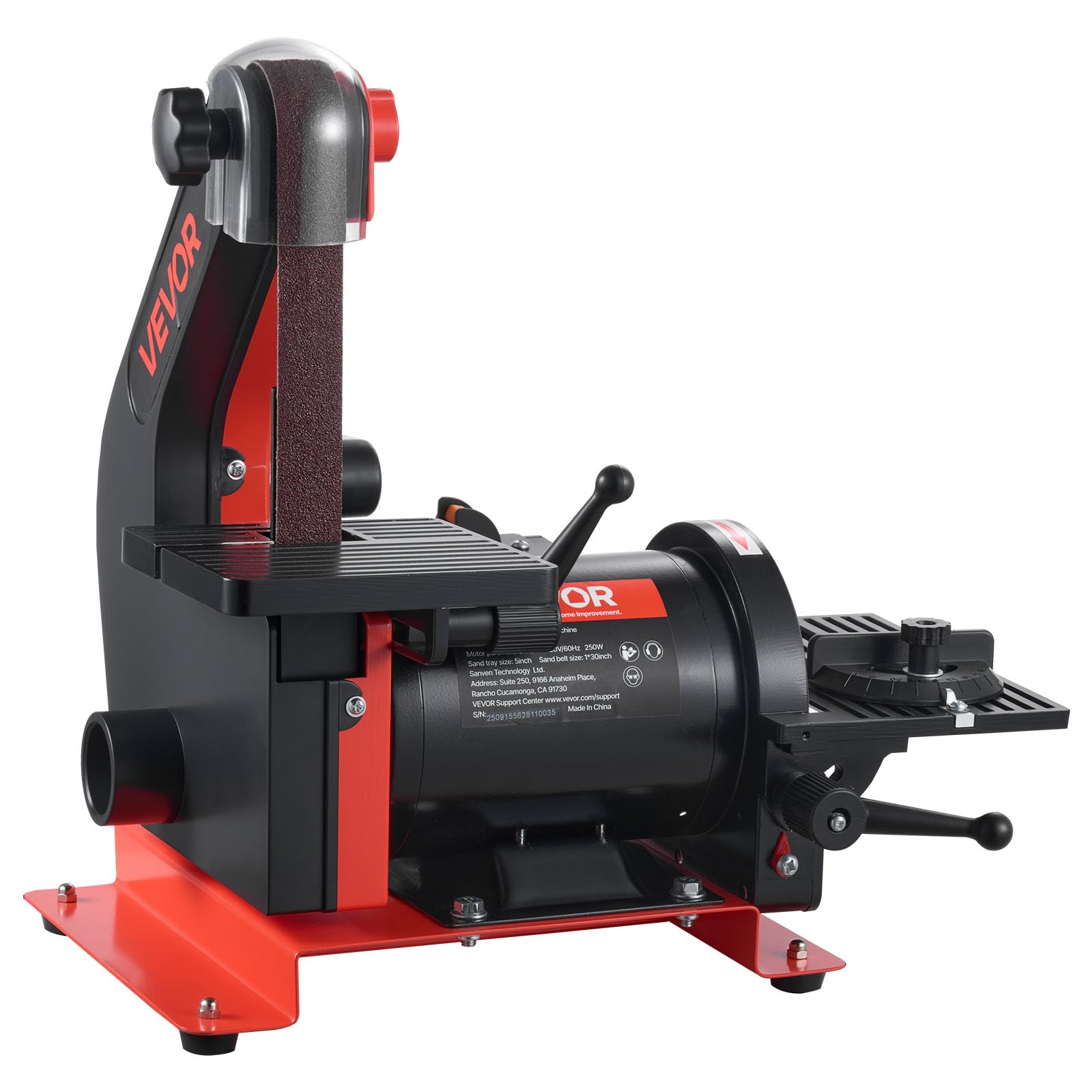
| VEVOR ComboBest Value | Value-First DIY | 250W | 1350 RPM | 5 in. | Amazon |
| BUCKTOOL MM493CTop Performer | Frequent Use & Durability | 2.3A | 3300 FPM | 5 in. | Amazon |
| BUCKTOOL IN-BG1600 | Knife Sharpening | 2.1A | 1700 FPM | 6 in. Grinder | Amazon |
| KFMK BD1600VS | Variable Speed Control | 3/4 HP | 1909–3248 SFPM | 6 in. | Amazon |
| RIKON 50-161VS | Precision & Low Vibration | 3/4 HP | 1909–3248 SFPM | 6 in. | Amazon |
| VEVOR JLD10-8 | Metal Grinding Power | 550W | 26m/min | — | Amazon |
| GOLDSAND GD-SDJ-8 | Reverse Functionality | 550W | 26m/min | — | Amazon |
| JAYEUW ZT2224 | All-Steel Build | 550W | 30m/s | — | Amazon |
In‑Depth Reviews
1. WEN 6515T Belt and Disc Sander
Our pick — over 4.5★ from 2,500+ verified ratings; the strongest balance of quality and price.
The two-in-one bench sander that delivers quiet, stable sanding for craft shops without draining the wallet.
If you want one tool that handles both flat disc work and long belt passes, this WEN pairs a 1-by-30 inch belt with a 5-inch sanding disc on a sturdy heavy-duty base. The 2.3A motor pushes the belt to 3160 FPM while the disc spins at 3450 RPM, which is enough speed for small woodworking projects, knife sharpening, and hobby detailing.
What wins people over is the balance of quiet operation and minimal vibration—the feedback is full of praise for how smoothly it runs on a bench thanks to that solid base and rubber feet. Buyers also report that the belt tracks well and stays quiet through a session. Assembly is easy, belts are cheap and simple to swap, and two separate dust ports connect to a shop vacuum to keep your workspace clean.
You get a 2-year warranty and an 80-grit disc plus a 100-grit belt in the box, so you can start sanding right away. The trade-off is plastic parts, which suit hobby use but not daily professional abuse. Buyers report the sanding disc feels glued on and tricky to replace, and the belt adjustment can be finicky until you dial it in just right. Across over 2,600 ratings it holds a strong 4.6-star score, making it the most trusted entry point into 1 x 30 sanding.
Owner-Approved Strengths
- Runs quiet with minimal vibration for a stable bench feel
- Twin dust ports keep fine sawdust out of the air
- Easy belt changes and cheap replacement belts
Honest Trade-Offs
- Plastic components feel less rugged than metal rivals
- Belt tracking needs patience to adjust perfectly
- Adhesive disc is hard to peel off when worn
The everyday pick: This is the sander for home workshops and hobbyists who want reliable two-surface versatility on a budget.
A fair warning: skip it if you plan heavy professional use—the plastic parts and finicky tracking favor lighter, careful work.
2. VEVOR 5″ Disc & 1″ x 30″ Belt Sander Combo
A budget-friendly combo that punches above its weight for DIYers tackling wood panels and furniture touch-ups.
VEVOR brings a 250W motor to the table, spinning the 5-inch disc at 3450 RPM and the 1 x 30 belt at 1350 RPM—a slower belt speed that suits controlled sanding and sharpening over aggressive removal. The spacious disc worktable tilts from 0 to 45° so you can set precise bevels, and the included miter gauge helps keep angled passes accurate.
The thing buyers rave about is the combination of a reinforced metal base and rubber feet, which work together to reduce vibration and noise for smoother, more precise passes. Owners describe it as a sturdy combo that offers great value for the price, with one noting it boosted a friend’s output dramatically. The protective eye shield is a thoughtful safety touch that blocks flying debris during longer sessions.
True to its budget roots, it ships with 80-grit coarse belts, and some owners find the included consumables gum up quickly—plan to buy better belts. The heaviest unit tips the scale at 16.8 pounds, making it a couple of pounds beefier than some rivals. It’s a capable entry-level partner for home DIY and furniture refinishing, not a tool for full-time professional shops.
What Buyers Highlight
- Stable rubber feet and metal base kill excess vibration
- Adjustable 45° table expands sanding angles
- Two dust ports connect easily to a vacuum
Where It Cuts Corners
- Stock belts are low quality and need replacing early
- Slower 1350 RPM belt limits fast material removal
- Occasional reports of the motor struggling under load
Best for starters: If you are easing into benchtop sanding for occasional projects, this delivers solid function without a heavy investment.
Not for pros: Professional fabricators will quickly outgrow the motor and stock consumables—this is a hobbyist’s tool at heart.
3. BUCKTOOL MM493C Belt Disc Sander
The 3590 RPM direct-drive workhorse that handles coarse belts on stainless steel without breaking a sweat.
BUCKTOOL steps up the build quality with a 1/3 HP 2.3A direct-drive motor that spins at 3590 RPM—a full 140 RPM faster than the WEN’s disc. That direct-drive design is the key story here: it delivers 25% more sanding efficiency than belt-driven motors, which means tough jobs on stainless steel get done smoother and faster. Owners confirm it handles coarse belts without stalling, proof of the motor’s ability to keep torque up under pressure.
The user-friendly touches make frequent use genuinely more pleasant. A one-button belt cover pops off for quick swaps, and built-in wrench storage keeps the hex keys right where you need them. The disc work table adjusts from 0–45 degrees for precise bevel work, and the sturdy metal enclosure earns regular praise for being solid, quiet, and remarkably vibration-free.
At 8.94 kg (about 19.7 pounds) it has real heft that keeps it planted during aggressive passes, and it sits on a footprint of 14.57″L x 13.39″W x 15.75″H—noticeably longer than the WEN’s 11.5″L. Owners note it’s quieter than cheaper plastic models, making it a step up for anyone who sanded with a bargain unit first. With a 2-year warranty backing a durable metal build, this is the pick for home users who want professional-grade feel without going full industrial.
Built Different
- Sturdy metal enclosure that stays stable on the bench
- Direct-drive motor holds power through tough passes
- One-button belt cover and wrench storage speed up swaps
Consider This
- Heavier footprint needs a solid bench to sit on
- Speed is fixed—no dial for delicate heat-sensitive work
Choose it for durability: Home woodworkers and DIY enthusiasts who sand frequently and want metal reliability over plastic convenience should start here.
Think twice if: You need variable speed for fine knife edges—this fixed-speed unit favors general sanding over precision sharpening.
4. BUCKTOOL IN-BG1600 Low Speed Belt Grinder

A low-speed grinding combo built for knife makers who need controlled edges without overheating their steel.
This BUCKTOOL is explicitly a low-speed machine, pairing a 1×30 inch belt with a 6-inch grinder wheel, all powered by a 1/3 HP 2.1A motor running at just 1790 RPM. That slow speed is the whole point for knife work—it prevents the edge from overheating and losing its temper, which is why owners call it a serious upgrade for sharpening and shaping blades.
The sharpening performance is the thing everyone raves about, with one owner reporting it brought a dull knife back to life in about 5 minutes. The direct-drive motor delivers 25% more sanding efficiency than belt-driven designs, keeping power steady under pressure. Buyers describe it as smooth, quiet, and accurate, with belts that track true and an easy quick-release system for swapping grits mid-project.
For knife makers, the quick belt change button and adjustable tool rests let you switch tasks fast, and the included 120-grit belt handles fine finishing work. A few owners note a slight roughness in the running sound and occasional bogging on startup after sitting idle, but most agree it delivers quality far above its price tier. After a year of use, one long-term owner reported no vibration and sturdy construction—a strong signal for a purchase meant to last.
Blade-Focused Strengths
- Slow 1790 RPM prevents edge overheating
- Accurate belt tracking for consistent bevels
- Adjustable tool rests suit knife-making precision
The Reality Check
- Low speed means slow material removal on big stock
- Some units run slightly rough on cold startup
Sharpening-first pick: Knife makers, hunters, and metalworkers who prioritize a controlled edge over raw speed will find their match here.
Not for woodworkers: If your main job is aggressive wood shaping, this low-speed unit will feel frustratingly slow.
5. KFMK BD1600VS Variable Speed Sander
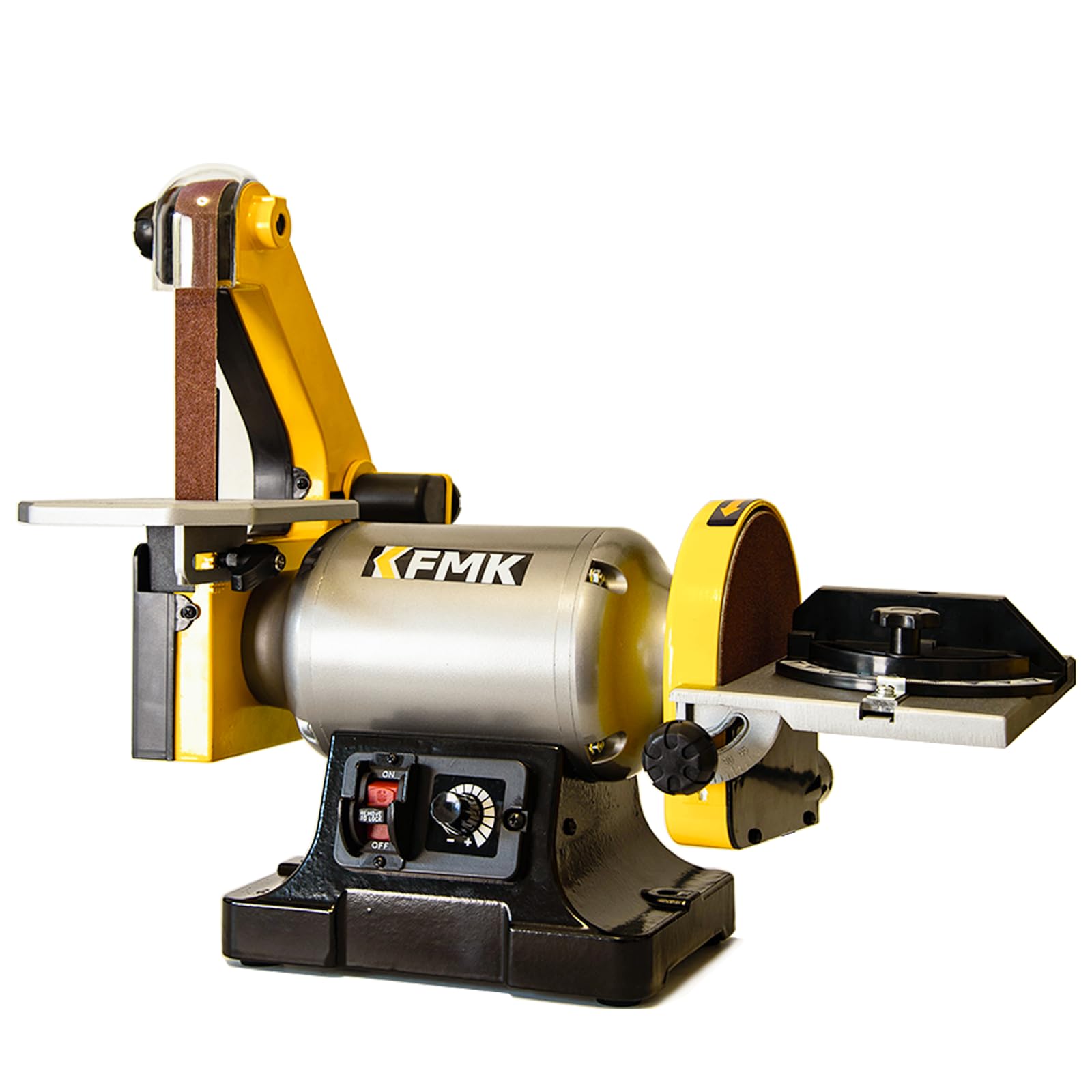
A 3/4 HP variable-speed combo that goes slow for delicate steel and fast for aggressive wood removal.
The KFMK BD1600VS brings a serious 3/4 HP direct-drive motor to the 1 x 30 format, and the headline feature is true variable speed. You can dial the disc from 2000 to 3400 RPM and the belt from 1909 to 3248 SFPM—run it slow to shape heat-sensitive metals or sharpen chisels, then crank it up for fast stock removal on wood. Owners say they can achieve a perfect edge on just about anything with this level of control.
Setup is thoughtful for actual use. Both the belt and disc sides get solid aluminum work tables for stability, and the disc table features a precise miter gauge for accurate angle sanding. A removable belt cover lets you contour sand around round corners when you pop it off, then reinstall it for straight-line work and safety. The direct-drive motor boosts efficiency and cuts maintenance compared to belt-driven setups.
Sharpening performance gets consistent praise, with buyers using it for blades, chisels, and golf shafts, finding the 80-grit coarse belt plus included accessories ready to work. The honest trade-off is that some owners mention the motor slows under heavy load, and a few mention the belt table has uneven grooves. It’s a compact, powerful unit that earns a 4.3-star score across over 200 ratings, but it’s best matched to sharpening and light-to-moderate sanding rather than marathon grinding sessions.
Speed Flexibility
- Variable speed protects heat-sensitive steel edges
- Solid aluminum tables stay stable during passes
- Removable cover enables round-corner contour sanding
Load Limits
- Motor can slow noticeably under heavy pressure
- Some durability concerns reported over extended use
Reach for this if: You switch between sharpening fine edges and sanding wood, and you need the speed dial to match each task.
Look elsewhere if: Your work is exclusively heavy industrial grinding—the motor prefers lighter, controlled passes.
6. RIKON 50-161VS Variable Speed Sander

A heavier, quieter variable-speed sander whose larger footprint and 3/4 HP motor make knife work feel easy.
You get a smoother, quieter run than the KFMK because the RIKON 50-161VS weighs 30.2 pounds—nearly double some rivals—and that mass dampens vibration. The 3/4 HP, 120V motor adjusts from 2,000 to 3,400 RPM, with belt speed from 1,909 to 3,248 SFPM (surface feet per minute, or how fast the belt moves), giving you the same variable range as the KFMK but with heavier construction that owners say runs markedly quieter.
The extra bench presence pays off in practice. Knife makers who upgraded from cheap Harbor Freight models report the 3/4hp motor doesn’t bog down even when running 24-grit ceramic belts under real pressure. The speed control is ideal for the two-stage sharpening workflow—high speed for beveling, low speed for the micro-bevel finishing pass. Both the belt and disc tables tilt from 0 to 45 degrees, and a miter gauge works with the disc-table slot for controlled angled cuts.
Owners consistently describe it as perfectly suited for knife shaping and profiling, with the larger design spacing the disc sander further from the belt for easier access. Separate belt and disc dust ports support shop dust collection, and base mounting holes let you bolt it down if you want zero movement. The 5-year warranty is a standout vote of confidence. The occasional complaint about noisy low-speed operation or stiff base-plate knobs exists, but the overwhelming takeaway from over 300 owners is that this premium build justifies the investment for serious hobbyists.
Heavyweight Advantages
- 30.2 lb frame absorbs vibration for precision work
- 3/4 HP motor powers through coarse ceramic belts
- Covers you with a 5-year manufacturer warranty
Premium Demands
- Substantial weight needs a sturdy dedicated bench
- Some units emit a low-speed motor growl
Best for serious sharpening: Knife makers and craftsmen upgrading from entry-level units who want stability, power, and a real warranty get their money’s worth here.
Who should skip: Casual DIYers on a strict budget—the weight and price overshoot what light hobby work requires.
7. VEVOR JLD10-8 Variable Speed Belt Grinder

A 550W VFD-driven grinder that flips between vertical and horizontal for serious metal shaping in tight shops.
VEVOR rethinks the benchtop format with a machine built for grinding, not just sanding. A 550W pure copper motor spins at 5500 rpm, and the VFD (variable frequency drive) system allows stepless speed regulation—glide from high-speed fast grinding down to low-speed fine sanding without stopping to swap anything. The belt line speed holds at 26m/min, and the 17.4-pound frame keeps things stable.
The versatility is what separates this from simpler combos. It supports both vertical and horizontal use, so you can set it up for flat grinding or switch to circular grinding depending on the workpiece. A detachable workbench lets you reposition for comfort, and the reinforced steel body handles different angles easily. The kit ships with 3 sanding belts in 100/180/240 grit, covering the jump from coarse material removal to fine finishing.
Owners call it excellent value and praise the powerful, heavy-duty performance that complements, rather than replaces, a full-size 2×72 grinder. The build quality earns frequent praise for its well-constructed feel. Be honest about setup: some buyers found the flat platen bearings ran hot until reamed, and a few report VFD reliability issues within a couple months. It also needs a helping hand to lift onto a bench. This is a capable specialist for knife makers and metalworkers who need variable speed and position flexibility without dedicating floor space to a 2×72.
Grinding Power
- 550W motor with VFD handles variable speed smoothly
- Vertical and horizontal modes adapt to different jobs
- Two grinding modes cover flat and circular work
Buyer Caveats
- Tracking can require adjustment or pulley modification
- A few customers note VFD or motor issues within months
- No reverse function on this model
Choose this for metal: Knife makers and metalworkers who need grinding power with speed control and flexible positioning will appreciate the VFD.
pass on it if: You only do light wood sanding—the 550W motor and complexity overshoot simple hobby needs.
8. GOLDSAND GD-SDJ-8 Belt Grinder
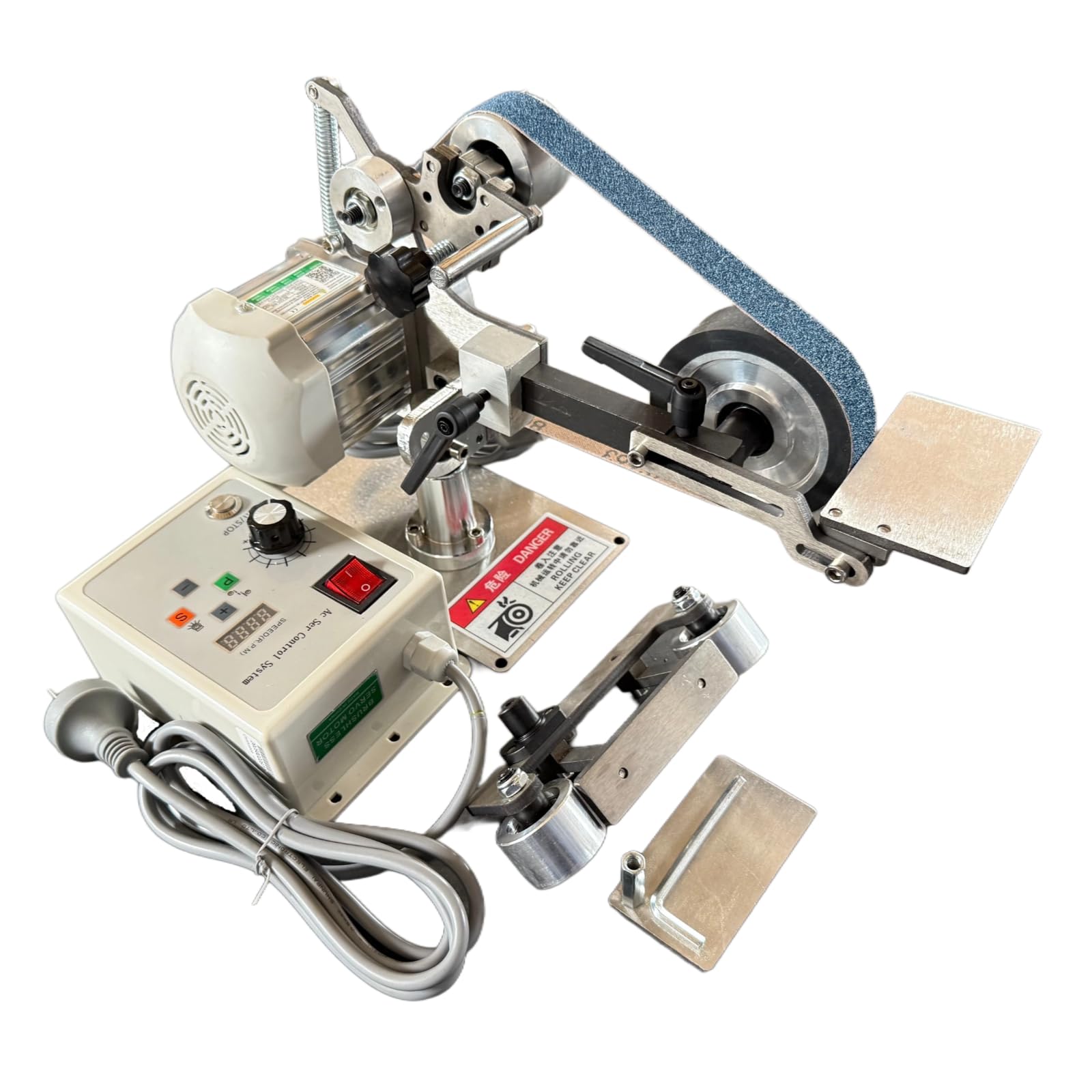
A 550W variable-speed grinder with a built-in reverse switch—a rare feature that sharpens both sides of a blade with ease.
The GOLDSAND distinguishes itself with an S button that reverses belt direction, a feature knife sharpeners specifically hunt for. Instead of flipping the blade or walking around the bench, you press a button and run the belt the other way to work the opposite edge. This 550W pure copper motor spins at 5500 RPM with a 26m/min belt line speed, supported by a VFD variable frequency drive for stepless speed regulation.
Owners who bought it over alternatives specifically for the reverse switch describe the machine as exceeding expectations, calling it the best knife sharpener they have seen at this level. The variable speed range lets you drop to low RPMs for fine edge work—one sharpener moved through all kitchen knives in about 20 minutes at 400-1k RPM. Vertical and horizontal mounting, plus a detachable workbench and steel frame, make it a compact alternative to a 2×72 at a fraction of the cost.
The build earns praise for its stainless steel construction, and it ships with three zirconia corundum belts in 100/180/240 grit, covering coarse to fine needs. The realistic caveats are that belt tracking is fiddly, especially when you reverse direction, and the included instructions are minimal—assembly relies on pictures. A few owners add flat washers to the tool rest screws for a sturdier feel. With a 4.6-star score, it’s a newer pick with fewer ratings but a clear, dedicated following among knife enthusiasts who value that reverse function.
Reverse Edge Perks
- Reverse button simplifies sharpening both blade edges
- Variable speed down to low RPM suits fine finishing
- Zirconia belts handle coarse to fine work from the start
Setup Friction
- Belt tracking needs patience, especially in reverse
- Sparse instructions lean on pictures for assembly
Best for the reverse feature: Knife sharpeners who want to flip belt direction without handling the blade will love the workflow this open up.
Who should pass: Beginners wanting a plug-and-play experience—this rewards those willing to dial in tracking.
9. JAYEUW ZT2224 Belt Sander Grinder

A CNC-machined, all-steel commercial grinder that brings serious rigidity and fast 30m/s belt speed to a desktop.
The JAYEUW pushes the desktop format toward commercial territory with an all-steel construction—the body is integral steel plate with a galvanized surface, and the wheels are high-quality steel too. This is not a plastic-housed hobby tool. It runs a DC brushless motor at 550W and 5000rpm, pushing the belt at a fast 30m/s line speed, which makes quick work of metal and wood alike. The CNC machining ensures high precision across the frame.
For sharpening, owners describe it as a powerful, well-made machine with meticulously machined metal parts that outperform other polishers they have used. The forward and reverse rotation is a key feature several buyers wanted, and the body can turn 90 degrees for horizontal or flat grinding positions. It ships with two belts in 60 and 800 grit—the coarse 60 for fast removal and the fine 800 for mirror-like finishing edges.
The 19.8-pound frame with dimensions of 15″L x 5.5″W x 9.8″H keeps a compact footprint, but the motor driver adds a separate box (17.5*5.5*15.5cm) to place on your bench. The fixed-angle worktable adjusts to any angle, and the package includes two different worktables plus a protective baffle. Be aware that belt tracking gets mixed feedback—owners note it can be finicky, particularly in reverse. A few report the included guide wheels need slight modification to track perfectly. It’s a specialized grinder for those who prioritize steel rigidity and speed over beginner simplicity.
Rigid Steel Strengths
- All-steel CNC-machined body resists wear and rust
- Fast 30m/s line speed handles material quickly
- Forward and reverse rotation plus 90° body turn
Grinder Gripes
- Belt tracking runs finicky and may need tweaks
- Separate motor driver box adds bench clutter
Buy for steel durability: Users who want commercial-grade rigidity and fast belt speed for metal polishing and sharpening will respect the build.
Make sure you: Have patience for belt tracking adjustments—this tool rewards careful setup over out-of-the-box convenience.
Understanding the Specs
Belt Speed: FPM vs RPM vs SFPM
Belt speed is often listed in FPM (feet per minute) or SFPM (surface feet per minute), which tells you how fast the abrasive surface actually moves past your workpiece. Disc speed in RPM (revolutions per minute) only tells you how fast the disc spins, not the surface speed. A faster belt removes material quicker but generates more heat—so lower speeds are better for fine steel edges that can lose their temper.
Direct Drive vs Belt-Driven Motors
A direct-drive motor connects straight to the sanding wheels without an intermediate belt system. This usually means more torque at the belt, less maintenance, and fewer parts to wear out. Belt-driven designs can be cheaper but often lose power through the extra linkage, which is why direct-drive units tend to handle coarse grits and heavy pressure without stalling.
FAQ
What is the difference between a 1 x 30 belt sander and a larger 4 x 36 unit?
Can I use a 1 x 30 belt sander for knife sharpening?
What does belt tracking mean and why does it matter?
What grit sanding belt should I start with?
Is variable speed worth the extra cost?
How much power do I need in a 1 x 30 belt sander?
Why does my sander vibrate so much on the bench?
Can I sand metal on a 1 x 30 belt sander?
What is the difference between a belt sander and a belt grinder?
How do dust ports help with sanding?
Final Thoughts: The Verdict
If you want one dependable pick, the 1 x 30 belt sander winner is the WEN 6515T because it blends quiet operation, dual sanding surfaces, and easy assembly into the most trusted package in the category. If you want a metal build with direct-drive durability, grab the BUCKTOOL MM493C. And for knife sharpening where edge control beats raw speed, the BUCKTOOL IN-BG1600 low-speed grinder is the one to reach for.
How We Picked
We do not accept paid placement. Every pick is matched to a real buyer and a real use-case; we do not hands-on test units.
Sources & Methodology
Specifications: manufacturer listings and product documentation. Review insights: verified customer reviews, as of September 2026. Pricing: not shown on this page (it changes often); check the current price via the retailer link.
As an Amazon Associate, KitchPrep earns from qualifying purchases. This does not affect which products we feature.
Related Guides
