
Specs are compiled from manufacturer listings and verified buyer reviews and can change over time — please confirm the key details on the product page before buying.
You want a barometer and thermometer, so you are watching air pressure trends and indoor temperature to predict what comes next. The real fork in the road is analog versus digital — one is a decorative conversation piece that needs a tap, the other is a data-rich screen that updates itself. This guide walks you through nine of the best, from mechanical wall instruments to wireless stations, so you buy the one that matches how you actually plan to use it.
I’m Mohammad Maruf — the founder and writer behind KitchPrep. This guide is built by comparing the manufacturers’ published specifications and the patterns across verified customer reviews, so you get each pick’s real strengths and trade-offs instead of marketing spin.
Find the ideal barometer and thermometer for your wall, desk, or weather hutch with no-nonsense facts on what actually works.
Our Picks at a Glance


How To Choose The Best Barometer and Thermometer
Choose your barometer and thermometer based on where it will live. A wood-paneled office suits a brass-framed aneroid (a mechanical dial that reads air pressure without batteries), while a kitchen counter benefits more from a digital console with a remote sensor (a separate wireless unit that sends outdoor readings to the display). After picking the spot, decide between a decorative instrument that updates slowly or a high-tech screen that refreshes constantly.
Mechanical charm comes with ritual
A traditional barometer measures pressure with a sealed metal capsule, and the needle can stick — owners regularly tap the glass to free the pointer before reading. That ritual feels intentional and antique, but it is exactly why the pressure dials on these units show drift and the humidity dials are often hit-or-miss. Calibration against a local reading takes patience, and any analog instrument needs that attention to stay useful.
Digital data does the work for you
A wireless station puts the remote sensor outside and the readings on a bright indoor display. You get indoor and outdoor temperature, humidity, and a forecast-shaped barometer graph that updates every few seconds. The trade-off is setup — you are pairing sensor and console, choosing a time zone, and finding wall or counter space near a power outlet for the backlight.
A Galileo thermometer is a glass talking piece
Those floating spheres rise and fall with temperature, and the lowest floating one tells you the approximate degrees. It is beautiful, but it needs a stable spot where it won’t be knocked, and the liquid inside can shift in shipping. Read it as an indicator that sparkles, not as a precision tool.
Quick Comparison
| Model | Best For | Type | Display | Power | Amazon |
|---|---|---|---|---|---|
| Ambient Weather BA212★ Best Overall | Study and library ambiance | Analog liquid barometer | None (dial-free) | None needed | Amazon |
| U UNNI Wireless AtomicBest Wireless Display | Distance remote sensing | Digital wireless station | 7.5″ always-on LCD | AC adapter | Amazon |
| AMTAST 3-in-1 DialBudget Champion | Ultra-budget analog | Analog dial trio | None (dial-based) | None needed | Amazon |
| La Crosse 308-1451 | Sunrise and fishing forecast | Digital atomic forecast | LCD with LED backlight | 5 AA batteries | Amazon |
| Lily’s Home SW756 | Classy analog home décor | Analog Galileo combo | Analog + floating spheres | None needed | Amazon |
| Lily’s Home SW1668-A | Office clock combo | Analog Galileo + quartz | Analog + floating spheres | 1 AAA battery | Amazon |
| Ambient WS-M0921THB | Classic wood wall hanging | Analog 8″ aneroid | Analog dial dials | None needed | Amazon |
In‑Depth Reviews
1. Ambient Weather BA212 Wall Mounted Weather Station
Our pick — over 4.5★ from 750+ verified ratings; the strongest balance of quality and price.
A liquid barometer that turns pressure swings into a passing show of water.
In a study or library this 18-inch-tall cherry wood frame is the anchor piece, at 1.8 pounds easy to hang and built to draw questions. It is a true liquid barometer — a sealed glass body half-filled with water — so you watch the liquid climb a narrow spout as pressure drops, which is the archaic, visual engine of weather prediction.
The housing gives you comfortmeter readings for temperature and humidity with a comfort zone indicator, all in one traditional package. As owners put it, “The pressure change moves the liquid up the stem before the rain came” — that is the exact accuracy you buy this for.
The main reason this beats the polished digital consoles is its charm-plus-function balance: appearance pulls overwhelming praise, and the joy of watching pressure move earns more love than nearly any other aspect. The catch is fragility — the narrow glass spout can break during assembly if handled roughly.
Rave Reason
- The beautiful presentation looks far more expensive than it is
- The water rising and falling is genuinely engaging to watch
- Easy to set up for most users
Handle With Care
- The delicate glass flute can break during assembly
- The instructions are not perfectly clear for everyone
- Accuracy is a mixed bag — it is a trend instrument, not a lab tool
Consider it if: you want a stately, functional centerpiece for a traditional room that invites conversation while tracking pressure.
Pass on it if: you need spot-on digital precision — this is a fluid crystal ball, not a wireless console.
2. U UNNI Weather Station Indoor Outdoor Thermometer Wireless Atomic Clock Wood
Bright, big-font readings for the person who will not squint at tiny numbers.
This wireless station delivers indoor and outdoor temperature plus humidity from a remote sensor that transmits readings up to a 330 ft radius every 30 seconds. The 7.5-inch always-on screen puts the numbers front and center in a large font that stays readable from across the room — owners say about 11 ft in practice, with the date as the only stubborn squint.
You also get dew point, heat index, barometer, comfort level, tide, and moon phase for each sensor location, which is a full weather command center for one price. The atomic clock syncs daily with the WWVB signal and handles daylight saving automatically, so the time stays honest without any fiddling.
What wins people over here is pure functionality, with setup close behind — the guided menu walks you through easily, and the display brightness adapts comfortably day or night. Accuracy is the fair caveat: most find it right in line with manual thermometers, but a genuine split emerges between those who love the numbers and those who call them grossly off.
What Shines
- Readable from across the room without glasses
- Brightness adjusts beautifully for any hour
- Atomic time sync keeps clock honest
Know The Trade
- Accuracy reads split among owners
- The “snooze/dimmer” is a touch bar, not a button
- Battery is for backup only — AC power runs the backlight
Grab this if: you want a self-updating digital hub that covers both indoor comfort and the outdoor sensor area without any dial-tapping ritual.
Think twice if: you expect laboratory precision from temperature and humidity sensors at this tier.
3. AMTAST 3-in-1 Imperial Weather Station 8.2” Dial Mechanical Barometer
The bare-bones three-dial instrument for fans of pure mechanical simplicity.
This AMTAST dial trio measures pressure in a range from 28.75 up to 31 inHg, temperature from -10 to 130°F, and humidity from 0% to 100% RH, all displayed on separate dials in a brushed-silver metal housing. It weighs 0.44 kg, so it is light enough for a horizontal or vertical mount nearly anywhere indoors or out.
The barrel has survived daily use since 2020 across two homes, and pressure trends genuinely signal incoming weather for those willing to calibrate against a local source. The catch shows up in fine-tuning: calibration needs patience with a tiny screwdriver, and the needle can stick so a gentle tap is part of the daily read.
Unlike the ambient-friendly BA212 above, this one offers zero decorative warmth — it is a functional, no-frills wall tool. Accuracy is the recurring split: dials are good for relative trends, but the humidity gauge in particular drifts and the barometer walks a tenth of an inch daily for some owners without frequent recalibration.
Solid Points
- Beach use with no rust reported
- Brushed metal wipes clean easily
- Horizontal and vertical flexibility
Where It Falters
- Calibration is finicky and easy to mess up
- Pressure drifts and needs frequent resets
- Humidity dial is not reliably precise
Reach for this: for a no-nonsense budget instrument if you enjoy the tinkering ritual of calibrating dials.
Look elsewhere: if you want plug-and-play readings without recalibrating or tapping the glass.
4. Ambient Weather WS-YG501 Galileo Thermometer, Hygrometer & Glass Barometer

A compact data hub that tracks pressure history and sunrise for the planning type.
This 7.2-ounce station tracks indoor and outdoor temperature with MIN/MAX records, plus humidity, a 12-hour barometric pressure graph in inHg or hPa, sunrise and sunset times, and dual alarms. The fisherman icon with a tendency arrow responds to temperature changes, and the atomic clock self-sets with automatic daylight saving updates.
What wins owners over is the dense data — comprehensive information in one small footprint, with the sunrise and sunset display genuinely useful for planning the day. Signal strength is a real high point, with owners reporting it punches through concrete and wood walls and recovers quickly after a loss.
But the split is real: buyers report the barometer reads absolute pressure, not the sea-level corrected value most weather apps show, so it looks off until you understand that. The display also reads best from above rather than head-on, and the backlit screen is battery-powered by 5 AA cells rather than a wall plug.
Useful Bits
- 12-hour barometric graph shows trends clearly
- Sunrise and sunset times aid daily planning
- Signal goes through concrete reliably
Read The Fine Print
- Barometer reads absolute, not sea-level relative
- Screen is best viewed from above
- Dual alarm and clock need time-zone attention
Pick it up: if you want a battery-operated digital forecast console with pressure history and sunrise planning in a small footprint.
Be aware: you are buying trend-tracking, not a calibration-grade barometer, and the display angle is a real quirk.
5. Lily’s Home Analog Weather Station with Galileo Thermometer

The good-looking glass trio that makes air pressure feel like a science fair.
This free-standing station brings together a Galileo thermometer with five gold-plated-tag spheres, a globe-shaped glass barometer with etched designs, and an analog hygrometer. The thermometer is built for indoor temps from 64ºF to 80ºF in 4º increments, covering the comfortable home range with beautiful floating color.
The globe barometer is the centerpiece here, etched with decorative detail and crafted to show whether pressure is rising or falling. The build draws serious praise for looking expensive and sturdy rather than cheap, and owners note the hygrometer proves genuinely useful in winter — one monitors it to trigger a humidifier whenever humidity drops toward 30%.
Setup is the honest friction: assembly is easy with common sense, but glass is fragile and arrives occasionally with a broken globe from shipping — the printed directions also leave the barometer fill amount vague. This is a decorative environmental monitor that sparks classroom-style curiosity, not a precision meteorology tool for exact pressure values.
Standout Traits
- Five colored spheres with gold tags look rich
- Barometer globe has beautiful etched designs
- Hygrometer is a real aid for winter humidity
Honest Limits
- Glass needs careful handling and placement
- Not meant for precise meteorological reads
- Occasional shipping damage to the globes
Choose this: as a housewarming or holiday gift for a home-and-garden lover who values beauty over exact numbers.
Skip it: for serious weather tracking — this one decorates first and measures second.
6. Lily’s Home SW1668-A Analog Weather Station with Precision Quartz Clock
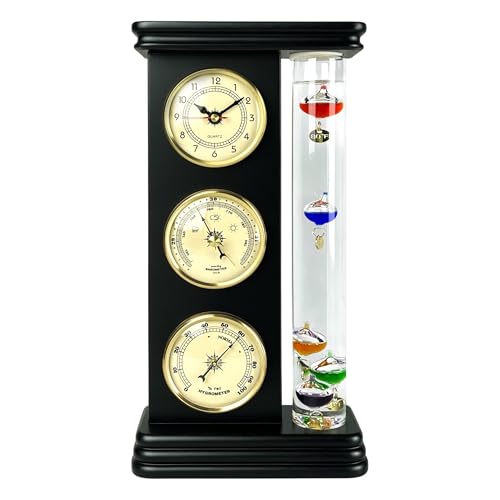
A five-sphere Galileo with a quartz clock that earns a desk spot in a home office or library.
This 12-inch-high matt black wood station combines a Galileo thermometer with five gold-tagged spheres, a precision quartz clock, an analog barometer, and an analog hygrometer. The thermometer range is built for home comfort from 64ºF to 80ºF in 4º steps, making it an eye-catching piece that actually tells you if the room is drifting warm or cold.
Owners consistently call the finish expensive-looking, with the wood quality itself drawing significant praise alongside the appearance. The quartz clock runs on a single AAA battery, which is the one powered element in the whole unit — everything else is fully mechanical.
The honest friction is the clock: most owners love the look and accuracy, but a recurring thread involves the minute and hour hands stopping while the second hand keeps moving, so the movement is the weak link. As with other analog barometers, a gentle tap helps free the needle when checking whether pressure is rising or falling.
Winning Qualities
- Wood finish looks more expensive than it is
- Five floating spheres add color and curiosity
- Doubles as a working clock on one AAA battery
Watch It
- Clock hands have stopped in some units
- Analog barometer needs a tap to show movement
- Accuracy of readings is mixed overall
Buy it for: an office or library shelf where a quality clock plus a Galileo conversation piece earns its spot.
Look past it: if you need a reliable timepiece as the primary function — treat the clock as a bonus, not the main act.
7. Ambient Weather WS-M0921THB 8″ Traditional Barometer

An 8-inch dark cherry wall piece with a pointer that signals coming weather trends.
This traditional aneroid unit measures temperature in Fahrenheit, barometric pressure in both mmHg and inHg, and humidity percentage, all in an 8-inch dark cherry lacquer frame with faux brass bezels and a mineral glass lens. It arrives with a suspension eye and ring, so hanging is a single-hook job on a study or restaurant wall.
The barometer allows sea-level calibration up to 3,000 feet — the maker is explicit not to buy it if you live above that elevation. Owners who set the fixed hand over the ambient marker and then tap the case find the movement difference reliably more accurate for coming weather than their local TV forecast.
Owners mention the dark wood and vintage gold styling look classy, and many say it works right from the start, matching local weather readings without any setup. The trade-offs: the gold needle can stick and need a tap to move, and an occasional unit arrives with a dial that does not move at all. Check the pointer early, before the return window closes.
Classic Appeal
- Rich dark cherry with faux brass looks timeless
- Matched local weather readings from the start
- Dual mmHg and inHg scales add flexibility
Mechanical Notes
- Needle sticks and responds to a tap
- Not meant for homes above 3,000 feet
- Calibration demands a steady hand
Hang this: when a vintage wood-and-gold wall instrument that tracks pressure trends fits the room’s character.
Hold off: if you live above 3,000 feet or want readings without ever touching the glass.
Understanding the Specs
Barometer types: liquid vs aneroid
A liquid barometer uses a sealed glass body half-filled with water; as pressure drops, the liquid rises in the spout and signals incoming rain. An aneroid barometer uses a sealed metal capsule and moves a needle across a dial — this is the type you tap to free the pointer before reading. Neither gives you a precise number without calibration against a local weather report.
Reading the Galaxy of Galileo thermometers
A Galileo thermometer suspends glass spheres in liquid; as the temperature changes, the liquid density shifts, and spheres float or sink. You read the temperature from the tag on the lowest floating sphere. These look stunning but work best in a stable range like 64ºF to 80ºF, which is why you see that range repeated across the Lily’s Home models.
Wireless sensor range and transmission
The U UNNI station transmits sensor data up to a 330 ft radius every 30 seconds — that radius is the open-air signal path, not through multiple concrete walls. Digital consoles need a power source for the backlight, though the battery backup keeps the data alive in an outage. The La Crosse instead runs entirely on 5 AA batteries, which suits a spot near no outlet.
What the hygrometer really tells you
The hygrometer measures relative humidity, the percentage of moisture the air holds. Analog dials here react slowly and drift, so treat them as a directional gauge — when a Lily’s Home owner starts a humidifier as the dial drops toward 30%, that is the realistic use pattern. Digital consoles give faster, more repeatable humidity numbers but still vary a few points from lab-grade sensors.
FAQ
Why does my analog barometer needle stick until I tap the glass?
Which is more accurate, a liquid barometer or a dial aneroid?
Does the Ambient WS-M0921THB work at high elevation?
How do I read a Galileo thermometer?
What does a 330 ft transmission radius mean for my wireless sensor?
Should I get a wall-mount barometer or a tabletop Galileo station?
Is the atomic clock worth it on a digital station?
Why does the humidity reading on an analog hygrometer seem off?
Final Thoughts: The Verdict
For most people, the barometer and thermometer winner is the Ambient Weather BA212 because it packs genuine liquid-barometer function into a cherry wood frame that earns compliments in any traditional room. If you want a digital self-updating hub with remote sensor coverage, grab the U UNNI Wireless Atomic Station. And for the desk that deserves a conversation piece, the Lily’s Home SW756 is the one to reach for.
How We Picked
We do not accept paid placement. Every pick is matched to a real buyer and a real use-case; we do not hands-on test units.
Sources & Methodology
Specifications: manufacturer listings and product documentation. Review insights: verified customer reviews, as of September 2026. Pricing: not shown on this page (it changes often); check the current price via the retailer link.
As an Amazon Associate, KitchPrep earns from qualifying purchases. This does not affect which products we feature.
Related Guides
