
Specs are compiled from manufacturer listings and verified buyer reviews and can change over time — please confirm the key details on the product page before buying.
If you cut metal with an angle grinder, you know the drill: a shower of orange sparks, a cloud of dust, and a rough edge that still needs filing. A portable band saw replaces that whole messy ritual with a single clean, quiet pass that leaves a straight, square cut every time. Whether you’re a plumber cutting pipe on a ladder, a welder prepping angle iron, or a woodworker resawing hardwoods, the right band saw saves you minutes on every cut and saves your ears from that terrible screech.
I’m Mohammad Maruf — the founder and writer behind KitchPrep. This guide is built by comparing the manufacturers’ published specifications and the patterns across verified customer reviews, so you get each pick’s real strengths and trade-offs instead of marketing spin.
You need a machine that holds a true line under load, matches the blade to your material, and fits the way you actually work — that’s what separates a great band saw from a frustrating one.
Our Picks at a Glance


How To Choose The Best Band Saw
A band saw’s single job is to move a looped metal blade through material in a straight line without wandering. Before you pick one, you need to decide what material dominates your work — the saw built for slicing steel pipe is a very different machine from the one that resaws oak boards.
Portable Deep-Cut vs. Benchtop Woodworking
Portable band saws grip a handle and ride the material, which makes them perfect for cutting metal stock, conduit, and pipe anywhere on a job site. Benchtop models sit on a stand with a fixed table, so you push the work into the blade — that’s what you want for curved cuts, circles, and resawing lumber. Choosing the wrong form factor means fighting the tool on every single cut.
Cutting Speed and Motor Power
Speed is measured in feet per minute (FPM), which is how fast the blade loop travels. Metal cuts best at slower speeds with more teeth touching the work, while wood wants a much faster blade. A variable-speed dial that drops to around 100-150 FPM lets one saw handle both steel and softwood without burning either. Motor size, measured in amps or horsepower, tells you how hard the saw can push before it stalls — bigger stock needs a bigger motor.
Cutting Capacity and Throat Depth
Two numbers define how big a piece you can tackle. Cutting capacity (like 5 inches) is the deepest material a portable saw can wrap around. Throat depth is the distance from the blade to the frame on a benchtop model, which sets the widest panel you can push through. If you resaw thick hardwood, a 13-inch resaw capacity in one pass is the spec that actually saves you from buying a second machine.
Quick Comparison
| Model | Best For | Motor | Cutting Speed | Cutting Capacity | Amazon |
|---|---|---|---|---|---|
| DEWALT DWM120K★ Best Overall | Jobsites & Steel | 10 Amp | 100-350 SPM | 5″ deep | Amazon |
| Makita XBP02ZBest Value | Cordless Portability | 18V LXT | 275-530 ft/min | 4-3/4″ | Amazon |
| QD-KYOHO BS250BTop Performer | Benchtop Wood & Steel | 1/2 HP, 5.3 Amp | 1515 / 3280 FPM | 4-3/4″ height | Amazon |
| VEVOR Portable | Budget Metal Cutting | 1100W, 10 Amp | 137.8-472.4 ft/min | 5″ round | Amazon |
| WOODSKIL 10-Inch | Dual-Speed Woodwork | 3.4 Amp | 2360 / 3000 FPM | 5-1/8″ height | Amazon |
| WEN BA3962 | Small Shop Resaw | 3.5 Amp | 1520 / 2620 FPM | 6″ depth | Amazon |
| PowerSmart Portable | Budget 45° Cuts | 10 Amp | 0-435 ft/min | 5″ x 5″ | Amazon |
| JET JWBS-14SFX | Heavy Resaw | 1.75 HP | — | 13″ resaw | Amazon |
In-Depth Reviews
1. DEWALT Portable Band Saw, Deep Cut, 10 Amp, 5-Inch (DWM120K)
Our pick — over 4.5★ from 750+ verified ratings; the strongest balance of quality and price.
The 10-amp jobsite workhorse that chews through steel and still cuts a pencil-thin line.
You get an “industry best” 5-inch deep-cut capacity here, which means this saw wraps around pipe and rectangular stock far bigger than its compact body suggests. The variable-speed dial (100-350 SPM, or strokes per minute) lets you slow things down for tough alloys or speed up for softer metal — and the multi-position front handle gives you plenty of hand space to guide a truly accurate cut. An integrated hang hook means you can store it on a rail without denting the castings, and the LED sight light keeps your cut line visible in a dark jobsite corner.
At 15 pounds, it’s light enough to carry one-handed, and the steel shroud plus rubber bumpers are built to shrug off drops that would crack lesser housings. The dual bearing blade guide rollers add durability to the blade support system, which is exactly where cheaper saws start to wobble. For a pro welding shop or a serious DIY fabricator, this is the tool buyers consistently describe as a “fantastic” addition that handles steel and metal with ease — and the blades last longer than expected, which softens the long-term cost of ownership.
Buyers report it “cuts straight, clean, pencil-thin lines quickly and portably on angle iron up to 2.5×2.5×3/8″ with stock blade” — a real compliment, since most stock blades are mediocre. The honest trade-off: DEWALT offers no table or stand for bench use, so if you want to run it vertically as a mini stationary saw, you’ll need a third-party mount. This is the crowd favorite for a reason — a 4.8-star average across 750+ owners says more than any spec sheet.
The Strengths
- Cuts square and true on angle iron up to 2.5×2.5×3/8″ with zero deflection
- Bright LED and variable speed make dark, tricky cuts genuinely easier
- Rubber bumpers and steel shroud survive real jobsite abuse
The Trade-Offs
- No factory bench stand — you’ll need a third-party table for vertical use
- The stock blade works fine but serious users swap in a Lenox for maximum life
Reach for it if: you cut steel, pipe, or angle iron all day and want a portable saw that won’t let you down on the job.
Figure out a mount if: you planned to run this as a benchtop vertical saw — DEWALT doesn’t sell a stand for it.
2. Makita XBP02Z 18V LXT Lithium-Ion Cordless Portable Band Saw
The cordless cutter that’s “always where they need it” — no cord, no generator, no sparks.
This is the saw for anyone who cuts metal away from an outlet — on ladders, on rooftops, or out in a field. The 18V LXT motor delivers variable speed from 275-530 ft/min, and the 4-3/4″ cutting capacity accepts a standard 44-7/8″ blade (an 18 TPI one ships in the box). It’s a tool-only purchase, so you supply your own Makita battery, which makes sense if you’re already in the 18V LXT ecosystem — and the 3-year limited warranty backs the build.
The defining trait here is portability without compromise. Owners call it “a life-changing tool for metal workers” that “goes through steel like butter, no noise, no sparks, no heat” — a direct contrast to dragging a grinder up a ladder. The trigger has a lock-off feature that requires two actions to power on, a real safety win when you’re balancing on a ladder. Owners mention it handles 1/8, 3/16, and 1/4 mild steel with ease, and praise its power, speed, and battery life for short jobs.
It’s heavier and a bit awkward for overhead work — that’s the honest cost of a cordless motor and battery hanging off your wrist. There’s no plastic carry case, and no stand fits this model without modification. But for a plumber cutting 2″ SCH 40 pipe on a roof, or a fabricator doing remote metal jobs, the cordless freedom outweighs the weight. This pick beats the corded DEWALT above on pure portability, while the DEWALT leads on raw sustained power for bench-style work.
Cordless verdict: If you already own Makita 18V batteries, this is the single smartest addition to your kit — the saw body alone is a bargain for the cutting capability it open up.
Awareness note: Plan for overhead fatigue and skip this if you need a built-in stand or case, because neither is included.
3. QD-KYOHO 10-Inch Bandsaw with Dual-Speed, 1/2 HP 5.3-Amp Motor
A dual-speed benchtop that glides through hardwoods at 1515 FPM and rips softwoods at 3280 FPM.
This machine is for the hybrid shop that cuts both wood and metal. The 1/2 HP, 5.3-amp pure copper motor starts fast and runs quiet, while the two-speed dial lets you pick 1515 FPM for hardwoods (no burning) or 3280 FPM for a smoother cut on softwoods. It handles work up to 4-3/4″ tall with a 9-5/8″ throat width — enough for most furniture-scale pieces. The 70-1/2″ blade loop keeps the design compact.
The real standout is the workspace. The tabletop measures a generous 20.5 x 17.5 inches and tilts 45° right and 5° left for angled cuts and complex shapes. A detachable dual-sided fence means you can feed work from either side, and the quick-release blade tension cuts blade-change time to seconds. The precision-ground cast iron table stays flat and stable, and the 2.5-inch dust port keeps your shop air cleaner.
Buyers successfully processed “hundreds of feet of 6″ cedar with no issues” and describe the build as solid, quiet, and minimally vibrating. The honest catch: setup is a little complex — the blade guides need careful adjustment, and the instructions aren’t perfect. It’s also over 40 lbs, so it’s bench-portable, not ladder-portable. With a 4.7-star average across almost 100 owners, this is the strongest benchtop value in the lineup — a machine that customers note “looks like a Rikon” at a fraction of the price.
Why Owners Stay Happy
- Quiet 5.3-amp motor with minimal vibration on intricate cuts
- Dual-sided fence and tilting cast-iron table handle complex angles
- Quick-release blade tension makes changes genuinely fast
Before You Buy
- Blade guide setup is fiddly on first assembly
- At over 40 lbs, it’s a bench fixture, not a carry-around tool
Ideal for: the hobbyist or small-shop woodworker who wants one benchtop saw that handles both hardwoods and softwoods without burning either.
Settle for less power if: you need to resaw thick stock taller than 4-3/4 inches — step up to the WEN or JET below.
4. VEVOR Portable Band Saw 110V with Removable Alloy Steel Base

A two-in-one metal cutter — hand-held in seconds, or locked into a swiveling bench base for precise work.
VEVOR packs a lot of machine into a budget price. That 1100W, 10-amp pure copper motor drives the blade from 137.8 to 472.4 ft/min, with a variable-speed dial so you can match speed to the material — steel, aluminum, PVC pipe, even composite cable. Without the base it offers a 5″ deep-cut for round stock; with the base attached, you get a 3.9″ x 3.2″ cut on rectangular stock, and the whole base swivels 0-45° for angled work. The soft-grip back handle keeps control comfortable during long cuts.
What makes this unusual at its price is the dual personality. Detach the alloy steel base and it becomes a hand-held portable; clamp it down and you’ve got a mini stationary saw with a workbench base that keeps material stable and secure. Reviewers point out it “cuts 1/8″ and 3/16″ mild steel easily with minimal pressure” leaving clean, square cuts — and one owner custom-cut a new exhaust on a Camaro with it. The blade guard is adjustable to prevent jamming, a thoughtful safety touch.
The trade-offs are typical of the budget tier. There’s no down-position lock for carrying the head, the 45° markings aren’t perfectly accurate, and the stock clamp can shift angles on small pieces — owners recommend a C-clamp for precision. The 13 kg (roughly 28.6 lb) weight with base makes it heavier than premium portables. For a DIY machinist or builder who wants one versatile cutter without spending premium money, this is a genuinely strong pick — a 4.4-star average across 600+ buyers backs that up.
Balanced call: You get 90% of a premium portable’s cutting ability for a fraction of the cost, as long as you accept the budget-tier clamps and markings.
Who it’s not for: precision miter work on small parts — use a C-clamp or step up to a saw with a more rigid base.
5. WOODSKIL 10-Inch Benchtop Bandsaw with Stand, 3.4A Dual-Speed
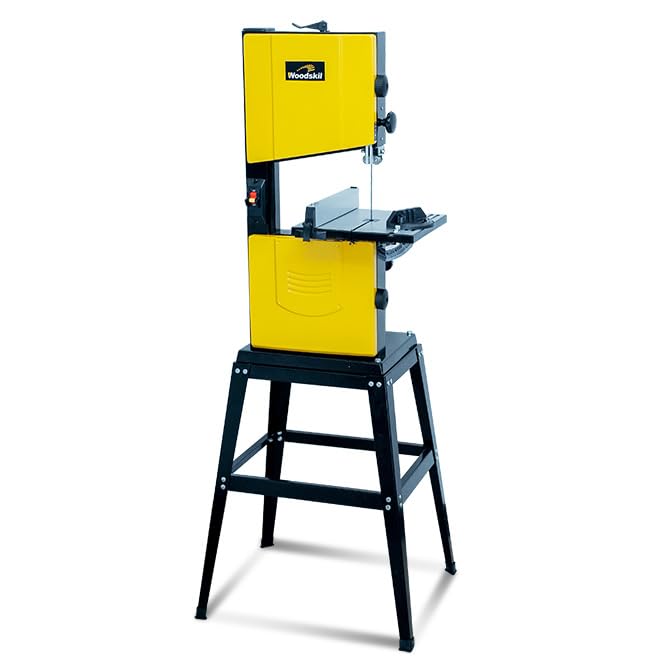
A dual-speed woodworking bench saw that switches from oak to plywood without burning either.
Woodworkers face a simple problem: hardwoods like oak burn at high blade speeds, but softwoods need speed for splinter-free cuts. This Woodskil solves it with two speeds — 2360 FPM for hardwood without burning, and 3000 FPM for fast, clean softwood and plywood cuts. The 5-1/8″ cutting height handles 4×4 lumber, while the 10-inch throat depth lets you slice wide panels for tabletops and cabinets. No need for multiple machines.
Maintenance is where this saw shines for beginners. The Quick Tension System releases blade tension with a single lift of the handle, and tool-free doors twist open so you can change blades and clean out sawdust in minutes instead of fighting screws. Six ball bearing guides support the blade from every angle, eliminating drift so your cuts follow the line, not your mistakes — ideal for scroll work and curved furniture legs. The table tilts 0-45° for bevel cuts, and the included rip fence and miter gauge deliver straight and angled cuts right from the start. The 1-7/8″ dust port hooks to a shop vac.
Owners describe it as excellent quality for the money that “cuts through 3/4 inch stock like butter” and works perfectly for small craft projects. The metal stand provides rock-solid stability, and the 2-year warranty covers weekend warriors and seasoned woodworkers alike. The honest caveat: accuracy can wander 1/32″ to 1/16″ on fine cuts, and the stock fence and miter gauge are functional but not precision-grade — a common theme at this price. It’s a fantastic entry point for beginners that won’t frustrate you out of the hobby.
What Wins People Over
- Tool-free doors and quick tension make blade swaps a 2-minute job
- Six ball bearing guides keep cuts drifting true on curves
- Dual speeds burn-proof hardwoods and speed through softwoods
Know Before You Commit
- Fine-accuracy cuts can drift 1/32″ to 1/16″
- Fence and miter gauge are basic, not pro-grade
Choose it for: weekend projects, toys, shelves, and curved cuts where easy blade changes matter more than absolute precision.
Look further if: you need furniture-grade accuracy under 1/32″ — consider stepping up in budget.
6. WEN Band Saw with Stand, 10-Inch, 3.5-Amp, Two-Speed (BA3962)

The small-shop resaw king — a 6-inch depth capacity that chews through thick hardwood blocks.
The WEN BA3962 is for the weekend woodworker who wants to resaw. Its 3.5-amp motor creates cuts up to 6 inches deep and 9-3/4 inches wide — a resaw capacity that owners have used to slice a 5.5″ x 6.5″ hardwood block into thin bookmatched pieces. It uses 72-inch blades from 1/8 to 1/2 inches in size, so you can swap between a fine scroll blade and a wide resaw blade depending on the job. Two speeds of 1520 or 2620 FPM let you match the cut to the wood.
The spacious 14-1/8 x 12-1/2 inch cast aluminum work table bevels up to 45 degrees for angled cuts, and the included fence, miter gauge, and work light make it a ready-to-work package. The 3-in-1 dust port keeps cleanup simple, and the metal stand brings it to a comfortable working height. Owners who upgraded from older saws report accurate cuts with no drift using the stock 3/8″ blade, and easy assembly right from the start. A 2-year warranty covers the investment.
Owners note it’s “not industrial-grade but great for weekend shops” — the honest truth about a 3.5-amp motor. The stock fence is basic (some replace it with a clamp), the work light is poorly placed, and it’s too low for very tall users — one owner raised it 4″ on a rolling base. For cutting through 4″ poplar and resawing medium hardwoods, it’s a genuine small-shop workhorse with a 4.4-star average across 350+ owners.
What it does best: resawing thick hardwood blocks into thin pieces — the 6-inch depth capacity is the standout spec that defines this pick.
Reality check: this is a weekend-shop saw, not a production machine; budget for a better fence and expect to adjust the tension.
7. PowerSmart Portable Band Saw, 10A Variable Speed, 5″ Cutting Capacity
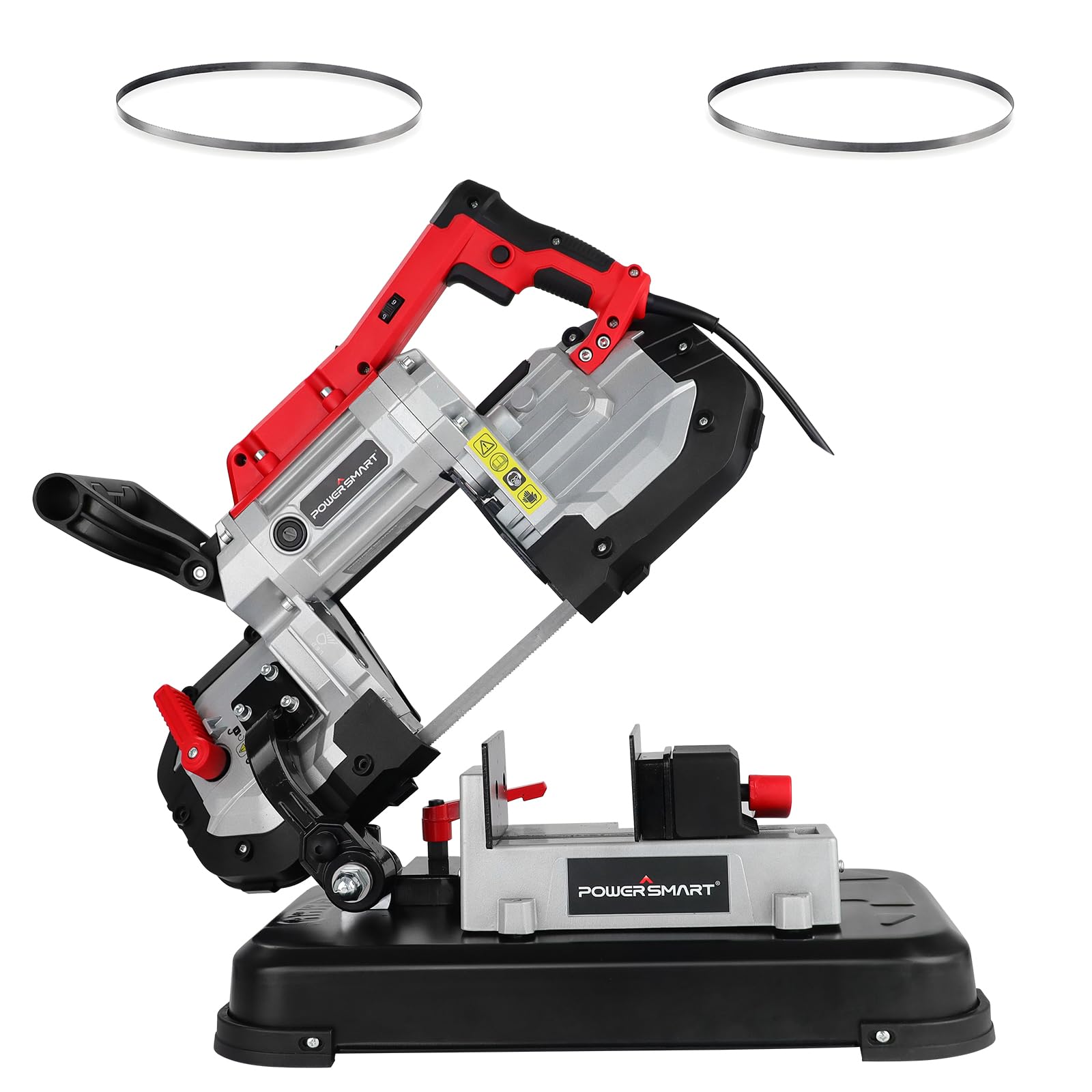
A 30-pound two-in-one cutter with a swiveling base and 6-speed dial for every material.
For the budget buyer, PowerSmart offers a compelling package: a 10-amp motor that cuts metal with no sparks, no burrs, and lower noise, paired with a detachable alloy steel base that rotates 0-45°. The 5″ x 5″ cutting capacity handles round or rectangular stock up to those dimensions. The variable-speed dial spans 0-435 feet per minute across 6 speeds, so you can dial in the right pace for different cutting materials. Two 44-7/8″ 14 TPI blades ship in the box, including a spare.
Owners appreciate its value and sturdy build, noting it cuts through 2x4s and small tree limbs as well as metal, and handles 1-1/2″ solid aluminum bar stock well. One happy buyer achieved repeatable 1mm cuts on a 4×4 after a minor blade alignment fix. The LED work light, dual bearing blade guide, and tool-less blade changing lever round out a feature set that outperforms pricier rivals. The removable base means it weighs 30 lbs with the base attached, giving you a stable benchtop cutter, or sheds the base to become a hand-held portable.
The honest catch here is setup and blade stability. The #1 complaint across owners is the blade popping off the drive wheels during cuts — as one reviewer noted on 2x2x1/16 box tube. The fix is a hidden 5mm Allen screw under the saw that adjusts drive wheel tracking, which the manual doesn’t clearly document. Assembly also gets mixed feedback, with some finding it easy and others noting it requires careful setup. For the mechanically patient buyer on a strict budget, it’s a solid 4.3-star value; for someone who wants plug-and-play reliability, the DEWALT above is worth the premium.
The Upside
- 6-speed dial across 0-435 ft/min adapts to wood, aluminum, and steel
- 30 lbs with removable 0-45° swivel base for bench or handheld use
- Spare blade and LED work light included from the start
The Learning Curve
- Blade can pop off drive wheels until you find the hidden tracking screw
- Setup and blade alignment demand patience and care
Best for: the budget-conscious DIYer who doesn’t mind a little setup tinkering to get a versatile 10-amp cutter for far less than premium brands.
skip it if: you need dead-reliable performance on the first cut with zero assembly fuss — invest in the DEWALT instead.
8. JET 14″ Woodworking Band Saw, 1.75 HP, 13″ Deep-Cut Resaw Capacity

The 272-pound resaw monster — a 13-inch cut in one pass, no second machine needed.
This is the endgame for serious woodworkers. The JET 14″ delivers a 13″ resaw capacity — meaning it slices material up to 13 inches tall in one pass, turning thick slabs into bookmatched panels without a jointer or a second saw. A 1.75 HP capacitor-run motor powers a 116″ blade loop, giving you the torque to push a wide blade through dense hardwood without stalling. It runs on 115/230V single-phase power and recommends a 20A circuit when wired for 115V.
The build quality is where JET earns its premium reputation. A 360 sq. in. ground cast-iron table tilts 0-45° right on a diecast-and-steel trunnion for bevel cuts, and stays flat and rust-resistant with an occasional coat of paste wax. The 14″ wheels accept blades from 1/8″ wide for tight scroll cuts up to 3/4″ wide for fast resawing, with a 13-1/2″ throat capacity. Independently adjustable ball-bearing blade guides keep cuts precise, and the quick-release tensioner makes blade changes fast. It ships with a steel stand, machined-aluminum resaw fence with an easy-read scale, and a hardware pack — though the blade itself is sold separately.
Owners describe it as cutting through material “like a steak knife through filet” and praise its quiet, stable operation on 6″ x 8″ seasoned oak. Setup runs 90 minutes to 2 hours with alignment, and at 272 pounds it’s a two-person lift that won’t fit through every doorway. The included resaw fence is machined aluminum with a scale, ready to cut. Backed by JET’s 5-year warranty with parts support, this is a floor-model machine that owners say they have “no regrets” about — the definitive pick for a home or small production wood shop that resaws serious stock.
What the Premium Buys You
- 13-inch resaw capacity slices thick slabs into bookmatched panels in one pass
- 272 lbs of cast iron and steel stays rock-solid and quiet under load
- Accepts 1/8″ to 3/4″ blades for everything from scroll work to fast resawing
The Honest Commitment
- Blade is sold separately — factor that into your first cost
- 272 lbs needs two people to assemble and won’t fit through low doorways
This is the one if: you resaw thick hardwood regularly and want a floor-model machine that will outlast every other tool in your shop, backed by a 5-year warranty.
Not the pick if: you work on a benchtop or need portability — this machine is a permanent shop fixture.
Understanding the Specs
Cutting Speed (FPM vs. SPM)
Speed tells you how fast the blade loop travels, and it dictates what you can cut cleanly. Metal needs slower speeds — around 100-500 feet per minute (FPM) — so the teeth have time to bite without overheating and dulling. Wood wants faster speeds of 1500 FPM and up for a smooth finish. Some saws are labeled in SPM (strokes per minute), which measures the band’s oscillation differently. A variable-speed dial is the single feature that lets one saw do both jobs without burning your material.
Motor Power (Amps and Horsepower)
Motor size determines how hard the saw can push before it stalls. Portable metal-cutting saws are rated in amps — a 10-amp motor is the industry standard for deep-cut portables, giving you enough grunt for steel stock. Benchtop wood saws are often rated in horsepower (HP), with 1/2 HP handling small craft work and 1.75 HP powering serious resawing. Don’t just compare the numbers — match the power to the material thickness you actually cut. A 3.5-amp saw is fine for 4″ poplar but will struggle on thick dense hardwood.
Cutting Capacity and Throat Depth
Cutting capacity on a portable saw is the deepest material it can wrap its blade around — a 5-inch capacity handles most pipe and rectangular stock. Throat depth on a benchtop model is the distance from the blade to the frame, which sets how wide a panel you can push through — a 10-inch throat handles tabletops, while a 13-inch capacity resaws thick slabs in one pass. Always measure the biggest stock you realistically cut and buy a saw with capacity to spare.
Blade Length and Teeth Per Inch (TPI)
Blade loops come in specific lengths that must match your saw’s wheel size — a 44-7/8″ blade fits most portables, while a 72-inch blade fits a 10-inch benchtop and a 116″ blade fits a 14-inch floor model. The teeth per inch (TPI) determines cut quality: higher TPI (14-18) gives smooth cuts on thin metal, while lower TPI (3-6) clears material fast on thick wood. The most versatile saws accept a range of blade widths, from narrow 1/8″ blades for tight curves to wide 3/4″ blades for fast resawing.
FAQ
Can a portable band saw cut both metal and wood?
What’s the difference between cutting capacity and throat depth?
Will a 10-amp portable saw handle angle iron and steel pipe?
Do band saw blades come included with the saw?
How do I stop the blade from popping off the wheels?
Is a cordless band saw as powerful as a corded one?
What size band saw do I need for resawing hardwood?
Can I mount a portable band saw upright to use as a stationary saw?
How important is a dust port on a woodworking band saw?
Which is better, a benchtop or a floor-standing band saw?
Final Thoughts: The Verdict
The best band saw for most buyers is the DEWALT DWM120K — a 4.8-star crowd favorite across 750+ owners that cuts steel straight and true with a 10-amp motor and 5-inch capacity. If you want cordless freedom for remote cuts, grab the Makita XBP02Z and never drag a grinder up a ladder again. And for the serious woodworker resawing thick slabs, the JET 14″ is the floor-model endgame that slices 13-inch stock in one clean pass.
How We Picked
We do not accept paid placement. Every pick is matched to a real buyer and a real use-case; we do not hands-on test units.
Sources & Methodology
Specifications: manufacturer listings and product documentation. Review insights: verified customer reviews, as of September 2026. Pricing: not shown on this page (it changes often); check the current price via the retailer link.
As an Amazon Associate, KitchPrep earns from qualifying purchases. This does not affect which products we feature.
Related Guides
