
Specs are compiled from manufacturer listings and verified buyer reviews and can change over time — please confirm the key details on the product page before buying.
When the grid drops and your house goes dark, the real question is whether your sump pump, fridge, and furnace all keep running while you sleep. A 14000 watt generator delivers up to 14,000 watts of surge power, keeping your sump pump, fridge, and furnace running through an outage. This guide compares the top 14000 watt models to match you with the right backup power for your home.
I’m Mohammad Maruf — the founder and writer behind KitchPrep. This guide is built by comparing the manufacturers’ published specifications and the patterns across verified customer reviews, so you get each pick’s real strengths and trade-offs instead of marketing spin.
From tri-fuel flexibility to remote-start convenience, we’ve dissected the top contenders in the 14000 watt generator class to match you with the perfect backup powerhouse for your home.
Our Picks at a Glance


How To Choose The Best 14000 Watt Generator
Shopping for this class of generator means you’re already past the “tailgate party” stage—you have a house, an RV, or a job site that needs serious, sustained electricity. The mistake most first-time buyers make is fixating on the peak “surge” number printed in big letters on the box, when the “running watts” figure is what your appliances actually demand over hours of use.
Fuel: Dual vs. Tri-Fuel Flexibility
Dual-fuel units run on gasoline and propane, giving you a backup when gas goes stale or is hard to find. Tri-fuel adds natural gas, which taps directly into your home’s existing utility line—no refueling needed for outages that last days. A tri-fuel generator with a natural gas hookup means you can essentially run indefinitely on your home’s gas supply, a huge advantage during extended emergencies.
Start Method: Electric vs. Remote
You want a push-button electric start at minimum; fighting a pull cord on a 500cc engine in a storm is misery. Remote start, via a key fob, lets you fire the generator from the dry comfort of your porch or garage—a small feature that becomes a huge deal during a week of relentless rain.
Safety & Connectivity: CO Sensors and Transfer Switches
Whole-home power means connecting to your electrical panel, so a transfer-switch-ready 50A outlet (a heavy-duty socket that links to your breaker box) is essential. And never skip a CO sensor—these shut the engine down automatically if carbon monoxide builds up, protecting your family from silent, odorless fumes.
Quick Comparison
| Model | Best For | Surge Watts | Fuel Type | Engine Displacement | Amazon |
|---|---|---|---|---|---|
| DuroMax XP13000EH★ Best Overall | Whole-home Value | 13,000W | Gas/Propane | 500cc | Amazon |
| DuroStar DS13000MXRemote-Start Star | Remote-Start Budget | 13,000W | Gas/Propane | 500cc | Amazon |
| WEN TF-1450XTri-Fuel Champion | Tri-Fuel Performer | 14,500W | Gas/Propane/NG | 500cc | Amazon |
| Westinghouse WGen10500DFc | High-Rated Classic | 13,500W | Gas/Propane | 500cc | Amazon |
| DuroMax XP15000HX | Max Output Dual-Fuel | 15,000W | Gas/Propane | 670cc | Amazon |
| Westinghouse WGen14500TFc | Large Home Power | 18,000W | Gas/Propane/NG | 713cc | Amazon |
| GENMAX GM13500iETC | Quiet Inverter Tech | 13,500W | Gas/Propane/NG | 550cc | Amazon |
| Champion MKE Series | Contractor-Grade Gas | 15,000W | Gasoline | 717cc | Amazon |
In‑Depth Reviews
1. DuroMax XP13000EH
Our pick — 4.5★ from 3,500+ verified ratings; the strongest balance of quality and price.
The DuroMax XP13000EH delivers proven whole-home power at a budget-friendly price.
Its 500cc engine and dual-fuel capability make it a reliable choice for powering an entire house. It offers the best balance of performance and cost for whole-home backup without a permanent installation. Its 500cc engine is a proven workhorse, and the all-metal frame and power panel means no plastic parts to crack or yellow with age.
Owners regularly report it running an entire house—one noted it powered their 4800 sq. ft. home. The electric start is a highlight; buyers report it fires up instantly with a button press. It’s a true dual-fuel unit (runs on either gasoline or propane). On propane-only, owners have powered 4 appliances for over 5 hours on a half-tank; another ran 8 hours on a full gas tank during a 9-hour outage, handling a 6000W load with two HVAC units.
Its 234-pound weight and loud muffler are the main drawbacks. At 234 pounds, this is a heavyweight that stays where you park it. Buyers are also honest about the muffler being loud, which is the norm for an open-frame generator of this power. As the review pages sum it up: it’s a reliable, sturdy unit that delivers exactly what the spec sheet promises, especially for the price.
What Wins People Over
- Proven reliability with a 100% copper windings build for longevity
- Electric start that fires up instantly per multiple owner reports
- True dual-fuel flexibility with easy front-facing fuel selector
Realistic Drawbacks
- Heavy at 234 pounds—plan your parking spot carefully
- Muffler is loud, typical for an open-frame unit
- No oil included in the box, so budget for that first fill
The pick for: Anyone who wants maximum whole-home reliability for a mid-range investment, especially if you value a proven track record over fancy extras.
Think twice if: Noise is strictly prohibited in your neighborhood or you need something you can easily lift into a truck bed—this one stays put.
2. DuroStar DS13000MX
A remote-start dual-fuel that costs less than the flagship DuroMax while keeping the whole-home performance.
The DuroStar DS13000MX offers remote start and dual-fuel power at a lower price than the flagship DuroMax. It brings the same 500cc engine displacement and dual-fuel capability (gas and propane) as the XP13000EH, but adds a remote control—letting you start and stop the generator from a distance. Remote start is a premium feature rarely found at this price point. It also packs a 43.75 A current rating, giving it serious amperage for heavy appliance loads.
Quality is the most-mentioned positive point in owner feedback. Value for money is the second biggest draw: owners mention it powering an entire home, including 1.5-ton ACs, a fridge, stove, microwave, TVs, and a water heater “without flinching.” Assembly is straightforward from the start, and the push-button start is a hit.
The reality check is the mixed feedback on starting time. While many report it starts flawlessly, a small but notable set of owners describe a CO alarm issue that shuts the unit down after about 20 minutes of running, despite open placement. This is a safety sensor doing its job, but it has been a frustrating experience for those who hit it. The other practical catch? The included hand truck is essential—this is a heavy unit that you’ll want to roll into place, not carry.
Why Owners Love It
- Remote electric start convenience via included key fob
- Top mentions for build quality and value for money
- Easy assembly right from the start
Before You Buy
- CO alarm sensitivity has caused shutdowns for a few owners
- Starting time feedback is mixed—some take a few tries
- Heavy build means you’ll rely on the wheel kit for moves
Best fit: Buyers who want the remote-start convenience and budget-friendly price without sacrificing dual-fuel power.
Watch out for: If your set-up area is enclosed, the CO sensor might be overly cautious—open air placement is a must.
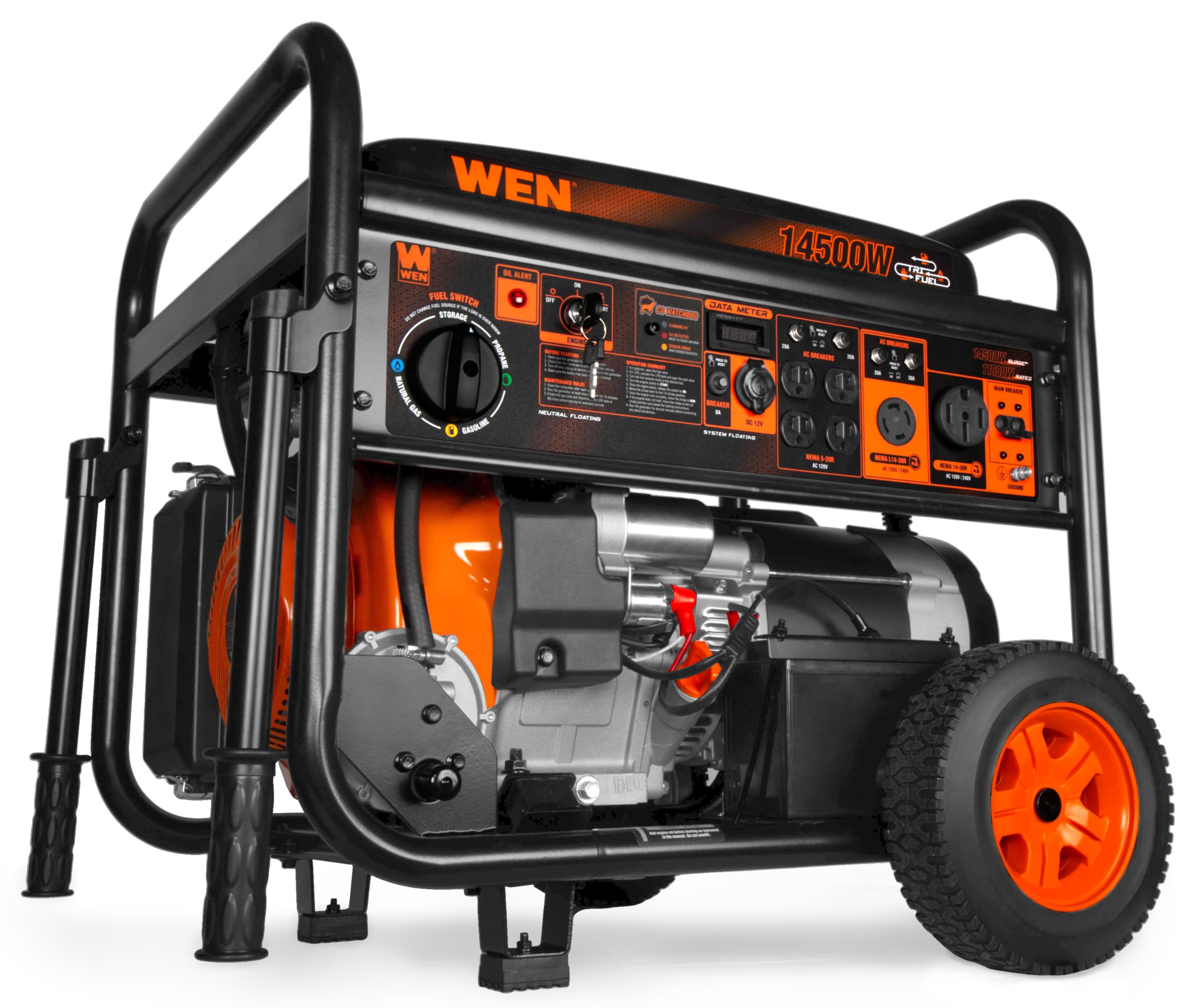
3. WEN TF-1450X
The tri-fuel overachiever that out-powers its price tag with a simple turn of a dial.
Bringing a 14,500-watt surge rating, the WEN gives you more headroom than the DuroMax at 13,000 watts and does it with three fuel options. The real a neat extra is the fuel flexibility: gasoline (14500 surge watts, 11500 running watts), propane (12500 surge watts, 10300 running watts), and natural gas (10500 surge watts, 8750 running watts). That natural gas option is huge—connected to your home’s line, you’re no longer dependent on stored fuel.
The WEN Watchdog CO Shutdown Sensor (a carbon monoxide detector that automatically kills the engine if dangerous levels are detected) is a standout safety feature. Owners who’ve put it to the test report it “runs my whole house including central air and my garage all at once.” It comes ready to work: includes a bottle of oil, a 6-foot LPG connection hose, and an NG quick-connect adapter—so you’re not hunting for parts before your first run.
The honest caveat is that this is a newer model with fewer owner miles logged—it holds a strong rating but from a smaller sample than the DuroMax’s thousands of reviews. One owner needed starting fluid on the very first fire-up. It’s a minor early-run quibble, not a pattern, but note that it might need a little coaxing on its first start. Its dimensions (28.8″L x 28.3″W x 25.8″H) are slightly more compact than the DuroMax at 30″L, a small bonus for tight garage spaces.
The Standout Features
- Genuine tri-fuel flexibility with a simple selection dial
- Higher 14,500W surge rating beats most dual-fuel rivals
- Includes oil, LPG hose, and NG adapter in the box
Small Trade-offs
- Newer model with a limited owner track record so far
- One owner needed starting fluid on the initial fire-up
- Running watts drop noticeably on natural gas (8750W)
Your best move: Homeowners who have natural gas hookups and demand the ultimate fuel-buying flexibility from their 14000 watt generator.
Keep in mind: If you plan to run everything on natural gas only, be sure your total appliance load stays under that 8750W running limit.
4. Westinghouse WGen10500DFc
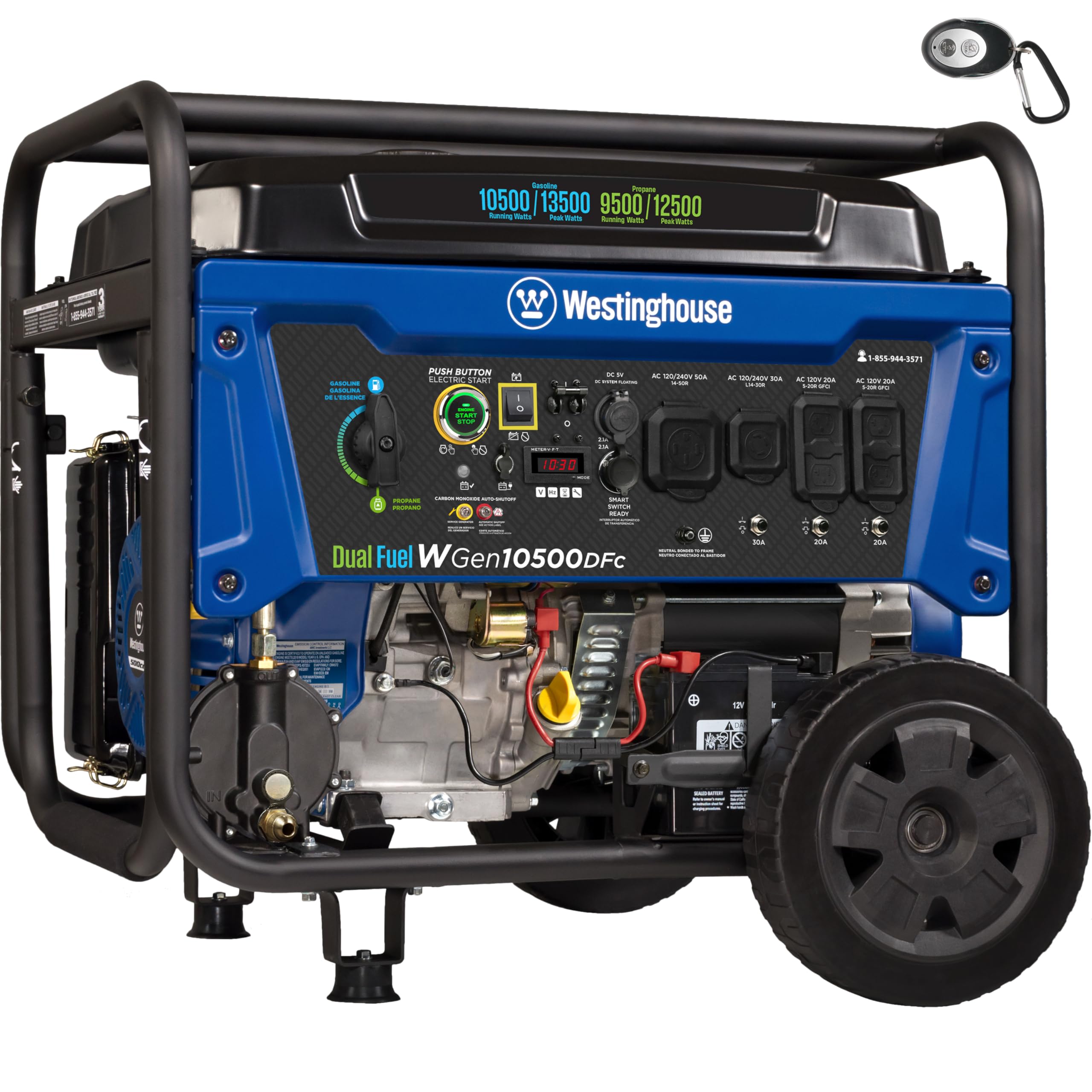
A high-rated powerhouse that owners consistently describe as a heavy-duty machine worth every penny.
This is the generator that owners champion for its build quality and reliability—the two most-discussed aspects by far. It delivers a punchy 13,500 peak watts on gasoline and 12,500 on propane (10,500 and 9,500 running watts respectively). The included remote start key fob is a massive convenience hit, letting you fire it up from inside the house during a storm. A 9.5-gallon fuel tank pushes runtime up to 19 hours, which is outstanding for a dual-fuel unit.
The engine is a heavy-duty 500cc Westinghouse 4-stroke OHV (overhead valve, a design that improves efficiency and longevity) with a long-lasting cast iron sleeve, backed by automatic low-oil and CO shutdown sensors. Owners with a ~2000 sq ft house report it powers everything. One owner even received a free tri-fuel upgrade from the company, a nice touch that points to good customer service.
The most common theme in the feedback is simply satisfaction. It starts immediately, runs smoothly, and the rubber covers on all outlets add a layer of safety you don’t always see. It’s a smaller footprint than the WEN at 27.2″L, but at 230 pounds it’s still a two-person (or a good dolly) job to move around.
Why It’s a Top Pick
- Exceptional owner scores for build quality and reliability
- 19-hour runtime on a 9.5-gallon tank for long outages
- Remote start key fob for convenient, dry start-ups
Honest Limitations
- 230-pound weight requires a wheel kit or strong help
- Propane running watts (9,500W) are lower than gas
- Some units may arrive with residual oil/fuel odor per the manual
Reach for this if: You want a proven, high-rated generator from a brand with a huge service network, and you value remote start on a 13,500W machine.
Look elsewhere if: You need tri-fuel (natural gas) capability—this one is strictly gas and propane.
5. DuroMax XP15000HX
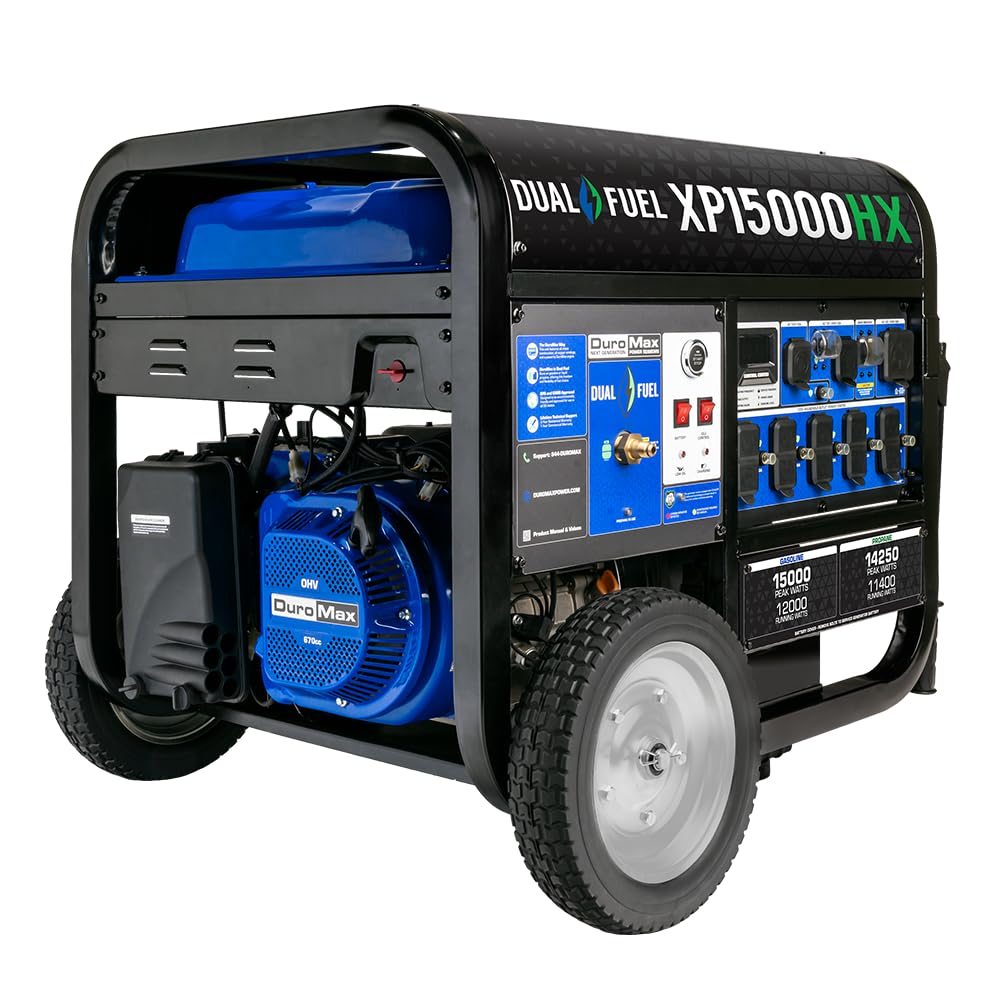
A bruiser built around a 670cc engine that’s ready to take over your entire electrical panel.
If you need the maximum output from a dual-fuel portable, this is it. The 15,000-watt surge is the highest on the dual-fuel side, and it’s driven by a serious 670cc OHV DuroMax engine—a 170cc step up from the XP13000EH. This extra displacement means it muscles through big simultaneous loads without breaking a sweat. Owners confirm it runs the whole house with central air humming along.
It’s loaded with modern conveniences: an all-new control center with a digital multimeter that displays voltage, frequency, total hours run, and hours until recommended maintenance. That maintenance reminder is a genuinely useful feature for keeping the machine healthy. The fully loaded power panel includes five 120V GFCI household outlets, a 120V 30AMP outlet, a 120/240V 30AMP twist-lock, and a heavy-duty 120/240V 50AMP outlet for transfer switch hookups.
The catch with this one is the mixed reliability feedback—a portion of owners have reported issues, including a non-functional idle control switch. It’s important to note the top-mentioned positive is quality, with owners calling it “well built.” A few also mention it’s a little loud, which is expected with a 670cc motor. At 345 pounds, it’s also the heaviest of the dual-fuel DuroMax options, so plan for that logistics challenge.
The Big Upgrades
- 15,000 watts of surge power—the most in the dual-fuel lineup
- Digital multimeter with maintenance countdown reminders
- Remote start included for convenient operation
What to Weigh
- Mixed reliability feedback, with some idle-control complaints
- Significant 345-pound weight for moving
- 50Hz frequency spec differs from standard US 60Hz—verify before buying
Consider this when: You have a larger home or workshop that needs the extra grunt of a 15,000W surge rating from a dual-fuel unit.
Be cautious: The frequency listing as 50Hz is unusual for US homes—double-check the spec sheet for your region before purchase.
6. DuroMax XP15000HXT
iv>
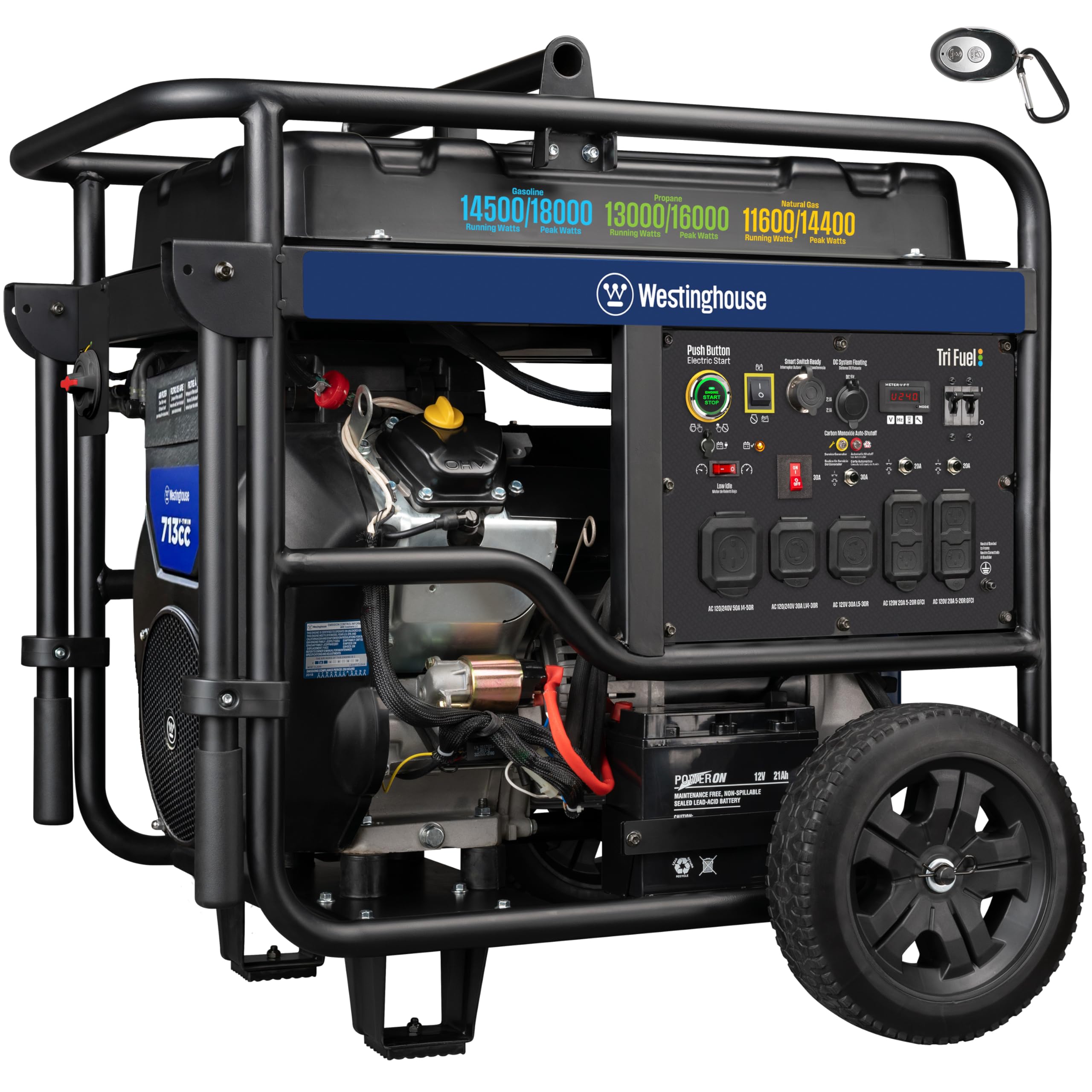
Westinghouse’s tri-fuel workhorse with a V-Twin engine and low THD for your sensitive electronics.
This is the serious upgrade for larger homes. It doesn’t just bump power—it changes the engine architecture. A 713cc Westinghouse V-Twin OHV engine produces 18,000 peak watts and 14,500 running watts on gas, with propane dipping to 16,000 peak/13,000 running and natural gas at 14,400 peak/11,600 running. That V-Twin runs smoother and quieter than a single-cylinder, and the cast iron sleeve adds durability.
What really sets this apart is the low THD (Total Harmonic Distortion). At less than 5% THD, the power is clean enough for sensitive electronics like phones, computers, and TVs directly—no separate inverter needed. The VFT data center displays voltage, frequency, and lifetime hours, and the low idle mode cuts fuel consumption when the load is light. A 10.5-gallon tank yields up to 16 hours at 25% load, giving you a full night of power on one fill.
Owners rate the quality highly and find it easy to assemble with a self-explanatory manual. The starting performance is where feedback splits—most fire it up fine, but a minority report units that “wouldn’t start at all.” There’s also one troubling report of defective lifting hook threads and a remote start that never worked, with slow warranty support. At 348.3 pounds, this is also a machine you’ll want on a solid dolly or permanently parked.
Why It’s a Flagship
- 713cc V-Twin engine for smoother, more durable operation
- Low THD (<5%) makes it safe for sensitive electronics
- 16-hour runtime on a 10.5-gallon tank at 25% load
Flagship Reality Check
- Starting performance is mixed—a minority report no-start units
- Warranty support has drawn complaints in rare cases
- Massive 348.3-pound weight for stationary placement
Best for: Homeowners with larger homes and sensitive electronics who want the power and cleanliness of a V-Twin tri-fuel without going full standby.
Be aware: The weight isn’t a “portable” factor—this is a semi-permanent installation on wheels.
7. GENMAX GM13500iETC
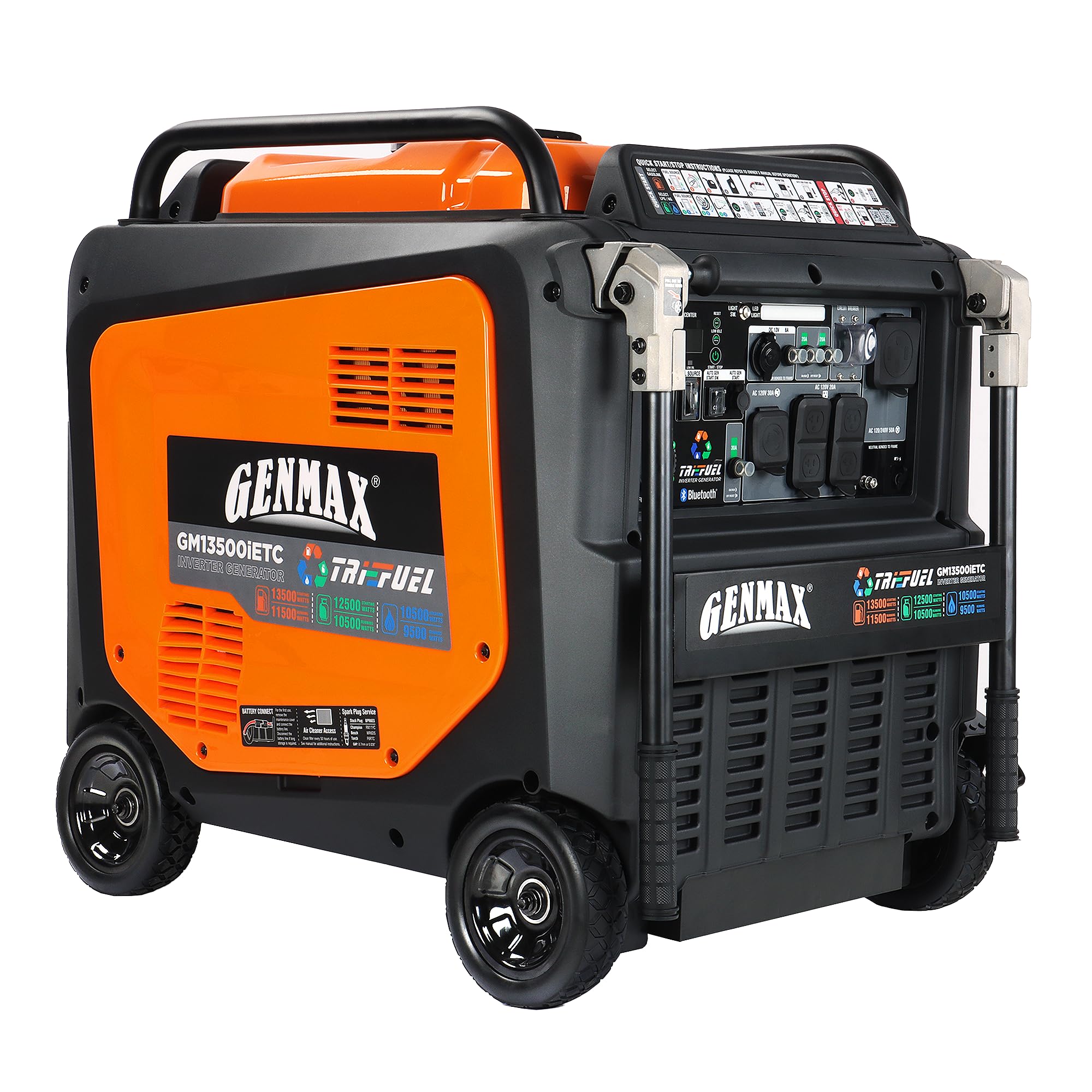
The quiet inverter that delivers clean power at a conversational 62 dB(A)—a different class of generator.
This is not your typical open-frame scream machine. The GENMAX is an inverter generator, which means it produces pure sine wave power that’s as clean as your wall outlet—at ≤3% Total Harmonic Distortion (THD). That makes it safe for laptops, phones, and medical equipment, a genuine concern for some whole-home backup. It’s also dramatically quieter, running at 62 dB(A) at 25% load, which is about the level of a normal conversation.
It’s also a tech powerhouse with 5 starting methods: push-button, remote key fob, Bluetooth app control, recoil backup, and ATS 2-Wire Auto-Start. That ATS autostart is revolutionary for a portable—it means the generator can automatically fire up when the power goes out, no manual intervention needed. The 550cc engine produces 13,500 peak watts on gas, and owners have tested it powering a 4-ton AC (with soft start), a dryer, oven, and pool pump simultaneously.
The Eco-Mode auto-adjusts the engine speed to match your load, which is how it achieves the impressive 11.2-hour runtime at a 6.9-gallon tank. It’s CARB certified for all 50 states, a detail that matters for California buyers. However, this quality comes at a premium price—the highest on this list among the “portable” class—and it’s a newer model, so long-term reliability is still being proven. Owners so far are impressed with its quiet operation and power quality, calling it “very quiet and capable.”
The Inverter Advantage
- ≤3% THD clean power, safe for all sensitive electronics
- 62 dB(A) noise level—as quiet as a normal conversation
- ATS 2-Wire Auto-Start for hands-free outage response
Premium Price, Few Wrinkles
- Premium price point is the highest of the non-28kW units
- Newer model with limited long-term ownership data
- 273.7 pounds is still heavy, though lighter than V-Twins
Pick this when: Quiet operation, sensitive electronics safety, and automatic start are your top priorities—this is the most civilized 13,500W machine available.
Know this: You’re paying a serious premium for that silence and clean power; budget-wise alternatives exist if noise isn’t a concern.
8. Champion MKE Series
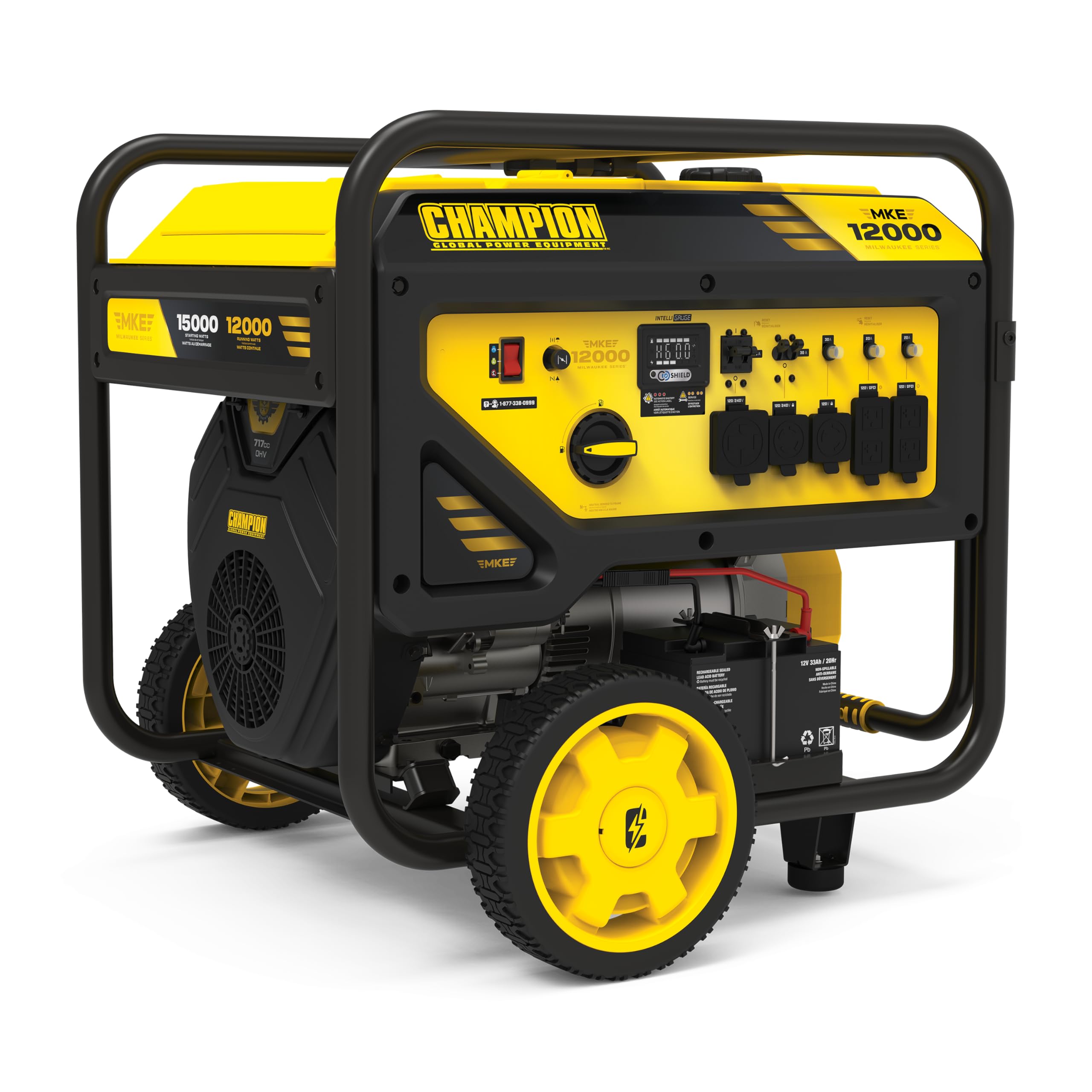
A 15,000-watt gas-only bruiser from Champion, built around the massive 717cc Milwaukee Series V-Twin.
Champion’s MKE Series is the contractor-grade option here. It skips the fuel flexibility to focus on raw, dependable power on gasoline: 15,000 starting watts and 12,000 running watts. The 717cc Milwaukee Series V-Twin engine is the biggest single-cylinder-adjacent displacement on this list, and it’s paired with a battery-included electric start and a toggle switch. Built-in Cold Start Technology makes it a reliable choice for winter outages.
This is a workhorse for job sites. Owners have run 220 MIG welders, chop saws, dryers, and washers off it. The Intelliguage is a useful addition—a digital display that tracks voltage, hertz, and run-time hours so you can monitor output and schedule maintenance. The built-in lift hook makes loading it into a truck using a winch or hoist significantly safer than manhandling 332 pounds. Champion’s 3-year warranty includes free lifetime technical support, a solid promise from a major brand.
The trade-offs are clear. The noise is a measured 78 dBA from 23 feet (about as loud as a busy city street), which is noticeable—as one owner put it, “powerful, loud.” There have also been isolated reports of diaphragm fuel pump issues, with one owner going through a few before wiring an electric pump. That’s a fixable but annoying failure point. For a contractor needing portable power on site, this is a proven name, but for home backup, its gas-only operation is a limitation.
What It Offers
- 717cc V-Twin engine with cold-start technology
- Built-in lift hook for safe truck loading
- Volt Guard surge protector on all outlets
Contractor Caveats
- 78 dBA noise level is loud for residential use
- Fuel pump diaphragm issues reported in some units
- Gas-only—no propane or natural gas backup option
Excellent for: Job sites and workshops where you need a dependable, high-output machine on gasoline and don’t mind the roar.
Not ideal for: Home backup where you want fuel flexibility or where noise could be a problem with nearby neighbors.
Understanding the Specs
Surge vs. Running Watts
This is the first number that matters. Surge watts (also called starting watts) is the brief burst of power needed to start a motor—like an AC compressor. Running watts is what the generator sustains over hours. A 14,500-watt surge generator might only run 11,500 watts continuously. Add up your essential appliances’ running wattage first, then make sure the generator’s running figure exceeds that total with a little headroom.
Fuel Strategy: Dual vs. Tri-Fuel
Dual-fuel units (gas + propane) give you a backup if one fuel goes stale or runs out. Tri-fuel units (gas + propane + natural gas) connect to your home’s gas line, offering theoretically unlimited runtime during an outage. Natural gas is the cheapest and most convenient, but you’ll lose some peak output compared to gasoline—so your total load still needs to fit under the natural gas running-watt figure.
FAQ
Will a 14000 watt generator run my whole house?
What is the difference between dual fuel and tri fuel generators?
Why is a CO sensor important on a generator?
What does transfer switch ready mean?
Can I use a 14000 watt generator to power an RV?
How long will a 14000 watt generator run on a full tank?
Is a generator with lower THD worth the extra money?
What does a remote start key fob actually do?
Which fuel type gives the longest runtime and best value?
How much maintenance does a 14000 watt generator require?
Final Thoughts: The Verdict
For most users searching for the best 14000 watt generator, the DuroMax XP13000EH is the smartest buy because it has a deep community of thousands of owners who have verified it for years—a track record no other unit on this list can match at its power level. If you’re willing to spend up for fuel flexibility and a natural gas hookup, the WEN TF-1450X is the pick to beat with its higher 14,500-watt surge. And if quiet operation and clean power for your electronics matter more than anything, the GENMAX inverter generator is the answer. Choose the one that fits your home’s load first, your fuel access second, and your storage space last—you’re buying a machine to give you confidence when the grid goes down.
How We Picked
We do not accept paid placement. Every pick is matched to a real buyer and a real use-case; we do not hands-on test units.
Sources & Methodology
Specifications: manufacturer listings and product documentation. Review insights: verified customer reviews, as of September 2026. Pricing: not shown on this page (it changes often); check the current price via the retailer link.
As an Amazon Associate, KitchPrep earns from qualifying purchases. This does not affect which products we feature.
Related Guides
