
Specs are compiled from manufacturer listings and verified buyer reviews and can change over time — please confirm the key details on the product page before buying.
If you’ve ever had a sander or paint gun stall mid-project because your compressor’s tank ran dry, you know the real enemy isn’t power — it’s recovery time. A true two-stage unit delivers the steady, high-pressure air that keeps grinders spinning and spray guns laying down an even coat, which is exactly what a serious home garage needs. This guide breaks down the top four stationary two-stage models, comparing real specs like CFM output, tank size, and PSI so you can match one to your tools without overpaying.
I’m Mohammad Maruf — the founder and writer behind KitchPrep. This guide is built by comparing the manufacturers’ published specifications and the patterns across verified customer reviews, so you get each pick’s real strengths and trade-offs instead of marketing spin.
We’ve matched each unit against the demands of a busy home workshop to find the true best 2 stage air compressor for a home garage that balances air output, noise, and footprint for real daily use.
Our Picks at a Glance
How To Choose The Best 2 Stage Air Compressor for a Home Garage
Before you buy a stationary compressor for your garage, match it to three things: how much air your tools demand, how much noise you can tolerate, and how much floor space you can spare. Get these right and you won’t stall a tool; get them wrong and you’ll be shopping again within a year. Every pick here uses a two-stage pump (a pump that compresses air in two steps for higher pressure and efficiency) and a 60 to 80-gallon tank, so they all serve the same heavy-duty purpose even if the exact size varies.
Air Delivery: The CFM Number That Matters
The single most important spec is CFM — cubic feet per minute — which is how much air the pump can push out. Every air tool lists its own CFM requirement, and your compressor must exceed the highest-demand tool you’ll run. A grinder or sandblaster needs far more air than a nail gun, so check the CFM rating at 90 PSI, the pressure most tools actually run at. Buy a compressor that can’t keep up, and you’ll spend your time waiting for the tank to refill mid-cut.
Tank Size and PSI: Your Air Reservoir
The tank stores compressed air as a buffer, so the pump doesn’t run every time you pull the trigger. A bigger tank means longer run times between pump cycles, so the motor cycles less often. Maximum PSI (pounds per square inch, the air pressure in the tank) matters too — a 175 PSI rating means the tank holds more air energy, giving you extra reserve for quick bursts of high-demand tools. For a home garage, a 60 to 80-gallon tank and 175 PSI is the balance.
Power and Pump Design
All the units here are two-stage, meaning the air is compressed twice for higher pressure and efficiency. They run on 230V power, so you’ll need a dedicated circuit in your garage — this isn’t a plug-into-the-wallportable unit. Look for an oil-lubricated cast-iron pump, which runs cooler and quieter than oil-free designs, and check the pump’s rated lifespan in hours for a sense of how long it’ll last.
Quick Comparison
| Model | Best For | Max Pressure | Air Flow (CFM) | Tank Size | Amazon |
|---|---|---|---|---|---|
| Campbell Hausfeld XC602100★ Best Overall | Balanced garage value | 175 PSI | 7.6 | 60 Gallons | Amazon |
| DEWALT DXCMV5076055 | High-volume air tools | 175 PSI | 15.3 | 60 Gallons | Amazon |
| Ingersoll Rand 2475N7.5 | Heavy continuous duty | 175 PSI | 24.0 | 80 Gallons | Amazon |
| Ingersoll Rand 2340L5-V | Quiet, durable cast iron | 175 PSI | 14.0 | 60 Gallons | Amazon |
In‑Depth Reviews
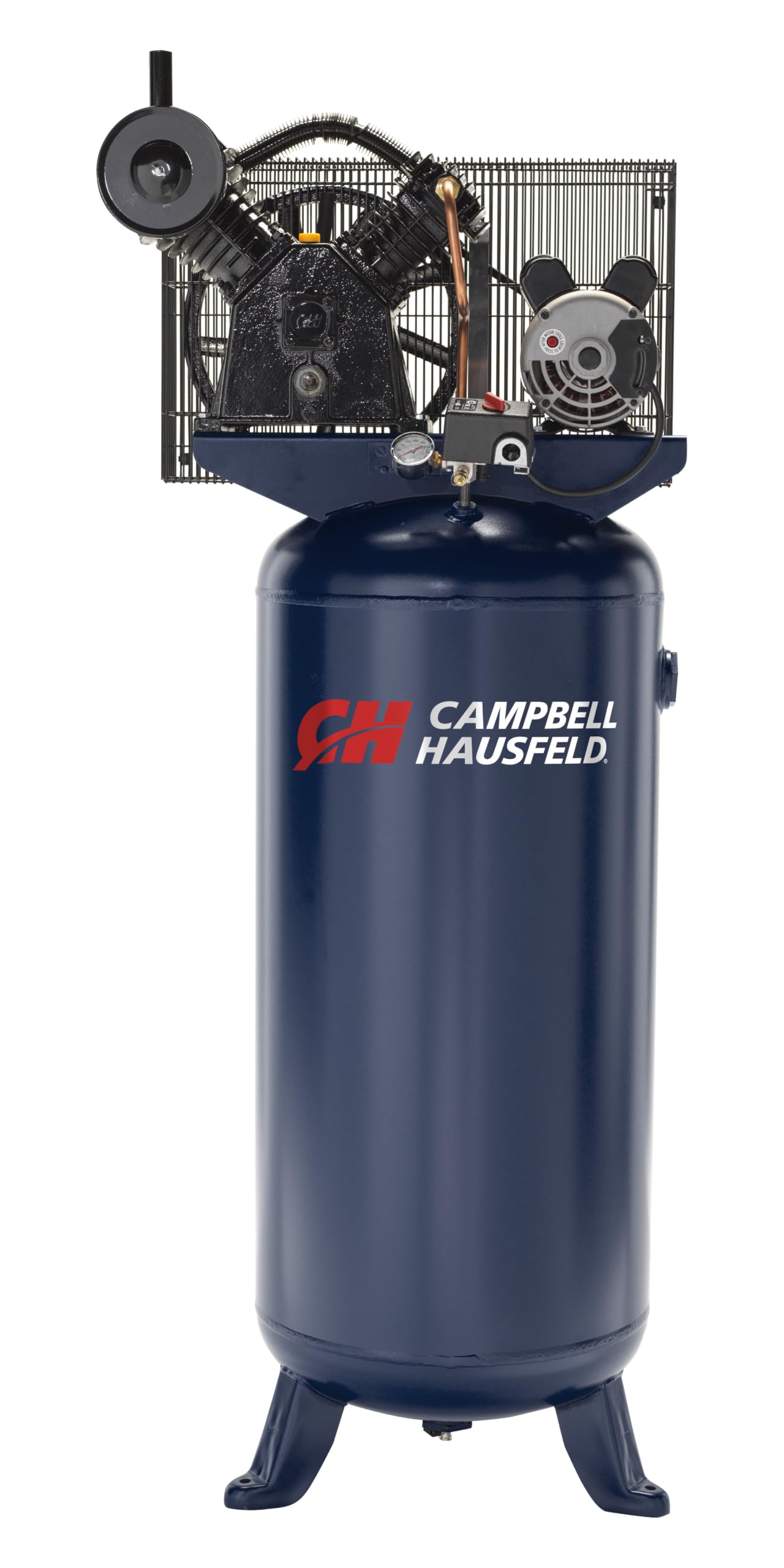
1. Campbell Hausfeld 60-Gallon 2-Stage Air Compressor, 175 PSI, 230V
Our pick — over 4★ from 100+ verified ratings; the strongest balance of quality and price.
The reliable shop workhorse that pairs a cast-iron two-stage pump with a 175 PSI tank for serious sanding and grinding.
The thing everyone raves about here is outright performance — owners consistently find it feeds a sander and keeps up without bogging down, and it’s the aspect that wins the most praise by a wide margin. The oil-lubricated cast-iron pump is rated for up to 10,000 hours of life based on its B-10 bearing rating., which is a solid engineering story for a home garage that sees weekend use. It holds its pressure well under load, maintaining 100 PSI while running a sander, and buyers report the motor keeps up with continuous sanding work.
Value is the second thing people call out. It’s a genuinely budget-friendly entry into true two-stage ownership, and buyers describe it as a well-built machine that looks good sitting in a shop. Owners also report the pre-filled oil and easy 115V to 220V rewire make setup simpler than expected, and the 23 x 23-inch upright footprint helps preserve floor space. That said, there is a real trade-off: the recurring gripe is the finish and handling during delivery, with an occasional unit arriving with scratches, peeling paint, or a small oil leak from shipping.
At 255 pounds, it’s far lighter than the 430-pound Ingersoll Rand Type 30 above, and its 7.6 CFM is a 2.0x gap smaller — so it’s not the pick for sandblasting or high-volume continuous spray work. The noise level gets genuinely mixed feedback: some owners are impressed by how quiet it is, while others find it noisy, so treat it as average for its class. Buyers also note it can vibrate and “walk” on the floor unless you bolt it down, so plan for a stable mounting spot.
What wins owners over
- Maintains 100 PSI under load while running sanders
- Fast recovery and holds pressure well between tasks
- Easy 115V to 220V rewire and pre-filled oil
- Allows longer, demanding pneumatic jobs at 175 PSI max
What to watch
- Can vibrate and walk unless bolted to the floor
- Occasional shipping damage and oil leaks on delivery
- Bottom drain is inconvenient to reach
The right fit: The strongest value-minded choice for a home garage doing sanding, grinding, nailing, and inflation where budget matters.
Think twice if: You need high-volume air for continuous sandblasting or spray work — that demands more CFM than this unit delivers.
2. DEWALT 60-Gallon Stationary Vertical Air Compressor (DXCMV5076055)
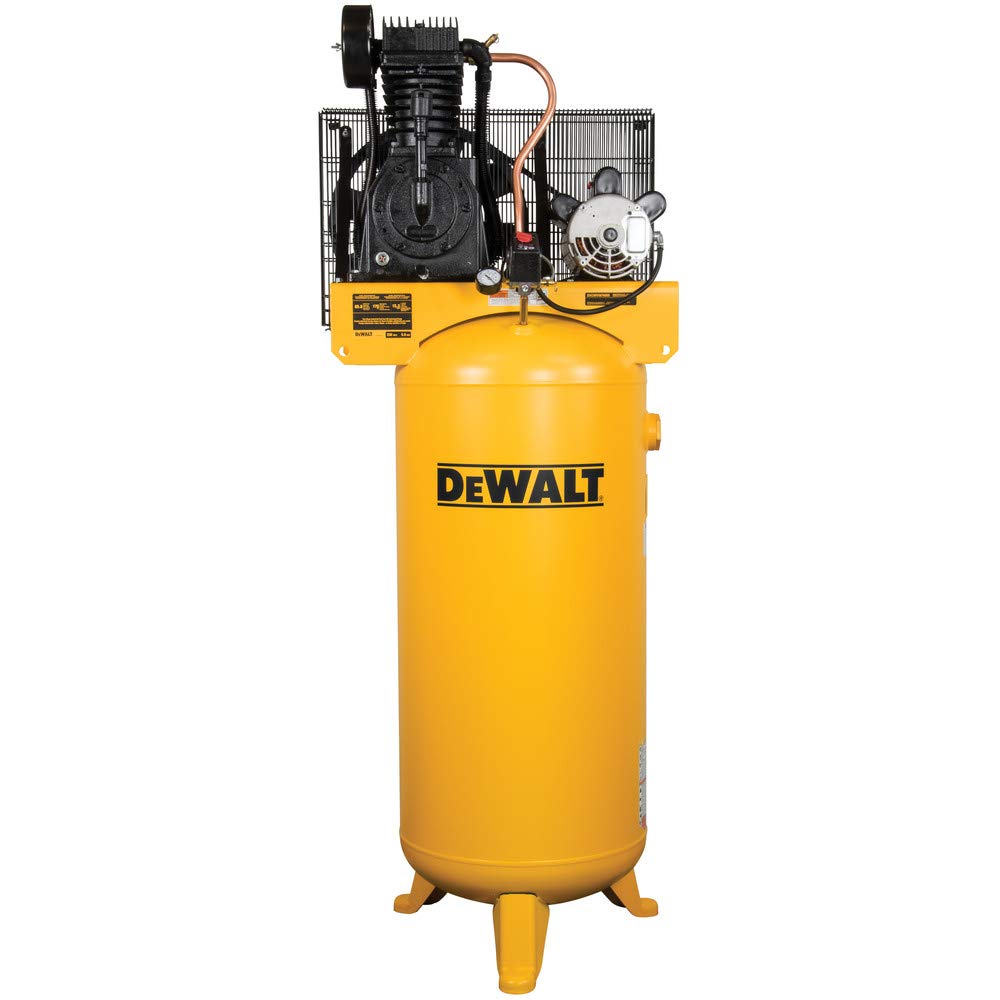
The airflow leader that feeds high-volume tools like a 15.3 CFM powerhouse while running quieter than you’d expect.
The DEWALT DXCMV5076055 earns its top spot for raw air output, delivering 15.3 SCFM (standard cubic feet per minute, the volume of air it moves) at 100 PSI and 13.5 SCFM at 175 PSI — a 2.0x gap over the Campbell Hausfeld’s 7.6 CFM, making it the clear pick for high-demand tools. Owners say the build quality is the standout feature, and they describe the unit as functioning flawlessly once set up. It reaches around 170 psig (pounds per square inch gauge, the pressure above atmospheric) very quickly, so the tank refills fast between bursts of work.
The 5 HP, 230-volt motor runs at a mere 65 dB, which is genuinely quiet for a stationary unit this size — you can hold a conversation nearby while it runs. The vertical design with a 40″L x 31″W footprint is taller that the Ingersoll Rand Type 30 (80″H vs 69″H), but it saves floor space over horizontals. One owner’s experience sums up the retention story: after 7 days sitting off, the tank still held its pressure.
Honest caveats: the owner reviews are thin at just over 30, so there’s less long-term data, and one reviewer noted a dangerous quality-control miss — a hole in a welded seam that shipped out, plus a lack of wiring instructions in some boxes. If you buy, inspect the tank and fittings before first start-up and confirm you have a 230V circuit ready.
The case for it
- Holds pressure for days when powered off
- Quiet 65 dB operation for a large stationary unit
- Fast fill to high psi for continuous tool use
- Solid build quality praised by owners
Check before buying
- Thin review base means less long-term data
- One reported weld seam defect at delivery
- Wiring instructions reportedly missing
Reach for this if: You run high-volume tools like sanders and grinders and want the biggest air delivery of the 60-gallon group.
Look elsewhere if: You’re wary of being an early adopter on a model with a small owner base — a more proven unit may suit you better.
3. Ingersoll Rand 2340L5-V 5 HP Type 30 Two-Stage Air Compressor

The industrial-grade cast-iron legend that’s quiet, fast-filling, and built for 100% continuous duty.
This Ingersoll Rand is the one buyers call “great value” and “excellent” — the performance and quality each draw equal praise in the owner feedback. It’s designed for 100% continuous duty with individually cast cylinders and a one-piece connecting rod., which makes it a true shop-grade unit rather than a hobbyist toy. Owners mention it’s surprisingly quiet for a 5 HP machine, and it fills to 150 psi fast, making sandblasting work dramatically quicker.
It delivers up to 14.3 CFM at 90 PSI and hits 175 PSI maximum pressure, straddling the gap between the Campbell Hausfeld’s 7.6 CFM and the DEWALT’s 15.3 CFM. At 430 pounds, it’s a 69% heavier build than the Campbell Hausfeld, and that weight translates to stability — this unit doesn’t walk. The compact 24″L x 33″W x 69″H footprint is 67% smaller in length than the DEWALT, so it slots into tighter garage corners. Owners recommend adding a 1/2″ reducer fitting and using IR’s oil to open up the extended 2-year warranty.
One fair warning: a single owner found pump bolts that were “not even started” and a stripped drain plug on delivery, so inspect the fittings thoroughly on arrival. Quality control aside, the consensus is strong — the review pages sum it up: “quiet, fast fill to 150 psi” and an excellent value for the build quality.
Owner consensus: Quiet for its size, fast to pressure, and built like a tank — the praise for performance and quality is even across the board.
The one catch: Inspect every bolt and fitting at delivery; an occasional unit needs attention before first run.
Best for: The garage owner who wants a serviceable, continuous-duty cast-iron pump that holds its value and stays quiet.
Not for: Anyone without 230V power or who wants a unit light enough to move easily — 430 pounds stays put.
4. Ingersoll Rand 2475N7.5 7.5 HP Two-Stage Air Compressor

The floodgate of air — a 7.5 HP monster with an 80-gallon tank that a medium shop can’t outrun.
The 7.5 HP Ingersoll Rand is the biggest unit in the lineup, and owners are honest that it’s “probably more substantial of a unit than I actually need” — but for anyone running a serious home garage or small shop, that’s the point. The 7.5 HP two-stage pump delivers up to 24.3 CFM at 90 PSI, the highest airflow here by a wide margin, and the 80-gallon ASME receiver tank (a tank built to the American Society of Mechanical Engineers safety standard) means you’ll hardly ever hear the pump cycle. Owners say even a medium-sized shop will never run out of air, and it’s rated for 100% continuous duty..
The cast-iron pump is engineered for over 15,000 hours of use., and The All Season Select synthetic lubricant stretches service intervals to 2,000 hours — four times longer than petroleum-based oils.. At 611 pounds and 80 gallons, this is a permanent fixture, not a movable tool. Owners describe it as top-notch for the money and note it works much better than a 5 HP unit they upgraded from, though the synthetic oil is pricey when it’s time to change it.
The real trade-off is scale: 24″L x 38″W x 70″H and over 600 pounds mean you need dedicated floor space and serious planning for delivery. This is comfortably the premium pick for the garage owner who would rather overshoot than stall again.
What it delivers
- 24.3 CFM at 90 PSI — the most air in this lineup
- 80-gallon tank means fewer pump cycles
- 15,000+ hour pump life rating
- 2,000-hour oil change intervals
What it costs you
- 611 pounds and 80-gallon footprint need dedicated space
- Synthetic oil is expensive to replace
- Overkill if you only run nail guns and inflators
Who it’s for: The owner running continuous spray, sandblasting, or multiple tools at once who never wants to wait on air again.
Who it’s not for: Casual hobbyists — the size, weight, and premium cost outweigh the benefit for light work.
Understanding the Specs
SCFM at 90 PSI
SCFM — standard cubic feet per minute — measures how much air the pump delivers at a standard pressure. Most air tools are rated at 90 PSI, so this is the number to compare. A sander needs roughly 8-10 CFM, while a spray gun can need 12 or more. Match your compressor’s SCFM to your biggest tool.
Two-Stage vs Single-Stage
A two-stage pump compresses air twice before sending it to the tank. This builds higher pressure more efficiently and runs cooler than a single-stage unit, which is why two-stage models deliver more consistent air for continuous work. For a garage that runs grinders and sprayers, two-stage is the right investment.
Tank Size and PSI
The tank stores air so the pump doesn’t run continuously. A 60-gallon tank suits most home garages; an 80-gallon adds reserve for long bursts. Maximum PSI — usually 175 — tells you how much energy the tank holds. Higher PSI means more stored work between pump cycles.
230V Electrical Requirements
All two-stage stationary compressors run on 230V power, meaning a dedicated circuit in your garage — not a standard wall outlet. Check your panel capacity and wiring before buying. These are permanent installations, not portable units, so plan the placement before it arrives.
FAQ
What size air compressor do I need for a home garage?
Is a two-stage compressor worth the extra cost over single-stage?
What does CFM mean and why does it matter?
Do these compressors run on a standard 120V outlet?
How loud is a two-stage air compressor?
How long does a two-stage compressor pump last?
What is the difference between a 60-gallon and 80-gallon tank?
Can I use these compressors for sandblasting?
Why is the motor HP rating different from the running HP?
Do I need to bolt these compressors to the floor?
Final Thoughts: The Verdict
For most home garages, the 2 stage air compressor for a home garage winner is the Campbell Hausfeld 60-Gallon because it delivers dependable two-stage performance and cast-iron durability at a value price, backed by owners who praise its power and pressure stability. If you demand maximum airflow for high-volume tools and don’t mind a thinner review base, the DEWALT DXCMV5076055 with 15.3 CFM is your top performer. And if you want a quiet, serviceable cast-iron legend, the Ingersoll Rand 2340L5-V is the one to reach for, while the 7.5 HP Ingersoll Rand is the supreme choice for the owner who never wants to run out of air again.
How We Picked
We do not accept paid placement. Every pick is matched to a real buyer and a real use-case; we do not hands-on test units.
Sources & Methodology
Specifications: manufacturer listings and product documentation. Review insights: verified customer reviews, as of September 2026. Pricing: not shown on this page (it changes often); check the current price via the retailer link.
As an Amazon Associate, KitchPrep earns from qualifying purchases. This does not affect which products we feature.
Related Guides
