
Specs are compiled from manufacturer listings and verified buyer reviews and can change over time — please confirm the key details on the product page before buying.
You already know the big number on the box rarely matches what your power station’s screen shows. A panel rated for 200W might hand you 150W in perfect midday sun, and far less when clouds roll in. Here’s the plain truth on which foldable panels actually get close to their rated output, how heavy they really are to lug around, and which one pairs best with the power station you already own.
I’m Mohammad Maruf — the founder and writer behind KitchPrep. This guide is built by comparing the manufacturers’ published specifications and the patterns across verified customer reviews, so you get each pick’s real strengths and trade-offs instead of marketing spin.
You’ll learn which foldable panels earn their keep, how efficiency ratings translate to real-world charging, and why compatibility with your power station matters more than wattage. 200 watt portable solar panel comparisons live and die by real output, not sticker specs.
Our Picks at a Glance

How To Choose The Best 200 Watt Portable Solar Panel
One rule of thumb saves you from most buyer’s remorse: the panel’s rated wattage is the ceiling, not the promise. Most owners see 70% to 85% of the rated number in good sunlight, and that’s normal physics, not a faulty panel. Your job is picking a panel that gets as close to its ceiling as possible for the weight you’re willing to carry.
Efficiency: The percentage that predicts cloudy-day output
Efficiency tells you how much of the sunlight hitting the panel becomes electricity. A 23% efficient panel turns under a quarter of that light into power; a 25% panel squeezes out a bit more from the same surface area. On a bright, direct-sun day the difference is modest, but under haze or low winter sun, that extra couple of percentage points is exactly what keeps a trickle flowing to your battery. Monocrystalline cells (a single-crystal silicon design) are the standard for portability because they pack more efficiency into a smaller, lighter panel than older polycrystalline types.
Compatibility: The connector is half the battle
Every power station has a specific input port and voltage range it accepts. The panel’s output connector (often an MC4 on the panel side) and the included adapter cables (commonly XT60, Anderson, DC7909, or DC5521) must match your station’s inlet. Before you buy, look up your power station’s maximum solar input voltage and its connector type. A panel that peaks at 24V won’t charge a station that only takes 18V, no matter how much sun it gets. Some stations use proprietary connectors that need a separate adapter, so check that too.
Weight and folded size: What you’ll actually carry
A foldable panel’s whole point is that it travels. Weights here range from about 9 pounds to nearly 19, and that difference is brutal on a long hike but irrelevant if the panel lives on your RV roof or in the car. Folding down to roughly the size of a large briefcase is typical, but designs vary — some fold into a neat square with a magnetic handle, others are fabric blankets with grommets. Match the portability to your real scenario, not the imagined one.
Quick Comparison
| Model | Best For | Rated Power | Efficiency | Weight | Amazon |
|---|---|---|---|---|---|
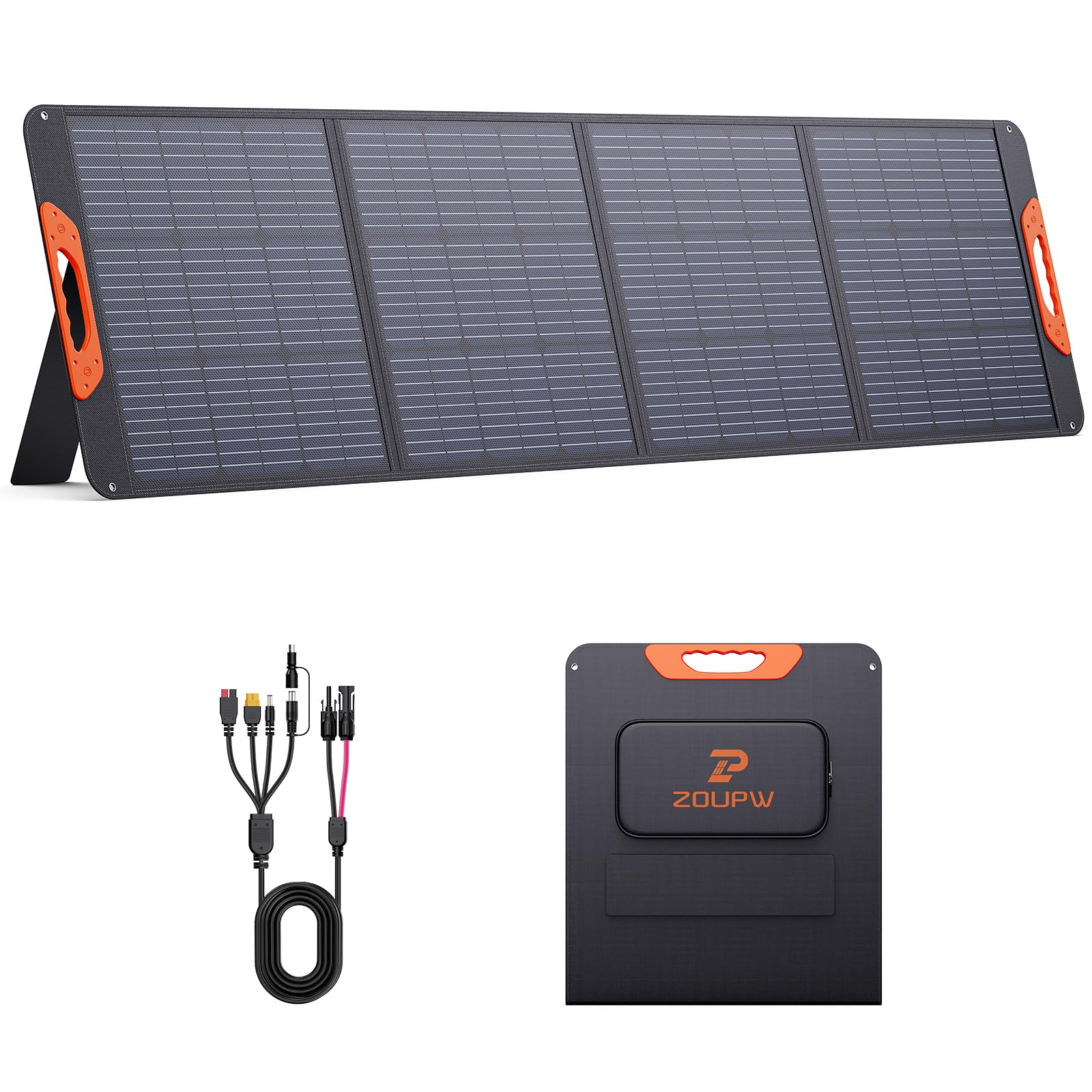
| ZOUPW 200W★ Best Overall | Universal compatibility with USB direct charging | 200W | 23.5% | 19 lbs | Amazon |
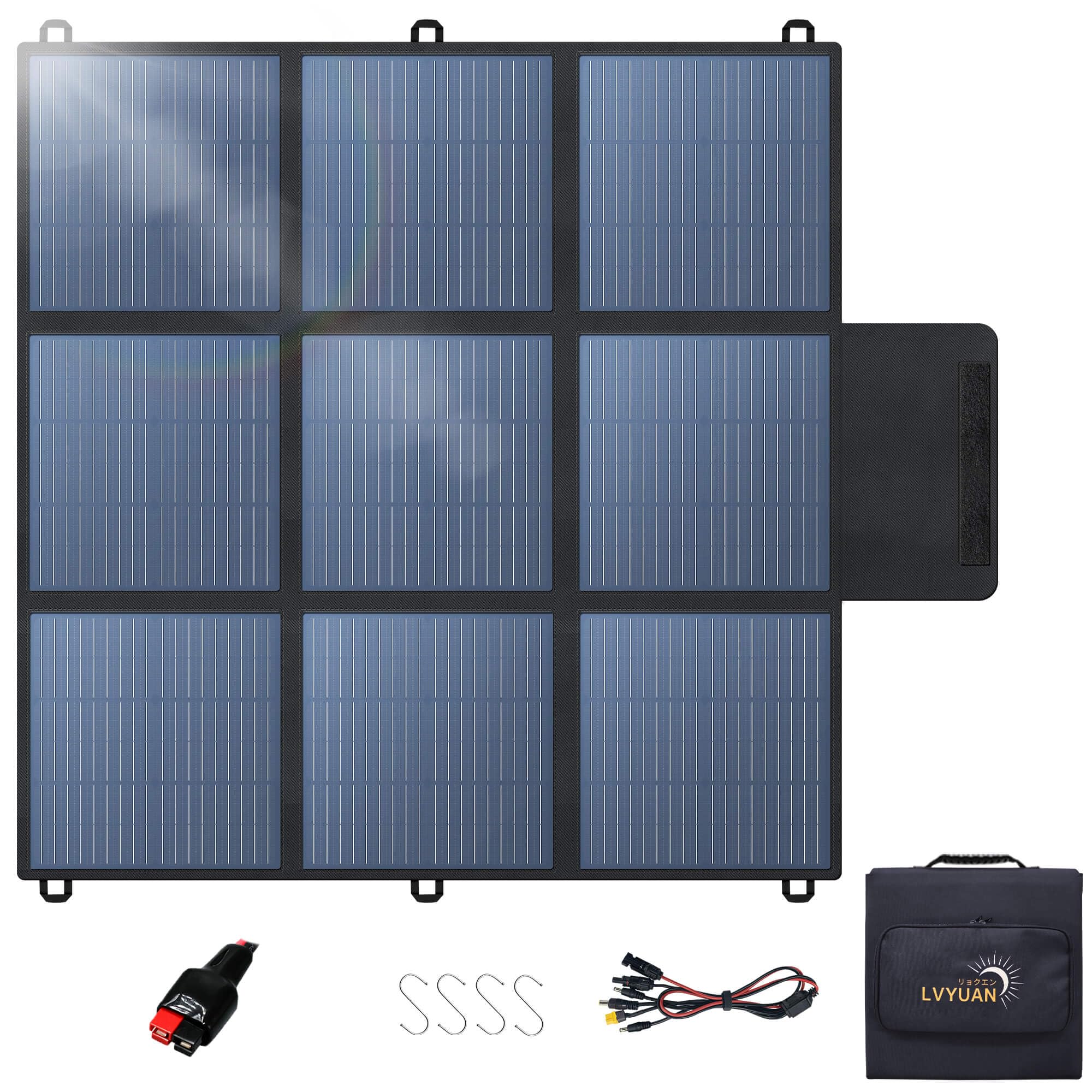
| LVYUAN 200W BlanketBest Value | Backpack hangers and tight storage | 250W | 23% | 11.6 lbs | Amazon |
| BALDR 200WUltralight Pick | Featherweight campers | 200W | 23.5% | 9.3 lbs | Amazon |
| SOLUPUP 200W | High-efficiency output and multiple USB ports | 200W | 24% | 18.5 lbs | Amazon |
| SOKIOVOLA 200W | Top-efficiency pick with a storage bag | 200W | 25% | 16.3 lbs | Amazon |
| TWELSEAVAN 200W | Connector flexibility and neat extras | 200W | 24% | 15.7 lbs | Amazon |
| EBL 200W | Proven performance for fridges and off-grid kits | 200W | 23.5% | 18 lbs | Amazon |
| Greenmagic 200W | Budget-friendly multi-panel setups | 200W | 23% | 11.5 lbs | Amazon |
| Renogy 220W | Rigid suitcase durability | 220W | 23% | 15.9 lbs | Amazon |
| Renogy E.Flex 200W | Lightest premium panel | 200W | 25% | 13.9 lbs | Amazon |
| Jackery SolarSaga 200W | Bifacial low-light performance | 200W | 26.7% | 14.3 lbs | Amazon |
In‑Depth Reviews
1. ZOUPW 200W Portable Solar Panel
Our pick — 4.5★ from 200+ verified ratings; the strongest balance of quality and price.
The crowd favorite for power stations, pairing a 23.5% efficiency rating with a cable kit that fits nearly everything.
Most owners praise its functionality above all else, and the spec sheet backs that up. The built-in 5-in-1 cable (XT60, Anderson, DC7909, DC8020, DC5521) means it connects straight to a Jackery, Bluetti, EcoFlow, or Anker without hunting for extra adapters. There’s a 10-foot cable so you can set the panel in the sun while the station stays in the shade.
Weighing 19 pounds, this isn’t the panel you want on a long hike, but the foldable briefcase design with magnetic handles makes it easy to carry from car to campsite. Four adjustable kickstands let you angle it 45° toward the sun, which owners say captures 25-30% more energy than laying it flat. The IP67 rating means sudden rain or splashes won’t ruin your day. A built-in USB-A (QC3.0) and USB-C (PD 60W) port let you charge a phone or tablet directly without a power station, which is a lifesaver during a blackout.
Buyers report getting around 170W in real sun — some hit that with a Bluetti, noting “that is a poor design of Bluetti not ZOUPW!” when output falls short. The build quality earns steady praise, and the 12-month warranty with 30-day money-back guarantee gives you a safety net. The honest trade-off is the weight: at nearly 19 pounds, it’s the heaviest on this list, so think twice if you’re backpacking.
What wins people over
- Functionality is praised most — owners call it well-built and reliable for camping use
- The 5-in-1 connector cable pairs with most major power station brands from the start
- IP67 waterproofing and ETFE coating shrug off damp RV and marine settings
- Direct USB-C PD 60W port charges devices even with no power station
Who should skip it
- 19 pounds is heavy — better for car camping than backpacking
- Folding and setup take a little finessing at first, per owner reports
- Output can be capped by your power station’s own input limits
Reach for it if: you want one panel that plays nice with most power stations and can charge a phone directly in a pinch.
Look elsewhere if: every pound matters — lighter foldable options exist on this list.
2. LVYUAN 200W Portable Solar Panel, 24V Foldable Blanket
A featherlight blanket that folds tiny, with a 250W rating that beats most 200W panels on paper.
Owners mention real-world output that rivals panels rated higher. One buyer in northern winter full sun saw 185W even at a poor angle, calling it “Impressive: 185W in northern winter full sun at poor angle.”
The portability is the other headline: at 11.6 pounds and folding down to 15.3 x 15.3 x 2.16 inches, it’s dramatically lighter than the 19-pound ZOUPW and packs into a neat square. Instead of kickstands, it uses 6 carabiners and 4 S-hooks, so you can hang it from a backpack, fence, or tree. Owners have carried it on a plane and reported it folds to the size of a backpack.
The catch is setup: there are no stands or mounts, so hitting a perfect sun angle takes creativity. Customers note fabric panels sag without support, and losing over 50% of potential watts when you can’t angle it right. Also, this blanket uses a 24V output — check your power station’s input voltage range first, and note that most Jackery, EcoFlow, and Bluetti stations need a separate adapter (the included connectors often don’t match directly).
Where it shines
- Power output is praised most — reviewers point out reliable charging for fans and fridges
- 11.6 pounds and tiny folded footprint make it a true travel panel
- Carabiners and S-hooks let you hang it from any anchor point
- Survived a winter storm and kept an EcoFlow River Pro 2 charged in freezing sun
The honest limits
- No stands or mounts means hard-to-tune sun angles, costing watts
- 24V output may be incompatible with some power stations without an adapter
- Ports are not fully waterproof, so keep them dry
Pick this for: backpackers and travelers who want max wattage per pound and don’t mind DIY angling.
Skip if: you want propping kickstands and universal plug-and-play compatibility.
3. BALDR 200W Foldable Solar Panel
The lightest 200W panel here at 9.3 pounds, with a separate solar controller for direct USB charging.
If your back hurts just reading about the 19-pound ZOUPW, this is the relief you’re after. At 9.3 pounds — well under half the weight of the top pick — the BALDR folds to 23 x 19 x 2 inches and disappears into a bag. Owners say it’s easy to set up, easy to store, and folds well, making it a favorite for hiking and RV trips.
It matches the top pick’s 23.5% efficiency with monocrystalline cells, and owners consistently report real output around 150-160W in good sun, with one seeing “70w-100w+ in cloudy conditions” — that’s a genuinely capable cloudy-day performer. The separate removable solar charge controller adds a USB-C PD 60W port and a USB-A 24W port, so you can charge phones, tablets, and cameras directly without a power station. One owner ran two CPAP machines overnight from it.
The 6-in-1 cable included means broad compatibility with Jackery, EcoFlow, Bluetti, Anker, and Grecell stations. The IP65 rating handles dirt, low-pressure water jets, and heavy snow, though the junction box itself needs to stay dry. Owners note it’s “light weight, easy to set up, easy to store,” and a few note outputs in the 144-160W range rather than the full 200W — normal physics for a panel this light.
Why it stands out
- 9.3 pounds is the lightest on this list — a genuine load off for campers
- 23.5% efficiency and strong cloudy-day output for the weight
- Removable solar controller gives you USB-C PD 60W and USB-A 24W direct charging
- 5 charging protections guard against overcharge, overcurrent, and shorts
Before you buy
- Real-world output usually lands around 150-160W, not the rated 200W
- Junction box isn’t waterproof, so rain needs a cover
Grab it if: you’re packing for a hike or a long trip where every pound counts against your back.
Think twice if: you expect a full 200W and want heavy-duty kickstands over featherweight fabric.
4. SOLUPUP 200 Watt Portable Solar Panel
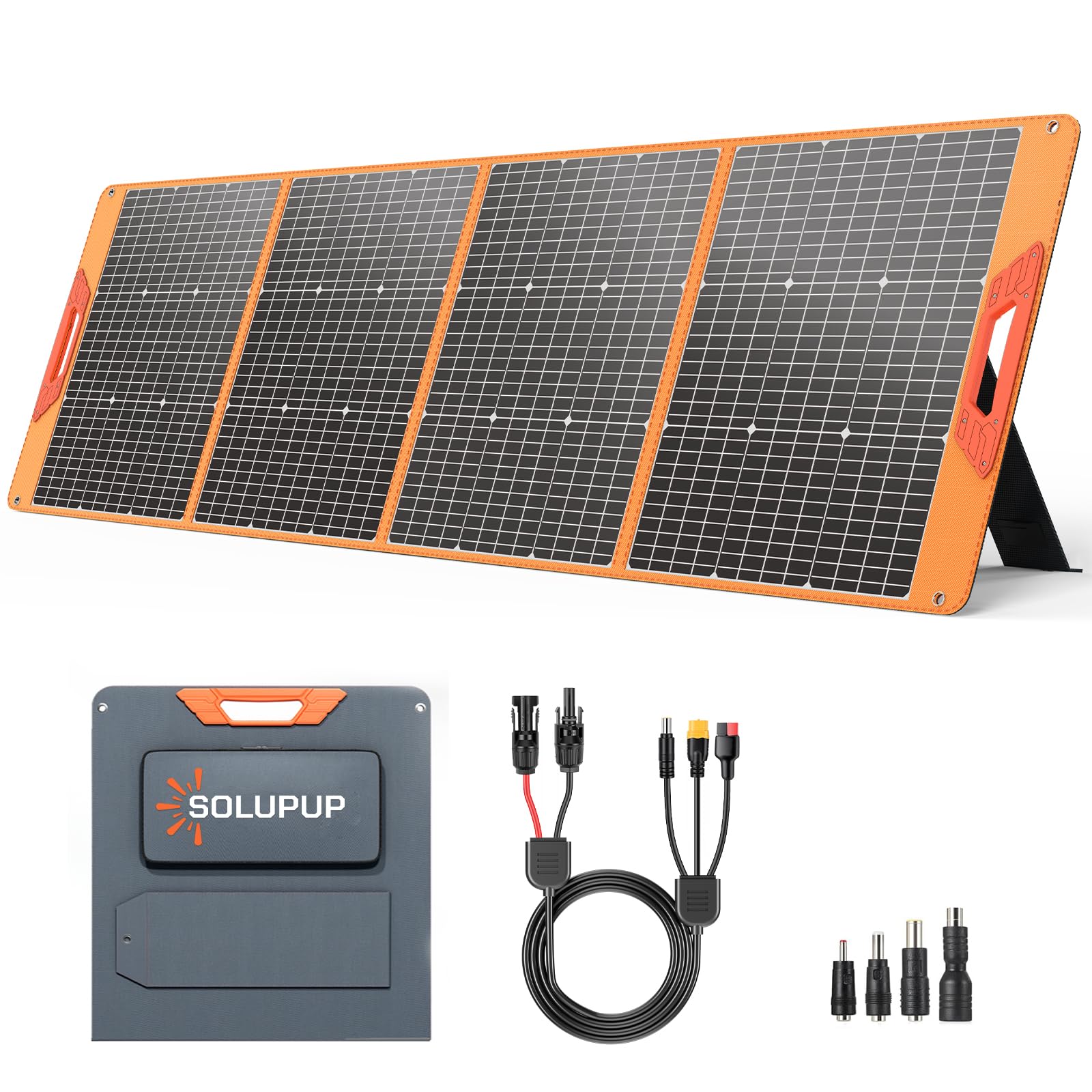
A 24% efficient workhorse that charged a VTOMan from 52% to 100% in around two hours of winter sun.
This panel’s defining spec is its 24% conversion efficiency (a step above the 23% and 23.5% panels elsewhere on this list), and owners feel it in real use. In winter morning sun it delivered roughly 182W to a VTOMan 1500W station, and one owner ran a DC fridge directly with about 95W input. Shoppers say it “charged at 175-200 the whole day” while keeping an EVO above 95%.
The power box is genuinely versatile: it packs MC4 to DC5521, Anderson, and XT60 adapters plus 4 DC conversion ports, and adds 1 SAE, 2 Type-C, and 2 USB-A fast-charging ports for simultaneous device charging. The brand claims support for 98% of power stations, covering Jackery, Ecoflow, Bluetti, Anker, Paxcess, Suaoki, and FlashFish. At 18.5 pounds, it’s a solid mid-weight panel that folds to 24.4 x 20.8 x 1.9 inches with a magnetic handle.
The honest caveat: while the output is praised, the stand can be finicky. One owner noted it’s “not very sturdy” and will blow over in the slightest wind, so stake it down or lean it against something stable. The IP66 rating handles downpours and dust well, and the ETFE-coated surface is built for damp camping and water adventures.
The good stuff
- 24% efficiency translates to strong real-world wattage — owners saw up to 200W
- Multi-output power box with 2 Type-C and 2 USB-A ports charges several devices at once
- MC4, XT60, and Anderson adapters cover nearly every major power station brand
- IP66 waterproofing shrugs off sudden downpours and dusty trails
Keep in mind
- The stand can topple in a breeze — plan to prop or stake it
- At 18.5 pounds, it’s a hunk to carry any real distance
Choose this for: heavy daily charging jobs where efficiency and multiple USB ports matter more than pack weight.
Pass if: you need a panel that stands firm in windy open fields without extra rigging.
5. SOKIOVOLA N-Type 16BB 200W Portable Solar Panel
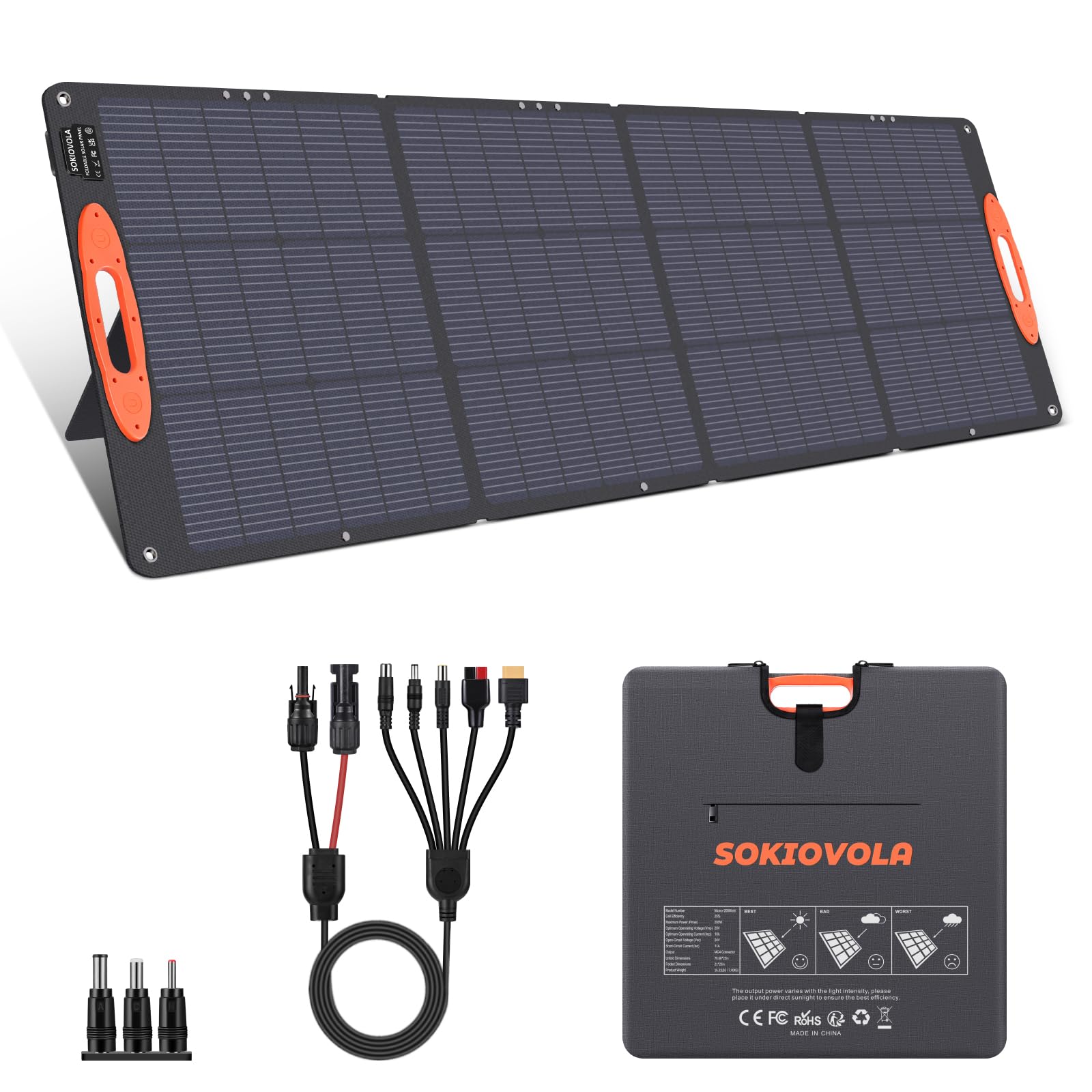
N-Type cells push 25% efficiency, and owners saw 177W peak in Southern California sun.
This is the efficiency king of the budget-friendly tier. The 25% conversion rate (using N-Type 16BB monocrystalline cells) is higher than the 23.5% on the top pick and the 24% on the SOLUPUP, which means more power from the same patch of sun. Owners in SoCal reported a 177W peak, and the included storage bag — a nicety several rivals skip — keeps it protected when traveling at 16.3 pounds.
The bundle is thoughtful: a 10.49-foot 5-in-1 extension cable (XT60, DC5521, Anderson, DC7909, DC8020) plus a dedicated panel bag and a 30-day refund guarantee. The IP68 rating is the highest waterproofing on this list, better than the IP67 of the top pick, so it stands up to serious weather. Owners consistently describe the build as high quality and the setup as easy, with one noting it “charges my power station efficiently, even in less-than-perfect sunlight.”
The honest trade-off emerges over time. One long-term review reported output dropping from 190W to about 100W over six months, with weak back rivets. That’s one owner’s experience after repeated use, not the consensus, but it’s worth knowing before you buy if you plan to leave it out daily. The 12-month warranty covers the first year, and support responds within 12 hours.
What stands out
- Performance and quality are both praised most — buyers call it high quality and great value
- 25% efficiency tops this list, delivering more power per square foot of sun
- IP68 waterproofing beats every other panel here for harsh weather
- Storage bag and 10.49-foot cable make setup and packing painless
The fit question
- A few buyers report power degrading over months of heavy use
- 16.3 pounds is mid-pack — fine for cars, heavy for backpacking
Buy it for: the highest efficiency and best waterproofing in this price range, with a bag to store it in.
Hesitate if: you need a panel that survives years of daily rough-and-tumble use.
6. TWELSEAVAN 200W Portable Solar Panel

A 24% efficient panel with an 8-in-1 adapter kit that owners call the best alternative to pricier name brands.
Owners rate the value here highly, and the reason is spelled out in the kit: a 5-in-1 MC4 connector cable plus 3 DC adapters, giving you 8 total connection options for Jackery, Ecoflow, Bluetti, Flashfish, Anker, and more. One owner who compared it against two Anker panels called it “cheaper and has better niceties.” That includes a 9.8-foot cable for flexible placement and an orientation bubble to help you aim the panel.
At 24% efficiency with ETFE lamination, it pulls real power — owners mention 180W near noon and 145W even in poor conditions, with one noting they “get close to 180-190 sometimes” on good days. The 15.7-pound weight and 23 x 22-inch folded size make it a solid middle-ground panel, and the magnetic handle makes carrying it easy. The built-in USB-C PD 60W and QC3.0 18W ports let you charge devices without a power station.
Two things to weigh before you commit. First, there’s no cover or bag included, so you’ll need to protect the panel during storage and transit. Second, the IP65 rating (dust-tight and protected against low-pressure water jets) handles rain, but the floppy fabric panels and flimsy kickstand drew a few notes from owners — one called it a “rugged but tricky solo setup.” The 24-month warranty and 30-day money-back guarantee add real confidence.
Why owners love it
- Value for money is praised most — owners call it a cheaper Jackery alternative
- 8-in-1 adapter kit plus a 9.8-foot cable covers nearly every power station
- Orientation bubble and cable pouches are small niceties that owners rave about
- 24% efficiency delivers 180W near noon in real tests
Watch out for
- No storage bag or cover included — plan your own protection
- Kickstand and fabric can be flimsy; solo setup takes a little practice
Perfect for: anyone who wants the widest connector compatibility and a few smart extras without the premium badge markup.
skip it if: you need a padded case and rock-solid kickstands included in the box.
7. EBL 200W Portable Solar Panel
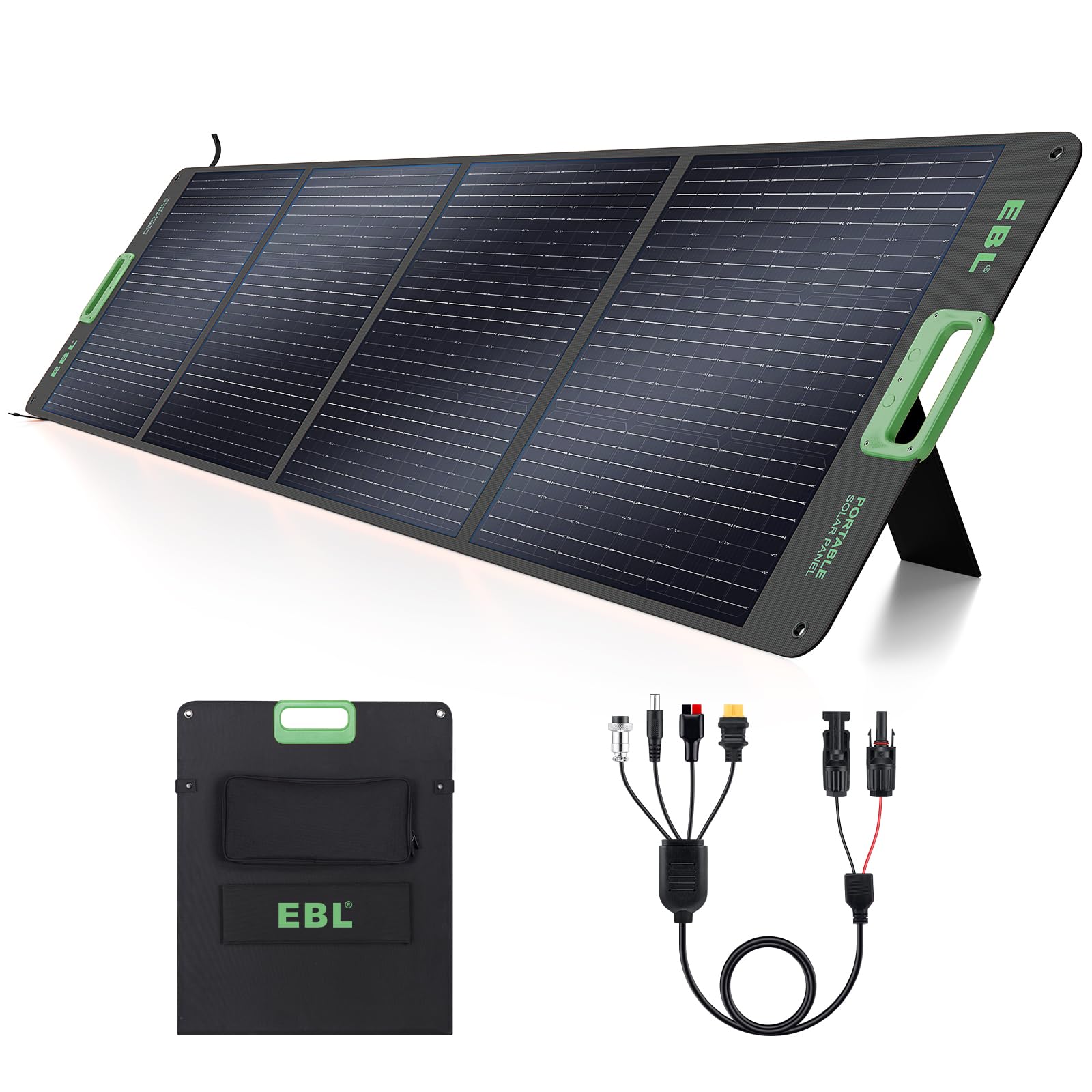
A proven performer with one of the largest owner bases here, holding strong output even late into the afternoon.
With 600+ owners behind it, this is among the most battle-tested panels on this list, and the verdict is consistent: it delivers. One owner hit 191W and still pulled 157W at 5 pm, showing solid late-day output. Another powered a 75-quart fridge, and owners note it stays stable in 15-20 mph winds.
The construction leans on upgraded PET lamination (a protective plastic coating process that shields the cells) and an 840D Oxford cloth outer layer, which is a rugged, wear-resistant fabric. At 17.95 pounds folding to 25.31 x 20.87 x 2.17 inches, it’s a carryable briefcase-style panel with 4 kickstands. The MC-4 to 4-in-1 cable covers XT60, Anderson, DC7909, and Aviation connectors for most major stations. It’s also FCC, RoHS, and EMC certified, with short-circuit and surge protection built in.
Not every owner hits the high numbers, though. A few report maxing out around 65W in Florida sun versus a 100W expectation, and one flagged that clouds or shade can drop output to just 1-2W. The cable is a short 6 feet, which limits placement flexibility. The 1-year warranty is shorter than the 2-year coverage on several rivals, but the sheer volume of happy owners makes this a safe, well-proven bet for off-grid fridge duty or blackout backup.
The case for it
- Performance is praised most — customers note 191W peaks and strong late-day output
- 840D Oxford cloth and PET lamination make it rugged and wear-resistant
- Holds up well on windy days and powered a 75-quart fridge
- Short-circuit and surge protection keep your devices safe
The trade-offs
- Some owners see far less than rated output in certain sun conditions
- 6-foot cable limits how far the panel can sit from your station
- 1-year warranty is shorter than several competitors’ 2-year terms
Get it for: a dependable, widely-reviewed panel that keeps producing late in the day for fridges and CPAPs.
Think it over if: you need a long cable or expect full rated output in marginal sun.
8. Greenmagic 200 Watt Portable Solar Panel
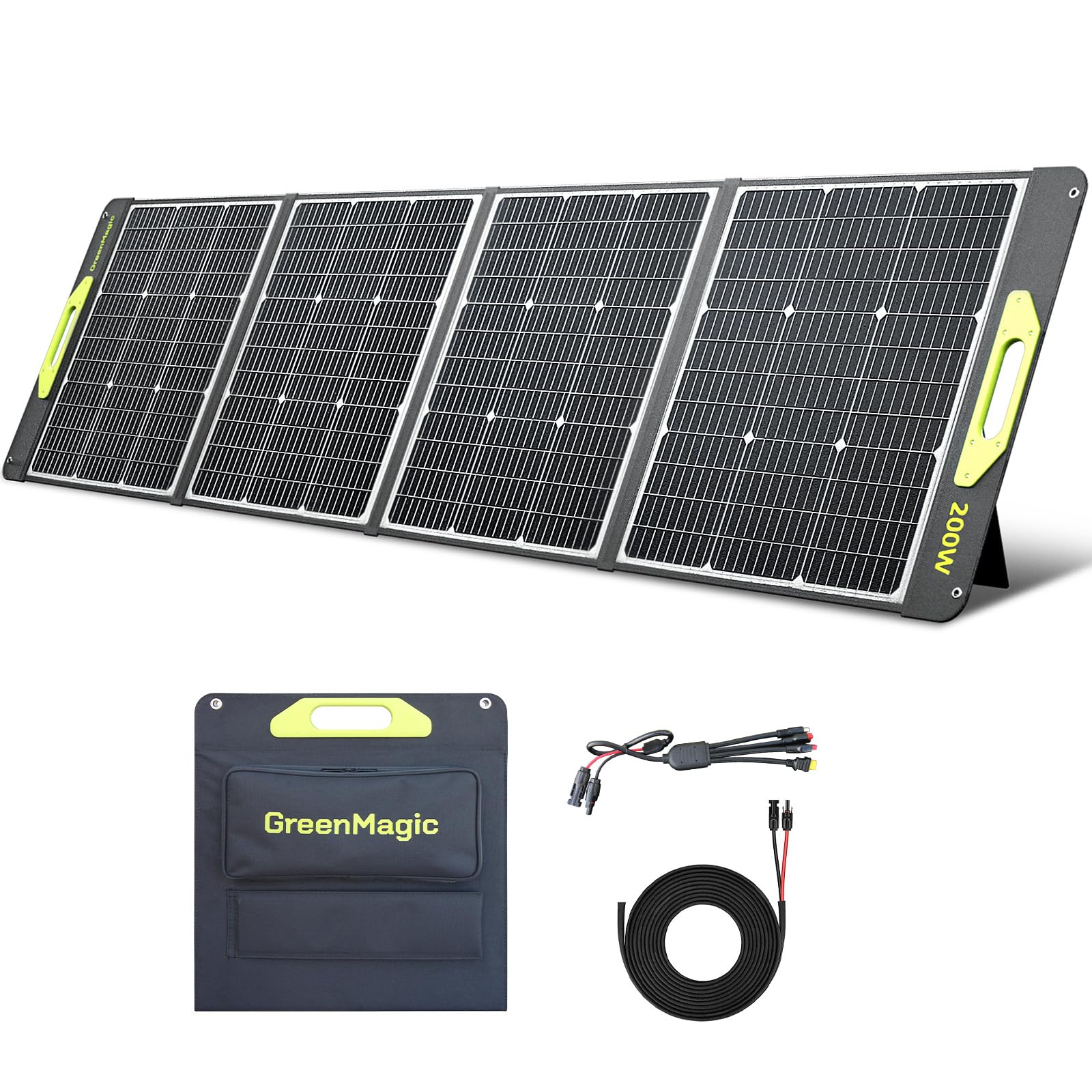
A budget-friendly 23.5% panel that owners say shines brightest when you buy several and wire them together.
The smartest way to use this panel is in multiples. One owner runs three in series for a 1kWh station with an 80V 10A controller, pulling up to 550W flat. That’s the real strength of this pick: it’s an affordable building block for a larger off-grid array, not just a single-panel convenience. At 11.5 pounds it’s one of the lighter options here, and the included parallel kits make multi-panel wiring straightforward.
Reviewers point out peak output around 148-160W in good sun — solid for the price tier, and the 23% efficiency with monocrystalline cells matches the category norm. The kit includes a 10-foot charging cable and a 4-in-1 charge cable (XT60, Anderson, DC connector), so it pairs with most power stations. The build drew mixed feedback on construction quality, with some owners finding it solid and well-packaged while others noted the materials feel lighter-duty than pricier rivals.
The honest knock is longevity. A handful of owners flag quality-control concerns, including one who reports the 12-month warranty wasn’t honored as expected after a June 2025 order. That’s a minority experience, but it means you should test your unit promptly. For the price, it’s a reasonable entry-level panel, but the construction is the most polarizing point on this list.
The upside
- Value for money is the most-praised aspect — a budget-friendly way to start
- 11.5 pounds and parallel kits make multi-panel setups easy to assemble
- 3 units in series can pull up to 550W, per owner reports
- 10-foot cable and 4-in-1 adapters cover most stations
The catch
- Construction quality earns mixed feedback — check yours on arrival
- A few shoppers say warranty support issues over time
Reach for it: if you’re building a multi-panel array on a budget and want light panels that daisy-chain well.
Look past it: if you want premium build quality and a long, low-maintenance warranty — this one’s fabric panels and basic kickstand won’t satisfy you.
9. Renogy 220W Portable Solar Panel

The rigid suitcase pick, rated at 220W, that owners say delivers over 240% more power than a 100W Jackery.
This is the brute-force option: a 220W rating with a rigid, no-fabric aluminum design that prefers to sit flat or propped on its sturdy rust-proof kickstands. Owners consistently report real output around 170-184W, with one noting it delivers “>240% more than 100W Jackery” — a concrete head-to-head that makes the higher rating feel real. Unlike the fabric blankets, this panel won’t sag, ripple in wind, or need DIY support to hold its angle.
The build quality is where it wins. Fiberglass reinforcement and ETFE coating (a tough clear film that resists UV and weather) back a 5-year output and workmanship warranty — the longest on this list and a strong signal of durability. IP68 waterproof connectors and IP67 waterproofing handle rain and snow, while the aluminum backsheet helps prevent the overheating that can throttle fabric panels. At 15.87 pounds, it’s mid-weight but folds down to a compact 27.17 x 18.11 x 3.15-inch suitcase with a carry case.
The trade-off: the leads are short, around 2 feet, so you’ll likely need an extension cable to place the panel in sun while your station stays shaded. A few owners also note the included storage bag is thin with no padding, so you may want extra protection in transit. It’s not a 200W panel, it’s a 220W panel — slightly bigger and heavier than the others here, but proportionally more powerful.
Why it earns its spot
- Build quality is praised most — rigid aluminum construction, no sagging fabric
- 5-year output and workmanship warranty is the longest on this list
- Real-world 184W output, over 240% more than a 100W Jackery per owners
- Rust-proof kickstands and flat-lay design handle wind well
Know before you go
- Short ~2-foot leads mean you’ll likely need extension cables
- Storage bag is thin with no padding — pack carefully
Best for: RV owners and overlanders who want a rigid, durable suitcase that won’t sag and carries a 5-year warranty.
Not ideal for: ultralight backpackers who need the smallest, lightest folded footprint.
10. Renogy E.Flex 200W Portable Solar Panel
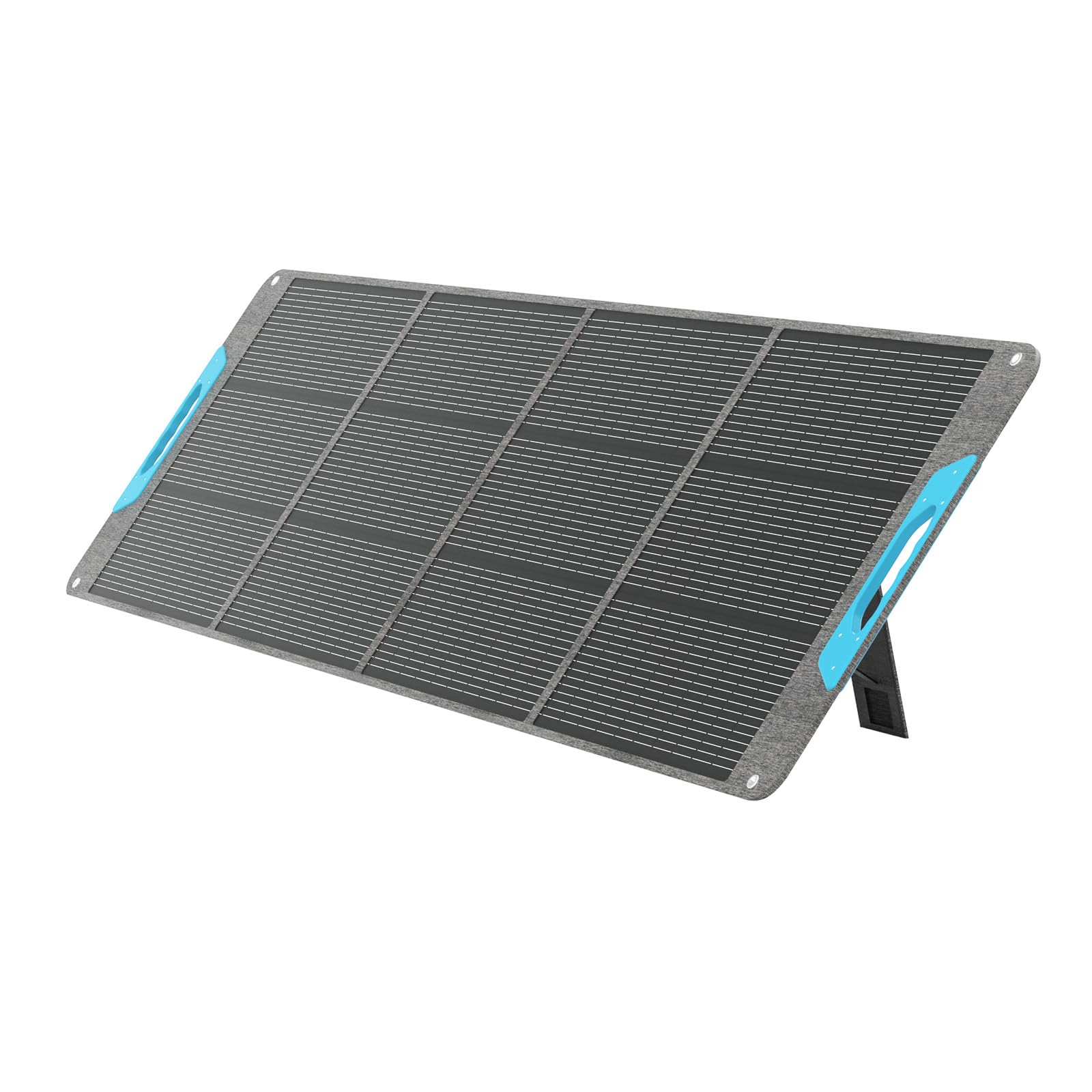
The lightest premium panel at 13.9 pounds, packing 25% N-Type efficiency with a magnetic fold design.
This is the panel for the camper who wants Renogy reliability without the 16-pound rigid suitcase. At 13.9 pounds with a quadfold design that packs to 23.72 x 22.99 x 1.97 inches, it slips behind a truck seat or into a roof rack space the rigid model can’t match. The unique magnetic closure (instead of snap or Velcro) makes setup and storage genuinely easy in tight camper spaces.
The efficiency is the technical headline: 25% from 16BB N-Type cell technology, which Renogy says outperforms the standard 22.5% of 9BB panels. That’s the marketing claim, and owners largely confirm it works — reporting outputs that match rigid panels at 90% efficiency on hot days and closer to 100% when cooler. One owner noted “any shadow reduces whole panel output” due to series wiring, so keep it fully clear of shade. Owners also praise it for staying clean in dusty boondocking conditions and maintaining a laptop’s battery above 99% while running a CPAP.
Versatility is a strong suit: it charges 3 devices at once via a USB-C PD 45W port and two USB-A ports (18W and 15W), plus an MC4 output for your power station or 12V battery. The 3-angle kickstands (40°/50°/60°) plus ground studs and reinforced grommets handle wind and mounting. The catch: the 2-year warranty is shorter than the rigid Renogy’s 5-year, and a few owners note the legs feel “janky” in wind, and no cable is included to connect to your station — that’s a separate purchase.
What makes it special
- Quality is praised most — owners call it one of the best systems they’ve used
- 13.9 pounds with a magnetic fold is genuinely easy to carry and store
- 25% N-Type efficiency delivers output that matches rigid panels
- USB-C PD 45W plus two USB-A ports charge multiple devices at once
What to know
- No cord included to connect to your power station — budget for one
- Any shadow on one cell can reduce the whole panel’s output
- 2-year warranty is shorter than the rigid Renogy’s 5-year term
Choose it for: truck campers and 4×4 owners who want premium efficiency in a packable, lightweight panel.
Pass if: you want a cable in the box or a longer warranty term.
11. Jackery SolarSaga 200W Portable Solar Panel, Bifacial

The flagship bifacial panel at 26.7% efficiency, pulling 165W average even while dusty on a 140-day trip.
This is the most advanced solar cell tech on this list. The bifacial design (capturing light from both the front and back faces) plus cutting-edge IBC technology hits a 26.7% conversion efficiency — the highest here, well above the 23% and 23.5% panels below it. Owners feel that advantage in real numbers: one kept a 12V freezer running on a 140+ day camping trip, pulling “average of 165w in full sun even with the panels being dusty,” which is remarkable durability and output combined.
The Jackery ecosystem is the real draw. It’s designed to pair flawlessly with Jackery Explorer 1000Plus, 2000Pro, 2000 Plus, and 3000Pro stations, with a DC8020 port plus USB-C and USB-A outputs. Setup is genuinely fast — the brand claims 10 seconds, and owners confirm it’s easy. It folds to 24 x 21.7 x 1.8 inches at 14.3 pounds, and owners say it packs down about the same size as their old 100W panels, which is a huge win for space efficiency. The IP68 rating is the joint-highest waterproofing here.
Be honest about the premium: this costs more than any other panel on this list, and the charging cable (9.8 feet, with DC8020/DC7909 and USB outputs) is not weatherproof. A few owners call the charge slow, and one noted 145W output rather than the full 200W. But if you own a Jackery station and want a panelbuilt to that ecosystem, the SolarSaga’s efficiency and durability are hard to argue with. The 5-year warranty is the longest protection here alongside the rigid Renogy, and the brand’s reputation for rugged, reliable gear is the final checkbox.
Why it’s the flagship
- Quality is praised most — owners call it well-constructed, rugged, and flawless
- 26.7% bifacial efficiency is the highest on this list
- Pulled 165W average even when dusty on a 140-day camping trip, per owners
- 5-year warranty is the longest protection here alongside the rigid Renogy
The premium trade-off
- Costs more than any other panel here — you pay for the badge and the tech
- Charging cable is not weatherproof, so keep the connection dry
- A few buyers report slower charge speeds than expected
Buy it for: Jackery station owners who want the most efficient, longest-warrantied panel and don’t mind the premium.
pass on it if: you’re on a budget or use a non-Jackery power station that won’t leverage the ecosystem.
Understanding the Specs
Conversion Efficiency
This percentage tells you how much of the sunlight hitting the panel actually becomes electricity. A 23% panel turns under a quarter of the light into power; a 25% panel squeezes out a bit more from the same surface area. On a bright, direct-sun day the difference is modest, but under haze or low winter sun, that extra couple of percentage points is exactly what keeps a trickle flowing to your battery.
IP Waterproof Rating
The IP (Ingress Protection) code tells you how well the panel resists dust and water. The first digit is dust protection and the second is water. An IP65 panel handles low-pressure water jets, while an IP67 or IP68 panel is more thoroughly sealed for rain and splashes — but the junction box (where the cable connects) is often not fully waterproof, so keep that part dry.
FAQ
Why does my 200W panel only output 150W on a sunny day?
Will a 24V panel like the LVYUAN work with my Jackery or EcoFlow station?
What connector types do I need for a power station?
Should I buy one 200W panel or two 100W panels to get 200W total?
How long will a 200W panel take to charge a 500Wh power station?
What does panel efficiency mean for cloudy days?
Can I charge my phone directly from a portable solar panel?
Is a rigid suitcase panel better than a foldable fabric blanket?
Final Thoughts: The Verdict
For most people, the best 200 watt portable solar panel is the ZOUPW 200W because it combines a 23.5% efficiency rating, IP67 waterproofing (fully sealed against dust and immersion), and a 5-in-1 cable that connects to nearly every major power station from the start. If you want the lightest panel for hiking or travel, grab the BALDR at 9.3 pounds. And if you’re a Jackery owner who wants the most advanced solar tech and longest warranty, the Jackery SolarSaga is the one to reach for — its 26.7% bifacial efficiency is the highest on this list, and the 5-year warranty means it’s built to last.
How We Picked
We do not accept paid placement. Every pick is matched to a real buyer and a real use-case; we do not hands-on test units.
Sources & Methodology
Specifications: manufacturer listings and product documentation. Review insights: verified customer reviews, as of September 2026. Pricing: not shown on this page (it changes often); check the current price via the retailer link.
As an Amazon Associate, KitchPrep earns from qualifying purchases. This does not affect which products we feature.
Related Guides
