
Specs are compiled from manufacturer listings and verified buyer reviews and can change over time — please confirm the key details on the product page before buying.
Dead batteries are a fact of life for anything that sits: a weekend car, a boat on a trailer, an RV in storage, a mower in the shed. A solar battery charger turns that problem into set-and-forget duty, using the sun to keep your 12V battery topped off so it starts the first time, every time. The real question is picking the right wattage and controller — too small and it barely keeps up, too big and you are paying for power you do not need.
I’m Mohammad Maruf — the founder and writer behind KitchPrep. This guide is built by comparing the manufacturers’ published specifications and the patterns across verified customer reviews, so you get each pick’s real strengths and trade-offs instead of marketing spin.
We break down the top solar maintainers, from compact dash units to 100W kits, so you can match the right battery charger for solar batteries to your vehicle, battery type, and sun exposure with confidence.
Our Picks at a Glance


How To Choose The Best Battery Charger for Solar Batteries
Solar battery chargers are not all the same. The right one depends on your battery, how long it sits, and how much sun your parking spot gets. Start with your battery type, then match the wattage to how quickly you need to recover lost charge. Keep it simple: a 5W to 10W panel maintains, while a 50W to 100W kit can actually recharge.
Wattage: The Main Difference Between Maintain and Recharge
A 5W to 10W panel compensates for the small parasitic drains from clocks and alarms, keeping a healthy battery full. It will not recover a dead battery. If you need to bring a battery back from low voltage, you need more power — a 50W panel is a 5.0x gap over a 10W unit, and a 100W kit can handle real off-grid duty.
Charge Controller Will Save Your Battery
An unprotected panel can overcharge your battery on sunny days and drain it at night. Look for a built-in or included charge controller. It stops charging when full and blocks reverse current. A basic controller protects a 12V battery; a smart MPPT controller (which tracks the sun’s maximum power point) squeezes out more energy on cloudy days.
Quick Comparison
| Model | Best For | Max Power | Controller Type | Weight | Amazon |
|---|---|---|---|---|---|
| SOLPERK 50W★ Best Overall | Recharging RV & boat batteries | 50 watts | 10A Waterproof | — | Amazon |
| Renogy 10WBudget Champion | Budget car maintainer | 10 watts | Built-in | 14.23 oz | Amazon |
| OYMSAE 10WTop Performer | Simple dash-top setup | 10 watts | Built-in | 13.44 oz | Amazon |
| Sunway Solar 5W | Tiny top-ups on dash | 5 watts | Built-in Diode | 0.69 kg | Amazon |
| Sunway Solar 8W | Dual-battery trucks | 8 watts | Built-in | 2.7 lbs | Amazon |
| SUNAPEX 20W | Flexible windshield mounting | 20 watts | Built-in | 1.06 kg | Amazon |
| POWOXI 15W | Smart MPPT charging | 15 watts | MPPT | — | Amazon |
| Sun Energise 25W | Permanent RV & boat installs | 25 watts | MPPT | 2.53 kg | Amazon |
| Topsolar 100W | Full off-grid systems | 100 watts | 30A | 7.2 kg | Amazon |
In‑Depth Reviews
1. SOLPERK 50W/12V Solar Panel Kit
Our pick — 4.5★ from 400+ verified ratings; the strongest balance of quality and price.
The torque of the lineup — a 50W panel that actually recharges, not just maintains, your battery.
Forget the 10W dash plaques. This 50W kit delivers the kind of power that changes your routine: owners with a pontoon boat report charging two batteries quickly so they spend more time fishing and less time hauling batteries home. The monocrystalline cells convert sunlight at a 21%-30% efficiency rate., and the included 10A waterproof controller protects your battery from overcharging while three lights show the charging status at a glance.
It is built for the outdoors. The low-iron tempered glass and corrosion-resistant aluminum frame are 100% waterproof and rustproof, and the maker rates it to withstand 2400Pa wind pressure and 5400Pa snow load. The 60-degree adjustable mounting bracket lets you tilt the panel from 0° to 60° to catch the sun, and all cable connections are plug and play.
The panel itself earns praise, but the controller is the weak spot — buyers report “Controller failed at about 3 months” as a recurring pattern. One reviewer uses it to power a bank of 4 Blink cameras and, despite the failure, still plans to buy again for the panel. The kit works with 12V rechargeable batteries, including LiFePO₄ (lithium iron phosphate), Lithium Ion, AGM (absorbent glass mat), SLA (sealed lead acid), GEL, EFB (enhanced flooded battery), and MF (maintenance-free), so it fits trailers, tractors, trucks, boats, and gate openers.
Why it wins
- 50W output is 5x a 10W panel — real recharging, not just topping off
- 10A waterproof controller with three status lights
- Adjustable mounting bracket from 0° to 60°
- Handles 2400Pa wind and 5400Pa snow load
The trade-off
- Controller reliability is the recurring weak spot
- 21.3″ x 21.3″ panel needs real mounting space
- Overkill for a single daily-driver car
Reach for it if: you need to actually recharge RV, boat, or tractor batteries that sit for weeks and want one kit that can do real work.
Plan around: the controller — some owners replace it with a third-party unit and keep the excellent panel running for years.
2. Renogy 10W Solar Panel Car Battery Trickle Charger
A featherweight 14.23 oz dash panel from a trusted brand that keeps parked cars alive.
The most cost-effective way to stop a rarely-driven vehicle from dying. At just 14.23 ounces and 10 watts, this panel is lighter than the OYMSAE 10W unit below (13.44 oz) and small enough to mount on a windshield or dash with suction cups. The quick SAE connection gives you three hookup options — ring terminals, alligator clips, and a cigarette lighter plug — so it works across boats, SUVs, RVs, electric fences, and accessory batteries.
The monocrystalline cells and multi-layered sheet lamination are weather-proof and dustproof, with a wide operating temperature range. For the money, this is a genuine “genius way to cheaply keep rarely-used vehicles from having dead batteries” — owners with multiple parked cars have bought several and stopped running extension cords entirely.
Owners mention it works well for infrequent car use, raising a battery about 0.1V/day from below 12V. The honest limits: the provided cabling is the weak link — short, unfused, and the cigarette adapter is useless if your outlets switch off with the ignition. A tractor owner found it fixed a dead battery and delivers reliable starts even after winter storage, but this is a maintainer, not a full charger for a deeply drained battery.
What it nails
- Three connection options (ring, clip, lighter)
- Featherweight 14.23 oz dash mount
- High-efficiency monocrystalline cells
- Genuinely cheap way to protect multiple vehicles
Know before buying
- Provided cables are short and unfused
- 10W won’t recover a fully dead battery
- Mixed results if your car cuts power to the lighter socket
Best for: the budget buyer with a car, tractor, or camper that sits idle for weeks and just needs a slow, steady top-up.
skip it if: you expect to recharge a deeply discharged battery — this maintains, it rarely resurrects.
3. OYMSAE 10W 12V Solar Panel Car Battery Charger
A 98-inch cable and tri-color status lights make this the easy-install pick for long-idle vehicles.
The defining feature here is the 98-inch extension cord — long enough to route from a windshield-mounted panel down to a battery under the hood without fighting for placement. It comes with a cigarette lighter plug, alligator clip, O-ring terminal, four suction cups, and two carabiner clips, so you can attach it just about anywhere. Owners praise how easy it is to install and the multiple connection options, which is exactly what the install experience should feel like.
The tri-color LED system is genuinely useful: blue means the panel is in the sun, red means it is actively charging, and green means the charge is complete. A short circuit turns all three off. The built-in microprocessor guards against overvoltage, overcharge, and short circuits, and blocks reverse current so the battery doesn’t drain at night.
The mixed reality: some customers note it works great — one has used it for two years across northeast winters to keep a motorcycle battery charged all year long. Others say it doesn’t charge in direct sunlight or drains a battery through the lighter plug; durability is the most-cited negative aspect. It is best treated as a solid, flexible maintainer for vehicles driven occasionally, with a seller that offered a replacement or refund when things went wrong.
Setup highlights
- 98-inch extension cord for flexible routing
- Blue/red/green charging status lights
- Multiple mounts: suction cups, carabiners, clips
- Overcharge and short circuit protection
The downsides
- Durability is the most-flagged concern
- Some units failed to charge in direct sunlight
- 10W is slow — days of full sun for a top-up
Choose it for: an infrequently-driven Expedition or similar vehicle where the long cable and clear status lights make setup painless.
Think twice if: your battery is already low — this is a maintainer and can take days of sun to build charge; a higher-wattage unit is a better fit.
4. Sunway Solar 5W Car Battery Trickle Charger

The 5W micro-panel that quietly covers the parasitic drain of clocks and alarms.
Designed for a single job: compensate for the small, steady drains from your vehicle’s clock or alarm system. At 5W, it won’t fool anyone into thinking it’s a charger — but it is perfect for keeping a healthy battery full on a car that sits. Owners confirm it maintains voltage between 12.45 and 12.69 Volts, exactly where a healthy 12V battery should sit. It mounts to the windshield or dash and plugs into the cigarette lighter with a built-in diode to prevent reverse charging.
The build is surprisingly tough for the size — ultra-clear PV glass over a durable ABS plastic housing — and it is low maintenance. Jet ski owners rave about it, reporting solid starts every time, and an ’06 Powerstroke owner uses it to maintain dual batteries during 2-3 week idle periods. It also carries a 12-month warranty and includes both a cigarette lighter adapter and alligator battery terminal clamps.
The limit is the same as the strength: 5W is tiny. It maintains, it does not rescue. A dual-battery truck may need a splitter or manual clip switching because the power port can’t charge both at once. And the suction cups are the weak point — owners describe them as insecure and easily lost.
Built for
- Holds a healthy battery between 12.45-12.69V
- Built-in diode stops reverse charging
- Tough PV glass and ABS housing
- Works via lighter plug or alligator clips
Keep in mind
- 5W cannot charge a weak battery — maintain only
- Suction cups are insecure and easy to lose
- Dual-battery setups need extra hardware
Perfect for: jet skis, classic cars, and seasonal vehicles where the goal is preventing drain, not fixing it.
Not for: anyone hoping to recover a dead battery or charge a second battery without extra wiring.
5. Sunway Solar 8W Car Battery Trickle Charger

A step up from the 5W with the same plug-and-play ease — a 14.9-inch panel for bigger batteries.
This 8W panel (rated up to 8.5W) fills the gap between the tiny 5W unit and the heavy-duty 20W+ models. Its larger 14.9″ x 8.3″ surface and 2.7-pound weight make it a more noticeable presence on your dash, and owners of older cars and trucks say it works well when the driveway gets daily sun. Like the 5W version, it features ultra-clear PV (photovoltaic) glass, an ABS plastic housing, a built-in diode to prevent reverse charging, and a 12V LED indicator that lights up when charging.
The build quality is the most-praised aspect, and the low-maintenance design means you set it on the dash, plug it in, and forget it. An owner with a car trailer uses it to keep the battery charged with no complaints, and it is rated to safely handle Wet, Gel, SLA, AGM, and Deep Cycle 12V batteries.
Two honest notes: there is no charging indicator on some units — owners note you can’t always tell if it’s actively working — and the 8W rating still puts it in maintainer territory, not recovery territory. One owner keeps it on the dashboard of a truck that isn’t driven daily and confirms it tops the battery off every time, which is the realistic job description.
What owners love
- Quality build with PV glass and ABS housing
- 12V LED charging indicator
- 8W handles bigger batteries than the 5W
- Reverse charging diode protection
Fair caveats
- Some units lack a visible charging indicator
- Still a maintainer — not for dead batteries
- 2.7 lbs is heavier than the compact 10W panels
Grab this if: you want the Sunway brand’s reliability with a bit more surface area for a truck, trailer, or motorcycle that sits in the sun.
Look elsewhere if: visible charging confirmation matters to you — a mixed bag in the reviews on indicator lights.
6. SUNAPEX 20W Solar Car Battery Trickle Charger
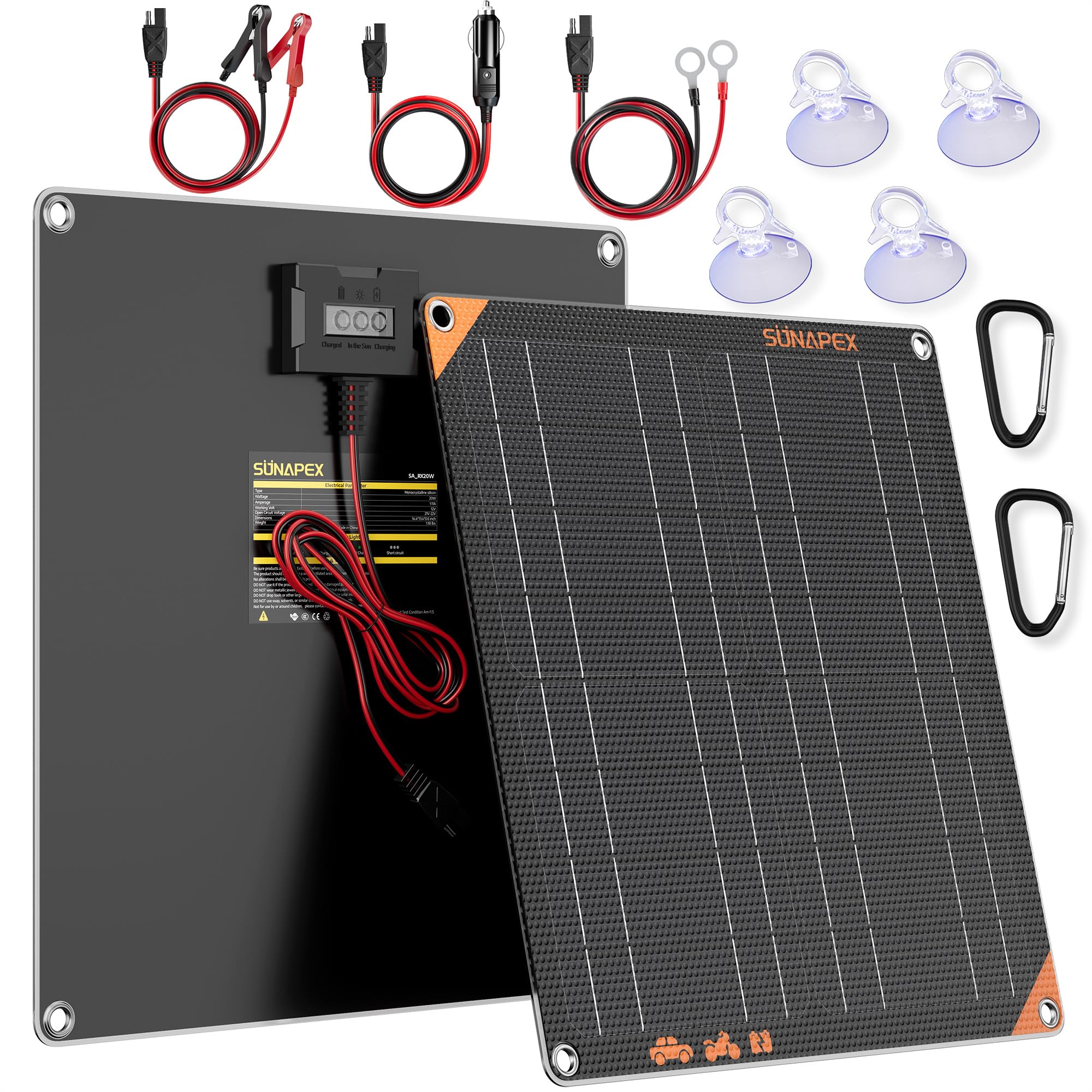
A flexible 20W panel with a 30% efficiency rating that still mounts flat to your windshield.
This 20W panel balances portability with real power. Its 30% high-efficiency monocrystalline cells deliver roughly 1.11A — enough to keep a 3.5L Nissan Murano battery charged through three weeks of sitting. The built-in intelligent controller prevents overcharging, over-voltage, and deep discharge, auto-stopping when full and resuming when voltage drops for 24/7 maintenance.
The flexible ETFE design is the standout. It weighs just 1.06 kg, uses suction cups and carabiners to stick to a front windshield, and is fully sealed to IP67 waterproof and dustproof standards, so it shrugs off rain and snow. Owners use it to keep a Travato chassis battery topped off when boondocking and to protect RV batteries in lots with no electricity — the 4 suction cups hold it secure on the glass.
The recurring pattern: functionality is the single most-praised aspect, with owners confirming it works even in low light. The catch is that won’t charge a battery below a certain voltage — dead batteries won’t recover — so it maintains a topped-off battery rather than resurrecting a depleted one. Owners also note it runs very hot in direct sun and the cables are on the short side.
Why it stands out
- 30% high-efficiency monocrystalline cells
- IP67 waterproof and dustproof sealed body
- Flexible ETFE with suction cups and carabiners
- Auto-stop and auto-resume charging
Watch out for
- Won’t recover a deeply discharged battery
- Runs very hot in direct sun
- Cables could be longer
Pick it for: RV owners who want a flexible, weatherproof panel that sticks to glass and keeps chassis batteries alive during long storage.
pass on it if: your battery is already dead — this maintains, it won’t bring a flat battery back without a real charger first.
7. POWOXI 15W MPPT Solar Battery Charger
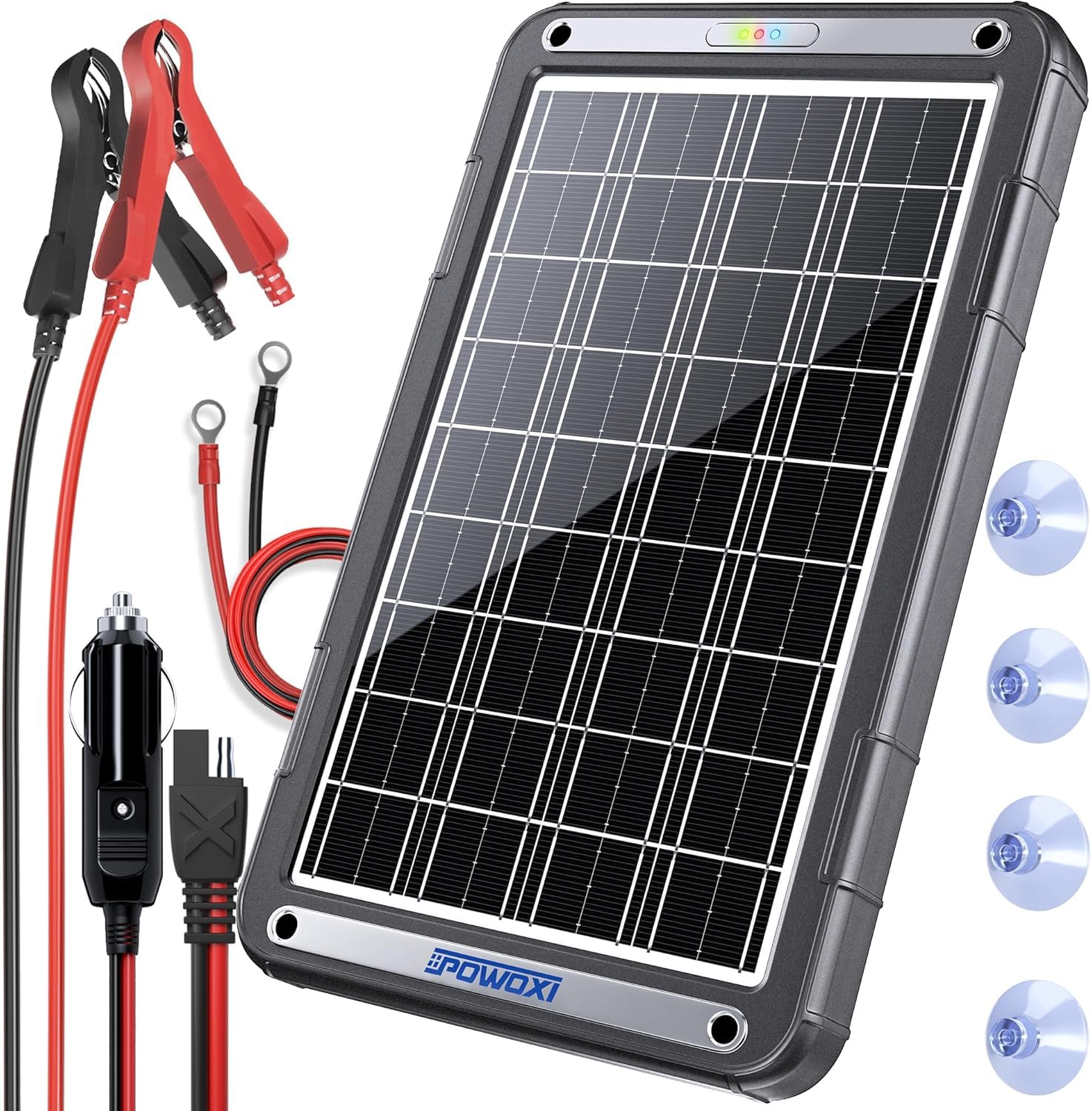
Doubles down on smart charging with an MPPT controller that squeezes out cloudy-day power.
Most solar maintainers use a simple PWM controller. This one uses an MPPT (Maximum Power Point Tracking) controller — the smarter tech that continuously adjusts to get the most power out of the panel in changing light. The MPPT controller claims up to 99% conversion efficiency, boosting cloudy-day output over standard PWM chargers. At 15W with a 1.02A amperage capacity, it sits neatly in the middle of the lineup for anyone who wants smart protection without jumping to a full 100W system.
The build quality and ease of setup draw consistent praise, with an ABS+PC frame that is stronger than flexible panels and won’t damage car paint like aluminum frames. It withstands temperatures from -40 to 137°C and is IP65 waterproof for heavy rain. The three LED lights (blue for sun, red for charging, green for full) update every 2 seconds as the MPPT calculates. Owners with RVs report it kept batteries charged and healthy through 6-month absences, and one car owner found it prevented battery drain over 5 weeks where the battery previously went flat in 12 days.
The honest caveat: reliability is the top praised aspect, but a small share of owners received defective units with reversed red/black wiring and no charge output. Battery life and power output get mixed feedback too — some find it powerful, others note low output on cloudy days. It supports gel, AGM, SLA, VRLA, and lithium-ion 12V batteries.
Smart features
- MPPT controller up to 99% conversion efficiency
- Withstands -40 to 137°C temperatures
- ABS+PC frame won’t scratch car paint
- Float stage prevents overcharging
Honest limits
- Some units arrived with reversed wiring
- Power output mixed in partial shade
- 15W is still maintainer territory
Best for: the buyer who wants MPPT’s smarter cloudy-day harvesting in a compact, paint-safe panel for a boat or motorcycle trailer.
Be prepared for: a quality-control lottery on some units — check wiring on arrival and use the warranty if the LEDs misbehave.
8. Sun Energise 25W MPPT Solar Charger

A rigid 25W panel with smart 3-stage charging — the dependable choice for permanent installs.
This is the panel for the owner who wants to mount something once and trust it for years. Its smart MPPT controller delivers up to 99% tracking efficiency and 98% peak conversion., and the 3-stage charging algorithm (Bulk, Absorption, Float) keeps a 12V battery at a stable level while avoiding overcharge. The maker rates the A+ mono cells at 21%-30% efficiency., and the tempered glass with corrosion-resistant ABS frame withstands up to 2400Pa wind and 5400Pa snow load.
Owners use it as a permanent roof-mounted or wall-mounted unit. A Promaster/Travato owner reports it maintained a 7-year-old battery at 12.6V for three years straight, and a Ford Transit 2020 owner credits it with preventing the chassis battery from going into deep sleep during long winter storage. One owner warns you need to clean the face with a non-abrasive cleaner daily, and several recommend buying a longer extension cord (owners suggest a 20ft cord) because the stock cable is short.
Its 2A current rating and compatibility with gel, Deep Cycle, SLA, Flooded, AGM, and LiFePO4 batteries make it genuinely versatile. — boat reviewers point out it works well for keeping batteries topped off. The mixed note: battery life feedback is split, with some owners finding it keeps batteries fully charged and others reporting it doesn’t always maintain power. It is a slow charger, best treated as a permanent maintainer.
Built to last
- MPPT with 99% tracking, 98% conversion efficiency
- 3-stage Bulk/Absorption/Float charging
- Withstands 2400Pa wind, 5400Pa snow
- Compatible with LiFePO4 and all major 12V types
Consider this
- Stock cable is short — plan for an extension cord
- Slow charge, not for depleted batteries
- Daily face cleaning needed for peak output
Reach for it if: you want a permanent, weather-proof 25W panel bolted to a roof or wall for an RV, boat, or lawnmower that needs constant tending.
Look elsewhere if: you need to recover a dead battery — this is a dedicated maintainer, not a rescue charger.
9. Topsolar 100W 12V Solar Panel Kit

The 100W full-system kit that moves you from battery maintainer to real off-grid charging.
This is the upgrade for anyone who wants to charge a 12V battery bank, not just maintain a single battery. The 100W panel with its 4.5A amperage capacity, paired with a 12V/24V intelligent 30A charge controller, forms a genuine charging system. The package includes two 16ft MC4 cables and two 5ft O-ring cables for battery connections, plus a V-shape mount tilt rack so you can aim the panel at the sun. Shoppers say it charged a Class A engine battery in 4 hours — real recharging speed, not trickle.
The monocrystalline cells are framed in heavy-duty anodized aluminum with tempered glass that shields the panel from weathering. The adjustable bracket mounts on ground, wood, or wall. Beyond cars and RVs, owners use it to keep a fridge running even on cloudy days, maintain entire fleets of tractors and buggies wired in parallel, and power gate openers, sheds, and garden watering. The 7.2kg panel and included tilt rack make it a legitimate small off-grid starter system.
The trade-offs: mounting bracket fit gets mixed feedback — one RV owner found the roof mounting holes didn’t line up and just drilled through the aluminum frame, and some report missing brackets. Instructions are the weakest area, with one owner getting stuck on 24V mode with no clear path back to 12V. But the core function earns the highest praise, with owners confirming it “works great” wired in parallel for multiple batteries.
Real system power
- 100W panel with 4.5A amperage capacity
- 30A smart 12V/24V charge controller
- Two 16ft MC4 + two 5ft O-ring cables included
- Could charge an engine battery in 4 hours
Install notes
- Mounting bracket holes may not line up perfectly
- Instructions are thin — some owners got confused
- Heavy 7.2kg panel needs a solid mount
Go with this if: you’re building a real 12V off-grid setup — cabins, RVs, sheds, or whole fleets — and want one kit that actually charges.
Pass it by if: you only need to top off a single parked car — 100W is far more than a dash-mount job needs.
Understanding the Specs
Watts: The Power Question
Panel wattage (5W to 100W) is the single most important number. A 5W to 10W panel compensates for small parasitic drains and keeps a healthy battery topped off. A 20W to 25W panel adds more margin for bigger batteries or shadier spots. A 50W to 100W kit can actually recharge a drained battery. Match the wattage to the job — don’t buy a 100W system to maintain one car.
Charge Controllers: PWM vs MPPT
A controller protects your battery from overcharging and stops it draining back through the panel at night. Basic PWM (pulse-width modulation) controllers are fine for simple maintenance. MPPT (Maximum Power Point Tracking) controllers are smarter — they adjust to extract more power in low light and cloudy conditions, making them better for panels that must work in less-than-perfect sun.
FAQ
Will a solar battery charger work when there is no sun?
What is the difference between a trickle charger and a maintainer?
Can a solar charger bring a dead battery back to life?
How long does it take to charge a 12V battery with solar?
Will a solar charger overcharge my battery?
Can I use a solar charger on a lithium battery?
Where should I place the solar panel for best results?
How do I connect a solar panel to my car battery?
Are solar battery chargers weatherproof?
Final Thoughts: The Verdict
For most buyers, the battery charger for solar batteries winner is the SOLPERK 50W because it delivers real recharging power — a 5.0x wattage leap over the 10W panels — at a price that undercuts the 100W systems. If you want a no-fuss dash maintainer on a tight budget, grab the Renogy 10W for its featherweight 14.23 oz design. And for a permanent off-grid setup that can feed a fridge and charge a battery bank, the Topsolar 100W is the one to reach for.
How We Picked
We do not accept paid placement. Every pick is matched to a real buyer and a real use-case; we do not hands-on test units.
Sources & Methodology
Specifications: manufacturer listings and product documentation. Review insights: verified customer reviews, as of September 2026. Pricing: not shown on this page (it changes often); check the current price via the retailer link.
As an Amazon Associate, KitchPrep earns from qualifying purchases. This does not affect which products we feature.
Related Guides
