
Specs are compiled from manufacturer listings and verified buyer reviews and can change over time — please confirm the key details on the product page before buying.
When the power drops, the first question isn’t about wattage math — it’s whether your fridge, sump pump, and Wi-Fi will keep working through the night. We’ve sorted through 13 of the most reliable 5000-watt-class generators on the market to find the ones that actually deliver on their promises, weigh the trade-offs of fuel type and noise, and help you pick the machine that matches your home, RV, or jobsite. if you need a whole-house backup or a portable companion for camping, this guide breaks down which generator earns its place on your shortlist.
I’m Mohammad Maruf — the founder and writer behind KitchPrep. This guide is built by comparing the manufacturers’ published specifications and the patterns across verified customer reviews, so you get each pick’s real strengths and trade-offs instead of marketing spin.
Find the right 5000 watt generator for your home, RV, or jobsite with our breakdown of the top performers, their real-world runtimes, and what owners actually experience.
Our Picks at a Glance

How To Choose The Best 5000 Watt Generator
Picking a generator is about matching the machine’s real output to the actual load you’ll put on it. A rule of thumb: the things you plug in — fridge, sump pump, lights, a microwave — each draw a certain wattage, and the starting surge of a motor (like an AC compressor) is often double its running draw. Calculate what you need simultaneously, then aim for a generator whose running watts cover that total.
Gasoline, Propane, or Natural Gas
Your fuel choice shapes everything from storage to runtime. Gasoline is the most common, gives you the highest peak output, and is easy to find — but it degrades over time, so you’ll need stabilizer. Propane stores indefinitely, burns cleaner, and is the pick for many RV owners, but it typically lowers peak wattage slightly. Tri-fuel units (gas, propane, and natural gas) give you the most flexibility for whole-home backup, especially if you have a natural gas hookup.
Inverter vs. Conventional Alternator
Conventional generators produce “dirty” power with a higher Total Harmonic Distortion (THD). That’s fine for tools and appliances, but sensitive electronics like laptops and TVs can be damaged. Inverter generators convert power to clean, stable output (usually THD under 5%), which is safe for your devices, and they run at lower engine speeds when demand is low — meaning quieter operation and better fuel economy. The trade-off is that inverters usually cost more for the same wattage.
Quick Comparison
Here’s how the picks stack up on the three specs that drive most buying decisions: running wattage, fuel flexibility, and runtime. The Amazon links are ready to go if a model catches your eye.
| Model | Best For | Rated Watts | Fuel | Runtime | Amazon |
|---|---|---|---|---|---|
| Westinghouse 6500W★ Best Overall | Whole-house backup | 5300 (gas) | Gas / Propane | 14.5 hrs | Amazon |
| Oxseryn 5000W InverterBest Value | Lightweight value | 4000 | Gasoline | 6 hrs | Amazon |
| Oxseryn 5000W Inverter ProTop Performer | Camping & power tools | 4000 | Gasoline | 10 hrs | Amazon |
| WEN 5600W | Off-grid daily use | 4500 | Gasoline | 12.5 hrs | Amazon |
| A-iPower 5000W | Whole-house backup | 4000 | Gasoline | 20 hrs | Amazon |
| Pulsar 5250W | Dual-fuel flexibility | 4250 (gas) | Gas / Propane | 12 hrs | Amazon |
| GENMAX 6000W Inverter | Electric-start convenience | 5250 | Gasoline | 9 hrs | Amazon |
| AMERISUN 5000W | Quiet, parallel-ready | 4000 | Gasoline | 10 hrs | Amazon |
| DuroMax XP5500HX | RV & emergency | 5500 | Gas / Propane | — | Amazon |
| WEN DF680iX | EV charging & RV | 5100 (gas) | Gas / Propane | — | Amazon |
| Westinghouse iGen5000DFcv | Quiet, fuel-efficient | 3900 | Gas / Propane | 18 hrs | Amazon |
| DuroStar DS13000MXT | Whole-home tri-fuel | — | Gas / LP / NG | — | Amazon |
| DuroMax XP13000EH | Whole-home dual-fuel | — | Gas / Propane | — | Amazon |
In-Depth Reviews
1. Westinghouse 6500 Watt Dual Fuel Home Backup Portable Generator
Our pick — over 4.5★ from 950+ verified ratings; the strongest balance of quality and price.
The two-fuel workhorse that keeps a 36-ft RV cool and a house lit for days.
This is the generator you call on when the outage stretches into multiple days. On gasoline it delivers 5300 running watts and 6500 peak watts, and it sips from a 4.7-gallon tank to run for up to 14.5 hours — the longest runtime of any pick here at this power level. That means you can fill it in the evening and mostly sleep through the night without a refill trip in the dark.
Owners lean on the dual-fuel flexibility, switching between gasoline and propane depending on what’s on hand. The panel is built for real-world hookups: a household duplex receptacle, an RV-ready TT-30R 30A outlet, and a transfer-switch-ready L14-30R 30A outlet, all with rubber covers. A 274 CC engine with a cast-iron sleeve and automatic low-oil and CO shutdown adds durability and safety. The crowd favorite — 4.6 stars across 900+ owners — and the recurring theme is that it starts on the first pull and keeps running.
Buyers report it powered a sump pump, refrigerator, and electronics through a 4-day outage without issue. The honest trade-off: noise opinions are split, with some calling it quieter than expected and others noting it’s loud — though an RV owner put it plainly, “when it’s summer and you lose power air conditioning surpasses noise.” At 23.2″L x 20.1″W x 19.1″H, it’s a substantial unit, so the included wheel kit is a welcome addition.
What wins owners over
- Quality and reliability dominate buyer feedback — over 270 owners single out build quality, and 237+ praise its dependability.
- Dual fuel with a massive 4.7-gallon tank means fewer refills and fuel flexibility.
- Comes with oil, funnel, propane hose, tool kit, and wheel kit right in the box.
Know before you buy
- Noise level is the one mixed point; expect a conventional open-frame roar, not a whisper.
- It’s a large, heavy unit — plan on using the wheel kit for moving it around.
The right fit: Homeowners who want one machine that can run a fridge, sump pump, and lights for a full day-plus on a single fill, with propane as a backup fuel source.
A fair caution: If you need a barely-there hum for campground quiet hours, a conventional open-frame generator isn’t it — this one makes its presence known.
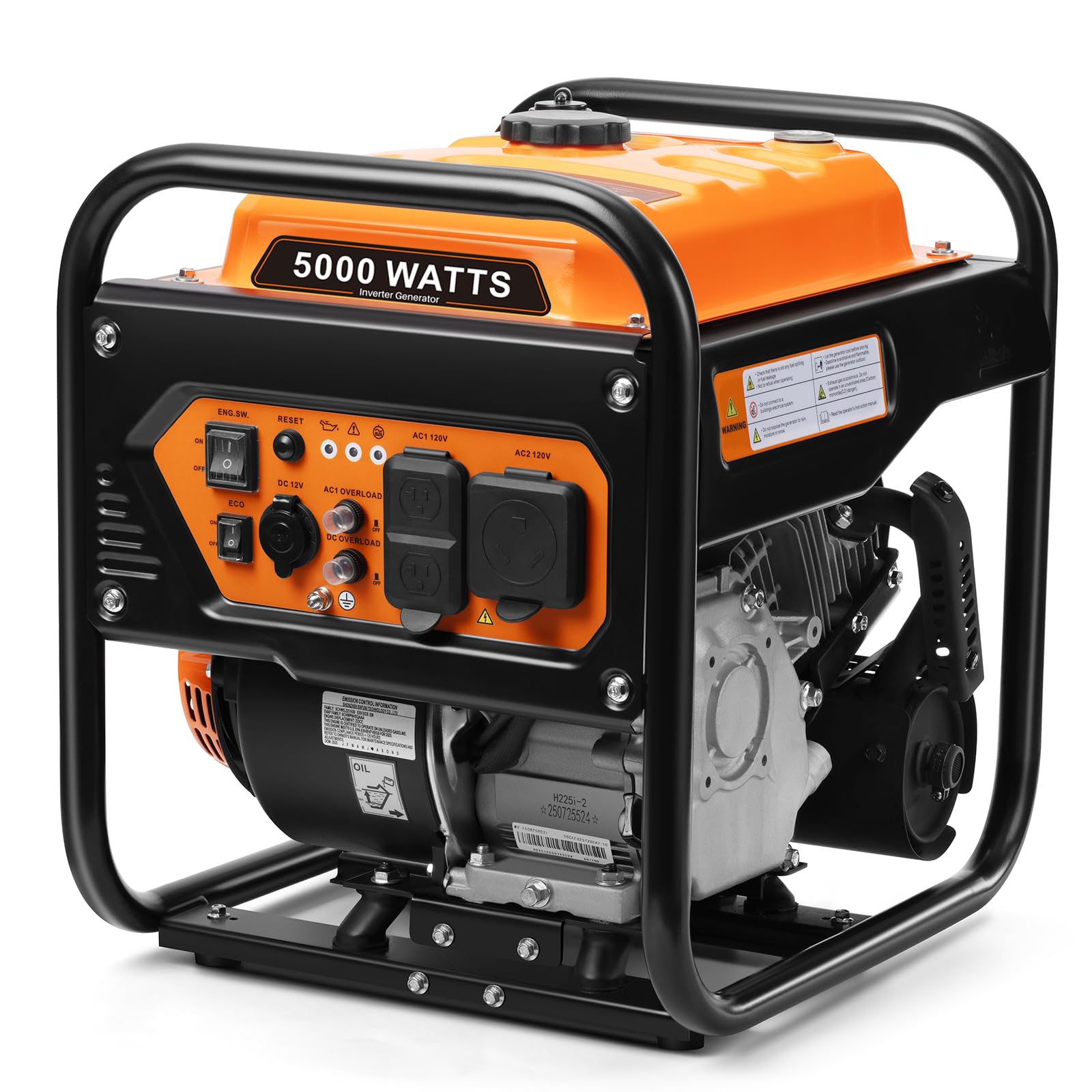
2. Oxseryn 5000-Watts Portable Inverter Generator
Clean inverter power at a price that makes you do a double-take.
The headline here is the value: 4000 running watts and 5000 peak watts with inverter technology that keeps THD under 5%, so your laptop, phone, and TV are safe. It’s a different breed than the open-frame Westinghouse above — this one is an inverter, which means quieter operation at 70dB from 23 feet and cleaner output for sensitive electronics, all in a 60-lb package that’s 19″L x 15″W x 18″H.
The runtime story is the one compromise to know. It runs up to 6 hours at 50% load on a 2-gallon fuel tank — a 2.4x shorter runtime than the Westinghouse’s 14.5 hours, with a 2.4x smaller tank (2 gal vs. 4.7 gal). Owners mention it “runs up to 6 hours at 50% load on a 2-gallon fuel tank,” which is fine for overnight essentials but means more frequent refills during a multi-day outage. ECO mode helps stretch fuel by adjusting engine speed to demand, and a built-in fuel gauge keeps you honest about what’s left.
Owners specifically note it runs their camper’s AC, heat, and fireplace easily, and that a tank lasts about 10-12 hours in light use. Reliability and performance are the most-praised aspects, with buyers calling it easy to start and appreciating the lightweight design. The 30A outlet makes it RV-ready, and the open-frame design balances portability with stability.
What makes it a value pick
- Inverter tech delivers clean power for sensitive electronics at a budget-friendly price.
- At 60 lbs, it’s genuinely more manageable than the 100+ lb conventional units.
- 70dB at 23 feet keeps it appropriate for residential areas.
The trade-off to weigh
- 6-hour runtime at 50% load means you’ll be refilling the 2-gallon tank during long outages.
- Noise gets mixed reviews — some say quieter than expected, others find it slightly noisy.
Grab it if: You want inverter clean power for your RV or electronics without paying premium inverter prices, and you’re okay with a shorter runtime per tank.
Look elsewhere if: You need a full night of unattended running — the 14.5-hour Westinghouse is the one for that.
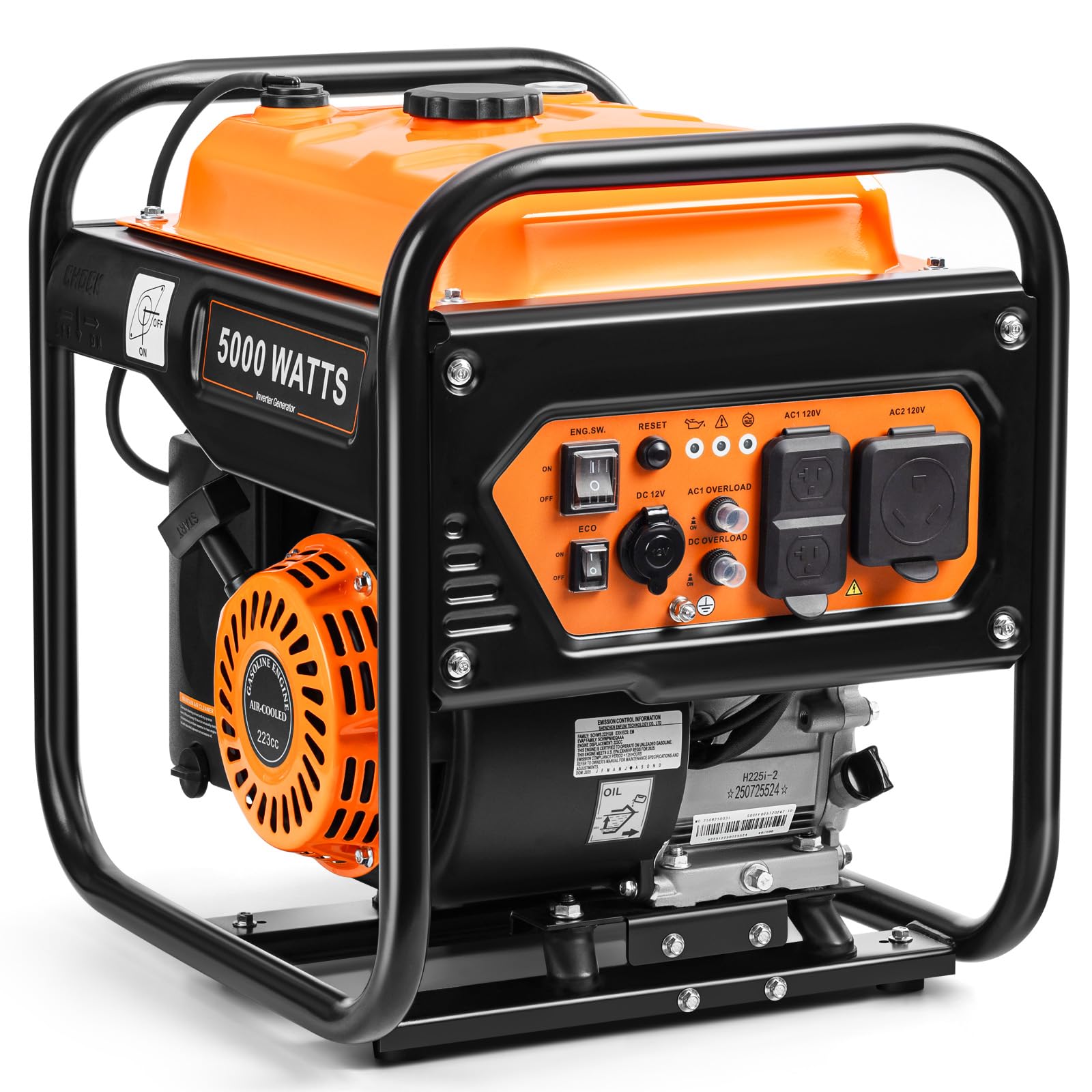
3. Oxseryn 5000W Inverter Generator Gas Powered Open Frame
A weekend-warrior inverter that ran a 10,000 BTU window AC and kept camping trips going.
This close sibling to the Oxseryn above trades a little runtime for a more open frame — it runs up to 10 hours at 25% load on a 2-gallon tank, and at 59 lbs it’s the lightest open-frame inverter here on paper. The 223CC four-stroke OHV engine produces 5000 peak watts and 4000 running watts, with inverter tech keeping power clean for laptops, phones, and cameras.
The defining real-world proof comes from owners who pushed it hard: One owner ran 3 sump pumps, 2 fridges, 2 fans, a TV, and a modem nonstop for 3 days after a June storm, then 24/7 for 7 days after an August derecho — “no issues.” Another noted a 10,000 BTU window AC unit ran effectively. The brief trade-off is that it doesn’t ship with oil (you’ll need 600ml of 10w-30), and a few found the starter pull can shift the lightweight frame — bracing it with a foot sorts that out.
At 70 dBA from 23 feet, it’s quiet enough for RV nights, and customers note real-world eco-mode runtime stretching to 16 hours on a tank. The panel includes a 12V DC port, two 120V AC ports, and a 30A RV port, making it genuinely versatile for camping, emergencies, and power tools.
Why it impresses
- 10-hour runtime at 25% load on a 2-gallon tank — long enough for a full camping day.
- At 59 lbs, it’s easy to lift into a truck bed or trailer.
- Reviewers point out it powered an entire household array of appliances through back-to-back storms.
Small things to know
- Oil isn’t included in the box — pick up 10w-30 before first start.
- It’s so light it can shift when you pull the starter; brace it.
Best for: RV campers and homeowners who want a light, quiet inverter that can power real appliances for a weekend or a storm stretch.
skip it if: You want dual-fuel flexibility — this one is gasoline-only.
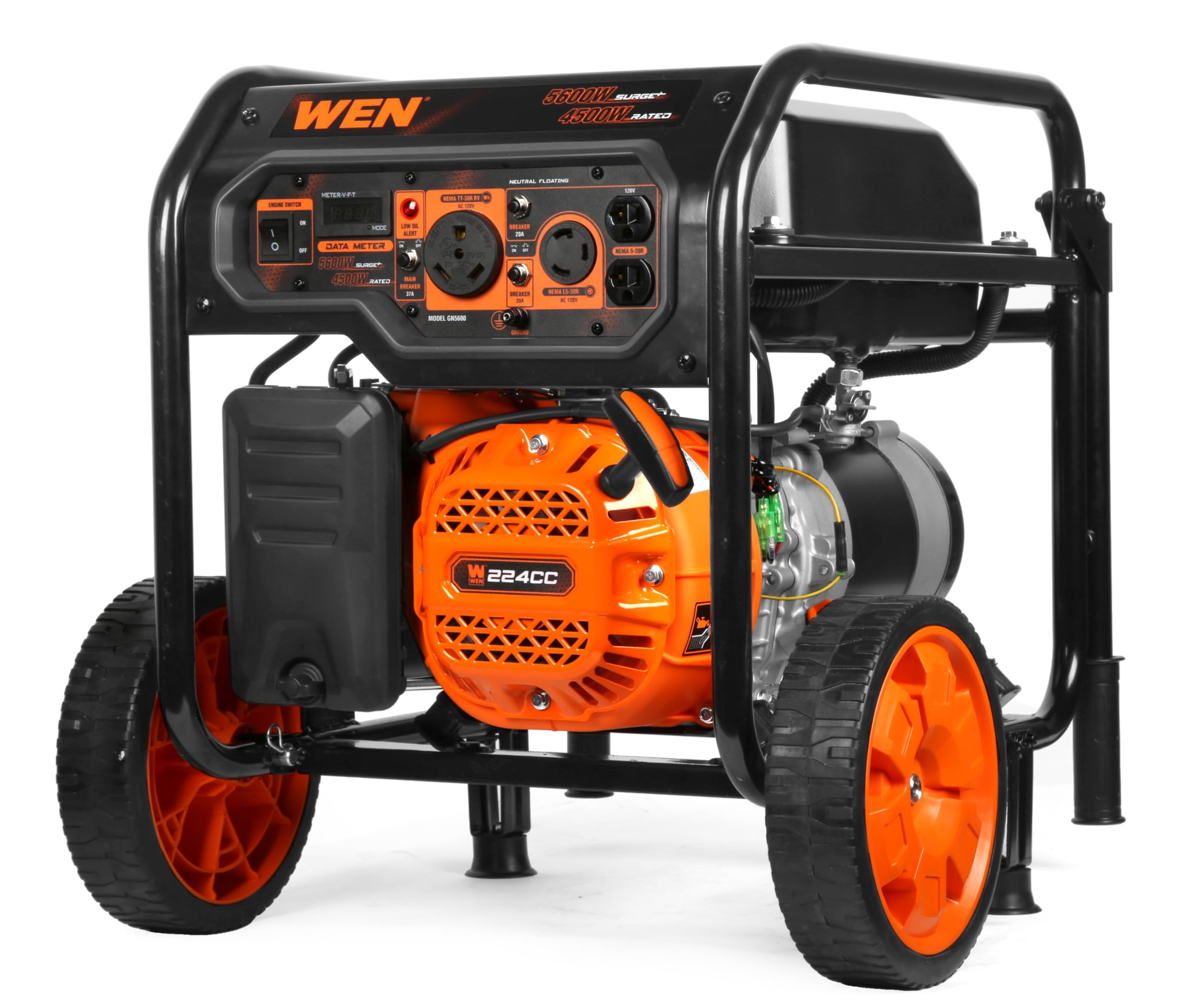
4. WEN 5600-Watt Portable Generator, 224cc
The off-grid commuter that has cranked first-pull for nine straight months.
If your generator runs every single day — not just during storms — this WEN is built for that rhythm. It delivers 5600 starting watts and 4500 running watts from a 224cc engine, with a 4.3-gallon tank good for up to 12.5 hours at half load. One off-grid owner runs it daily to charge trailer batteries and reports it “cranks first pull 99% of the time,” powering the trailer’s AC, microwave, refrigerator, lights, and battery charger simultaneously.
The panel is set up for serious hookups: two standard 120V 20-amp outlets, one RV-ready 120V 30-amp TT-30R outlet, and one transfer-switch-ready 120V 30-amp NEMA L5-30R twist-lock receptacle. It’s a conventional generator, so noise is moderate — one owner called it “not too loud” and noted it “sips gas.” The wheel and handle kit makes it easier to move, though at 112.4 lbs it’s still a two-person lift into a truck.
Houston owners dealing with hurricane season appreciate the confidence, and the three-year limited warranty adds confidence. A note for first-timers: one owner recommends running a fuel additive like Seafoam through the tank on the first run to keep the carburetor clean, which smoothed out initial surging.
What owners love
- Legendary start reliability — first pull nearly every time, even after months of daily use.
- 12.5-hour half-load runtime means overnight security on a single fill.
- Three-year limited warranty on a budget-friendly machine.
Consider this
- At 112.4 lbs, it’s heavy — the wheels help, but lifting it is a chore.
- No inverter tech, so keep the sensitive electronics on a surge protector.
Reach for it if: You live off-grid or in a hurricane zone and need a daily-driver generator that starts without fuss and runs all your essentials.
Think twice if: You plan to power laptops and TVs directly — you’d want an inverter for that.
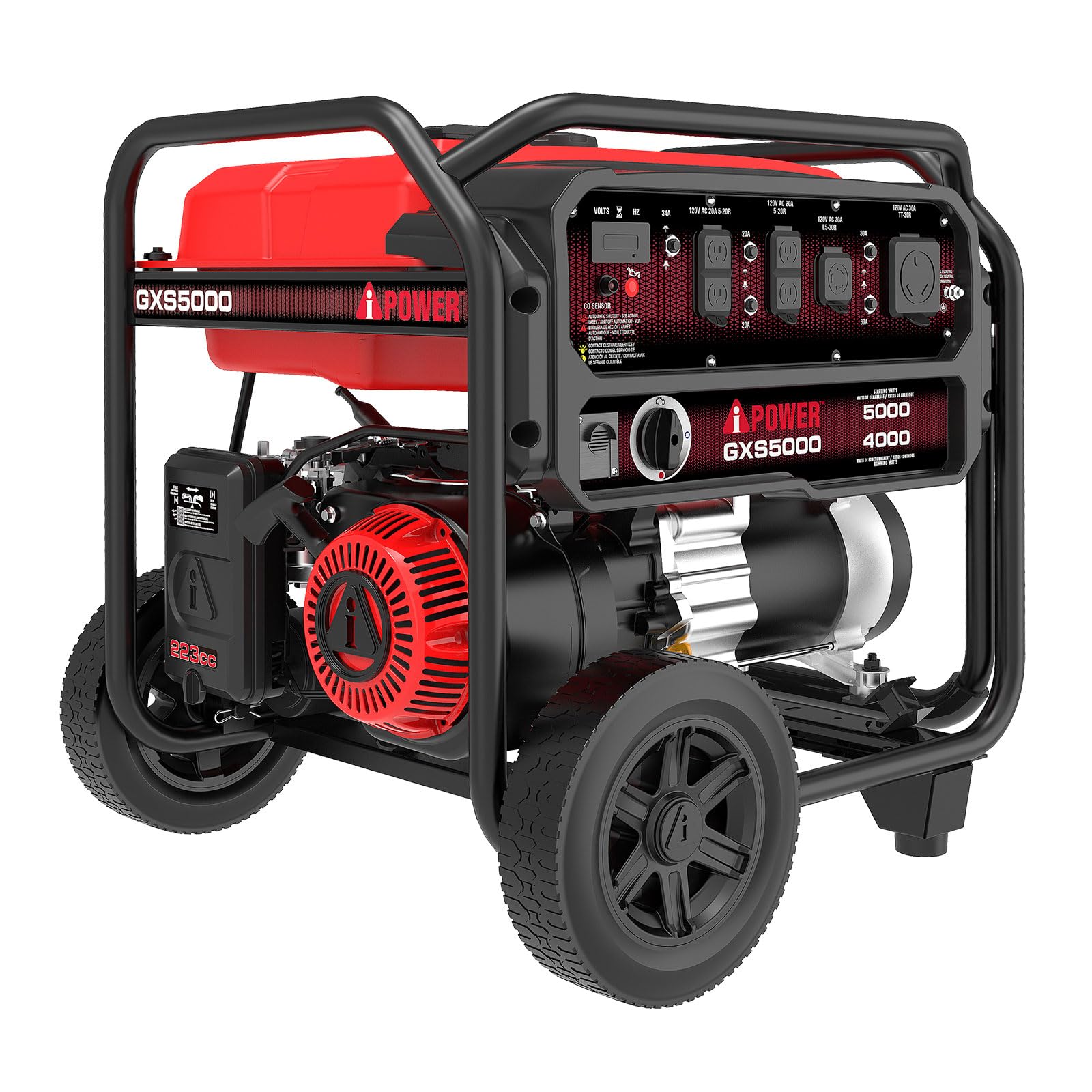
5. A-iPower 5000-Watt Portable Generator, GXS5000
The marathon runner — a 6.3-gallon tank stretches outages into days.
Runtime is the entire game here. This A-iPower runs for up to 20 hours at 25% load thanks to a huge 6.3-gallon fuel tank, which is the longest endurance of any 5000-watt-class pick in this roundup. That spec alone can mean the difference between one refill and three during a multi-day outage. The 223cc OHV engine with a cast-iron sleeve pushes out 5000 starting watts and 4000 running watts at a sound level of 68dB.
Shoppers say it powers a two-story house — four 9K BTU ACs, two fridges, a pump, three TVs, two PCs, and lights — with spare capacity, and some note a 6kW load (a 3.5-ton AC plus a 2HP pump) handled with only brief start surges. The panel features a CO sensor indicator light, a data center display, two 5-20R duplex 20-amp outlets, an L5-30R 30-amp, and a TT-30R 30-amp RV outlet.
The honest caveat is that this is a loud conventional generator — noise is the most-mentioned negative in buyer feedback, so it’s not the pick for quiet campgrounds. Performance and value for money are the most-praised aspects, and the three-year warranty adds confidence. It’s a big unit at 111.6 lbs, so the included toolkit and wheels matter for transport.
The standout strengths
- 20-hour runtime at 25% load — the longest endurance here, powered by a 6.3-gallon tank.
- Owners confirm it handles a 6kW load with a 3.5-ton AC and 2HP pump.
- CO sensor shutdown and a data center display for monitoring.
The honest trade-off
- Noise is the recurring complaint — it’s loud, and 45+ owners flag it.
- No electric start; it’s recoil pull only.
Choose it for: Whole-house backup where a single fill must last as long as possible, and you can tolerate conventional-generator volume.
Pass on it if: You need quiet operation for a campsite or a neighborhood with noise rules.
6. Pulsar 5,250W Dual Fuel Portable Generator, PG5250B

A four-year camper companion that started in 10°F on an iced-over propane bottle.
This is the generator that proves dual-fuel reliability over years, not just spec sheets. It delivers 5,250W peak and 4,250W rated on gasoline, and 4,750W peak and 3,850W rated on LPG, with Switch & Go Technology letting you transition between fuels while it’s running. The 4-gallon tank provides up to 12 hours at half load on gas, and the included propane hose means you can burn the cleaner, shelf-stable fuel when it matters.
The long-term owner story is compelling: One owner ran it on propane from 2021 to 2023, starting at 10°F with an iced-over bottle. It powered a freezer, lights, a camper fridge, and even a CPAP without a single defect. The 224cc air-cooled engine sits in a powder-coated steel frame with fold-down handle and never-flat wheels.
Here’s the balanced picture: the electric start feature gets mixed feedback — some say it works well, others report it doesn’t work at all. Pull-start is easy, so that’s the workaround. The panel gives you two 120V AC outlets, a 30Amp RV port, and a 120/240V twist-lock outlet, backed by a 3-in-1 digital meter and low-oil shutdown. At 115 lbs, it’s on the heavier side of this list.
what separates it
- Switch & Go lets you change fuels without stopping the engine.
- Proven cold-start reliability — owners cite 10°F starts on propane.
- 12-hour half-load runtime with a 4-gallon tank.
Watch for this
- Electric start is hit-or-miss per owner feedback; pull-start is the fallback.
- It’s a noisy conventional unit — no quiet-hour claims here.
The match: Camper owners and preppers who want proven multi-year reliability and the freedom to run on propane in extreme cold.
The caution: Don’t buy it for the electric start button — treat pull-start as the primary method.
7. GENMAX 6000W Portable Inverter Generator, GM6000XiE

Push a button, get 6000 peak watts of clean inverter power — no yanking required.
For anyone who dreads the pull-cord workout, this GENMAX flips the experience: electric start with a push-button, battery included, and Cold Start Technology for quick ignition in chilly weather. The 312cc four-stroke OHV engine produces 6000 peak watts and 5250 rated watts, with inverter technology delivering clean power at less than 3% THD — safe for your laptop, tools, and appliances.
It’s a lightweight inverter at 106.9 lbs, which the maker claims is 50% quieter and 30% lighter than a traditional 6000-watt generator. The 3.8-gallon steel fuel tank provides up to 9 hours of runtime at 50% load. Owners running it as a contractor unit praise the fuel efficiency (a quarter tank at half load) and the ability to run a demo hammer while charging batteries.
Here’s the honest fit-note: reliability feedback is genuinely mixed. Some owners power essential equipment flawlessly and call it a great value, while others report breakdowns within a few engine hours that required warranty replacements. If you buy this one, lean on the 1-year warranty and free lifetime technical support, and be ready for the possibility of a service call. The CO detection sensor that auto-shuts-down on unsafe carbon monoxide is a meaningful safety plus.
The appeal
- Push-button electric start with battery included — no pull-cord strain.
- Clean inverter power under 3% THD for sensitive electronics.
- Buyers report it runs a 15,000 BTU AC via a 50-ft cord.
The honest concern
- Reliability is the most-mentioned aspect and it’s mixed — some units fail early.
- Durability gets negative feedback in a few reviews; warranty support is the safety net.
Consider it if: Electric start is non-negotiable and you want clean inverter power for tools and electronics at a lighter weight.
Be cautious if: You need a zero-doubt, fire-and-forget backup for a critical outage — the mixed reliability record suggests weighing a more proven pick.
8. AMERISUN 5000W Gas Inverter Generator
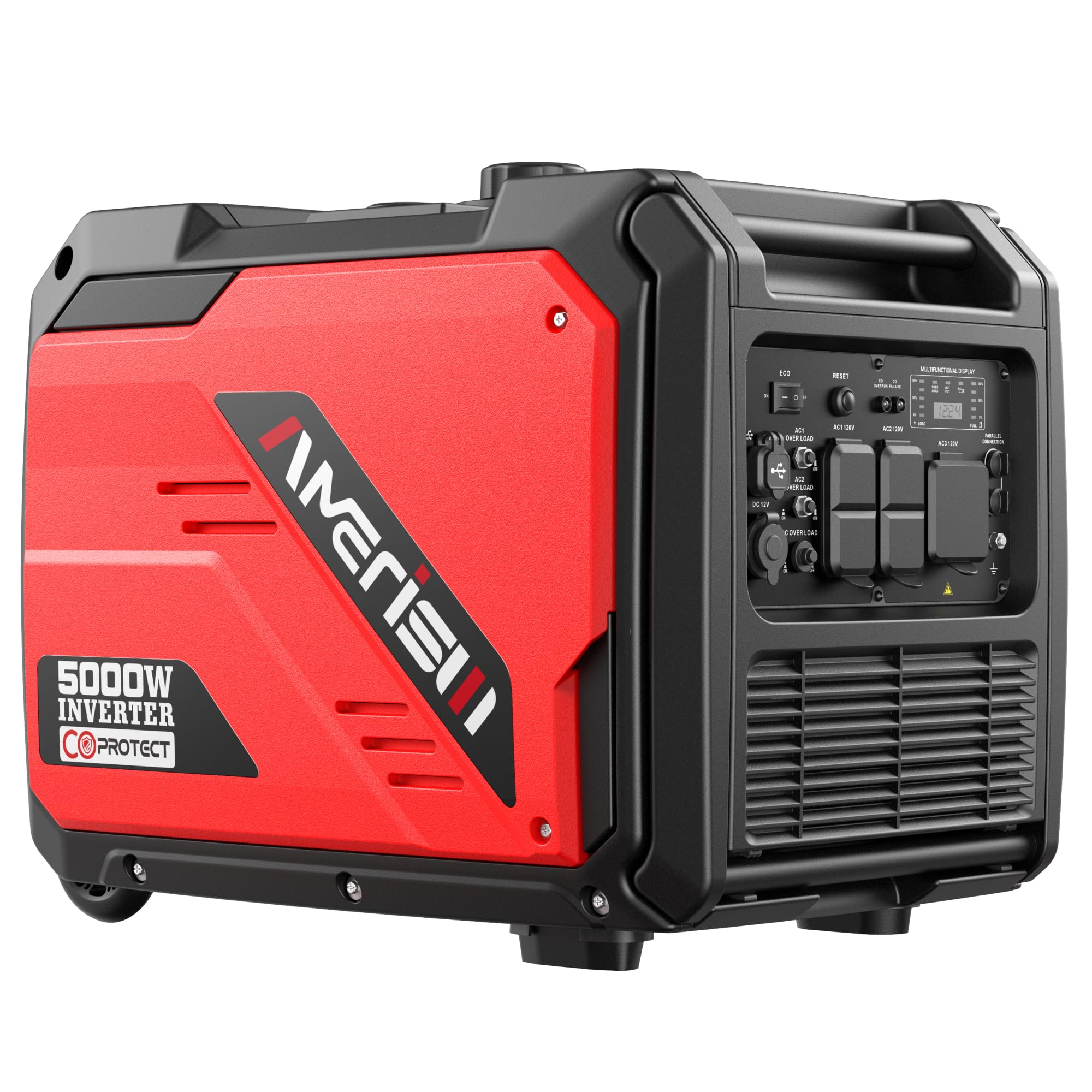
A one-hand-carry inverter that runs a PS5, a 55-inch TV, and a CPAP all at once.
Portability is the story here. Owners mention carrying this inverter with one hand, and the 223cc engine plus wheels make it a genuinely mobile backup. It produces 5000W peak output with a 3.43-gallon tank good for up to 10 hours at 50% load, and at 70db from 23 feet it earns its “super quiet” label — owners consistently call it whisper-quiet.
The real-world endurance is striking: One owner ran it continuously for 100 hours, while another powered a fridge, washer, 55-inch TV, PS5, fans, and a CPAP for 11 hours on 6 liters of gas. The panel is versatile — 4 AC 120V-20A outlets, one 120V/30A outlet, 2 USB ports (5V), and a 12V DC car port. It’s also parallel ready, so you can link a second 5000W unit for more capacity.
The CO sensor tech adds a smart safety layer with real-time detection plus a CO failure light for extra reliability. This unit is EPA-certified and CARB-compliant, backed by a 2-year limited service and lifetime technical support. The one durability caveat: some owners note it’s not strong enough for heavy worksite use, and the carburetor can retain fuel if stored too long — so run it dry or add stabilizer between uses.
Why it shines
- Whisper-quiet at 70dB — owners call it the standout feature.
- Parallel-ready design lets you double up for more power later.
- One-hand-carry portability with wheels included.
Keep in mind
- Not built for heavy worksite loads — it’s a home and camping machine.
- Carburetor fuel retention can cause starting issues if stored long; empty the tank or add stabilizer.
The right pick for: RV owners and hurricane-region households who want a quiet, portable inverter that powers the full entertainment stack plus essentials.
Not for: Jobsite work with heavy tools — you’d want a heftier frame and more sturdy internals.
9. DuroMax XP5500HX 5,500-Watt Dual Fuel Portable Generator

All-copper windings and a digital control center make this a dual-fuel machine built to last.
Durability is the defining angle of this DuroMax. The 210cc OHV-V engine features ALL COPPER WINDINGS — unlike aluminum, copper conducts heat better and extends generator life, a spec that serious buyers look for. It produces 5,500 watts on gasoline or propane, with a sleek digital control center and a wide outlet spread including two 120V GFCI household outlets and one 120/240V 30AMP twist-lock outlet.
The MX2 Switch doubles the 120V power available for your RV, which is a standout feature for camper owners who need more on a single phase. Electric start comes standard, and the CO Alert automatically shuts the unit down when harmful fumes are detected — a meaningful safety net for home backup. The wheel and handle kit plus foldable handle make the 131-lb unit manageable.
Owner experiences in emergency situations are strong: One owner relied on it during California fires to keep food cold, while another runs a 1,200 sq ft cottage (minus AC and dryer) covering the well pump, fridge, and freezer. There’s a minority who report starting troubles, so treat the break-in and monthly run ritual as important. It’s a premium-priced unit, but the copper windings and dual-fuel flexibility justify it for buyers who plan to keep one machine for a decade.
The premium advantages
- 100% copper windings for better heat conduction and longer life.
- MX2 switch doubles 120V output for RV use.
- Electric start plus CO Alert auto-shutdown for safety.
What to watch
- A few customers note starting issues; monthly break-in runs are recommended.
- At 131 lbs, it’s a heavy unit — the wheel kit is necessary, not optional.
The match: RV owners who need doubled 120V power and homeowners who want a dual-fuel machine with premium copper internals that will outlast a conventional unit.
A note: If you want to avoid any electric-start quirks, test it monthly and keep the pull-start method in mind.
10. WEN 6800-Watt Dual Fuel RV-Ready Electric Start Portable Inverter Generator, DF680iX

A dual-fuel inverter that can even top up your electric vehicle during a blackout.
This is the most future-ready generator on the list. The 224cc dual-fuel engine runs on gasoline (6800 surge watts, 5100 rated watts) or propane (6000 surge watts, 4500 rated watts), and its bonded-neutral 240V configuration enables low-power Level 2 charging for battery and hybrid electric vehicles. If you own an EV, this is the generator that can keep your car charged when the grid goes down.
It’s a full-featured package: electric start, a fuel shutoff that boost lifespan by burning the remaining fuel out of the carburetor before shutdown, and the WEN Watchdog CO Shutdown Sensor that auto-turns-off at dangerous carbon monoxide levels. The panel is loaded — one L14-30R 120V/240V receptacle, two three-prong 120V receptacles, one TT-30R RV receptacle, one 12V DC receptacle, two 5V USB ports, and a voltage selector switch.
Owners who run it daily on propane for a year found it reliable and quiet, with one noting it runs both 15,000 BTU ACs plus a stove fan and lights through a 30A plug from 25 feet away. A 40lb tank lasted 28-30 hours in Texas heat, which is excellent endurance. The noise feedback is mixed — some find it surprisingly quiet in eco mode, others say it’s a bit loud. At 99.2 lbs, it’s manageable with the onboard wheels and telescoping pull handle.
The unique strengths
- 240V bonded-neutral output enables Level 2 EV charging — a capability almost no portable offers.
- Fuel shutoff extends engine life by protecting the carburetor.
- Reviewers point out 28-30 hours on a 40lb propane tank in Texas heat.
Balance this
- Reliability has negative feedback in a subset of reviews — some report no-spark failures.
- Noise is mixed; eco mode helps but it’s not a whisper machine.
- Too tall to fit under some RV storage compartments.
Choose it if: You own an EV or want the most versatile dual-fuel inverter setup for RV and home, with the fuel-shutoff convenience that minimalizes maintenance.
Weigh this: The mixed reliability notes mean you’ll want that 3-year warranty active and a spare spark plug on hand.
11. Westinghouse 5000 Peak Watt Super Quiet Dual Fuel Portable Inverter Generator, iGen5000DFcv
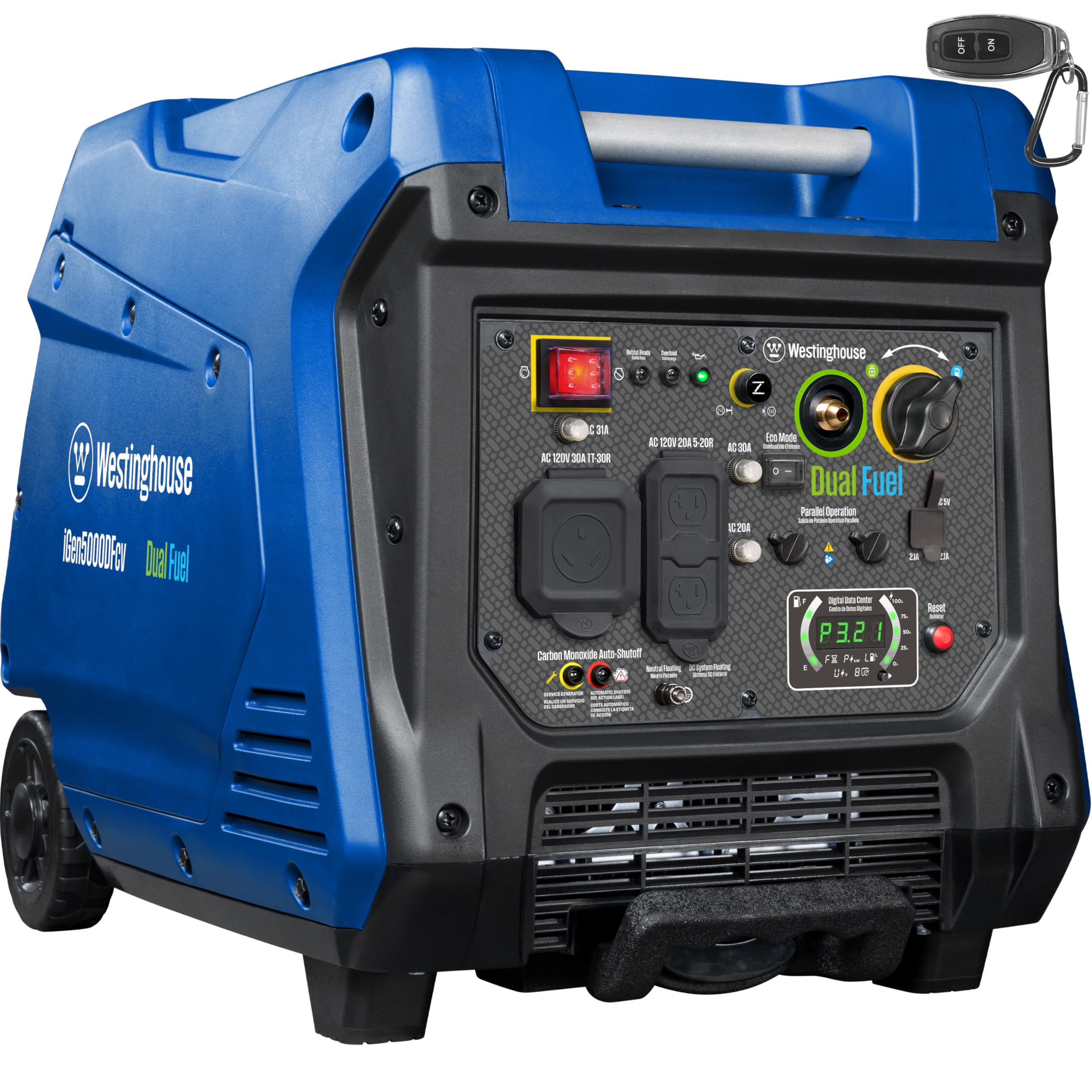
Sleep-level quiet at 52 dBA with an 18-hour tank — the camper’s dream machine.
This is the generator for people who want to forget it’s running. At as low as 52 dBA noise output, it’s quiet enough to sleep next to, and the 3.4-gallon gas tank delivers up to 18 hours of run time — the second-longest endurance on this list. It produces 5000 peak watts and 3900 rated watts at less than 3% THD, so your sensitive electronics are completely safe.
The LED data center is a genuine upgrade: a rotating digital display shows fuel level, power output, remaining run time, voltage output, and lifetime hours. Owners call it “one of the best generators I have owned,” powering a camper for 3.5 days on a 100-pound propane tank while staying “so quiet you will sleep like a baby.” It’s dual-fuel with gas or propane, recoil start (no electric), and features a telescoping handle plus wheels at 80.5 lbs.
The defining balance here is fuel efficiency vs. starting effort. There’s no electric start — owners note it started on the second pull, which is fine, but if you hate pull-cords, that’s the trade-off. Quality and quiet operation are the most-praised aspects by a wide margin. The panel has a 5–20R duplex household outlet, an RV-ready TT-30R 30Amp outlet, and two USB outlets, all with automatic low-oil and CO shutdown for safety.
Why it’s a stand-out
- 52 dBA noise — quiet enough to sleep next to in a camper.
- 18-hour runtime on a 3.4-gallon tank — top-tier endurance.
- LED data center shows fuel, output, and remaining runtime.
The trade-off
- Recoil start only — no electric start button for those who want one.
- At 3900 rated watts, it’s at the lower end of the 5000-watt-class spectrum.
Reach for it if: You camp in an RV or travel trailer and want a generator so quiet you’ll forget it’s running, with fuel economy that stretches a tank for days.
Look elsewhere if: You need electric start or want to run heavy 240V tools — this is a 120V-focused machine.
12. DuroStar DS13000MXT 13,000-Watt Tri Fuel Portable Generator
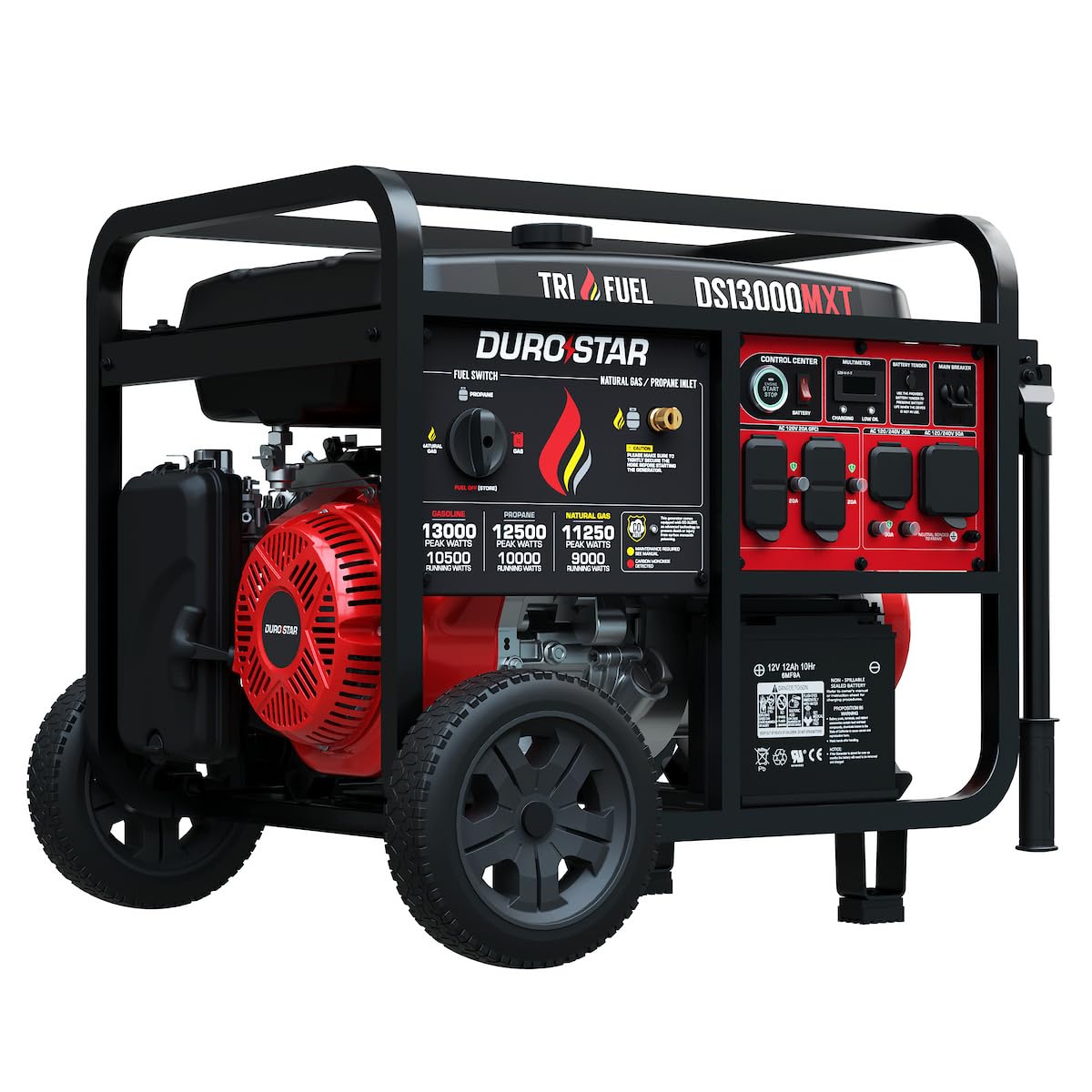
A 13,000-watt tri-fuel giant that powers a whole home — or a 20-foot food truck.
This DuroStar takes the 5000-watt class and blows right past it, delivering 13,000 watts of power to run your entire home during a storm. The 500cc four-stroke OHV engine runs on gasoline, propane, or natural gas — a tri-fuel setup that gives you ultimate flexibility, especially if you have a natural gas hookup and never want to worry about fuel storage. The CO Alert system automatically shuts down when harmful fumes are detected.
A food truck owner runs a 20-foot truck on it, while homeowners powered AC, fridge, freezer, microwave, pumps, lights, and phones for 72 hours with a refill every 12 hours. The push-button start plus remote control fob is a standout feature — start it from inside without walking outside. The fully loaded power panel includes a transfer-switch-ready 50 amp outlet, making it a true whole-home backup solution.
The practical notes: it’s extremely heavy and large, so the wheel kit is essential, and a few owners flagged that the oil drain tube placement near the tire needs care when moving — one caught a wheel and caused a leak. It’s a premium, high-output machine that’s genuinely overkill for camping but ideal for whole-home emergency power where you want a single unit to cover everything.
The firepower
- 13,000 watts with tri-fuel capability — gas, propane, or natural gas.
- Remote electric start with a fob — start from inside the house.
- 50-amp transfer-switch-ready outlet for whole-home connection.
The size reality
- It’s a massive unit — the wheel kit is mandatory for moving it.
- Oil drain plug placement near the tire needs caution; check it before moving.
The pick for: Homeowners who want one generator to power the entire house — HVAC, oven, well pump — with natural gas as an endless fuel source.
Not for: Campers or tailgaters — this is a stationary whole-home workhorse, not a portable companion.
13. DuroMax XP13000EH 13,000-Watt Dual Fuel Portable Generator

The crowd-magnet that powers a 4,800 sq ft house and starts at the touch of a button.
With 13,000 watts of power, this DuroMax is the heavy hitter that homeowners turn to for complete whole-house coverage. The 500cc four-stroke engine is dual fuel (gasoline or propane) with 100% copper windings, a superior heat conductor that extends generator life. One owner powers a 4,800 sq ft home with it, while another ran a 3-ton AC and 6,000W load for 8 hours on a full tank.
The push-button electric start is instant — owners praise touching the button and watching it fire immediately. The front-facing interface lets you switch fuel types in seconds, and the heavy-duty all-metal frame and power panel means no plastic parts to crack. It’s built to handle severe weather and years of wear, with no-flat tires that roll over terrain and a transfer-switch-ready 50 amp outlet for permanent home connection.
The honest trade-offs: at 234 pounds, this is the heaviest unit here — it’s not “portable” in any casual sense, and buyers recommend a cover for outdoor storage. Some note it’s noisy, and the choke sticker can be confusing (it’s reversed). Running it on propane is a favorite for longevity, with one owner citing 5+ hours on half a tank while powering four appliances. The electric start is reliable enough that some say no choke is needed at all.
What makes it a top-tier pick
- 13,000 watts of dual-fuel power for complete whole-home backup.
- 100% copper windings and an all-metal frame built for decades.
- Push-button electric start that owners call instantly reliable.
Prepare for this
- At 234 lbs, you’ll need the wheel kit and a ramp for any transport.
- No oil included in the box; the choke sticker is reversed per some owners.
Choose it for: A whole-house backup that must power everything — HVAC, oven, water heater, and more — with propane as a clean, long-storing fuel option.
Consider the size: This is a stationary powerhouse, not a tailgating generator; make sure you have a designated storage spot.
Understanding the Specs That Matter
Running Watts vs. Peak Watts
Running (or rated) watts is what the generator produces continuously, while peak (or starting) watts is a brief surge needed to kick motors like AC compressors and sump pumps into motion. Size your setup by adding up the running watts of everything you’ll power simultaneously, then make sure it’s under the generator’s rated output — the peak handles the momentary startup spike.
THD and Clean Power
Total Harmonic Distortion (THD) measures how “clean” the electrical waveform is. Conventional generators often have THD above 5%, which is fine for tools but can damage sensitive electronics like laptops, TVs, and CPAP machines over time. Inverter generators typically deliver under 5% THD, making them safe for your valuable devices and quieter at low loads.
Fuel Type and Runtime
The fuel tank size tells you how long you’ll run before a refill. Gasoline gives the highest output but degrades over months in storage, so add stabilizer. Propane stores indefinitely, burns cleaner, and is ideal for emergencies, but slightly lowers peak wattage. Tri-fuel adds natural gas for endless supply if you have a hookup. A bigger tank (4.7 gal vs. 2 gal) translates directly to fewer 2 a.m. refill trips.
Start Type and Portability
Recoil start means pulling a cord each time — simple but a workout in cold weather. Electric start adds a battery and push-button ignition for instant starts, plus some models offer remote fobs. Weigh the unit: a 60-lb inverter is genuinely portable, while a 234-lb whole-home unit needs wheels and a permanent spot. Your body and your storage plan should make this call for you.
FAQ
What can a 5000-watt generator actually power at once?
What’s the difference between a conventional and an inverter generator?
Is a dual fuel or tri fuel generator worth it?
How long will a 5000-watt generator run on a tank of gas?
Is a CO sensor worth having on a portable generator?
Can I plug my generator into my house’s electrical panel?
Why does my generator surge or run rough sometimes?
How do I store a generator between outages?
Is electric start or recoil start better for a generator?
Which fuel type is best for emergency backup?
Final Thoughts: The Verdict
If you want one dependable pick, the 5000 watt generator winner is the Westinghouse 6500 Watt because it pairs the longest runtime (14.5 hours) with dual-fuel flexibility and a proven reliability record across hundreds of owners. If you want clean inverter power for your electronics at a budget-friendly price, grab the Oxseryn 5000W Inverter. For a full whole-home backup that starts at the touch of a button, the DuroMax XP13000EH is the one to reach for.
How We Picked
We do not accept paid placement. Every pick is matched to a real buyer and a real use-case; we do not hands-on test units.
Sources & Methodology
Specifications: manufacturer listings and product documentation. Review insights: verified customer reviews, as of September 2026. Pricing: not shown on this page (it changes often); check the current price via the retailer link.
As an Amazon Associate, KitchPrep earns from qualifying purchases. This does not affect which products we feature.
Related Guides
