
Specs are compiled from manufacturer listings and verified buyer reviews and can change over time — please confirm the key details on the product page before buying.
Before you buy 20 gauge cable, ask yourself what you are building. A speaker system needs flexible, high-strand copper that routes around corners. A kiln or foam cutter needs a resistance wire that survives extreme heat. A doorbell just needs a simple two-conductor run that strips cleanly. Match the conductor type and insulation to your project’s movement, heat, and environment.
I’m Mohammad Maruf — the founder and writer behind KitchPrep. This guide is built by comparing the manufacturers’ published specifications and the patterns across verified customer reviews, so you get each pick’s real strengths and trade-offs instead of marketing spin.
Whether you are wiring a model, a doorbell, or a speaker, this breakdown of the best 20 gauge cable options helps you match the right conductor and insulation to your exact project.
Our Picks at a Glance


How To Choose The Right 20 Gauge Cable
20 gauge is among the most common wire sizes for low-voltage work, but the “right” version depends entirely on your project. A 100-strand silicone wire bends like string, while a solid-core wire holds whatever shape you bend it into. Start by deciding if you need stranded or solid, then match the insulation to the environment.
Stranded vs Solid Core
Stranded wire is made of many thin copper wires twisted together, which makes it flexible and resistant to breaking from repeated bending. Solid core is a single piece of copper, so it holds its shape and pushes easily into breadboards and terminal blocks. Stranded wire survives repeated bending and vibration without breaking. Solid core holds its shape for clean breadboard and terminal connections.
Silicone vs PVC Insulation
Silicone insulation handles extreme temperatures and stays flexible even in the cold, which is why you see it on 3D printers, RC models, and battery leads. PVC is stiffer and cheaper, with a lower temperature ceiling, but it is tough and resists oil and gas. Silicone handles extreme temperatures and stays flexible; PVC resists abrasion and costs less.
Quick Comparison
| Model | Best For | Strands | Insulation | Temp Range | Amazon |
|---|---|---|---|---|---|
| BNTECHGO 20 AWG★ Best Overall | Flexible electronics & antennas | 100 | Silicone | -60°C to 200°C | Amazon |
| Nichrome 80 20 GaugeHeat Specialist | High-heat kiln & foam cutting | Single | None (bare alloy) | Up to 1180°C | Amazon |
| Fermerry 20 AWG KitColor Kit Champ | Multi-color electronics projects | 100 | Silicone | Up to 200°C | Amazon |
| Southwire 20/2 Bell Wire | Doorbells & low-voltage signals | Solid | Thermoplastic | Not listed | Amazon |
| Haerkn 20 AWG Kit | 7-color DIY & boat wiring | 100 | Silicone | -60°C to 200°C | Amazon |
| TUOFENG 20 AWG Stranded | Model railroads & repairs | 100 | Silicone | -60°C to 200°C | Amazon |
| TUOFENG 20 AWG Solid | Breadboards & fixed circuits | 1 | PVC | -40°C to 80°C | Amazon |
| GS Power 20 AWG Speaker | Car audio & 12V wiring | 10 | PVC | -40°F to 176°F | Amazon |
| Extreme Dog Fence Wire | Underground pet containment | Solid | PVC | Not listed | Amazon |
In-Depth Reviews
1. BNTECHGO 20 Gauge Silicone Wire
Our pick — over 4.5★ from 800+ verified ratings; the strongest balance of quality and price.
The 100-strand tinned copper core that bends like string and solders like a dream.
The thing everyone raves about here is the flexibility, and the spec sheet explains why. This 20 AWG wire packs 100 strands of 0.08 mm tinned copper, which is what makes it drape and flex instead of springing back at you. Owners describe it as “super flexible and easy to work with,” and the silicone jacket stays pliable down to -60°C, so it won’t stiffen up in a cold garage or an unheated workshop.
The tinned coating on each strand does double duty. It resists corrosion, which matters if your project lives in a damp environment, and it makes soldering noticeably easier because the solder wets the surface cleanly. The 600-volt rating and 200°C heat ceiling mean this isn’t a fragile hobby wire — it’s rated for real electrical work, from RC models and drones to 3D printer cable chains that flex thousands of times.
What wins people over is the sheer ease of use. Buyers use it for portable ham radio antennas and ground plane radials, praising how it untangles without the fight you get from stiff plastic-coated wire. Buyers consistently praise the build quality, and the 100-foot spool covers full projects without extra packs.
Why Owners Reach For It
- Extreme flexibility from the 100-strand core makes tight routing easy
- Tinned copper resists corrosion and takes solder cleanly every time
- Wide -60°C to 200°C range handles heat and cold extremes
Who Should Look Elsewhere
- Comes in a single black spool, so color-coding means buying more
- Overkill if you only need a short fixed run of solid wire
Grab it for: any project where the wire has to flex, route around corners, or survive repeated bending without breaking.
Think twice if: you need a rigid wire that holds a formed shape for breadboard work — that is a job for solid core.
2. Nichrome 80 20 Gauge Wire
The resistance wire that fires at cone 10 and refuses to melt.
This is not a conductor — it is a heating element. Nichrome 80 is a nickel-chromium alloy with a resistance of 0.64 Ohms/ft, which means it generates heat when current passes through it instead of just carrying it. The max operating temperature of 2150°F (1180°C) is what makes it the go-to for hot-wire foam cutters, kiln shelving supports, and ceramic art that needs serious sustained heat.
Buyers in ceramics studios fire it at low-fire cone 05 and report it “held up without any issues,” while others push it all the way to cone 10 and confirm it does not melt. That heat retention is the most-discussed strength after raw functionality. The single-strand construction at 0.81mm diameter means it’s strong enough for the tension a foam cutter requires, though it won’t hold up to heavy hanging loads — that is just not what this wire is for.
The 50-foot length covers a lot of cutting table or kiln projects for the money, and it arrives annealed soft, which makes it easier to shape around your work. Unlike the silicone wires in this list, there is no insulation to strip — this bare alloy wire is the element itself, so you wire it straight into your heating circuit.
What It Excels At
- Survives extreme heat up to 1180°C without melting or degrading
- Consistent 0.64 Ohms/ft resistance gives predictable heating
- Annealed soft means it bends and shapes easily for your rig
What It Is Not For
- Not a general-purpose conductor — do not use for standard signal wiring
- Bare alloy means no insulation for protection against shorting
Reach for this when: the project generates serious heat — kilns, foam cutters, and heating elements are its home turf.
Look elsewhere if: you just need to carry a signal or power, because a plain copper conductor does that better and cheaper.
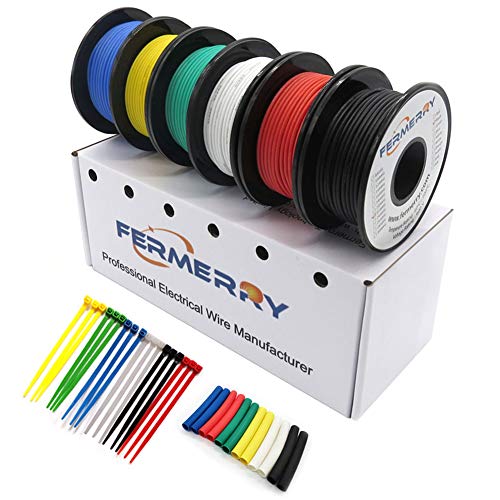
3. Fermerry 20 AWG Stranded Wire Kit
Six color-coded spools that make circuit identification genuinely painless.
If you have ever traced a tangle of same-colored wires trying to find which one goes where, this kit solves that instantly. You get six colors — black, red, blue, white, green, and yellow — each on its own 10-foot spool for 60 feet total. The color variety is exactly what electronics hobbyists need, and the kit sweetens the deal with 18 pieces of heat-shrink tubing and 18 wire ties so you can finish the job cleanly.
The electrical specs mirror the BNTECHGO pick closely: 100 strands of 0.08mm tinned copper with a silicone sheath rated for 200°C and 600 volts. The difference is the current handling — this one is rated for 10A, which is generous for a 20 AWG hookup wire and gives you headroom on motor circuits and battery leads. The silicone insulation strips easily and the tinned copper takes solder well, which is what owners repeatedly highlight for small electronics and DIY builds.
One honest trade-off shows up in the feedback: the jacket makes smaller gauges “a bit fatter than they need to be,” so if you are threading wire through very tight spaces, the slightly bulkier insulation can be a squeeze. For general bench work, prototyping, and repair, the convenience of six ready colors outweighs that minor gripe.
The Strong Points
- Six spooled colors keep power, ground, and signal runs easy to track
- 10A current rating gives real headroom for small motors and LEDs
- Comes with heat-shrink tubing and wire ties for a complete kit
The Fit Note
- Insulation adds noticeable bulk for very tight routing spots
- 10-foot spools run short for larger projects
Perfect for: the hobby bench where color-coding saves you from tracing mistakes on every project.
skip it if: you need long single-color runs, because 10 feet per spool disappears fast.
4. Southwire 20/2 Twisted Bell Wire

The two-conductor solid wire built for doorbells and low-voltage signals.
Some wiring jobs are not about flexibility — they are about a clean, reliable two-wire run. This Southwire bell wire is a solid-core, 20-gauge, 2-conductor twisted pair with 100 feet per coil, and it is purpose-built for call bells, buzzer systems, and door chimes. The solid construction means you strip it, land it on a terminal, and it stays put without fuss.
What owners appreciate is that it is genuine solid copper, not copper-clad aluminum, which matters for conductivity over longer runs. The thermoplastic insulation is UV-resistant, so while the listing says residential indoor, it can handle outdoor exposure without the jacket degrading quickly. Buyers have used it for garage door opener wall switches and low-voltage lighting, finding it strips cleanly and makes solid connections.
The honest caveat is durability feedback is genuinely split. The solid core and tough insulation earn praise from most, but the twisted pair can untwist and tangle during handling, and at least one owner found the insulation tore in their hands. If you need a quick, affordable two-conductor run for a doorbell or signal circuit, this is a solid choice from a trusted brand — just handle the coil gently as you pull it out.
Where It Shines
- Solid copper core strips cleanly and holds secure connections
- UV-resistant jacket handles indoor and some outdoor runs
- Twisted pair keeps polarity organized for signal circuits
The Catch
- Twisted pair can tangle if you are not careful unrolling it
- Solid core is not ideal for tight, repeated-bend routing
Best fit for: doorbells, garage sensors, and low-voltage signal wiring where a solid two-conductor run is all you need.
Not for: projects that demand flexible routing, since the solid core resists tight bends.
5. Haerkn 20 AWG Silicone Wire Kit

Seven colors and 161 feet of soft silicone wire for serious color-coding.
This kit takes the multi-color approach further than most. Instead of six colors, you get seven — black, red, yellow, green, blue, white, and brown — each on a 23-foot spool for 161 feet total.
The conductor is 100 strands of 0.08mm high-purity oxygen-free tinned copper, rated for 600 volts and a -60°C to +200°C temperature range. The 5A current rating is more conservative than the Fermerry kit’s 10A, so this is best for signal and light-power work rather than motor loads. Owners praise the softness and flexibility, and one clever detail is the velcro-style strap on each spool that keeps the wire from unwinding into a mess during storage.
Buyers rate the quality highest, using it for boat electronics and small repairs. The insulation resists shrinking and burning even when soldering nearby, which gives you confidence when working in tight spaces. If you want maximum color variety per dollar and your circuits stay within 5A, this is a strong value pick.
Why It Stands Out
- Seven colors give you the most circuit-identification options
- Oxygen-free tinned copper conducts well and solders easily
- Velcro straps on each spool keep the kit tangle-free
Consider This
- 5A current rating limits it to signal and light-power duty
- Softer insulation needs care against abrasion
Choose this for: complex wiring jobs where distinguishing seven separate circuits beats buying multiple single-color spools.
Reconsider if: you plan to push more than 5A through the wire, where a higher-rated kit makes more sense.
6. TUOFENG 20 AWG Silicone Wire Kit
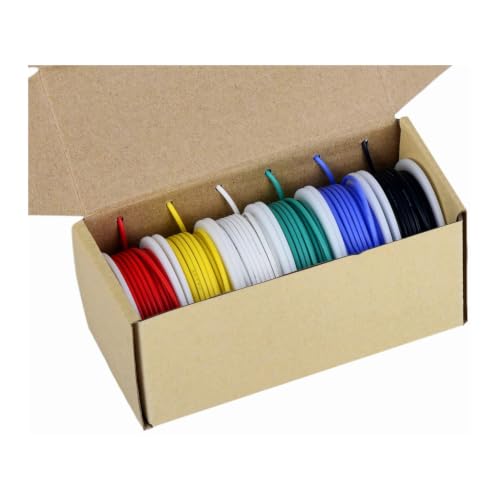
The well-rounded silicone kit that owners keep coming back to.
It uses the same proven formula: 100 strands of 0.08mm tinned copper in a soft silicone jacket rated -60°C to +200°C for 5A and 600V. It is a balanced package that suits LED projects, DC motors, and model wiring.
The feedback is remarkably consistent — owners call it good quality, easy to strip, and crimps well, with the silicone insulation holding up nicely. One buyer specifically uses it for model railroads and praises how well it works, while another appreciates that it strips and solders without hassle. Value for money ranks second, with the length-to-price ratio praised by owners.
The only real pushback comes from automotive users who found it almost too flexible for terminal insertion into plug connectors. If you need a stiffer wire that holds its shape while you push a terminal into a housing, this is not it. But for general electronics repair, test leads, and hobby builds, the flexibility is exactly what you want.
What Works
- Balanced 23-foot spools cover most projects without waste
- Easily strips, solders, and crimps for clean terminations
- Silicone insulation holds up through repeated flexing
Watch Out For
- Very flexible core can be awkward for plug connector terminals
- 5A rating caps the current you can safely carry
Grab this for: hobby electronics, model work, and repairs where easy stripping and soldering matter most.
Pass on it if: you need a firm wire for inserting into multi-pin connectors, where solid core wins.
7. TUOFENG 20 AWG Solid Wire Kit
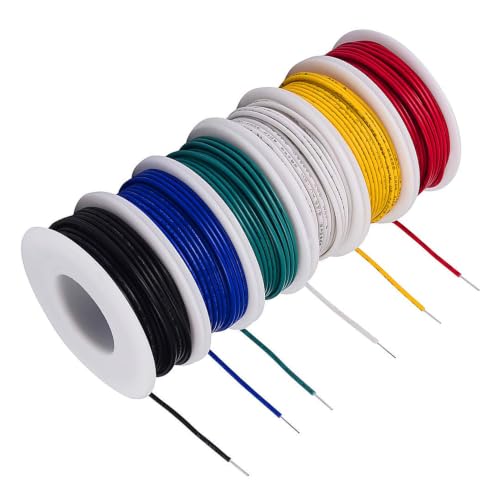
The solid-core kit that holds its shape on breadboards and PCBs.
This is the direct counterpoint to all the stranded kits in this list. Instead of 100 flexy strands, each conductor is a single solid tinned-copper core that holds whatever bend you form into it. That makes it the right tool for breadboards, protoboards, and PCB through-holes, where a wire that springs back and fights you is a constant annoyance.
The kit adds real value beyond the wire itself: it includes a mini wire stripper, heat-shrink tubing, and colored cable ties, all organized in a pull-through dispensing box that keeps each color separate and tangle-free.
Owners are pleasantly surprised by the quality, with one noting they expected “run of the mill cheap wire” and instead got solid construction with decent insulation. The stiffness is a feature here — it holds shapes for structural circuits and stays where you route it in engine bays or control panels. If your work is fixed point-to-point wiring, this is the more cooperative choice than any stranded wire.
Why It Wins For Fixed Wiring
- Solid core holds its bent shape for tidy, organized routing
- Breadboard-compatible for clean prototyping connections
- Includes stripper, heat-shrink, and ties in a dispensing box
Its Limits
- PVC insulation tops out at 80°C, so not for hot environments
- Solid core work-hardens and can break if bent repeatedly
Best for: breadboard prototyping, PCB connections, and any fixed circuit where the wire should stay where you put it.
Avoid if: the wire will flex constantly in use — repeated bending will fatigue a solid core.
8. GS Power 20 AWG Speaker Wire
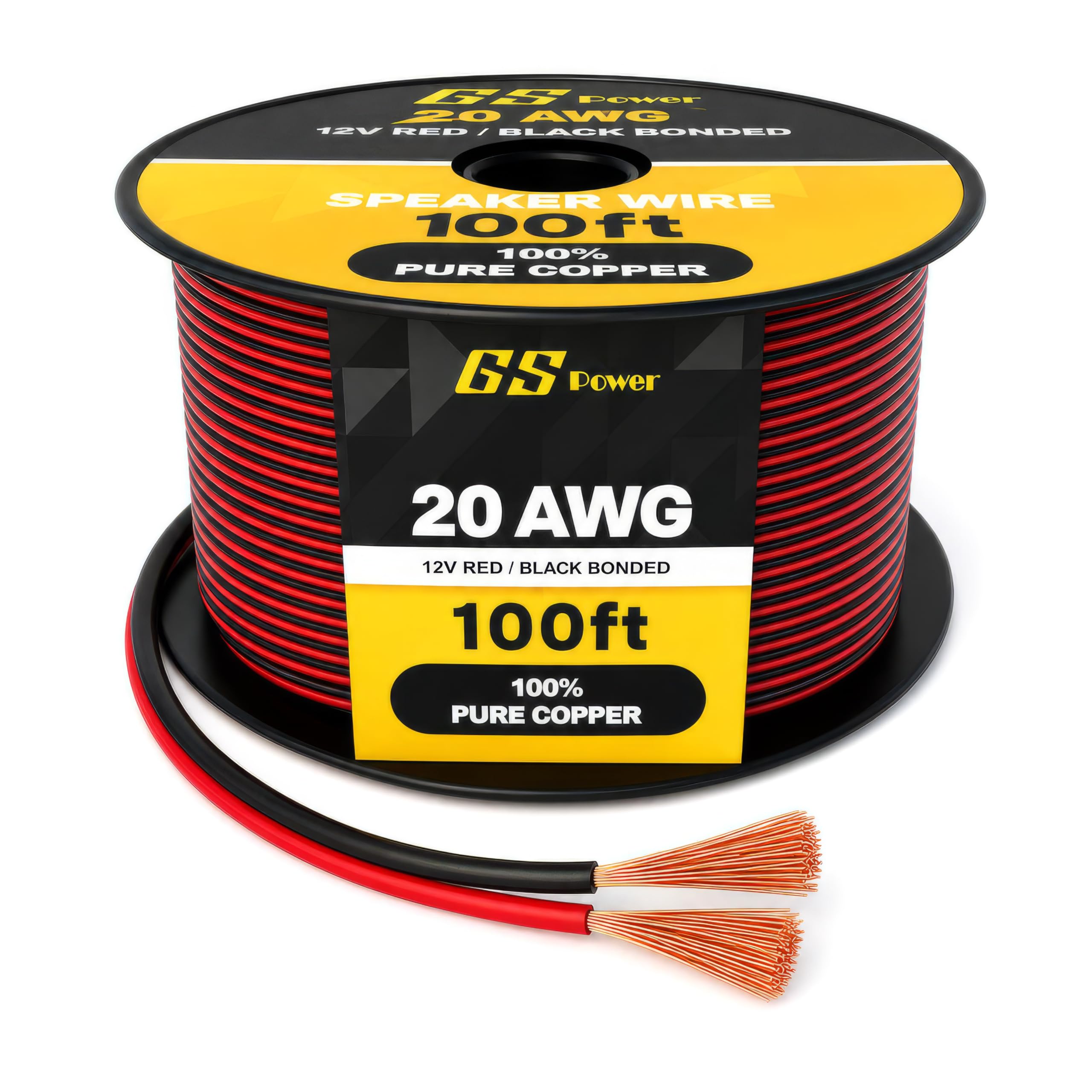
Bonded red-and-black OFC copper built for clean car audio signals.
Car audio has specific demands: clean signal transfer, easy routing behind dashboards, and insulation that survives engine heat and oil. This GS Power spool delivers on all three. It is 99.99% oxygen-free copper — not copper-clad aluminum — which means lower resistance and better signal integrity over long runs, exactly what you want for speakers and 12V power.
The format is clever: a bonded red-and-black pair totaling 200 feet (100 feet red, 100 feet black) that you can separate when you need individual conductor runs. Each conductor uses 10 strands of 0.25mm copper, giving enough flexibility to snake through door panels and under boat consoles without kinking. The automotive-grade PVC insulation is rated -40°F to +176°F and resists oil and gas exposure, so it holds up in engine bays where silicone might get cut.
Owners confirm the wire is exactly as advertised — strong enough to pull through firewall grommets and flexible enough for tight bends. Owners highlight the true OFC copper that solders cleanly, unlike cheaper clad wire. If you are wiring a car stereo, LED lighting, or a trailer harness, this bonded pair keeps your polarity organized from spool to speaker.
Built For The Road
- True OFC copper delivers clean signal with low resistance
- Oil-resistant insulation handles engine bay environments
- Bonded red/black pair keeps polarity clear during install
Note This
- 10-strand core is stiffer than 100-strand silicone wire
- Limited to 12V low-voltage DC applications
Choose this for: car audio, trailer wiring, and 12V automotive projects where oil resistance and clean signal matter.
pass on it if: you need ultra-flexible routing, because the 10-strand core is noticeably stiffer than silicone alternatives.
9. Extreme Dog Fence 20 Gauge Wire

A 1000-foot coil of sturdy PVC-coated wire for the whole invisible fence.
Containment wire does a specific job: it carries a low-voltage signal around your entire yard, buried or stapled, and it has to survive weather, moisture, and the occasional determined digger. This Extreme Dog Fence spool gives you 1000 feet of 20-gauge solid copper with heavy-duty PVC insulation, enough to cover about an acre of perimeter or expand an existing system.
The durability is what owners rave about most, with the thicker-than-typical insulation earning repeated praise. Buyers compare it favorably to cheaper alternatives, noting it buries easily and hooks up smoothly to existing systems including Sportdog and Petsafe. One owner replaced a GPS collar with this wired setup because the boundary was simply more reliable — the wire always works, no satellite needed.
At 1000 feet, you have enough for a good-sized yard plus spare for future repairs, which matters because splices are the weak point of any underground fence. The bright yellow jacket makes the wire easy to spot for repairs, a detail owners appreciate when hunting for a break. If you are installing or fixing an invisible fence, this is the purpose-built choice.
Why It Is Worth It
- 1000 feet covers a full acre of perimeter or expands an existing fence
- Thick PVC insulation holds up to weather and digging
- Compatible with major fence brands for easy integration
Fair Warning
- Premium length comes with a premium price tag
- Overkill if you only need a short electrical hookup run
Best for: homeowners installing or expanding an in-ground pet containment system who want one coil to finish the job.
Not for: general electronics work — this wire is engineered for one specific outdoor task.
Understanding the Specs
Strand Count & Flexibility
Strand count is the single biggest factor in how a wire behaves. A 100-strand conductor (like most silicone wires here) bends like fabric and survives constant flexing, which is why it is used in 3D printer cable chains and RC models. A 10-strand conductor is stiffer but still routeable. A single solid core holds its shape but will break if bent repeatedly. Match the strand count to how much the wire will move in your project.
Insulation & Temperature
Silicone insulation handles from -60°C up to 200°C, making it the choice for heat and cold extremes. PVC is cheaper and tougher against abrasion and oil, but its ceiling is lower — around 80°C for electronics-grade PVC or 176°F for automotive wire. If your wire sits near a heat source or in a cold garage, silicone wins. If it rubs against metal or sees oil, PVC holds up better.
FAQ
What is the difference between 20 gauge stranded and solid wire?
Can I use silicone wire for car audio installations?
What does tinned copper mean and why does it matter?
Is nichrome wire the same as regular copper wire?
How much current can 20 AWG wire safely carry?
Can I use 20 gauge bell wire for a doorbell?
Will this wire work with my existing invisible dog fence brand?
What is the temperature limit for silicone wire insulation?
How deep should I bury my dog fence wire?
Is higher strand count always better?
Final Thoughts: The Verdict
If you want one dependable pick, the 20 gauge cable winner is the BNTECHGO silicone wire because its 100-strand tinned copper core delivers the flexibility and easy soldering that electronics projects demand. If heating is your job, the Nichrome 80 handles extreme temperatures no copper wire could survive. And for a full-yard invisible fence, the Extreme Dog Fence coil gives you 1000 feet of sturdy, weather-ready coverage in one spool.
How We Picked
We do not accept paid placement. Every pick is matched to a real buyer and a real use-case; we do not hands-on test units.
Sources & Methodology
Specifications: manufacturer listings and product documentation. Review insights: verified customer reviews, as of September 2026. Pricing: not shown on this page (it changes often); check the current price via the retailer link.
As an Amazon Associate, KitchPrep earns from qualifying purchases. This does not affect which products we feature.
Related Guides
