
Specs are compiled from manufacturer listings and verified buyer reviews and can change over time — please confirm the key details on the product page before buying.
When the power goes out, you need to know which generator will actually keep your fridge running or your AC blowing. The right electric backup generator for you depends on one question: do you want to power a few rooms or your entire home, including the central air? The picks below range from lightweight inverter units (which produce clean, stable power safe for electronics) you can roll to a campsite to 212-pound giants that connect directly to your home’s electrical panel. You’ll see the real trade-offs so you can match each unit’s wattage to what your appliances actually draw.
I’m Mohammad Maruf — the founder and writer behind KitchPrep. This guide is built by comparing the manufacturers’ published specifications and the patterns across verified customer reviews, so you get each pick’s real strengths and trade-offs instead of marketing spin.
Think of starting watts as the muscle and running watts as the endurance — you need enough of both to keep your fridge cold and your furnace fan spinning. We break down the eleven most reliable electric backup generator models by their true power output, fuel flexibility, and how easy they are to live with during a storm.
Our Picks at a Glance

How To Choose The Best Electric Backup Generator
Buying a generator is a big purchase you hope to rarely use, which makes it easy to over- or under-buy. The key is to start with your home’s actual electrical needs, then work backward to fuel type, runtime, and portability. A generator that’s too weak will trip its breaker the moment your AC kicks on; one that’s too big wastes fuel and is a pain to move.
Calculate Your Starting vs. Running Watts
Every appliance has a running wattage — what it uses to keep going — and a starting wattage, a brief surge when it powers up. Motors, like those in a refrigerator compressor or a sump pump, can draw two to three times their running watts for a few seconds. Add up the running watts of everything you want to power at once, then add the single largest starting surge on top. That total is the minimum starting watts your generator needs.
Fuel Type: Gasoline, Propane, or Natural Gas
Gasoline is the most portable and gives you maximum power, but it goes bad in storage after a few months. Propane stores indefinitely and burns cleaner, though you get fewer watts than on gas. Natural gas gives you essentially unlimited runtime if your utility stays online, but you’ll need a professional to install the connection. Dual-fuel units handle gas and propane; tri-fuel models add natural gas, giving you the most flexibility during an extended outage.
Inverter vs. Open-Frame: What’s the Difference?
An inverter generator produces “clean” power with a stable sine wave, which is safe for sensitive electronics like laptops and phones. They also run quieter and often have eco-mode to save fuel. Open-frame generators make more raw power per dollar but are louder and their power can spike, which is risky for delicate devices. For whole-home backup on a budget, an open-frame is fine; for electronics and RV use, go inverter.
Portability and Setup Realities
An electric start with a key fob is a huge convenience over yanking a pull cord, especially in cold weather. But consider the weight — a 200-pound generator needs sturdy wheels and maybe two people to maneuver it into place. Also check the outlets: a 50A outlet is required to power a whole home via a transfer switch, while a 30A RV outlet suits camping setups. And make sure you’re buying a model with a carbon monoxide (CO) sensor that auto-shuts the unit down — that’s the single most important safety feature.
Quick Comparison
| Model | Best For | Starting Watts | Running Watts | Weight | Amazon |
|---|---|---|---|---|---|
| Westinghouse 12500 Dual Fuel★ Best Overall | Whole-Home Backup | 12500 | 9500 | 212.1 lbs | Amazon |
| PowerSmart 4800W InverterBudget Champion | Quiet RV/Camping | 4800 | 3800 | 68 lbs | Amazon |
| PowerSmart 4800W (223cc)Top Performer | Sensitive Electronics | 4800 | 3800 | 89 lbs | Amazon |
| WEN DF480iX | Dual Fuel Portability | 4800 | 4000 | 78.5 lbs | Amazon |
| WEN DF680iX | EV Level 2 Charging | 6800 | 5100 | 99.2 lbs | Amazon |
| GENMAX GM4600IAEDC | Compact Remote Start | 4700 | 3800 | 58.4 lbs | Amazon |
| DuroStar DS13000MX | Heavy-Duty Home Power | 13000 | — | — | Amazon |
| Westinghouse 12500 (Gas) | High-End Home Backup | 12500 | 9500 | 212 lbs | Amazon |
| Champion 4500-Watt | Quiet Dual Fuel Inverter | 4500 | 3500 | 99.2 lbs | Amazon |
| Generac 12500 Tri-Fuel | Three-Fuel Flexibility | 12500 | 9500 | 219 lbs | Amazon |
| DuroMax XP13000HXT | Tri-Fuel Whole Home | 13000 | — | 240 lbs | Amazon |
In‑Depth Reviews
1. Westinghouse 12500 Peak Watt Dual Fuel Home Backup Portable Generator
Our pick — over 4.5★ from 800+ verified ratings; the strongest balance of quality and price.
The 212-pound powerhouse that keeps a whole house running — from the remote start to the 50A outlet built for a transfer switch.
This Westinghouse earns its top spot because it can power an entire 100-amp home, including central AC, through its dedicated 50A outlet (a high-capacity connection for heavy loads). Buyers report exactly that: “Ran my whole home and didn’t break a sweat.” The 457cc cast-iron-sleeve engine (a durable metal cylinder lining) delivers 12500 peak watts and 9500 running watts on gasoline, and you can switch to propane for 11200 peak and 8500 running watts when gas runs dry.
What wins people over is the blend of raw power and genuine ease of use. The remote start key fob lets you start it from inside the house, and the automatic low-oil and carbon monoxide shutdown (which cuts the engine if oil is low or CO builds up) add real confidence. It’s rated to run up to 12 hours on its 6.6-gallon tank — enough to get you through a typical overnight outage without a trip to the gas station. The setup is genuinely plug-and-play: it ships with a battery charger, oil, funnel, and tool kit, so you’re not hunting for parts at 2 a.m. during a storm.
The honest trade-off is its size. At 212.1 pounds, this isn’t a unit you toss in the trunk — it needs its wheels mounted and ideally two people to move it before the wheels go on. It’s also noisy, with several owners comparing the sound to a gas lawnmower. If you need whole-home power and have a place to park a big machine, this is the one; if you need something to load into an RV, look at the lighter inverter options below.
What Owners Rave About
- Powers entire homes including central air via 50A outlet
- Remote start fob works reliably from inside
- Dual fuel gives you gasoline and propane backup options
- Genuinely easy to set up from the start
The Trade-Offs
- Heavy at 212.1 lbs before the wheels help
- Noisy — owners liken it to a gas lawnmower
Reach for this if: you want one machine to back up your whole house, including the AC, and you have the space and help to manage a 212.1-pound unit.
Look elsewhere if: you need something quiet enough for a campsite or light enough to move solo.
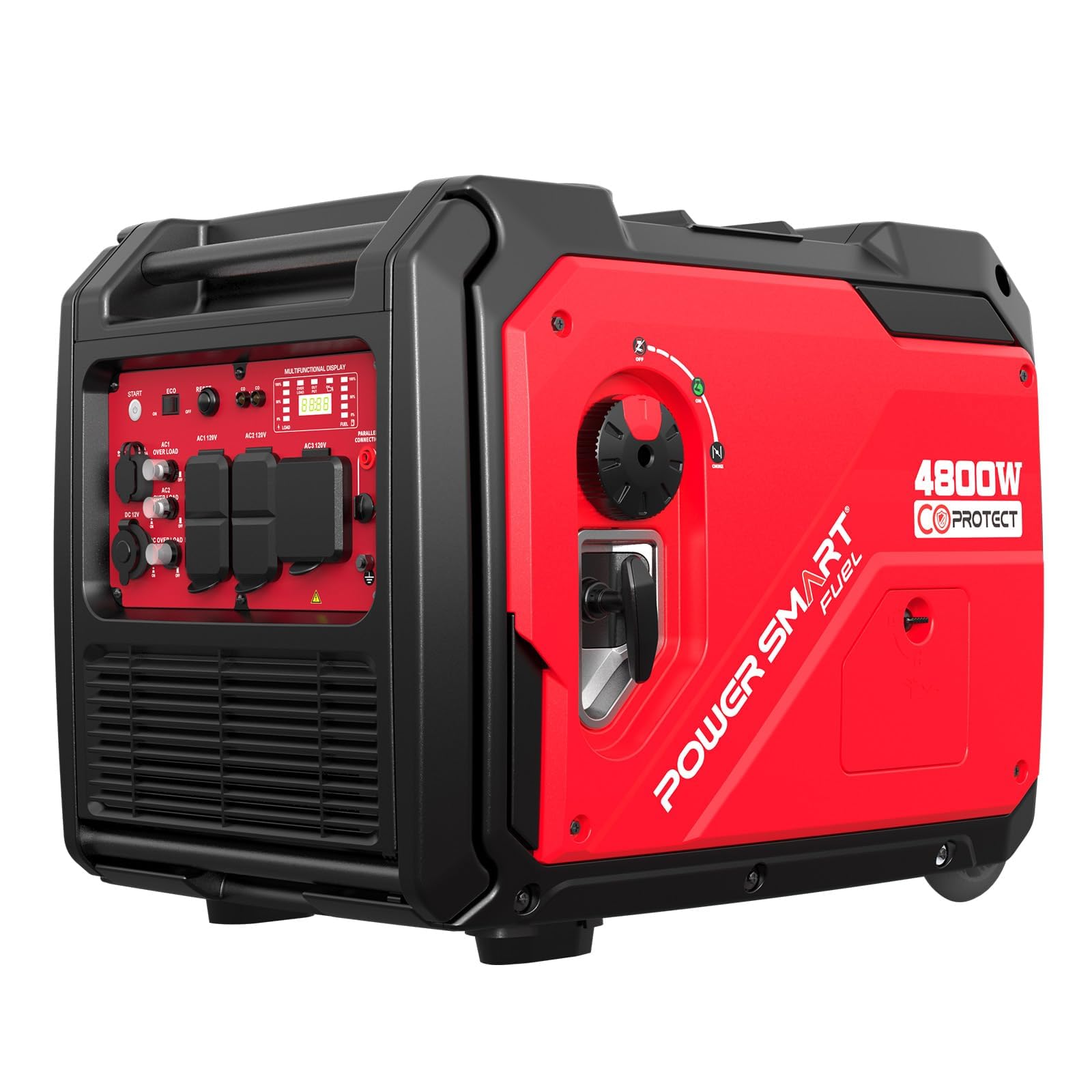
2. PowerSmart 4800W Inverter Generator, Parallel Ready & Electric Start
The featherweight inverter that slips into an RV bay yet still cranks out 4800 surge watts of clean power.
This PowerSmart is the pick for anyone who wants quiet, portable power without a premium price tag. It pumps out 4800 starting watts of clean inverter power (stable electricity that won’t damage your laptops and phones). Owners have run it for 72 hours straight during a power outage, and at 68 pounds it’s light enough to roll wherever you need it — a huge advantage over the 212.1-pound Westinghouse at the top of this list (a 3.1x weight gap).
The inverter technology makes it genuinely quiet, and the fully enclosed body keeps neighbors — and campground wildlife — undisturbed. Its 3.4-gallon tank provides up to 5 hours of continuous runtime at full load, with eco-mode stretching that further. The panel is versatile for its size: one 120V 30A RV outlet, two 120V 20A household outlets, and USB ports. It’s also parallel ready, so you can double the output by linking two units.
Value opinions split here — many call it an incredible deal, while a few advise caution. The recurring worry is long-term reliability, with a handful of owners reporting issues after several months of use. It’s also rated with a 2-year warranty, which is shorter than some rivals. For the price, though, you’re getting clean inverter power, electric start, and a portable frame that beats anything near its size for the money.
Why It’s a Value Pick
- Clean inverter power protects sensitive electronics
- 68 lbs is easy to move around
- Quiet operation for camping and neighborhoods
- RV-ready 30A outlet built in
What to Know
- Shorter 2-year warranty than some rivals
- A few owners mention reliability concerns after months
Grab it for: a budget-friendly, portable inverter that handles your RV, campsite, and essential home loads quietly.
Think twice if: you want the longest warranty or plan to run your whole house — this is for essentials, not full-home backup.
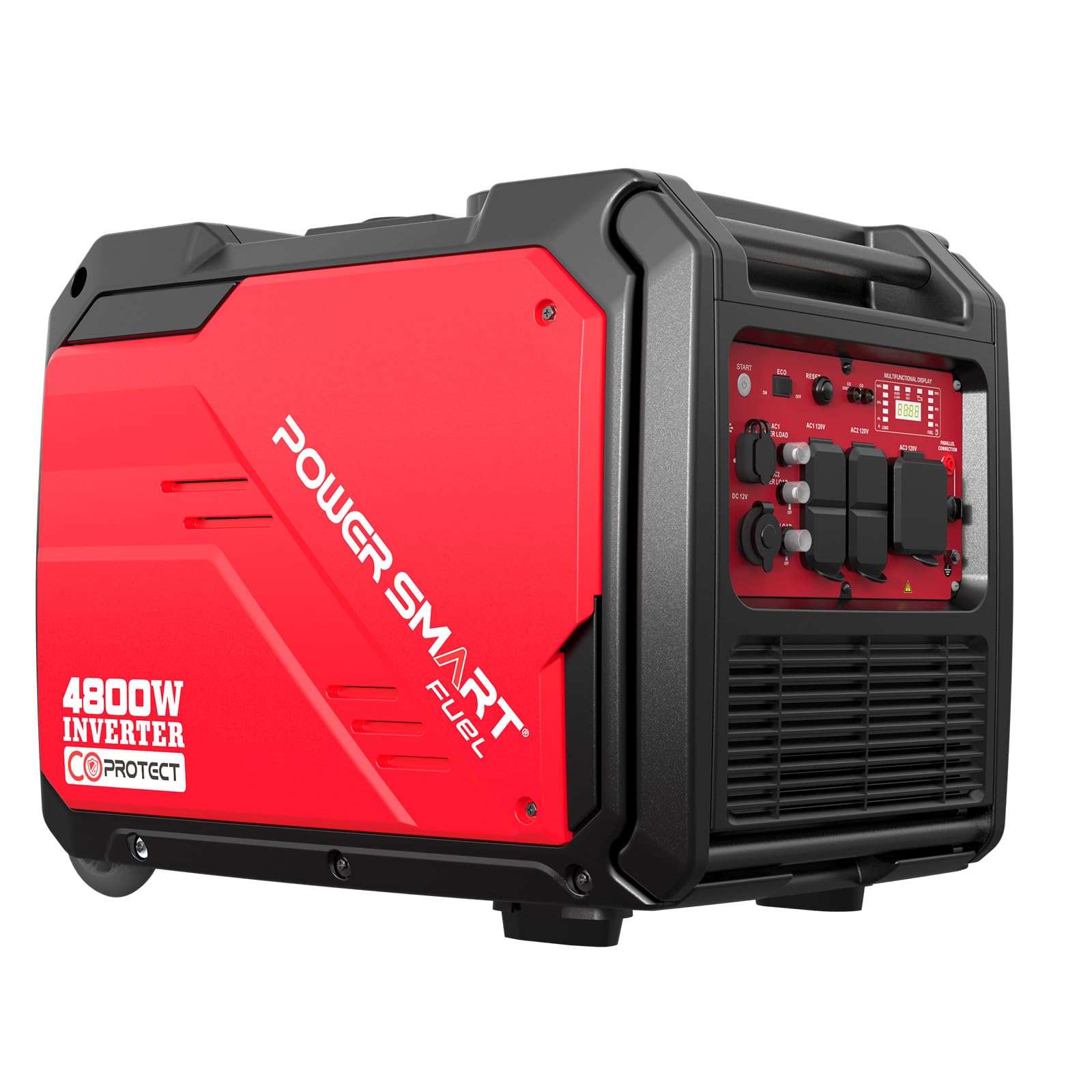
3. PowerSmart 4800W Portable Inverter Generator (223cc)
Extra 500W of headroom over standard 4500W models, so your RV air conditioner starts without a groan.
This 223cc PowerSmart is built with one specific advantage: a 4800-watt surge output that leaves headroom above typical 4500W units. That margin matters for high-induction appliances like a 15,000 BTU RV air conditioner and sump pumps, which need a strong surge to start. It delivers 4800 peak watts and 3800 rated watts, and the pure sine wave output is safe for phones, laptops, and even medical equipment.
The electric start is one-touch, with a manual pull backup, and the integrated CO Watchdog sensor shuts the unit down if carbon monoxide builds up. Run time is a strong point: up to 10 hours at 50% load on its 3.43-gallon tank, with an intelligent eco-mode that adjusts engine speed to match demand. At 65 dBA from 23 feet (about as loud as a normal conversation), it won’t dominate a campground.
Owners consistently praise how well it handles real-world storm duty, with stories of keeping refrigerators and freezers running for two days during a hurricane. At 89 pounds with a compact frame and wheels, it’s genuinely mobile for job sites and campgrounds. The main maintenance note: it’s worth doing the early oil changes more frequently — some owners found metallic shavings in the initial oil — and swapping the spark plug for a BPR6ES to get one-pull starts reliably.
Solid mid-size pick: a 4800-watt inverter that runs clean, quiet, and long — great for a truck camper or emergency essentials.
Keep in mind: early oil changes are more frequent, so budget a little maintenance time in the first weeks.
4. WEN 4800-Watt Dual Fuel RV-Ready Inverter Generator (DF480iX)
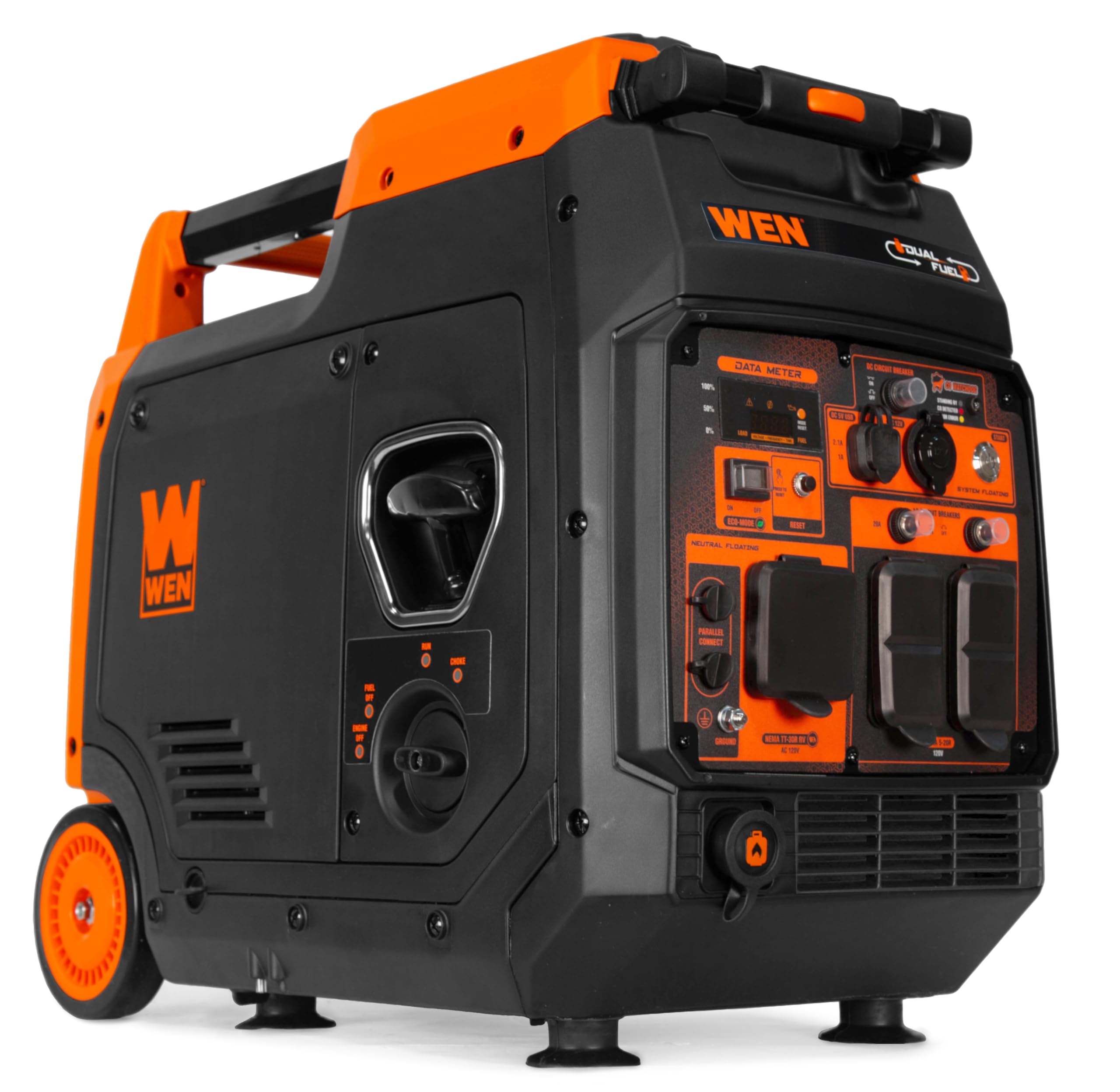
Runs on gas or propane with the quiet of a conversation, and a telescoping handle to pull it anywhere.
The WEN DF480iX gives you dual-fuel freedom in a portable 78.5-pound package. On gasoline it delivers 4800 surge watts and 4000 rated watts; switch to propane and you get 4320 surge and 4000 rated watts. That propane option is a genuine emergency advantage — it stores indefinitely and burns cleaner. Owners have run it for 10 days straight, and one 76-year-old owner found it easy to manage, a strong vote for its usability.
Quiet is this unit’s calling card. WEN rates it around the sound of a normal conversation, which owners largely confirm — one called it “barely audible on the patio.” The panel is packed: four three-prong 120V receptacles, a TT-30R RV outlet (standard for campers), a 12V DC receptacle, and two 5V USB ports. The telescoping pull handle and onboard wheels make it easy to roll, and the fuel shut-off (which stops gas flow to the engine) helps preserve the carburetor between uses.
The catch is battery maintenance. Several owners note the battery drains if the generator isn’t recharged regularly, so it’s worth a trickle charger (a device that slowly charges the battery) or a monthly run. There’s also a minor quibble about the battery connection panel being fiddly to reattach. For anyone who wants a real dual-fuel choice in a manageable size — especially for an elderly relative’s oxygen concentrator or a camper — this is the balance.
What Shines Here
- Conversation-quiet operation
- Both gas and propane fuel options
- Long telescoping handle makes rolling easy
- Fuel shut-off extends engine life
What to Watch
- Battery drains if not recharged regularly
- Battery connection panel is fiddly to reattach
Choose it for: a quiet, dual-fuel inverter that’s easy for anyone to operate and move.
Skip if: you want a remote start — this uses electric push-button, not a key fob.
5. WEN 6800-Watt Dual Fuel RV-Ready Inverter Generator (DF680iX)

A standout 240V output that can give your electric vehicle a low-power Level 2 charge during an outage.
This WEN stands apart with a bonded-neutral 240V configuration that supports low-power Level 2 charging for battery and hybrid electric vehicles. That’s a niche feature almost no portable generator offers — it lets you top up your EV when the grid is down. On gasoline it delivers 6800 surge watts and 5100 rated watts; on propane, 6000 surge and 4500 rated. The 6800 peak is handled by the same 224cc dual-fuel engine family as its smaller sibling.
Owners running it on propane have powered two 15,000 BTU RV air conditioners, a stove fan, and lights off a single 30A plug. For RVers, a 40-pound propane tank lasted 28-30 hours of continuous use in Texas heat, which is impressive endurance. The panel includes an L14-30R 120V/240V receptacle, two three-prong 120V outlets, a TT-30R RV outlet, a 12V DC receptacle, and two 5V USB ports. The voltage selector switch and six-foot LPG regulator hose add real flexibility.
The honest caveats are size and mixed reliability reports. At 99.2 pounds, it’s a heavier lift, and one owner found it wouldn’t fit under an RV’s storage bay. Reliability feedback is split — many praise it as quiet and powerful for the price, while a few report no-spark failures that warranty support didn’t resolve quickly. If you need 240V for EV charging or have a larger camper, the capability is hard to match; if you just need basic essentials, the lighter WEN above may suit better.
top-tier capability: 240V output (double the standard 120V household voltage) and 6800 watts make this the pick for EV owners and serious RVers.
Reality check: at 99.2 lbs it’s noticeably heavier, and a few owners hit reliability snags.
6. GENMAX 4600W Dual Fuel Generator (GM4600IAEDC)
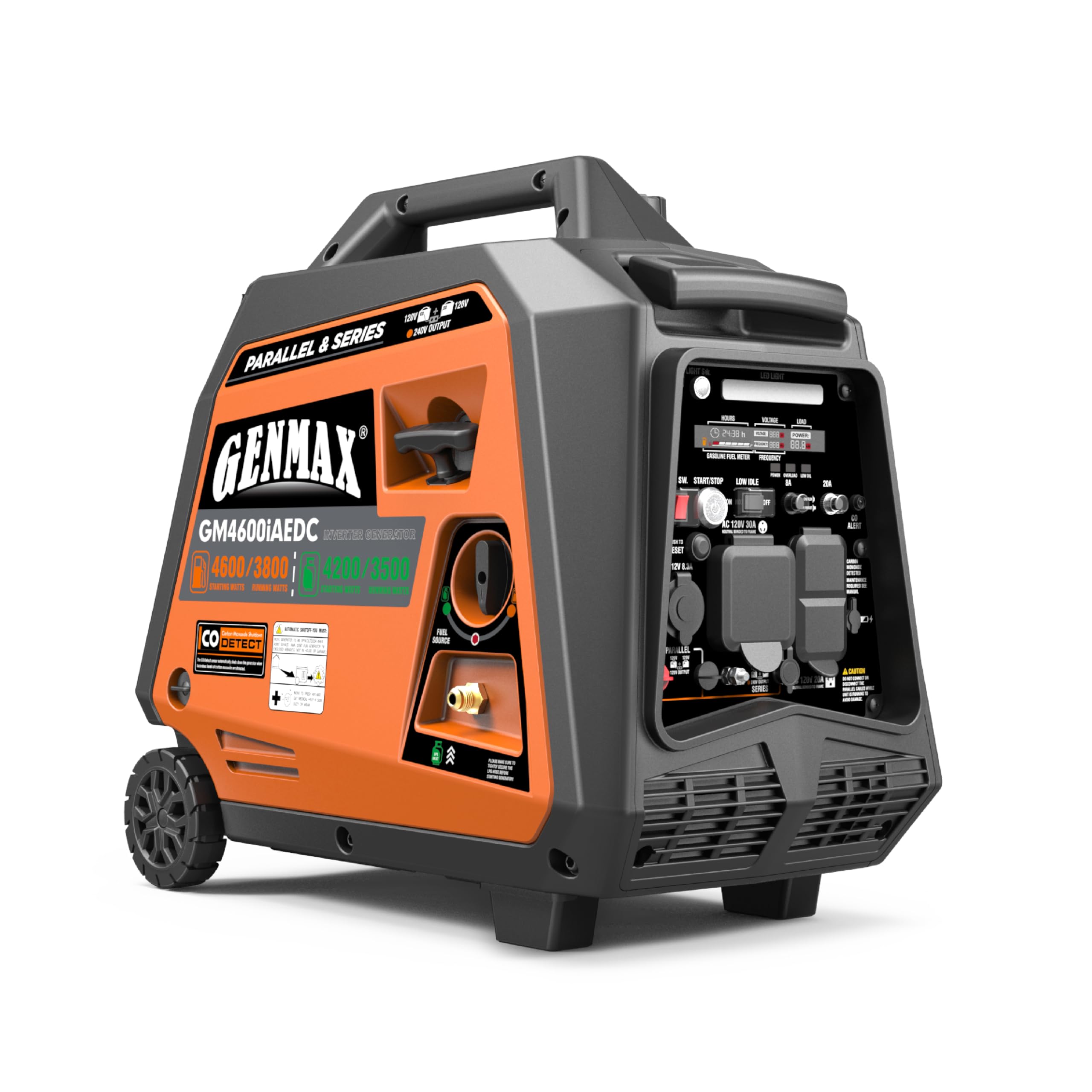
The 58.4-pound unit with a digital control panel, remote start, and a built-in LED floodlight for night work.
The GENMAX is built around portability and digital convenience. At just 58.4 pounds, it’s the lightest full-featured unit here, with a telescopic handle and wheels that make it easy to move — the brand even notes it’s manageable for “ladies” to carry long distances. The 159cc dual-fuel engine produces 4700 starting watts and 3800 running watts on gas, with under 3% total harmonic distortion, making it safe for sensitive electronics.
Its digital control center is a real differentiator: a big LED display shows hours run, voltage output, load, and fuel level. It offers push-button start plus a remote start key and a battery charger, with a DC 12V outlet ready for a USB-C adapter. The 30A RV-ready outlet suits campers, and it includes a magnetic dipstick that catches iron filings in the engine oil for better long-term health. A CO detector auto-shuts the unit down and an LED floodlight illuminates dark spaces for 30 seconds on startup.
Customers note it ran 18 hours on 2/3 of a propane jug during Hurricane Helene, with the remote, meters, and CO shutoff all working well. It’s also used in pairs — two units can be combined in parallel or series for a 240V output to charge an electric vehicle like the Rivian R1T. The trade-off is reliability opinions split sharply: some praise 650 hours without a hiccup, while a few report units that failed to start or broke within a month. With a 3-year warranty and lifetime technical support, it’s a capable portable if you get a good unit — just check it early.
Feature-dense and light: remote start, LED display, and a floodlight in a sub-60-pound frame.
Worth knowing: reliability feedback is genuinely mixed — test yours right away and lean on the 3-year warranty.
7. DuroStar DS13000MX 13,000-Watt Dual Fuel Portable Generator

A 13,000-watt dual-fuel workhorse that powers whole homes — including multiple AC units — with a push-button start.
The DuroStar DS13000MX is built for serious whole-home backup. Its 500cc engine delivers 13,000 peak watts, and reviewers point out it handling 1.5-ton air conditioners, a fridge, stove, microwave, TVs, and a water heater — all at once. It’s dual fuel (gasoline or propane) with a front-facing fuel selector, so switching between tanks takes seconds, not tools. The push-button electric start eliminates pull-cord struggle entirely.
What owners emphasize is how well it handles the surge moment. One noted only “slight strain” when the AC kicked in, which is the moment smaller generators trip their breakers. The remote start and all-metal construction add to its appeal for long-term reliability. It’s also transfer-switch ready with a 50A outlet, so you can hardwire it into your home’s panel for a smooth backup.
The main feedback check is on starting time. While many report flawless push-button starts, a few units have had issues that required troubleshooting — one owner initially thought his was broken before realizing the gas valve was off. It’s worth reading the startup procedure carefully. For the price and this level of power, though, the DuroStar is a strong contender if you need whole-home capability on a flexible fuel supply.
Why It’s a Heavyweight
- 13,000 watts handles multiple big appliances
- 50A outlet for transfer switch connection
- Push-button electric start
- Dual fuel with easy front-facing selector
Before You Buy
- Heavy unit — plan for a hand truck at delivery
- Follow the startup procedure carefully to avoid false start issues
Pick it for: a full-house backup machine with dual-fuel flexibility and enough surge for central air.
Pass if: you need something portable — this is a big, heavy unit meant to stay near a transfer switch.
8. Westinghouse 12500 Peak Watt Home Backup Portable Generator (Gas)

The gas-only Westinghouse that runs your whole home for 80 hours straight without a complaint.
This is Westinghouse’s gas-only version of their top performer, and it’s a favorite for a specific reason: pure, reliable, whole-home power. One owner ran their house for 80 hours without issues, powering everything from a 5-ton heat pump to multiple refrigerators and freezers. It delivers 9500 running watts and 12500 peak watts from the same 457cc cast-iron-sleeve engine, with an auto choke that simplifies cold starts.
The remote start key fob is a genuine luxury during a storm — you can start it from inside instead of heading out into the weather. Its 6.6-gallon tank provides up to 12 hours of runtime, and the panel includes two GFCI 120V 20A outlets, a 30A transfer-switch-ready outlet, a 50A RV outlet, and two USB ports. One owner compared it favorably to a 14-year-old Generac, noting the larger handle and 3x bigger tires make it genuinely easier to move.
The biggest gripes are its weight and manuals. At 212 pounds, it’s a two-person job to maneuver before the wheels are on, and the instruction booklets drew sharp criticism — one experienced owner said it took an architect and an electrician over 30 minutes to confidently start it the first time due to confusing instructions. A recurring long-term note: the wheels can fall off after about a year, so treat them gently. If you want whole-home power on gas alone and don’t need propane flexibility, this is a proven, durable workhorse.
Proven reliability: shoppers say 80-hour runs and whole-house coverage including 5-ton heat pumps.
Know before you buy: read the manuals thoroughly — they’re widely called confusing — and expect a 212-pound lift.
9. Champion Power Equipment 4500-Watt Dual Fuel RV Ready Inverter Generator

An exceptionally quiet 61 dBA inverter with a 21-hour propane runtime — built by a brand with a real support network.
Champion brings serious engineering credibility here, with a unit rated at 61 dBA — quiet enough for forest camping, as owners note. It’s a dual-fuel inverter delivering 4500 starting watts and 3500 running watts on gasoline, with a standout 21 hours of runtime on propane at 3150 running watts. That’s the longest endurance on this list for its class, ideal for multi-day outages where refueling trips are a hassle.
The inverter output is clean, making it safe for laptops and phones. Owners praise its immediate electric start — one called it the easiest of three generators they’ve owned — and Champion’s EZ Start Dial simplifies the process further. A lithium-ion battery replaces the lead-acid units that typically fail, and the Intelligauge power meter lets you monitor voltage, frequency, and hours. The unit ran an RV for 4 days in one account, and a Florida restaurant owner called it “the strongest & best bang for the buck” backup they’ve found.
At 99.2 pounds, it’s not the lightest inverter, and there’s no remote start — you’ll press the button at the unit. Owners note it’s moderately quiet rather than silent. The free 3-year warranty and lifetime technical support from a company with a strong reputation are a real plus for confidence. For quiet dual-fuel power with exceptional propane endurance, this is a top-tier choice.
What Earns the Price
- Exceptional 21-hour propane runtime
- Very quiet 61 dBA operation
- Reliable lithium-ion battery start
- Free 3-year warranty and lifetime support
What to Note
- No remote start — button is on the unit
- 99.2 lbs, so it’s on the heavier side for an inverter
Ideal for: campers and RV owners who want quiet power with long propane endurance and a trusted brand.
Not for: whole-home backup — this is an essentials and RV machine, not a 50A house feed.
10. Generac 12,500 Starting Watt Tri-Fuel Portable Generator
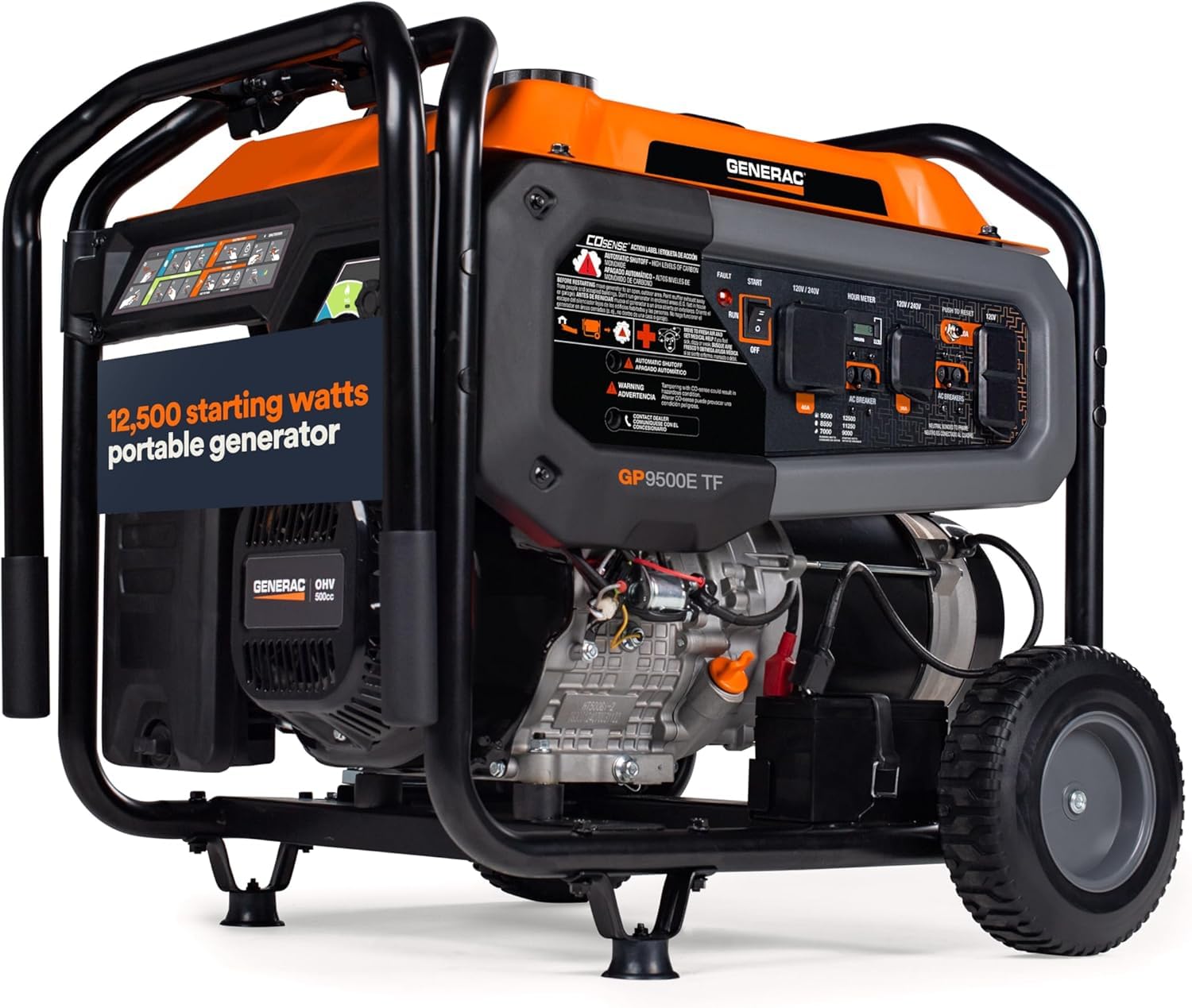
Gas, propane, or natural gas — one dial gives you three fuel options and virtually unlimited runtime on the gas line.
Generac is a household name in home backup, and this tri-fuel model shows why. A simple dial turn switches between gasoline, liquid propane, and natural gas, delivering 12,500 starting watts and 9,500 running watts. The natural gas option is the standout — if your utility line stays up during a storm, you have essentially unlimited runtime. The 7.5-gallon tank still manages 9.5 hours at 50% load on gas, or 14 hours at 25% load.
Its 500cc OHV engine pairs with automatic voltage regulation (AVR) to keep output stable for motor-driven tools and pumps. The COsense technology auto-detects rising carbon monoxide and shuts the unit down before danger — a feature owners in tight spaces will appreciate. The push-button electric start with an included 12V battery eliminates pull-cord effort, and the panel has two 120V 20A GFCI duplex outlets, a 30A twist-lock, and a 50A outlet for transfer switch hookup.
The honest caveat: this is a heavy 219-pound machine with 9.5-inch never-flat wheels and a folding handle to help, but it’s still a big unit to position. Reliability feedback is limited given its newer release, and one owner had a governor spring failure they felt wasn’t supported well. Generac’s 3-year residential warranty and brand reputation are strong counterweights. For a true tri-fuel whole-home solution, this is a compelling premium option.
Maximum flexibility: tri-fuel operation and a 50A outlet make this a genuine whole-home backup.
Consider: at 219 lbs it’s a heavy lift, and a few early buyers report support frustrations.
11. DuroMax XP13000HXT 13,000-Watt Tri Fuel Portable Generator
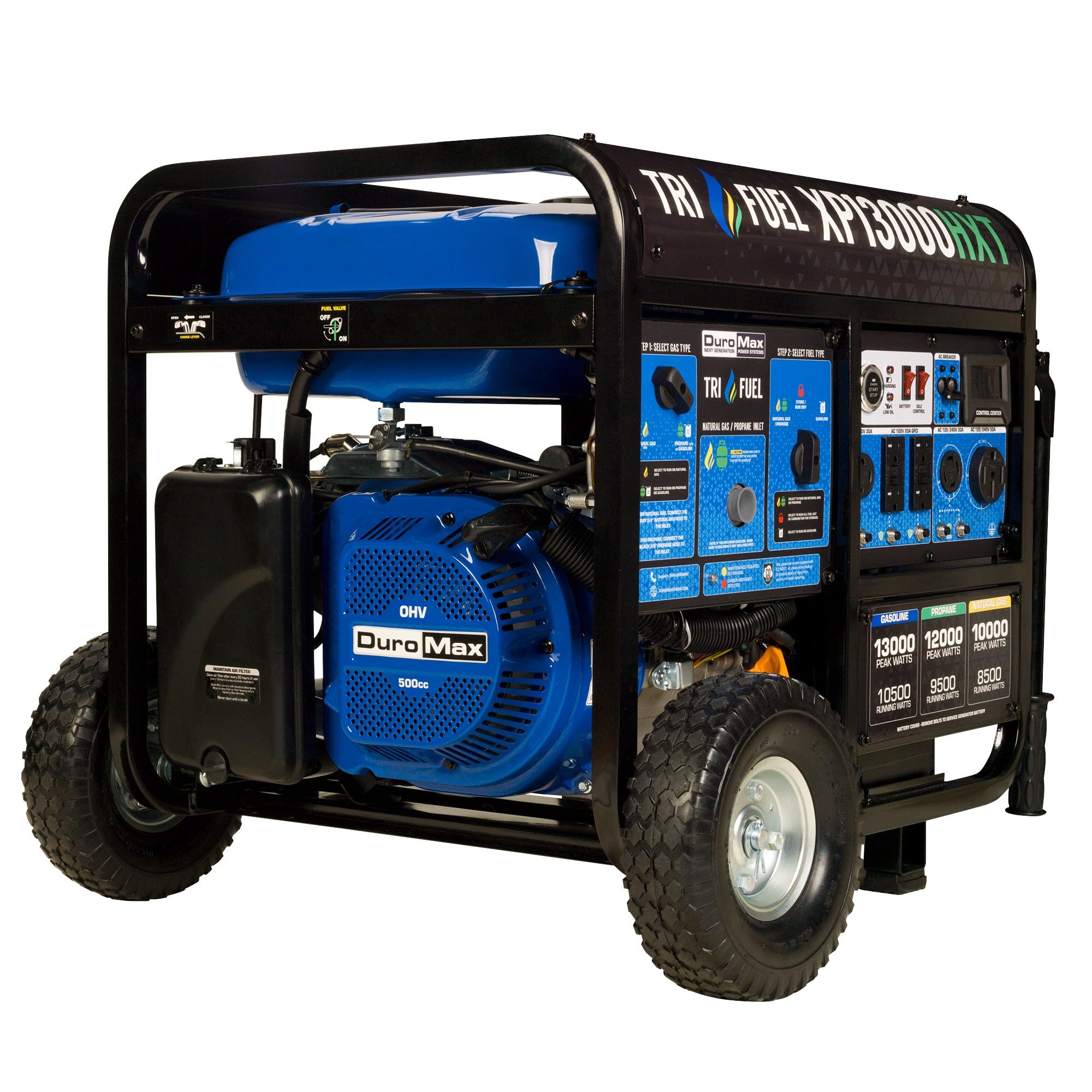
A 13,000-watt tri-fuel beast with remote start that runs a whole house for 48 hours on natural gas.
The DuroMax XP13000HXT is the tri-fuel heavyweight, and it’s the pick for owners with a natural gas line. Powered by a 500cc OHV engine, it pushes 13,000 watts and runs your entire home — AC, furnace, two fridges, and small loads — at around 60% load, per one owner’s interlock install. On natural gas, it ran for 48 hours straight, making it effectively unlimited backup if your utility stays online.
It ships with an impressive kit: a 15-foot natural gas hose, a propane regulator, a remote control, and a full tool set. The push-button start and remote mean you can fire it up from inside during a storm. One owner called it the best investment they’ve made, noting the total install cost them around versus for a standby Generac — a huge savings for whole-home natural gas backup. The front-facing interface changes fuel type in seconds.
The practical notes: at 240 pounds, this is the heaviest unit here — it has wheels, but plan for the moving. Owners advise a monthly 10-15 minute run and a battery maintainer, since the battery can die after a few months of sitting. It’s also slightly noisy given the 500cc engine. One reviewer noted the battery died after three months, but customer service replaced it free, which is a good sign for post-purchase support.
Why It’s a Tri-Fuel Winner
- Natural gas option gives near-unlimited runtime
- Remote and push-button start
- 50A outlet for whole-home transfer switch
- Included 15-foot natural gas hose
What to Plan For
- 240 lbs is a serious lift to position
- Battery needs monthly running or a maintainer
- No oil included — buy some before delivery
Reach for it if: you have a natural gas line and want whole-home backup for a fraction of a standby generator’s cost.
Look elsewhere if: you need portability — this 240-pound unit is meant to stay put near a gas connection.
Understanding the Specs
Starting vs. Running Watts
Starting watts (also called surge watts) is the brief burst of power an appliance needs to turn on — think of a fridge compressor or AC motor kicking in. Running watts is what it needs to keep going. A generator’s peak wattage must cover your largest surge plus everything else running at once. You’ll often see generators rated like “9500 running / 12500 peak,” so always check both numbers against your own appliance math.
Dual Fuel and Tri-Fuel
Dual-fuel generators run on gasoline or propane; tri-fuel adds natural gas. Gasoline gives maximum power but degrades in storage. Propane stores indefinitely and burns cleaner but reduces output — a generator that makes 12500 watts on gas might drop to 11200 on propane. Natural gas provides the longest runtime if the utility line stays up, but requires a professional connection. More fuel options mean more ways to stay powered during a long outage.
FAQ
How do I know what size generator I need for my house?
Is an inverter generator worth the extra cost?
Can I run a generator on propane instead of gasoline?
What does a CO sensor do and why does it matter?
How long can a generator run continuously?
What’s the difference between a 30A and 50A outlet?
Will a generator damage my laptop or TV?
How do I maintain a generator between outages?
Is it safe to run a generator in the rain?
Can I plug a generator directly into a wall outlet?
Final Thoughts: The Verdict
Across the board, the electric backup generator winner is the Westinghouse 12500 Dual Fuel because it delivers whole-home power with the convenience of remote start and the safety net of dual-fuel flexibility. If you want quiet, portable power for an RV or campsite, grab the PowerSmart 4800W Inverter at a light 68 pounds. And for natural-gas whole-home backup that approaches standby-generator capability at a fraction of the cost, the DuroMax XP13000HXT is the one to reach for.
How We Picked
We do not accept paid placement. Every pick is matched to a real buyer and a real use-case; we do not hands-on test units.
Sources & Methodology
Specifications: manufacturer listings and product documentation. Review insights: verified customer reviews, as of September 2026. Pricing: not shown on this page (it changes often); check the current price via the retailer link.
As an Amazon Associate, KitchPrep earns from qualifying purchases. This does not affect which products we feature.
Related Guides
