
Specs are compiled from manufacturer listings and verified buyer reviews and can change over time — please confirm the key details on the product page before buying.
When the grid drops, a 10,000-watt generator is the difference between camping in your living room and living normally. This list sorts through the 11 most serious home-backup contenders, matching each one to a real need — from a fuel-flexible tri-fuel inverter that sips gas to a dual-fuel workhorse that a food-truck owner runs daily. You’ll see exact running and peak wattage, run times, and engine sizes, so you can match the machine to your house, your fuel supply, and your wallet.
I’m Mohammad Maruf — the founder and writer behind KitchPrep. This guide is built by comparing the manufacturers’ published specifications and the patterns across verified customer reviews, so you get each pick’s real strengths and trade-offs instead of marketing spin.
We’ve matched each model to the loads it genuinely handles, from whole-home A/C to jobsite tools, so you can pick the right 10000-watt generator for your outage plan without over-spending on power you will not use.
Our Picks at a Glance


How To Choose The Best 10000-Watt Generator
At this power class, you are deciding how your whole house behaves when the lights go out. The main job is matching the generator’s real output, not its peak number, to the appliances you refuse to live without — your fridge, well pump, furnace fan, and possibly a window A/C.
The running-watts reality check
Peak (or starting) watts cover the brief surge when a motor kicks on, like a refrigerator compressor or a sump pump. Running watts are what the generator sustains hour after hour. A 12,500-watt peak machine with 9,500 running watts is a different beast from a 10,000-peak model with 8,000 running watts — the second may struggle to carry a central A/C and a fridge at the same time.
Fuel choice changes your outage strategy
Dual-fuel models burn gasoline or propane, which helps when gas stations are dark or when you want fuel that stores for years. Tri-fuel adds natural gas, which turns your generator into an almost unlimited power source if your gas line keeps flowing. Think about what fuel you can actually secure during a storm before you choose.
Safety gear you should not skip
Carbon monoxide (CO) sensors are now standard on serious models — they shut the engine down if fumes reach dangerous levels. A transfer-switch-ready outlet (the 50-amp 14-50R) lets a licensed electrician wire the generator into your panel, so you are never running extension cords across the house.
Quick Comparison
| Model | Best For | Running Watts (Gas) | Peak Watts (Gas) | Run Time | Amazon |
|---|---|---|---|---|---|
| Westinghouse 12500W Dual Fuel★ Best Overall | Whole-home backup | 9500W | 12500W | 12 hrs | Amazon |
| Pulsar G12KBN-SGLong Runner | Big tanks, long outages | 9500W | 12000W | 12 hrs | Amazon |
| DuroStar DS13000MXHeavy Hauler | Heavy whole-home loads | — | 13000W | — | Amazon |
| Genkins 11000W Dual Fuel | Food trailers & jobsites | 8000W | — | ~6 hrs | Amazon |
| WEN DF1100X | Budget hurricane season | 8300W | 11000W | 8.5 hrs | Amazon |
| Pulsar GD10KBN Inverter | RV & tailgates | — | 10500W | — | Amazon |
| DuroMax XP10000E | Proven 50-state reliability | 8000W | 10000W | — | Amazon |
| Generac 12500W Tri-Fuel | Brand-name tri-fuel home backup | 9500W | 12500W | 9.5 hrs at 50% | Amazon |
| Westinghouse iGen12000TFc | Electronics-safe clean power | 9000W | 12000W | 19 hrs at 25% | Amazon |
| DuroStar DS13000MXT | Natural gas whole-home | — | 13000W | — | Amazon |
In‑Depth Reviews
1. Westinghouse 12500 Peak Watt Dual Fuel
Our pick — over 4.5★ from 800+ verified ratings; the strongest balance of quality and price.
The crowd-proven whole-home standby that starts from your pocket with a key fob.
The headline here is the remote start key fob — you fire up 9,500 running watts from inside your house, which matters when the storm is howling. The heavy-duty 457cc cast-iron-sleeve engine pairs with a 6.6-gallon tank for up to 12 hours of runtime, and the fuel gauge means you are not guessing when to refill. It also runs on propane at 8,500 running watts if gasoline runs dry.
Buyers talk most about performance, with ease of setup second. Owners run whole homes and 41-foot trailers on it, and one says, “Ran my whole home and didn’t break a sweat.” Dual-fuel flexibility, build quality, and value-for-money all get consistent praise in the reviews.
The honest trade-off is the noise. Owners call it as loud as a gas lawnmower, typical for an open-frame unit — quiet-inverter seekers should look further down this list. It is also a 212.1-pound machine that needs its wheel kit installed (included tools make that a breeze).
What wins people over
- Fob-based remote start with integrated battery and over-crank protection
- Transfer-switch-ready and RV-ready 50A outlet included
- 3-year limited service, labor, and parts coverage
Fair caveats
- Noise level is open-frame loud — expect lawnmower volume
- At 212.1 pounds, you will want the wheel kit fitted
Reach for this if: you want the most proven whole-home generator here — 4.7 stars across 800+ owners — with the convenience of remote start.
Think twice if: you need whisper-quiet operation for close neighbors; this is a conventional open-frame machine.
2. Pulsar G12KBN-SG Heavy Duty Dual Fuel
A giant 8-gallon tank that powers a 2,600-square-foot house and A/C through the night.
The defining spec is the 8-gallon fuel tank delivering up to 12 hours of continuous operation at half load on gasoline. Buyers report it powers a 2,400 to 2,600-square-foot home with central A/C, one noting 16 hours on a single tank. The 457cc air-cooled OHV engine with electric start is wrapped in a durable powder-coated frame, and the outlet selection covers four 120V 20A sockets plus 30A and 50A twist-lock connections.
Reliability is the aspect buyers mention most, with performance a close second. One long-term owner reported zero issues after three years, and the dual-fuel gas/LPG capability is praised for emergency flexibility. The noise feedback is genuinely split — some find it quieter than their old 5,000-watt unit, while others describe it as loud but acceptable.
The real-world caveat is the break-in ritual: owners emphasize three oil changes during break-in, and a 50A hookup is required to run the whole house.
Why it earns its place
- 12-hour runtime at half load on a massive 8-gallon tank
- Metal tank with fuel gauge and durable powder-coated frame
- Rated 9,500 running watts on gas, 8,550 on LPG
Plan for this
- Break-in requires three oil changes before full trust
- Noise is mixed in owner feedback — expect a loud open-frame
Best suited to: homeowners who want the longest possible run between refills during multi-day outages.
Not for: buyers who cannot handle the heavy-lift delivery and break-in maintenance routine.
3. DuroStar DS13000MX 13,000-Watt Dual Fuel
A 500cc dual-fuel brute that carried a whole home’s A/C, stove, and water heater at once.
The 500cc engine’s 13,000-watt surge lets owners run a 1.5-ton A/C, fridge, stove, microwave, TVs, and water heater simultaneously without the unit flinching. The push-button electric start and front-facing fuel selector keep operation simple, and the all-metal steel frame is built for years of hard use. It is transfer-switch-ready with a 50A outlet.
Quality is the aspect buyers mention most by a wide margin, with value-for-money second. Owners describe it as phenomenal, genuinely quiet for its size, and easy to assemble from the start, with fuel-efficient operation during storms. The CO alert adds a layer of family protection that auto-shuts the engine if fumes build up.
There is a real split in the starting feedback — most report flawless push-button starts, but a few had units that only ran about 10 minutes or threw CO-alarm shutdowns that defied troubleshooting. Worth noting: owners stress following the startup procedure, and one “CO alarm issue” turned out to be a forgotten gas valve, which is user error, not a defect.
The power read: With 13,000 peak watts from a 500cc engine, this handles heavy loads as well as any machine here. But feedback from 250 owners shows starting times vary more than with the top picks.
Who it beats: Any home with a heavy simultaneous load; it outperforms the 839-rated WEN on raw surge capacity.
4. Genkins 11000 Watt Dual Fuel
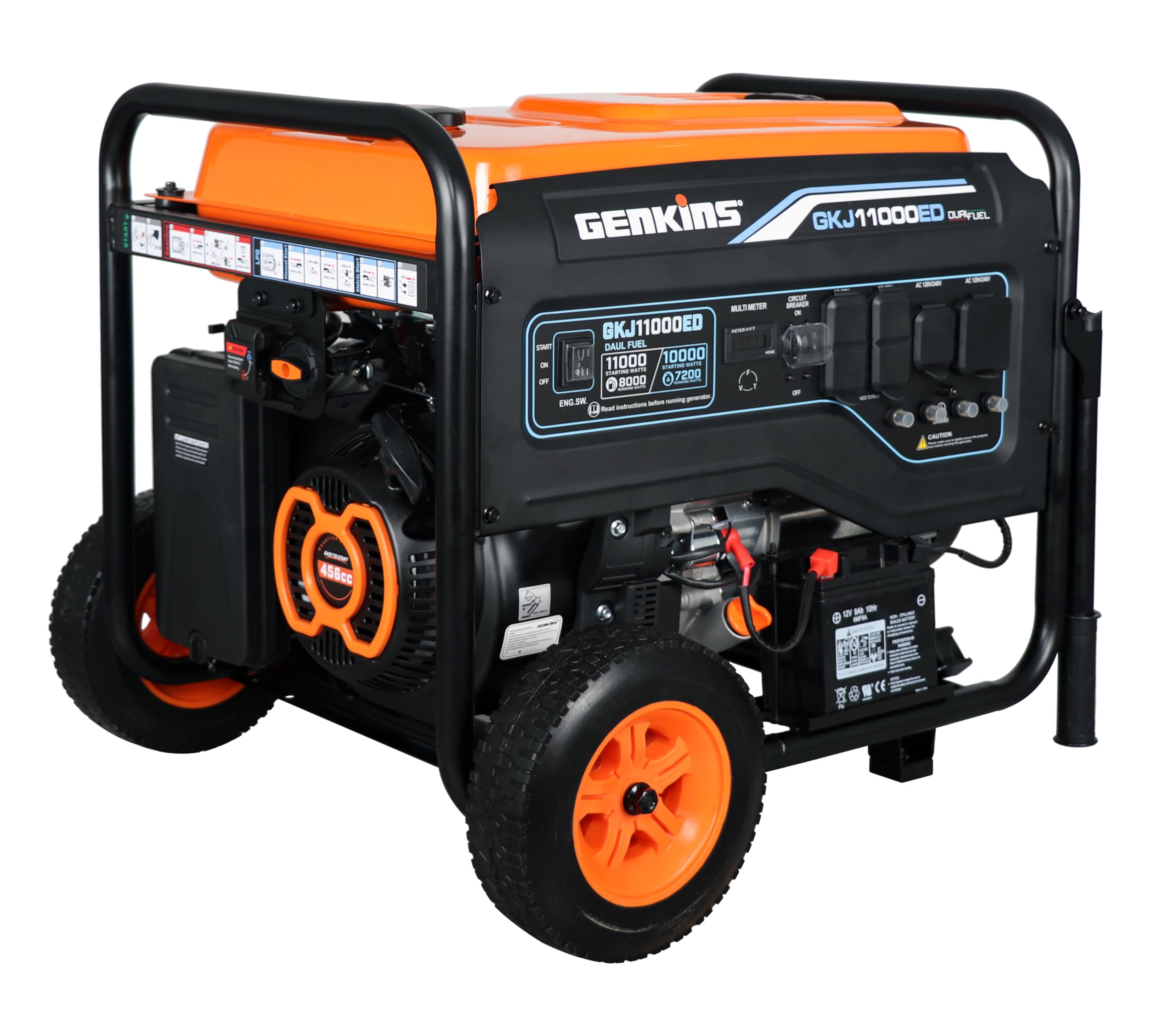
The 459cc dual-fuel that a food-trailer owner says runs his 14-foot rig with no problems.
Food-truck and jobsite buyers will feel at home here: the Genkins delivers 8,000 watts on gas (7,200 on LPG) from a 459cc four-stroke engine. It is lighter than the WEN — 196 pounds versus 213.8 pounds — and more compact at 28″L. The outlet panel has two GFCI 120V/20A sockets, an L5-30R 30A, and an L14-30R 120/240V 30A for transfer-switch setups.
The most telling owner feedback comes from a vendor running a food trailer: “Runs my food trailer 14 ft, with no problems,” noting a fill-up lasts about six hours and that it is loud — but no louder than the generators around it. A hurricane-season user borrowed one and found it “worked flawlessly, started every time,” strong real-world evidence for storm readiness.
The brand’s smaller review history is a caveat, and one owner hit a won’t-start unit with no support — reading the manual carefully is key, as another owner who did reported it started right up. For the money, this is a solid mid-range dual-fuel, not a premium one.
Built for mobile work
- 196-pound weight and 28″ footprint are manageable for a trailer
- Electric start with recoil backup plus automatic idle control
- Weather-protected outlets and durable steel frame
Consider this first
- Small review base means less long-term pattern data
- One won’t-start unit reported; follow the startup guide closely
Grab it for: food trailers, jobsite tools, and RV-ish loads where portability and dual-fuel matter more than premium brand polish.
Look elsewhere if: you want a deeply proven machine with thousands of owners behind it.
5. WEN DF1100X 11000-Watt Electric Start

The budget hurricane-season hero that one buyer says ran his dad’s whole house.
For the money, this is the value king of the list. The 6.6-gallon tank and included 47-inch LPG hose mean you can switch fuels in seconds.
Performance and starting performance are the joint most-mentioned positives, exactly what you want from an emergency machine. The review pages tell the story best: a buyer bought it for his elderly dad for hurricane season, and “pretty much ran his whole house during the last storm.” Another owner uses LP gas because it is “better on the carburetor,” a smart tip for occasional use.
At 213.8 pounds it is the heaviest machine in the comparison against the Genkins, so plan for a two-person lift or the included wheel kit. Owners also note the manual is excellent but that propane first-timers need to move the choke lever to “run” or it will not turn over — a fix that takes seconds once you know it.
The value case
- Dual-fuel switch dial between gas and propane
- CO Watchdog shutdown sensor for safety
- Includes wheel kit, 47-inch LPG hose, and 2-year warranty
Know before you buy
- 8.5-hour runtime trails the Westinghouse’s 12 hours
- 213.8-pound weight needs the wheel kit fitted
Perfect for: first-time buyers who want proven dual-fuel performance and storm-ready reliability without a premium spend.
Not ideal for: all-night marathon outages where the longer runtime of the Westinghouse pays for itself.
6. Pulsar GD10KBN 10500W Inverter
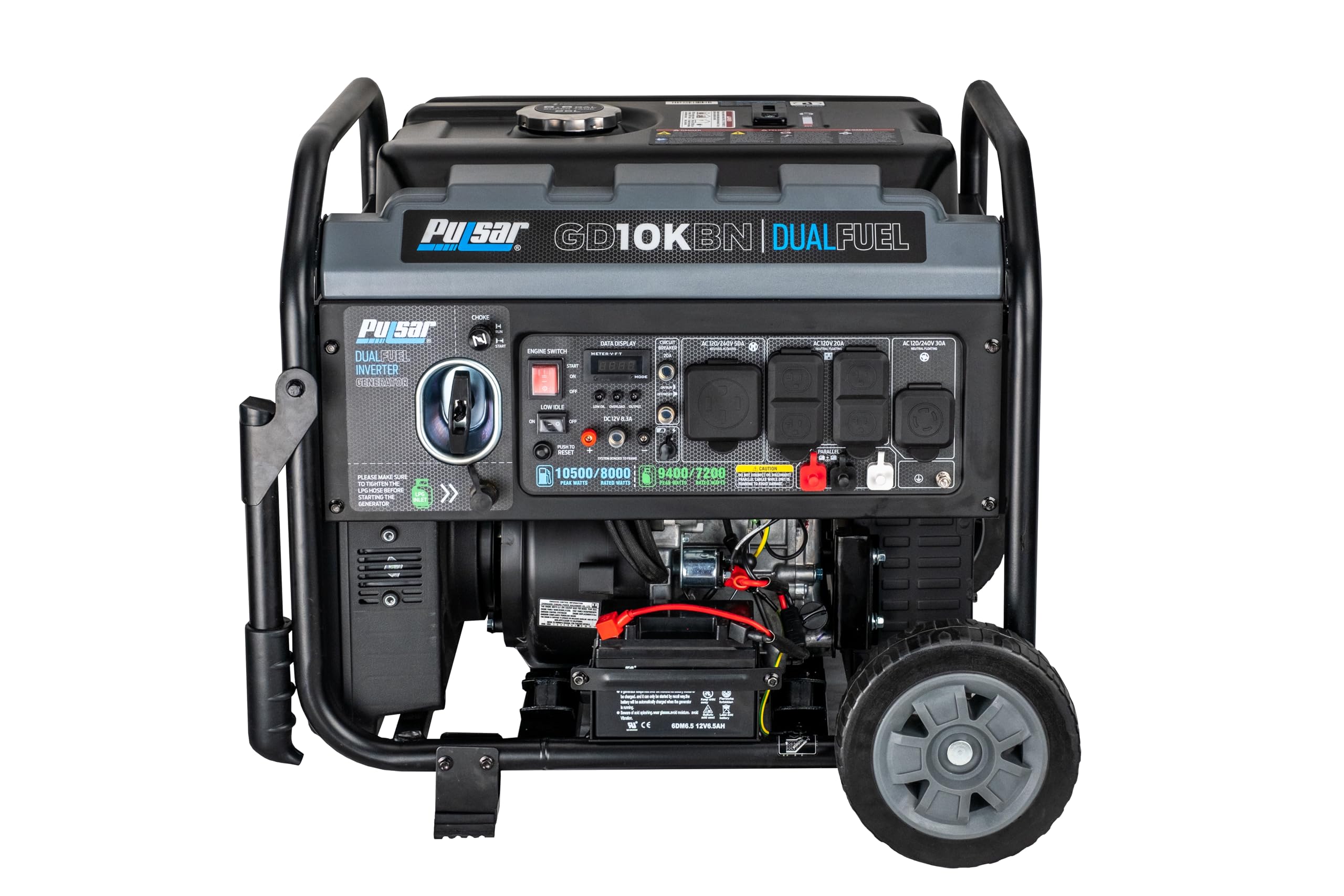
A 125-pound inverter that slips between home backup and RV trips with a digital displays hub.
The story here is weight: at 125 pounds, this is dramatically lighter than the open-frame giants above, and it is an inverter, which means cleaner power for sensitive electronics. The 312cc engine peaks at 10,500 watts, and the digital multimeter shows voltage, frequency, total hours, and hours until recommended maintenance — a level of detail the conventional frames lack. The 15-50R outlet makes it RV-ready for campgrounds and tailgates.
Owners confirm it handles real loads without flinching — one runs a full-size commercial warmer, a half-size commercial refrigerator, a hot water heater, and A/C simultaneously, reporting “it doesn’t phase it at all.” Reliability is the top positive aspect, and buyers appreciate the dual-fuel flexibility.
Here is the honest friction: this thing is loud. The noise level is the most-mentioned aspect, and the feedback is negative — “as loud as a B52 taking off” and “loud as a yelling match between two people.” The listed 68 dBA figure undersells the real-world experience for some. If quiet operation is why you wanted an inverter, this may disappoint despite the clean power.
What stands out
- 125 pounds is the lightest machine in this list by far
- Digital display with maintenance countdown
- RV-ready 15-50R outlet for campgrounds
The loud truth
- Noise is the dominant complaint — expect inverter-loud, not quiet
- 312cc engine is smaller than the open-frame 457cc units
Choose it when: you want a dual-fuel inverter’s clean power and portability for RV and light home use, not marathon quiet.
skip it if: a quiet neighborhood is non-negotiable — the Westinghouse iGen12000TFc below is the hushed alternative.
7. DuroMax XP10000E 10,000-Watt

The battle-tested veteran that ran for 77 straight hours through Hurricane Irma.
Raw endurance is this machine’s claim to fame. The 439cc OHV DuroMax engine provides 8,000 running watts and 10,000 starting watts, and One Florida owner ran his entire home plus neighbors’ fridge and freezer for 77 continuous hours during Hurricane Irma.. The exclusive MX2 technology lets you choose between 120V and 240V simultaneously or 120V-only with full power — a genuinely useful flexibility for how you distribute loads.
The reliability pattern across 600+ owners is strong. Reviewers describe instant starts, a steady voltage meter, and a healthy runtime of about 8-10 hours at medium load. Assembly is straightforward — wheels and handles install simply — and the airless tires are praised as ideal for thorny terrain. One owner noted it ran about 24 hours and considered it considerably quieter than smaller units.
The recurring expert advice is the 8-hour break-in: four hours no-load, four hours light, then an oil change. A few owners flag the key as prone to falling out (a tie-wrap fixes it) and note the unit is very heavy, needing two people. It is gas-only, so if fuel flexibility matters more than proven endurance, the dual-fuel options above win that argument.
The endurance case: 10,000 peak watts, EPA and CARB approved in all 50 states, and a documented 77-hour storm run make this the reliability pick for hurricane country.
The trade-off: No propane option and a 210-pound frame — this is a dedicated gasoline machine for serious outages.
8. Generac 12,500 Starting Watt Tri-Fuel
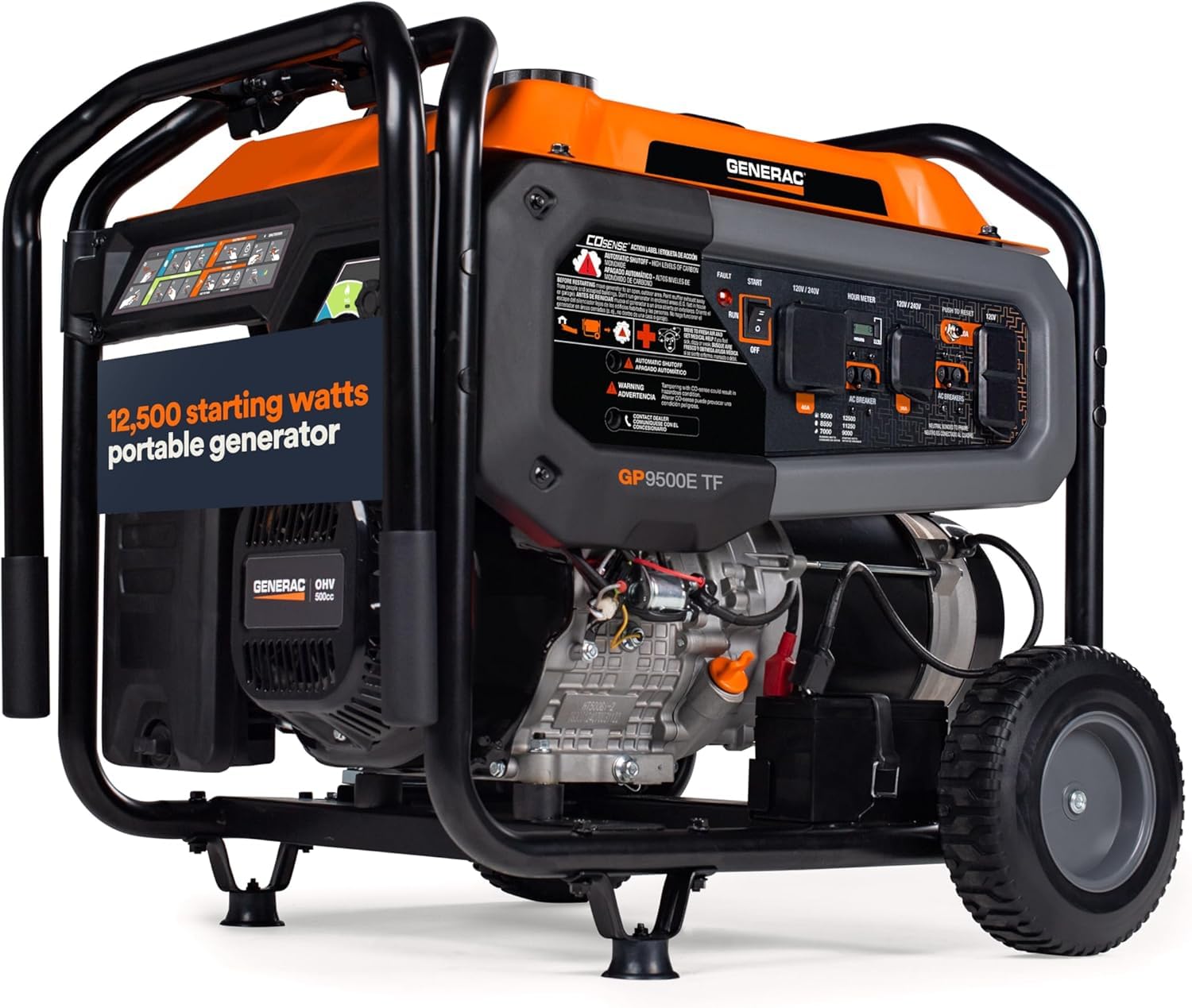
The trusted name in home backup runs on gas, propane, or natural gas with zero pull-cord effort.
Name recognition is real here, and the specs back it up: 9,500 running watts and 12,500 starting watts from a 500cc OHV engine, with the starting surge delivering 32% more capacity than running output for those simultaneous A/C-and-sump moments. The COsense technology auto-shuts down before carbon monoxide gets dangerous, and the push-button electric start with a 12V battery kills the pull-cord struggle. The 7.5-gallon tank delivers 9.5 hours at 50% load.
Owners call it “excellent,” noting it meets all criteria as described and has “lots of power, it should run the whole house including the AC.” One buyer replaced a still-working GP5500 with this purely for the brand trust. The natural-gas hookup is the standout feature — connect to a line for virtually unlimited runtime, which is a huge point for multi-day outages.
The friction point in the review history is support: one owner broke a governor spring after 2.2 hours and found Generac support unhelpful with no part number, plus local service centers declining service. It is a rare story, but worth knowing before you commit. At 219 pounds with never-flat 9.5-inch wheels, it is heavy but transportable.
Why buyers trust it
- Tri-fuel rotary dial with natural gas compatibility
- COSense automatic CO detection and shutdown
- HomeLink transfer-switch compatibility for safe hookup
Watch for this
- Support experience was poor in one documented breakdown
- 219-pound weight still needs the wheel kit
Buy it for: the reassurance of a major home-backup brand and the natural-gas unlimited-runtime option.
Hesitate if: you want the deepest owner track record at this power — the Westinghouse and Pulsar have far more reviews behind them.
9. Westinghouse iGen12000TFc Tri-Fuel Inverter
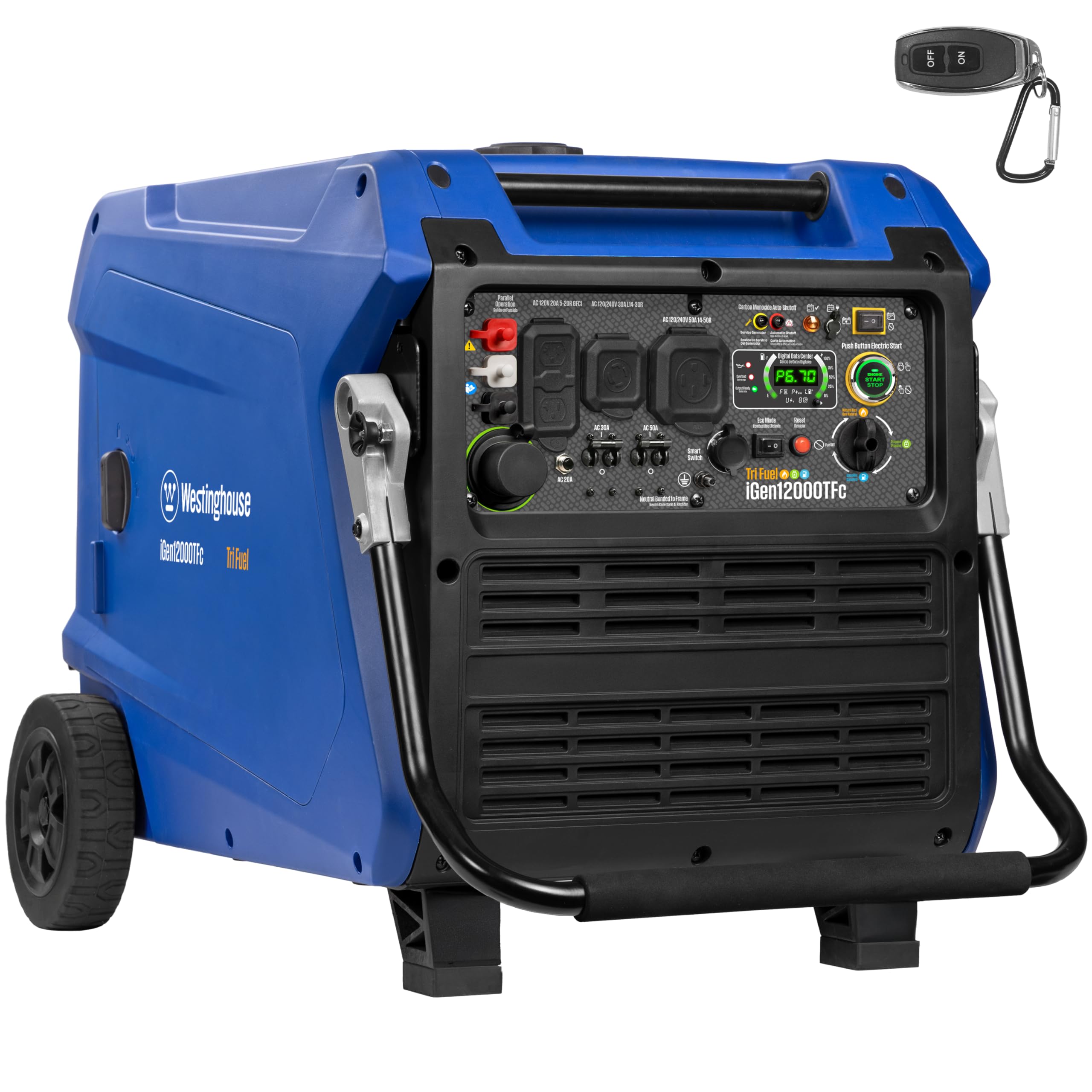
The 64 dBA tri-fuel inverter that runs 19 hours and protects your expensive electronics.
This is the luxury end of the list, and the specs explain why. The inverter produces electricity with ≤3% total harmonic distortion (THD) — that is the measure of power cleanliness, and under 3% means it is genuinely safe for laptops, TVs, and medical devices. Eco Mode, insulation, and mufflers hold noise to as low as 64 dBA, which is the quietest figure in this entire roundup. The 7.9-gallon tank delivers up to 19 hours at 25% load, the best endurance here.
Quality and reliability are the twin most-mentioned positives, and owners describe it as “super quiet” and a “top quality portable inverter generator” with a well-thought-out manual. It is tri-fuel (gasoline at 9,000 running watts, propane at 8,100, natural gas at 7,200), parallel-capable to double output, and the LED data center shows fuel level, power output, remaining runtime, voltage, and lifetime hours in real time.
You pay a clear premium for this — it is the most expensive pick in the lineup. At 191 pounds it is still a heavy lift, though lighter than the open-frame 212-219 pound machines.
The quiet power case
- ≤3% THD — safe for sensitive electronics
- 64 dBA operation with Eco Mode and insulation
- 19-hour runtime at 25% load on 7.9 gallons
Premium caveats
- Battery drains in storage — plan for a charger
- Highest price here; propane runtime may fall short of claims
Reach for it when: you want inverter-clean power, the quietest operation in this class, and the longest runtime — and you can justify the premium.
Pass if: your budget is better spent on a conventional dual-fuel with similar peak watts and a fraction of the price.
10. DuroStar DS13000MXT 13,000-Watt Tri-Fuel
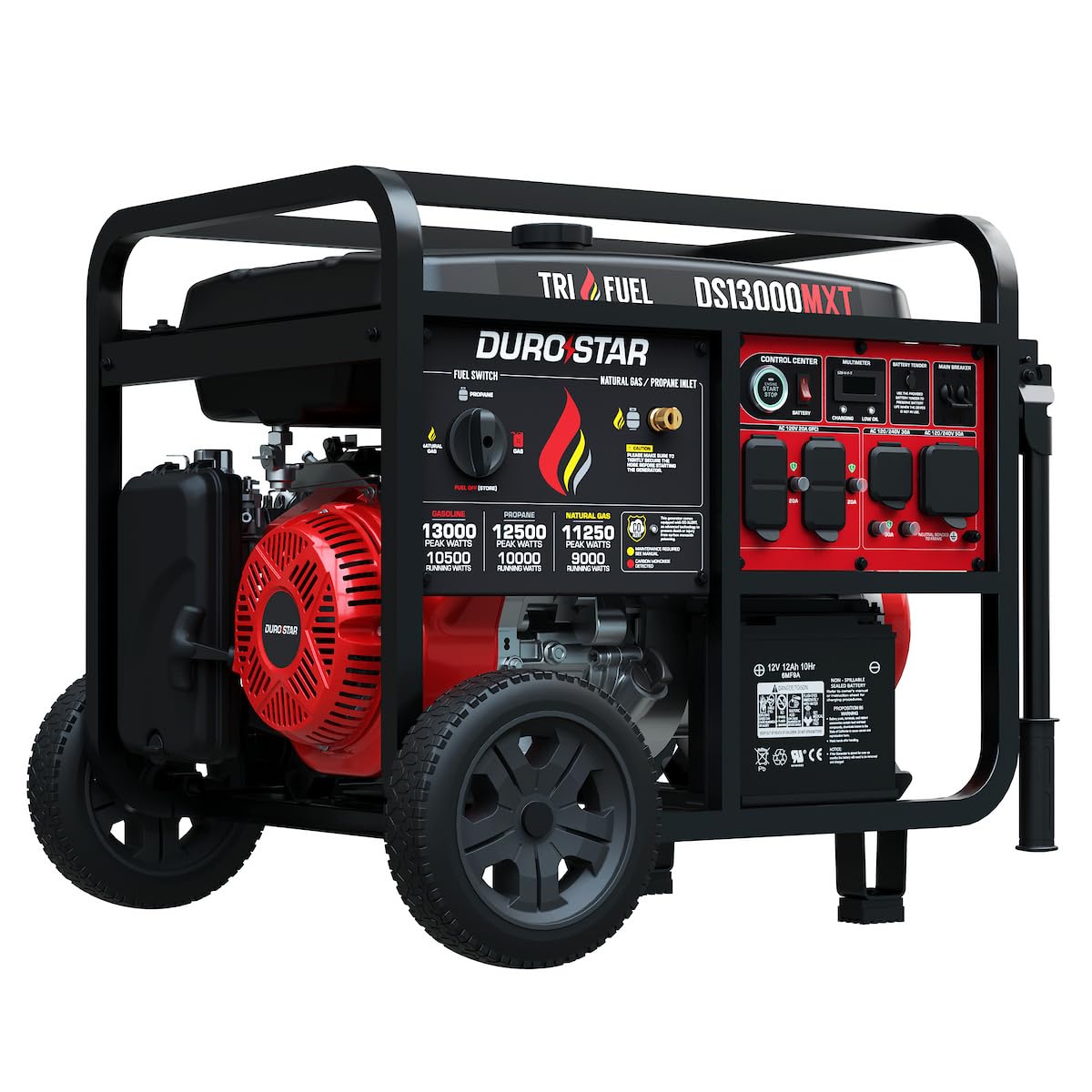
The tri-fuel 500cc that ran a home for 72 hours straight on a single delivery of fuel.
This is the natural-gas specialist. The DS13000MXT runs on gasoline, propane, or natural gas — and the box includes a 15-foot x 3/4-inch natural gas hose, which is the entire point for homeowners with a gas line. One owner logged 72 hours of continuous power for A/C, fridge, freezer, microwave, sump/ejector pumps, lights, and phones on gas, refilling every 12 hours. The 500cc 4-stroke OHV engine with remote electric start handles the 13,000-watt peak demand.
Performance is the top positive aspect, with satisfaction close behind. Owners call it “one of the best purchases in my 33 years of living” and note the push-button start and remote fob work great. The CO Alert auto-shutdown adds the safety layer for running it near living spaces. It is described as noisy but acceptable — standard for an open-frame at this power.
The specific recurring fix is the oil drain tube: it sits near the tire and can get snagged, pulling the plug and causing a leak — owners advise watching it closely. Shipping also drew complaints, with one delivery delayed over a week at the terminal. If you have natural gas access and want the fuel-flexibility trifecta, this is the machine to beat at its price.
The gas-line verdict: A 15-foot natural gas hose in the box plus 13,000 peak watts makes this the most complete tri-fuel package for homeowners with a gas hookup.
Proceed with care: The oil drain tube placement near the wheel is a known weak point — security-check it after transport.
Understanding the Specs
Running vs. Peak Watts
Running watts are the continuous power a generator sustains. Peak (or starting) watts cover the brief surge when a motor kicks on. Your fridge might draw 600 running watts but need 1,800 to start its compressor. Match the running watts to your total appliance load, and use peak watts as the buffer for simultaneous motor starts.
Run Time and Fuel Tank
Run time tells you how long a tank lasts at a given load — a 6.6-gallon tank at 12 hours versus an 8-gallon tank at 12 hours tells you which engine is more efficient. For outages, longer run time means fewer 2 a.m. refills. Pay attention to whether the spec is measured at half load or 25% load; they are very different figures.
THD and Sensitive Electronics
Total harmonic distortion (THD) measures how “clean” the electricity is. Conventional generators often run 5-10% THD, which most appliances tolerate. Inverter generators like the iGen12000TFc produce under 3% THD, making them safe for laptops, TVs, and medical devices that need stable power.
Fuel Types and Storage
Gasoline is the easiest fuel to find but degrades over months. Propane stores indefinitely and is cleaner-burning. Natural gas gives nearly unlimited runtime when the line keeps flowing. Dual-fuel means gas or propane; tri-fuel adds natural gas. Choose based on what you can secure during an emergency.
FAQ
What can a 10,000-watt generator actually run at once?
Is dual fuel or tri-fuel worth the extra cost?
How long will a 10,000-watt generator run on one tank?
Do I need a transfer switch or can I use extension cords?
What is a CO sensor and why does it matter?
How heavy are these generators and can I move them alone?
Is an inverter generator worth the higher price for home backup?
Which generator is best for a food truck or mobile business?
How many hours of break-in does a new generator need?
Final Thoughts: The Verdict
For most people, the 10000-watt generator winner is the Westinghouse 12500 Peak Watt Dual Fuel because it pairs the strongest owner reputation — 4.7 stars across 800+ ratings — with remote-start convenience, dual-fuel flexibility, and a proven 12-hour runtime. If you want electronics-safe clean power and the quietest operation in this class, grab the Westinghouse iGen12000TFc despite the premium. And for the best value in storm-season backup, the WEN DF1100X delivers proven dual-fuel reliability that one owner says ran his whole house during the last storm.
How We Picked
We do not accept paid placement. Every pick is matched to a real buyer and a real use-case; we do not hands-on test units.
Sources & Methodology
Specifications: manufacturer listings and product documentation. Review insights: verified customer reviews, as of September 2026. Pricing: not shown on this page (it changes often); check the current price via the retailer link.
As an Amazon Associate, KitchPrep earns from qualifying purchases. This does not affect which products we feature.
Related Guides
