
Specs are compiled from manufacturer listings and verified buyer reviews and can change over time — please confirm the key details on the product page before buying.
Damp basement walls can ruin boxes, furniture, and anything else you store down there. Your fix is one of two approaches: a coating that sits on the surface to block water, or a sealer that soaks in to harden the concrete itself. This guide ranks nine proven options by wall type, using real owner reports from heavy rain rather than label claims.
I’m Mohammad Maruf — the founder and writer behind KitchPrep. This guide is built by comparing the manufacturers’ published specifications and the patterns across verified customer reviews, so you get each pick’s real strengths and trade-offs instead of marketing spin.
You’ll see which formulas handle hydrostatic pressure, which stop brick dust, and which guard against mold as you shop for the right basement sealing paint for your walls.
Our Picks at a Glance


How To Choose The Best Basement Sealing Paint
Before you buy a drop, you need to know what is actually happening with your walls. A coating is a thick film that blocks water from passing through, while a penetrating sealer reacts inside the concrete to block moisture at the source. Choosing the wrong type for your wall material wastes time and leaves the dampness unresolved.
Identify Your Wall Material First
Poured concrete, cinder block, and brick each behave differently. Poured concrete accepts penetrating sealers beautifully, but block walls often need a flexible coating that bridges the mortar joints. Brick walls, especially older ones, tend to shed dust and sand, so a sealer that locks that down matters as much as stopping water.
Match the Coating to the Water Pressure
Not all leaks are equal. A wall that weeps during heavy rain is under hydrostatic pressure — the force of groundwater pushing against the concrete. Some coatings are rated to resist a specific pressure, like 12 psi or 20 lbs, which tells you how much force they can hold back. If your wall shows damp patches after storms, this number is your lifeline.
Check the Coverage Math
Coverage per gallon ranges from under 15 square feet for a thick rubber membrane to over 100 square feet for a thin paint. Measure your wall area, plan for two coats on bare concrete, and buy enough the first time. Running out mid-project leaves you with a weak seam and a damp patch.
Quick Comparison
| Model | Best For | Coverage | Water Resistance | Finish | Amazon |
|---|---|---|---|---|---|
| INSL-X WaterBlock★ Best Overall | Damp concrete walls | 75–125 sq ft/gal | 12 psi pressure | Semi-Gloss | Amazon |
| TUFINEIN Rubber SealantFlexible Fixer | Cracks & leaks | 21.4 sq ft | -40°F to 176°F | Rubber membrane | Amazon |
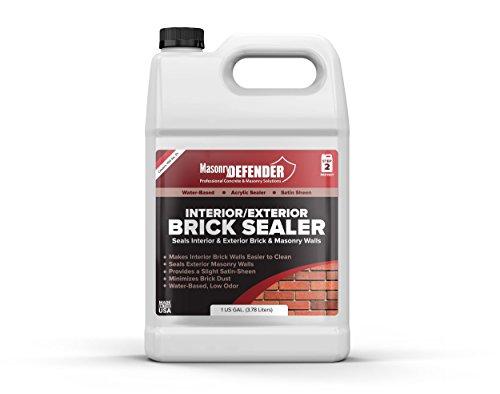
| MasonryDefenderDust Buster | Brick dust control | 80–150 sq ft/gal | Water resistant | Satin sheen | Amazon |
| Zinsser WaterTite | Mold & mildew | 100 sq ft | 20 lbs pressure | Matte | Amazon |
| Tkaimy Sealant | Invisible repairs | 14 sq ft/kg | Water-based membrane | Clear | Amazon |
| Ames Blue Max | Foundations & roofs | — | 1200% elongation | Blue rubber | Amazon |
| KOMPOZIT Floor Paint | Garage & patio floors | 300–400 sq ft/gal | Hot tire resistant | Satin | Amazon |
| Stormdry Brick Sealer | Exterior brick & stone | — | 25-year protection | Clear cream | Amazon |
| RadonSeal | Poured concrete floors | — | Deep penetrating | Clear | Amazon |
In‑Depth Reviews
1. INSL-X WaterBlock Acrylic Masonry Waterproofer Paint
Our pick — over 4.5★ from 250+ verified ratings; the strongest balance of quality and price.
The top-rated coating that stops weeping concrete walls after two coats.
This is the paint owners reach for when damp walls and floor seepage are the daily reality. It’s a water-based coating made for vertical interior and exterior concrete, which means it suits basement walls, foundations, retaining walls, cinder blocks, stucco, and brick. The standout stat is its ability to withstand up to 12 psi of hydrostatic pressure — the measure of groundwater force — so it holds back the kind of leak that shows up after a hard rain.
The effectiveness is what wins people over, and the quality follows close behind. Buyers report that two coats stopped water leaking in during “a few good long heavy rains” and everything stayed dry afterward. One owner noted it “goes on like a heavy paint” and that a long-nap roller, not a brush, delivered the bright white coverage they wanted. The included can opener and stir stick are a small but real convenience.
Coverage runs 75 to 125 square feet per gallon, and it tolerates high alkali conditions up to pH-13, which matters on fresh masonry. It also dries fast, but you must paint only when surface and air temperatures sit between 50°F and 90°F — cold weather will ruin the bond. The semi-gloss finish leaves a clean, washable surface rather than a flat, chalky one. Given its rating against a hefty review base, this is the safest bet for most basement walls.
Where It Shines
- Rated to withstand 12 psi of hydrostatic pressure for real leak protection
- Water-based with low odor and simple soap-and-water cleanup
- Works across concrete, block, stucco, and brick surfaces
Know Before You Paint
- Needs two coats for reliable waterproofing on bare walls
- Temperature-sensitive — only applies between 50°F and 90°F
Reach for this if: your concrete basement walls weep or leak after storms and you want a proven, easy-rolling paint that holds up under pressure.
Look elsewhere if: you’re working in cold weather or you need an invisible sealer that soaks in rather than a visible paint film.
2. TUFINEIN Rubber Liquid Waterproof Sealant
A thick rubber paint that stretches with the wall and bridges small cracks.
When your leak is a crack rather than a whole damp wall, this rubberized sealant is the specialist. It’s built on elasticity — the coating smoothly covers small gaps and resists the substrate’s natural movement, which is exactly what a rigid paint can’t do. Initial film formation happens in 2 to 4 hours, and it holds stable from -40°F to 176°F, so freezing winters and hot summers won’t make it crack.
Application is where owners get the most value. It self-levels and can go on with a brush, roller, scraper, or even poured, and it forms a dense rubber membrane that seals water, gases, and moisture. It suits metal roofs, sheds, concrete basements, walls, gutters, wooden skylights, and even low-pressure small swimming pools and bird baths. The quality earns the most praise, with application close behind.
The honest trade-off is coverage — owners mention that with two coats, the 1.5 kg (53 oz) container covers less than 11 square feet. That’s a fraction of what a paint covers, so this is a patch-and-crack product, not a whole-wall solution. Also, its cured surface stays tacky, so it’s not meant for walking surfaces. You win big on flexibility and crack coverage, but you pay for it in square footage.
Crack coverage, not wall paint: the rubber formula stretches and seals small cracks where rigid paints fail, but the 11 sq ft two-coat coverage means it’s best for targeted leak repair, not sweeping an entire basement.
Best for: sealing cracks, joints, and small problem spots on concrete, metal, or roofs where flexibility matters more than coverage area.
skip it if: you need to seal an entire large wall — the small coverage per can adds up fast in cost.
3. MasonryDefender Brick Sealer
A clear acrylic sealer that locks down dust and sand on old brick walls.
If your basement has exposed brick, you know the constant gritty film that settles on everything. This acrylic sealer is the answer — a water-based, clear formula that forms a washable barrier to repel dirt and grime while locking down the dust and sand that old brick and mortar shed. Sealing performance is the thing everyone raves about, with application close behind.
Owners of 1875, 1905, and 1920s homes report that a single coat stopped dust and sand fallout from their brick walls, and it didn’t alter the look they loved. It dries fast to a subtle satin sheen, and multiple coats increase the shine if you want a glossier look. The low-odor, water-based formula sprays, rolls, or brushes on, and it covers 80 to 150 square feet per gallon, which beats most competing sealers on value.
The one mixed note is color — while most see it bring out rich brick tones, a few report it can turn some bricks white. It’s a water-resistant barrier, not a heavy waterproofing film, so it’s best for dust control and moisture resistance rather than stopping active leaks. For an old brick wall that crumbles when you touch it, this is the quiet hero.
Preserves the look, kills the dust: a single coat stopped dust and sand fallout on 1875-era brick walls, all without changing the surface character — a rare balance of protection and appearance.
Choose this for: interior or exterior brick walls, fireplaces, and masonry that shed dust and need a clear, breathable, washable seal.
Think twice if: you have a full-on active leak — this is a water-resistant sealer, not a high-pressure waterproofing paint.
4. Zinsser WaterTite Mold & Mildew White Waterproofing Paint
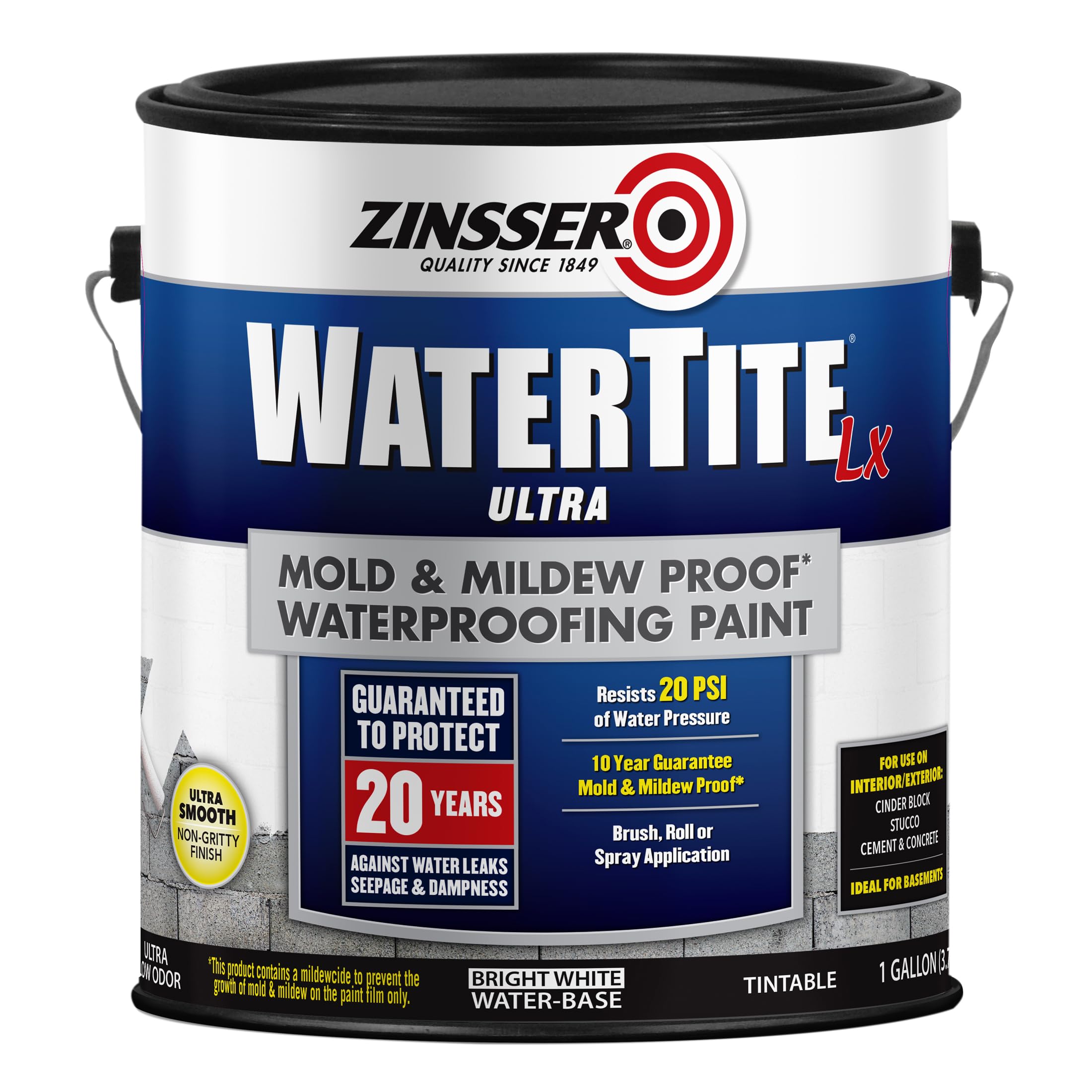
A mold-resistant white paint rated for 20 lbs of water pressure.
Zinsser handles tougher water pressure than the top pick — this latex-base paint resists up to 20 lbs of water pressure, compared to 12 psi for the top pick, so it suits walls facing serious groundwater force. It’s also formulated to resist mold and mildew, backed by a 15-year waterproof guarantee and a 10-year mold-and-mildew-proof guarantee on the paint film.
The formula delivers a very smooth, bright white, non-gritty finish that applies easily to dry walls with a brush or roller. Customers note it “stopped the water” weeping through poured concrete walls during heavy spring rains, and it took two coats on their walls. Another owner refreshed a dingy basement corner shower by scraping, wire brushing, and bleaching cinder blocks, then painting — the finish held up great.
The catch is odor — a few reviewers point out the smell is strong, with one saying they had to stop several times. The finish is matte, so you trade the washable gloss of the INSL-X for this mold-fighting formula with a higher pressure rating. Coverage is up to 100 square feet per gallon, and it dries in 2 hours. This is the specialist for mold-prone, high-pressure walls.
The Strong Points
- Resists up to 20 lbs of water pressure for tougher leaks
- 15-year waterproof and 10-year mold & mildew guarantees
- Ultra low odor with easy soap-and-water cleanup
The Trade-Offs
- Some shoppers say a strong smell during application
- Coverage of 100 sq ft per gallon is on the lower side
Pick this if: you’re dealing with mold-prone walls or weepy concrete under serious water pressure and want guaranteed protection.
Pass on it if: you’re sensitive to paint fumes — the odor notes are enough to give you pause in a small, enclosed space.
5. Tkaimy Waterproof Sealant
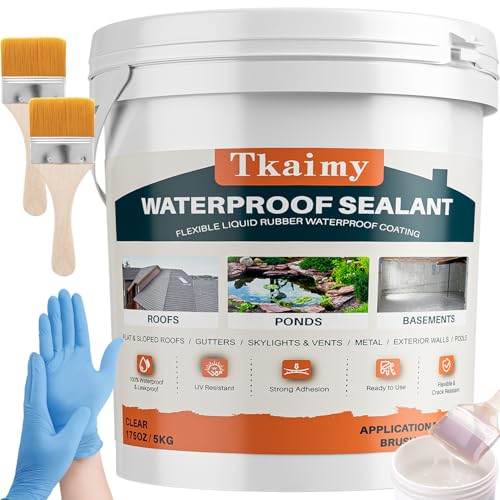
A transparent gel that seals leaks without changing the surface you’re fixing.
This one answers a different question: what if you don’t want to see the fix? Tkaimy cures into a transparent waterproof membrane that won’t change surface texture or color, so it works on basements, roofs, sheds, walls, metal, wood, concrete, gutters, skylights, and RVs. The water-based gel stays clear, which is why it earns consistent praise.
Application is simple — mix well, then brush, roll, dip, or pour it on. Owners note it’s “thick enough to cover cracks well, but easy to spread,” and it dried much faster than expected. It’s sturdy and prevents leaks, with one owner using it to stop a slow bathroom leak entirely. Quality is the most-praised aspect, with effectiveness close behind.
Coverage is the real number to watch: each 1 kg covers approximately 14 square feet at one layer, and the label recommends 2 to 3 layers with 24 hours between coats. That makes it a precise, high-value product for cracks and localized repairs rather than whole walls. The cure time also stretches in cold, rainy weather — the maker specifies use at 50°F or higher. For invisible, reliable leak repair, this is a standout.
Invisible and effective: owners rave about its sealing power and fast dry time, and the clear finish means the repair is invisible on concrete patios, rocks, and even headlamps — versatility that few paint-style products offer.
Grab this for: invisible crack and leak repairs on a wide range of surfaces — indoors or out — where you want the fix to disappear.
Leave it on the shelf if: your goal is to coat a whole wall; the 14 sq ft per kg coverage makes large areas impractical.
6. Ames Blue Max Liquid Rubber Waterproofer

A stretchy blue rubber coat that moves with the surface instead of cracking.
Here’s the flexibility king. Ames Blue Max is a durable blue coating with 1200% elongation — meaning it can stretch over 12 times its length before breaking. That’s what keeps it from cracking and peeling as your foundation shifts, settles, and expands with temperature changes. It’s built for above- and below-grade basements, foundations, insulated concrete forms, and underlayment.
Waterproofing is the thing owners praise most, and application follows. It can brush, roll, or spray onto vertical or horizontal surfaces, and it’s non-toxic and VOC compliant in all 50 states. Owners sealed leaking Bilco basement door seams and “NO LEAKAGE!” after heavy rains. It also works as a primer on metal and RV roofs before a top coat. The 1-gallon pail brushes easily and cleans up with water.
Durability draws mixed feedback — some report it lasting over 6 years, others say it doesn’t hold up. The formula is UV sensitive, so exterior use demands a top coat to protect it from sun damage. One owner noted a strong odor despite the VOC-free claim, and it took 4+ days to dry in 95°F desert heat, not the stated time. It’s a capable, flexible membrane, but the blue color (the only option) and drying quirks mean it rewards patience.
Why Owners Trust It
- 1200% elongation resists cracking from foundation movement
- Non-toxic and VOC compliant in all 50 states
- Versatile on concrete, wood, and metal — including roofs
What to Watch
- UV sensitive — exterior use requires a protective top coat
- Drying time can stretch far past stated hours in heat
Reach for this if: you need a flexible rubber membrane that bridges movement and seals foundations, door seams, or underlayment — and you don’t mind painting blue.
Look elsewhere if: you need a fast-drying solution or a clear finish; this one is blue, slow-curing at times, and needs a top coat in sunlight.
7. KOMPOZIT Acrylic Concrete & Garage Floor Paint
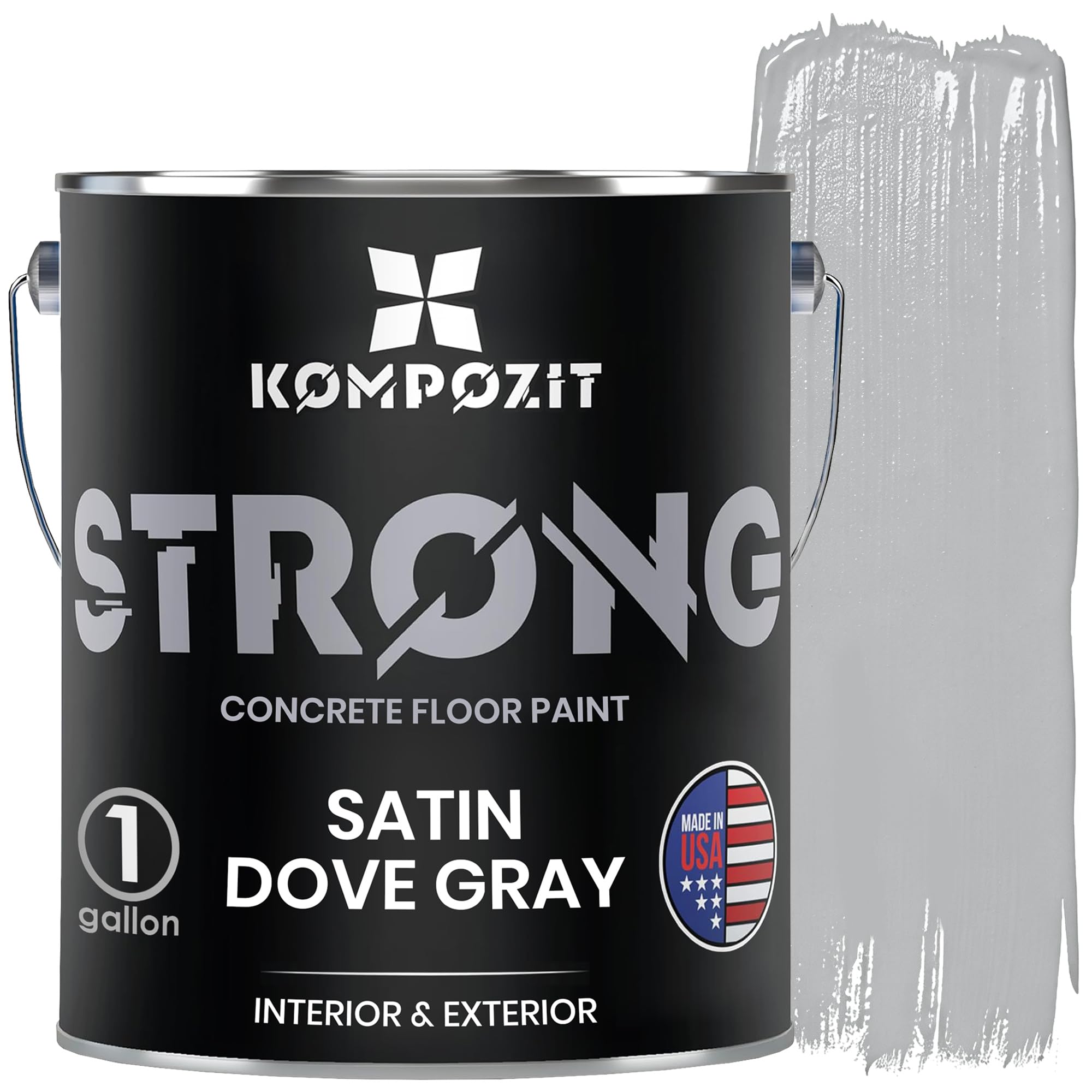
A satin gray acrylic floor paint that resists sun, rain, and hot tires.
Not every basement problem is a wall — sometimes it’s the floor. This acrylic paint from KOMPOZIT is engineered for garage floors, basements, patios, porches, and workshops, with 100% acrylic protection and hot tire resistance built in. That makes it a smart pick for the slab under your car or the walkway leading to your backyard.
Durability is the weak point of most floor paints, and that’s exactly what owners praise most here. One owner coated a walkway slab and reported the coating “stays put & doesnt fade or wash away” in sun or rain, and it didn’t peel even over a stubborn old rust-colored stain. Coverage earns the second-most praise. The self-priming formula skips a separate primer step on properly prepared concrete.
The coverage math is generous — about 300 to 400 square feet per gallon, depending on surface porosity. It touches dry in 30 minutes to 2 hours, recoat in 2 to 4 hours, light foot traffic in 8 hours, and vehicle traffic in 48 to 72 hours. The catch: a garage-floor owner found the paint wore away where tires sat after a week, despite following the dry times. It’s a strong all-rounder for light-duty concrete, but heavy vehicle traffic may demand a dedicated floor coating.
Sun-and-rain tough: buyers report it held up through weather and resisted fading and peeling even over old stains — but a garage-floor user saw tire wear, so judge it by your traffic level.
Choose this for: freshening up patios, walkways, porches, and light-use basement or garage floors with generous coverage and a clean satin look.
Pass if: you park vehicles on the surface daily — one owner saw the paint wear off where tires sat.
8. Stormdry Brick Sealer

A single-coat cream sealer that penetrates brick for 25 years of protection.
Stormdry is the premium long-game play for exterior brick and stone. Its cream-based formulation penetrates deeply to form an invisible water-repellent barrier in a single coat — no film, no sheen, just the wall’s natural look. It’s for brick, stone, mortar, cement, sandstone, and granite, though not limestone or painted surfaces. The headline claim is 25 years of certified waterproofing protection.
Application is straightforward, and owners say the results hold. One put it on a brick wall years ago and reported it “stopped the leaks we experienced in driving rain” and remained invisible and effective since. Another sealed a stone chimney two years ago with no problems since, and a power-washed pavement with spalling (surface flaking from freeze-thaw) was coated generously. It sheds water “like a freshly waxed car.”
There’s rare negative feedback — a single report that it didn’t repel water — but the broader pattern is strong. It’s breathable, so masonry dries naturally, and it maintains the thermal properties of cavity wall insulation, which is why the Energy Savings Trust verified it as an energy-saving method. It also carries BBA approval. This is a serious, independently tested investment for people who want to set-and-forget exterior masonry.
The Premium Payoff
- Single-coat application penetrates deep, not just surface-level
- 25-year certified protection against penetrating damp
- Independently approved by BBA and tested by the University of Portsmouth
Before You Commit
- Not applicable on limestone or painted surfaces
- Premium price point vs. paint-style waterproofers
Invest here if: you want a true, invisible, deeply penetrating, decades-long fix for exterior brick, stone, or mortar walls.
Choose something else if: you’re working with painted masonry or limestone, or you need a visible coating to match a painted surface.
9. RadonSeal Concrete Sealer

A 5-gallon penetrating sealer that densifies concrete from within.
This is the opposite philosophy from paint. RadonSeal penetrates deep into poured concrete and reacts inside to densify and strengthen it from within, so there’s no surface film to peel, flake, or blister. It reduces water penetration, moisture vapor, and efflorescence — the white mineral deposits that bloom on basement walls — while letting moisture vapor escape so it never traps water inside the slab.
Effectiveness earns the most owner praise, with ease of application close behind. Spray it on with a pump sprayer or roll it, and it goes deep with little product — one owner sealed a three-car garage with a 5-gallon jug and had some left over. Another reported reduced basement radon readings. It also strengthens the concrete itself, reducing dusting, wear, and cracking over time.
This 5-gallon size is a big commitment, so it’s built for floors and wall slabs, not small patches. The formula is low-odor, zero VOC, and water-based, and it’s paintable — a great prep step before epoxy or paint. The value debate is mixed, but owners consistently confirm it stops dust from being tracked in. It’s the right tool for newer, denser poured concrete; older, porous block needs the company’s PLUS formula instead.
Inside-out protection: this sealer densifies the concrete itself rather than coating it, which is why it stops dusting and strengthens slabs — the right pick for poured floors where a paint film would just wear off.
Reach for this if: you have a newer poured concrete floor or foundation wall that dusts, weeps moisture, or needs a strong base before you paint or epoxy over it.
pass on it if: your basement is old, porous block — the maker explicitly directs those surfaces to the RadonSeal PLUS formula instead.
Understanding the Specs
Hydrostatic Pressure Ratings
This number tells you how much water force a coating can hold back. It’s measured in psi or pounds of pressure. A paint rated for 12 psi, like the INSL-X, handles typical groundwater weep, while a 20 lbs rating, like Zinsser, steps up for heavier force. Match the rating to how bad your leak is — a wall that only shows damp after storms needs less than one that visibly weeps.
Elongation and Flexibility
This measures how far a dried coating can stretch before it tears. It matters because foundations move, settle, and shift with temperature. Ames Blue Max stretches 1200% — that’s 12 times its length — which is why it resists cracking where a rigid paint would fail. If your wall has hairline cracks or you’re coating a joint, look for a high-elongation rubber product.
Coverage Area Per Gallon
Always check this before you buy. Coverage ranges from 11 square feet for a thick rubber sealant (TUFINEIN) to 300-400 square feet for a thin floor paint (KOMPOZIT). Measure your wall, multiply by two for a double coat, and buy accordingly. The cheapest paint per gallon is the most expensive if you need three gallons to finish.
Surface Coating vs. Penetrating Sealer
These are two fundamentally different tools. A coating, like the INSL-X or Zinsser, builds a film on the surface that blocks water. A penetrating sealer, like RadonSeal or Stormdry, soaks into the masonry and reacts inside. Coatings give you a visible finish and color; penetrators stay invisible but can’t bridge active cracks. Know which you need before you open the can.
FAQ
Can I just paint over a damp basement wall?
What is the difference between waterproofing paint and a water-resistant sealer?
How much basement sealing paint do I need for my walls?
Will sealing paint stop hydrostatic pressure leaks?
How long does basement sealing paint last?
Is a penetrating sealer better than a coating for a basement floor?
How do I stop dust and sand from falling off my brick walls?
Can I use basement sealing paint on exterior walls?
Why does my basement smell musty even after I paint the walls?
What is efflorescence and will sealer stop it?
Final Thoughts: The Verdict
For most people, the basement sealing paint winner is the INSL-X WaterBlock because it pairs a crowd-favorite track record with a strong 12 psi hydrostatic rating and easy roller application. If you’re fighting mold or need heavier pressure resistance, grab the Zinsser WaterTite with its 20 lbs rating. And if your problem is dusty old brick rather than leaks, the MasonryDefender is the one to reach for — the reviews consistently show a single coat stops the dust dead.
How We Picked
We do not accept paid placement. Every pick is matched to a real buyer and a real use-case; we do not hands-on test units.
Sources & Methodology
Specifications: manufacturer listings and product documentation. Review insights: verified customer reviews, as of September 2026. Pricing: not shown on this page (it changes often); check the current price via the retailer link.
As an Amazon Associate, KitchPrep earns from qualifying purchases. This does not affect which products we feature.
Related Guides
