
Specs are compiled from manufacturer listings and verified buyer reviews and can change over time — please confirm the key details on the product page before buying.
Before you buy a cordless band saw, ask yourself one honest question: how deep do you need to cut, and how often do you want to change blades? These portable metal cutters have replaced angle grinders and reciprocating saws for plumbers, electricians, and fabricators because they leave a clean, burr-free edge without showering your work area in sparks. The trade-offs are real — cutting depth, battery platform, and weight all shift depending on the job you plan to tackle.
I’m Mohammad Maruf — the founder and writer behind KitchPrep. This guide is built by comparing the manufacturers’ published specifications and the patterns across verified customer reviews, so you get each pick’s real strengths and trade-offs instead of marketing spin.
Whether you are upgrading your kit or buying your first portable cutter, this breakdown of the top cordless band saw models sorts the deep-cut workhorses from the one-handed compact options.
Our Picks at a Glance


How To Choose The Best Cordless Band Saw
Before you pick a model, identify the largest material you’ll cut most days. A compact saw with a 2-inch capacity handles EMT conduit and threaded rod with ease, but you will stall halfway through a 4-inch fence post. Matching the throat size to your daily workload stops you from overspending on a deep-cut model you rarely need.
Cutting Capacity and Throat Depth
This spec, measured in inches, tells you the widest material the saw can straddle in a single pass. Compact models hover around 2 to 2.5 inches, which suits conduit, unistrut, and copper pipe. Deep-cut versions reach 5 inches, letting you slice through thick steel plate, 4×4 lumber, and large-diameter pipe without flipping the workpiece.
Battery Voltage and Platform
The voltage (measured in volts) drives both power and runtime, but the real decision is which battery system you already own. Sticking with your existing brand’s 18V or 20V platform means you buy the bare tool and skip the expensive battery and charger. Switching to a new platform only makes sense if that brand’s battery lineup covers your other tools too.
Motor Type and Speed Control
A brushless motor (a motor without carbon brushes that rub inside it) generates more power per watt of battery and runs cooler, which translates to longer runtime and less maintenance. Pair that with a variable-speed trigger or a speed dial, and you can slow the blade down for thin metal or speed it up for wood — a control that also protects blade life.
Quick Comparison
| Model | Best For | Cutting Capacity | Weight | Motor Type | Amazon |
|---|---|---|---|---|---|
| DEWALT DCS374B★ Best Overall | Deep cuts in heavy metal | 5 inches | 12.4 lb | Brushless | Amazon |
| RIDGID R8604BBest Value | Everyday conduit cutting | 2 inches | 9.7 lb | — | Amazon |
| ONEMANA BW2110Budget Champion | Value with included battery | 2.5 inches | — | Brushless | Amazon |
| FLEX FX2331-Z | Ultra-compact portability | 2 inches | 3 lb | Brushless | Amazon |
| Milwaukee 2529-20 | One-handed light cutting | 2.5 inches | 6 lb | Brushless | Amazon |
| Bosch GCB18V-2N | Balanced all-around compact | 2.5 inches | 7.3 lb | Brushed | Amazon |
| Makita XBP03Z | Fast cuts on strut and rod | 2.5 inches | 9 lb | — | Amazon |
| DEWALT DCS378B | Brushless balance and speed | 3-3/8 inches | 10.8 lb | Brushless | Amazon |
| Bosch GCB18V-5N | Deep cuts in tight spaces | 5 inches | 14 lb | Brushless | Amazon |
| Milwaukee 2729-20 | Vertical chop saw station work | 5 inches | 15 lb | Brushless | Amazon |
| Makita DPB182Z | Simple one-speed portability | 64 mm round pipe | 7.6 lb | — | Amazon |
In‑Depth Reviews
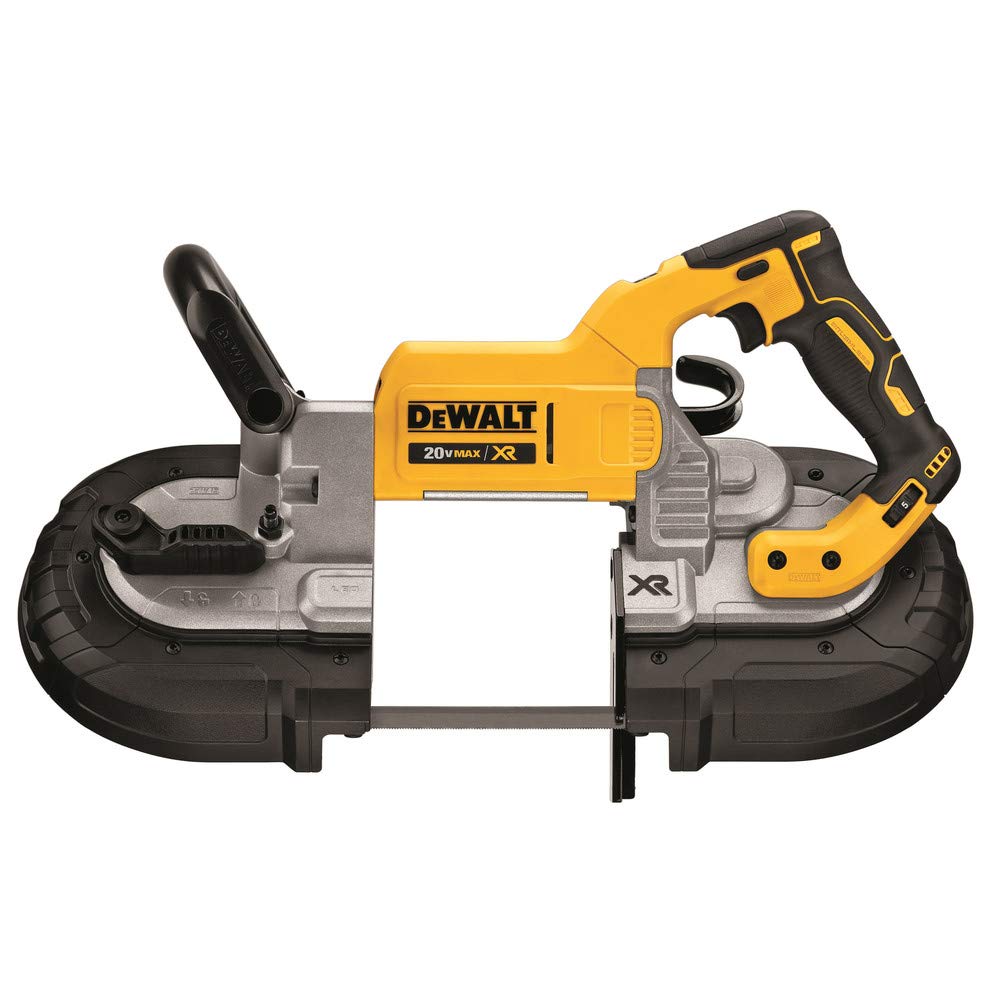
1. DEWALT 20V MAX Band Saw (DCS374B)
Our pick — over 4.5★ from 1,500+ verified ratings; the strongest balance of quality and price.
The 5-inch deep-cut king that makes oilfield pipe and thick steel feel like routine work.
If your days involve cutting saddles in heavy pipe, this DEWALT is the one the pros reach for.
The brushless motor (a magnet-driven motor that runs cooler and wastes less battery than brushed types) gives you variable speed through a trigger, so you can slow down for thin material and open it up for solid stock. Time on the job is easier thanks to the LED work light that stays on for 20 seconds after you release the trigger, which means no fumbling for a flashlight when the shadow falls across the cut line. Blade changes skip the tools entirely — a lever releases the blade tension.
This saw body is built for deep-cut duty, and the integrated hang hook lets you store it on a rack without resting the weight on the front handle. Buyers report it handles serious production work — as the review pages sum it up: “Works like it should cut about 500 saddles in oilfield pipe.” The crowd favorite in this lineup, It holds a 4.8-star rating from over 1,700 owners.. Note that this is a bare tool, so it arrives with no battery, charger, or case — the case only appears in the pricier kit.
Why it leads the pack
- 5-inch capacity beats every compact saw on this list by a wide margin
- Variable speed trigger suits both delicate and heavy cuts
- LED work light with a 20-second delay keeps dark corners visible
What to know going in
- Bare tool only — battery, charger, and case sold separately
- At 12.4 lb, it is no one-handed tool for overhead work
The deep-cut pick: You want one saw that handles the biggest pipe and plate you’ll ever meet, and you already own DEWALT 20V batteries.
Think twice if: You mostly cut small conduit in tight spaces — a lighter compact model will serve you better day to day.
2. RIDGID 18V Compact Band Saw (R8604B)
A featherweight 9.7-pound cutter that tackles EMT and fence posts without draining your budget.
This RIDGID is the entry point that punches above its tier. At 9.7 pounds, it is noticeably lighter than the DEWALT deep-cut above, and its ABS plastic body keeps the weight off your wrist during long runs of conduit. It is a compact model, so think 2-inch-class material — EMT, threaded rod, and thin strut — rather than thick steel plate.
The defining feature here is speed adjustment, and the owner consensus is that it saves blades. As owners mention, the speed control means blades survive longer — the rollers tend to pop the blade off before it can snap, which is a clever bit of design. A construction plumber who uses it daily calls it just as good as the Makita equivalent. The included blade, however, draws the one recurring gripe: it arrived brittle and snapped before the teeth wore out. Budget for a quality replacement blade and this saw keeps cutting.
One honest caveat about the fine print: this model is not eligible for RIDGID’s Lifetime Service Agreement, and the battery and charger come separately. If you are already in the RIDGID 18V ecosystem, that is the whole point — this is the cheapest way to add a reliable bandsaw to your bag.
The value read: For anyone already holding RIDGID 18V batteries, this is the smartest dollar-per-cut on the list. The blade caveat is a 10-minute fix, not a reason to walk away.
3. ONEMANA 20V Brushless Portable Band Saw
A budget pick that arrives with a battery, charger, and extra blades — ready to cut on day one.
Most bare-tool saws force you to spend more on batteries before your first cut. This ONEMANA skips that entirely: it ships with a 2.0Ah lithium-ion battery, a charger, and spare blades in the box. That makes it the lowest-friction way to start cordless cutting, especially if you do not own a compatible battery platform yet.
It does not skimp on control either. The brushless motor feeds a 2.5-inch cutting capacity, and you get six different speeds plus an LED work light to keep the cut line visible in dim conditions. A wraparound benefit: this saw runs on Makita platform batteries too, so if a trade friend has spares, you can borrow a charge. Customers note it cuts steel quickly and cleanly, with one construction plumber calling it a daily driver on par with his Makita.
The honest trade-off is in the details. The included 2.0Ah battery is small, so expect shorter runtime on heavy cuts, and the saw arrives with the band not installed — assembly is required before your first use. There is no carry bag in the box either, though an 18-inch tool bag fits it fine.
The first-saw verdict: If you are starting from zero batteries and want to cut metal tomorrow, this is the least expensive complete setup here. Just know the small battery means you will want a spare for long jobs.
4. FLEX 24V Brushless Compact Band Saw (FX2331-Z)

A 3-pound featherweight that slips into tight spaces where bigger saws refuse to go.
At just 3 pounds, this FLEX is the lightest saw in this entire lineup — nearly a third of the DEWALT deep-cut’s weight. The trade-off is a 2-inch cutting capacity, but that is precisely the point for electricians and anyone working in crawlspaces, above ceilings, or inside tight junction boxes. The compact dimensions — 15.1″L x 5.5″W x 8.1″H — make it feel more like a heavy-duty tool than a saw.
FLEX’s 24V platform claims 20% more power than typical 18V systems, with THERMA-TECH heat management to keep it cool. The brushless motor is sensor-free by design, meaning fewer moving parts to wear out. The variable-speed trigger puts speed control right at your fingertip, and the quick-release blade cover pops open without tools when it is time to swap blades. A built-in rafter hook keeps it within arm’s reach between cuts.
Trade feedback is emphatic about real-world results. Owners say it out-performed coworkers’ Milwaukee M18 and DEWALT 20V saws, cutting through EMT conduit, rigid pipe, and threaded rod without a single issue. It is a bare tool, so the battery and charger come separately, and its 3-pound frame means it is a light-duty companion rather than a deep-cut replacement.
The tight-space pick: If you crawl, climb ladders, and work overhead all day, this 3-pound saw is the one that will not fatigue your arm. Bring bigger saws for big pipe.
5. Milwaukee M12 Fuel Compact Band Saw (2529-20)

A 12-volt workhorse that cuts through fence posts and conduit with surprising authority.
Do not let the 12-volt badge fool you — this Milwaukee M12 Fuel saw is the tool owners describe in one word: quality. It weighs just 6 pounds, which puts it squarely in one-handed territory, and the 2.5-inch throat depth gives it more reach than its compact frame suggests. As owners note, the deeper gap lets it cut bigger pipe than other models in its class.
The blade speed tops out at 570 feet per minute, and while it lacks variable speed, the M12 Fuel line’s brushless motor keeps the cutting steady. The integrated work light illuminates the cut line, and the reinforced nylon housing shrugs off jobsite drops. One owner cut through 25 chain-link fence posts (1-5/8″ line) with ease., reporting the smaller size was easier to handle than a larger model.
This bare tool runs on Milwaukee’s M12 battery system, so it will not share batteries with your M18 tools — that is the main compatibility check before you buy. The 2.5-inch maximum cutting capacity covers conduit, PVC, and small metal stock, and owners say it handles “almost anything 2″ and smaller” without complaint.
The M12 loyalist’s pick: If you already carry M12 batteries, this 6-pound saw is the perfect lightweight companion for small cuts all day long.
6. BOSCH GCB18V-2N 18V Compact Band Saw

A 7.3-pound all-rounder that outlasts bigger names on daily jobsite abuse.
If you work in tight spaces, BOSCH designed this compact saw for you: Bosch claims this saw is up to 60% lighter and 40% more compact than standard deep-cut models., yet it still takes a 2-1/2-inch cut in one pass. At 7.3 pounds, it balances well in two hands and works fine one-handed for short bursts.
The all-aluminum base gives it a rugged feel that owners say outlasts the DEWALT equivalent, and the 18V brushed motor delivers clean cuts with minimal sparks — the kind of finish that needs no burr removal afterward. The tool-free blade guard and tool-free blade change make swapping blades a 30-second job. A centered handle with a soft grip keeps control, and the LED light tracks the cut line.
Reviewers point out one quirk: this saw is loud, and the non-brushless motor is the reason. Battery choice matters too — an 8Ah pack makes the front heavy, while a 4Ah lasts all day and balances better. One electrician made 300 cuts through strut and EMT on a single charge, with the original blade lasting six months.
The balanced pick: For mixed jobsite work where you want a compact saw that will outlive your current contract, this BOSCH is a dependable middle path.
7. Makita XBP03Z 18V LXT Compact Band Saw

A fast-cutting Makita that turns unistrut and all-thread into butter-smooth slices.
Speed is the Makita XBP03Z’s reason to exist. The 18V LXT motor spins the blade at 630 feet per minute, which is the fastest blade speed on this list, and the 2-1/2-inch cutting capacity handles the bread-and-butter jobs of any electrician or plumber: conduit, unistrut, copper pipe, threaded rod, angle iron, and channel. Owners sum it up plainly: it goes through everything like butter.
The aluminum blade housing adds durability where it counts, and the exterior blade adjustment gives you more accurate blade tracking, which translates to straighter cuts. The wheel cover encloses the blade outside the cutting area, which is what lets this saw run one-handed safely. It weighs 9 pounds and comes with a 32-7/8″ 14TPI blade and a hex wrench in the box — this is a bare tool, so the battery and charger are separate.
The trade-off that owners mention most is blade durability — the included light-duty blades break easily if you push too hard. As the review pages put it: “show some finesse.” Pair this saw with a quality aftermarket blade and it rewards you with fast, clean cuts through mild steel.
The speed pick: If you want the fastest cuts on strut and rod and you live in the Makita LXT ecosystem, this is the one — just budget for better blades.
8. DEWALT 20V MAX XR Bandsaw (DCS378B)

A mid-size DEWALT that splits the difference between compact and deep-cut duty.
This DEWALT fills a gap that neither the 5-inch DCS374B nor the compacts can: a 3-3/8-inch cut capacity in a body that weighs 10.8 pounds and stays easy to use single-handed. It is the tool for jobs that are too big for a compact saw but do not justify hauling out a deep-cut monster.
The brushless motor delivers 535 MWO at 570 SFPM for fast, accurate cuts., which owners describe as fast, powerful, and accurate. The variable-speed trigger plus a speed dial gives you two ways to dial in the perfect cut rate for whatever material you are slicing. An integrated blade guard protects both you and the blade, while the built-in LED keeps the work area lit. A lanyard-ready attachment point lets you tether the tool on improve jobsites.
What really sets this saw apart is the Tool Connect chip pocket — it accepts a Tool Connect chip (sold separately) so you can track the tool with the Site Manager app. Balance is a highlight in owner feedback, with several noting it is easy to use with one hand, and a woman owner reports cutting through dense metal smoothly without the tool feeling heavy on her arm.
The middle-ground pick: If you need more reach than a compact but less heft than a deep-cut, this is DEWALT’s most versatile bandsaw. The Tool Connect tracking is a genuine bonus for crews.
9. BOSCH GCB18V-5N 5-Inch Deep Cut Band Saw
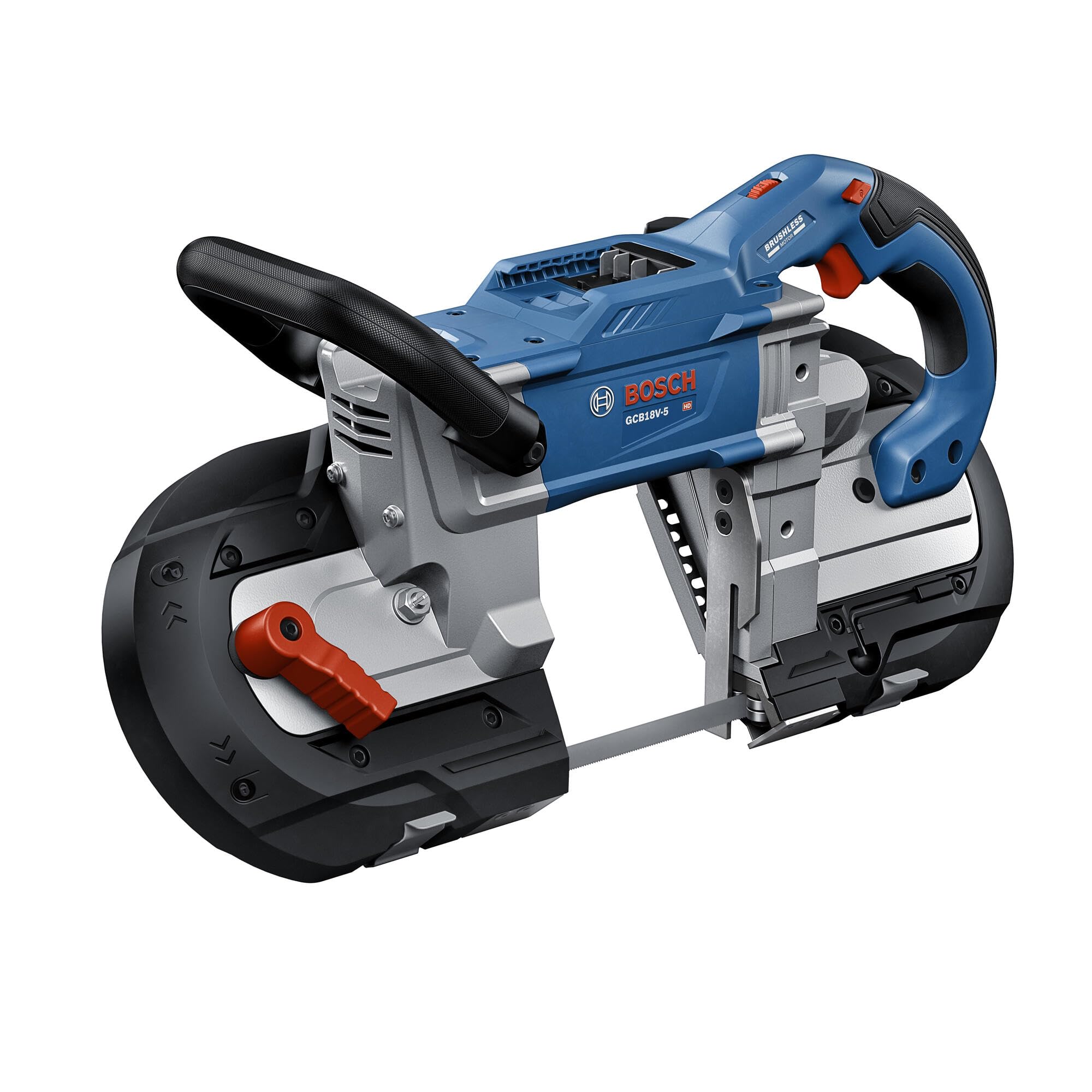
The 5-inch Bosch that out-cuts the equivalent Milwaukee while being easier to service.
When your work involves handrails, stainless channel, or 4×4 posts, the 5-inch cutting capacity here lets you slice cleanly through larger material in one pass. The brushless motor stretches battery runtime while keeping cuts smooth and burr-free — the kind of finish that needs no grinding afterward. At 14 pounds, this is a two-hander, and owners are clear about that: definitely a two-hand operation.
The AMPShare battery system is this saw’s quiet superpower — it is designed to be multi-brand compatible across many cordless products, so your battery investment stretches further than a single brand’s platform. The variable-speed trigger plus a speed dial tailors the cut rate to the job, and the adjustable material guide lets you position the cutting area for close, accurate work.
Owners who switched from Milwaukee are emphatic: this “hog” cuts faster and longer than its Milwaukee 18V equivalent. The LED work light tracks the cut line, and the hanging hook keeps it stored between jobs. The rubber handle and ergonomic layout make for good two-handed balance, though no one should expect one-handed operation from a 14-pound saw.
The two-hand deep cut: If you are in the Bosch ecosystem and need 5-inch reach, this out-cuts the competition while keeping battery flexibility and easier blade changes.
10. Milwaukee 2729-20 M18 Fuel Deep Cut Band Saw
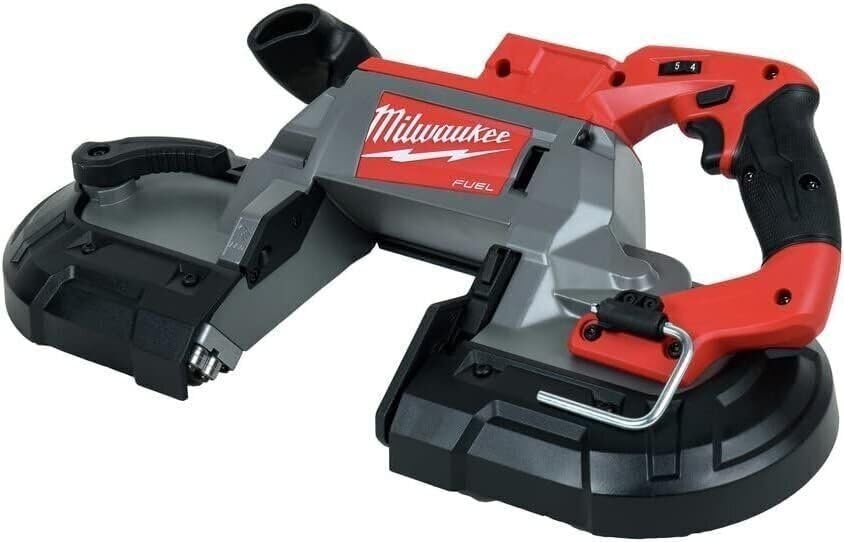
The 15-pound deep-cut beast that performs like a full-size vertical bandsaw.
If you want a portable bandsaw that behaves like stationary shop equipment, this is it. The 5-inch cutting capacity makes it the tool of choice for conduit and strut work at scale, and owners describe its performance as “like a full-size vertical bandsaw.” The M18 Fuel brushless motor delivers sustained power without the battery drain you might expect from a 15-pound saw.
The defining move here is how owners adapt it: several mounted theirs to a bench to use as a vertical cutting saw, and one liked it so much he bought a second to mount as a chop saw. It is that combination of portable freedom and stationary precision that makes this saw a favorite. The reinforced housing and steel blade guides are built for the abuse of commercial jobsites.
The honest caveat is feedback splits on durability and battery life — some shoppers say the M18 system drains faster under heavy 5-inch cuts, and the blade quality matters more here than on smaller saws. One buyer received a unit with “Clo” written on the battery insert, which raised clone concerns, though build quality otherwise met expectations. Blades last significantly longer than reciprocating saw blades, per owner report.
The station builder’s pick: If your workshop needs a vertical metal-cutting station and you already run M18 batteries, this is the portable saw to bolt down.
11. Makita DPB182Z 18V LXT Portable Band Saw

A straightforward single-speed Makita that keeps the controls simple and the weight low.
This Makita takes the opposite approach from the speed-dial crowd: a single fixed blade speed of 3.2 metres per second, on the logic that you will run it at full speed anyway. The result is a tool with fewer settings to fiddle with — set the blade, pull the trigger, and cut. The capacity is 64mm diameter round pipe and 64mm x 64mm square pipe, which covers conduit, copper pipe, threaded rod, and angle iron.
The tool-less blade change keeps swaps fast, and the 7.6-pound weight makes it suitable for one-handed operation — a genuine advantage when you are holding the workpiece with your other hand. The blade measures 835mm long and 13mm wide, and the aluminum construction keeps the weight down. It runs on Makita’s LXT 18V system but is not compatible with the g-series batteries, so check which Makita packs you own.
This is a bare tool — battery, charger, and case sold separately. Buyers report the included blade goes dull quickly, but quality aftermarket blades are a better value anyway. A couple of delivery complaints mention missing protection covers, so inspect the box on arrival. The 3.9-star score reflects those inconsistencies, not the cutting performance.
The simplicity pick: If you want one-speed-no-thought operation in a lightweight LXT tool, this delivers — just budget for a better blade and check the package on arrival.
Understanding the Specs
Cutting Capacity (Throat)
This is the single number that decides whether a saw fits your material. It measures the widest workpiece the saw can straddle in one pass, in inches. A 2-inch compact handles conduit and threaded rod. A 2.5-inch model adds unistrut and small pipe. A 5-inch deep-cut saw clears steel plate and large-diameter pipe without flipping the work — but costs more and weighs more.
Blade Speed (SFPM or m/s)
Blade speed tells you how fast the band travels, measured in surface feet per minute (SFPM) or metres per second. Faster speeds cut quicker but generate more heat, which can wear blades prematurely. Variable-speed triggers let you slow down for thin or hard materials to protect blade life — the control is more valuable than a high top speed.
FAQ
What is the difference between a compact and a deep-cut cordless band saw?
Will a cordless band saw cut through steel?
How long does a battery last on a cordless band saw?
Can I use one hand to operate a cordless band saw?
What does a brushless motor do for a band saw?
Is variable speed worth paying for on a band saw?
Do I need to buy a battery and charger separately?
How do I change the blade on a cordless band saw?
Final Thoughts: The Verdict
If you want one dependable pick, the cordless band saw winner is the DEWALT DCS374B because its 5-inch cutting capacity handles the widest range of material in this list while the crowd’s 4.8-star score across 1,700+ owners shows real-world reliability. If you want a lighter compact that stays polite on your arm, the BOSCH GCB18V-2N is the balanced middle path at 7.3 pounds. And for the tightest budgets, the ONEMANA arrives complete with battery and charger so you can cut metal the day it lands on your doorstep.
How We Picked
We do not accept paid placement. Every pick is matched to a real buyer and a real use-case; we do not hands-on test units.
Sources & Methodology
Specifications: manufacturer listings and product documentation. Review insights: verified customer reviews, as of August 2026. Pricing: not shown on this page (it changes often); check the current price via the retailer link.
As an Amazon Associate, KitchPrep earns from qualifying purchases. This does not affect which products we feature.
Related Guides
