
Specs are compiled from manufacturer listings and verified buyer reviews and can change over time — please confirm the key details on the product page before buying.
You need a 200 amp panel that can handle your home’s future electrical load — EV chargers, heat pumps, generators — without forcing a costly return and rewiring. The key specs to match are the number of circuits (spaces you can grow into), the enclosure rating for indoor or outdoor placement, and whether it works as a main breaker for your service entrance. Get these right the first time, and you avoid the headache of swapping panels later.
I’m Mohammad Maruf — the founder and writer behind KitchPrep. This guide is built by comparing the manufacturers’ published specifications and the patterns across verified customer reviews, so you get each pick’s real strengths and trade-offs instead of marketing spin.
We’ve analyzed the market to find the 200 amp panel that offers the perfect mix of installation ease, safety, and long-term value for your home. Read on for our top recommendations and expert tips.
Our Picks at a Glance

How To Choose The Best 200 Amp Panel
Your home’s electrical panel is the central hub for safety. Choosing the right one means matching circuit spaces, enclosure rating, and bus material to your current load and future additions, so you avoid a costly panel swap later.
Circuit Spaces vs. Total Circuits
The first number you’ll see is “spaces” — how many physical breakers you can snap in. The second is “total circuits,” which counts the poles. A 20-space panel gives you 20 slots for branch breakers, but that number is more about growth. If you plan on adding a workshop, pool, or electric vehicle charger, a 30-space or 40-space panel saves you from buying a sub-panel down the line.
Indoor vs. Outdoor (NEMA Rating)
Where you mount the panel dictates the right enclosure. An indoor panel, typically with a NEMA 1 rating, is fine for a garage, basement, or utility room. For an outside wall by the meter, you need a NEMA 3R rating, which means it’s built to resist rain, sleet, and snow. Picking the wrong rating risks water intrusion and corrosion of the expensive breakers inside.
Bus Bar Material: Copper’s Clear Advantage
The bus bar is the metal strip that distributes power to the breakers. Cheaper panels use aluminum, which has higher resistance and can heat up under load. Higher-quality panels use tin-plated copper, which is more conductive, runs cooler, and resists corrosion, giving you a more reliable and longer-lasting installation. Tin-plated copper is a worthwhile upgrade for the price.
Safety Certifications and Interrupt Ratings
Look for UL Listing and the Interrupting Current Rating (AIC) — how much fault current the panel can safely handle. A 22,000 AIC rating is standard for modern 200A residential service, meaning it can safely stop a massive short circuit without failing. These ratings are safety standards that affect your home insurance and electrical inspector’s approval.
Quick Comparison
| Model | Best For | Spaces / Circuits | Enclosure (Indoor/Outdoor) | Bus Material | Amazon |
|---|---|---|---|---|---|
| Square D Homeline HOM2040M200PCVP★ Best Overall | Best Overall Value | 20 / 40 | Indoor | Aluminum | Amazon |
| Leviton LP320-BPDPremium Pick | Most Innovative Design | 30 / 30 | Indoor | Copper | Amazon |
| Square D HOM2040M200PCContractor’s Pick | Flexible Installation | 20 / 40 | Indoor | Aluminum | Amazon |
| ABB TM2020RCUBK1 PowerMark Gold | Best Outdoor Main Panel | 20 / 40 | Outdoor (NEMA 3R) | Copper | Amazon |
| Square D HOM3060M200PCVP | Max Circuit Capacity | 30 / 60 | Indoor | Aluminum | Amazon |
| ABB TM3220CCU2K | Premium Kit with Breakers | 32 / 40 | Indoor (NEMA 1) | Copper | Amazon |
| SIEMENS W0404MB1200CT | Compact Outdoor Sub-Panel | 4 / 4 | Outdoor | Alloy Steel | Amazon |
| SIEMENS PNW0816B1200TC | Outdoor Trailer Supply | 8 / 16 | Outdoor (NEMA 3R) | Copper | Amazon |
| SIEMENS PN4060B1200C | Indoor High-Capacity | 40 / 60 | Indoor (NEMA 1) | Copper | Amazon |
| Siemens MC2040B1200S Meter Combo | All-in-One Meter & Panel | 20 / 40 | Outdoor (NEMA 3R) | Alloy Steel | Amazon |
In‑Depth Reviews
1. Square D Homeline HOM2040M200PCVP
Our pick — over 4.5★ from 350+ verified ratings; the strongest balance of quality and price.
The crowd-favorite kit that pairs a big brand with five included breakers for a value-packed first install.
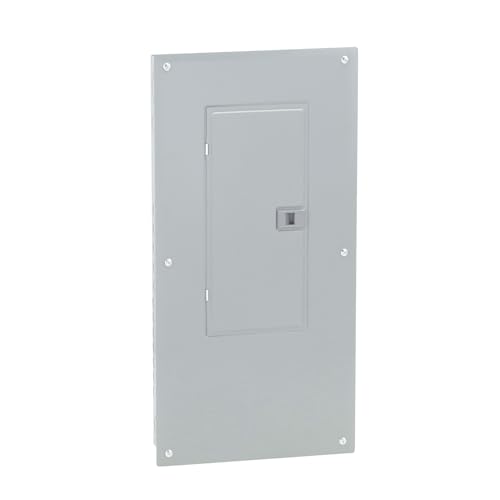
You get a ready-to-use package here. The HOM2040M200PCVP includes the panel plus a practical starter set: three HOM120 single-pole breakers and two HOM230 double-pole breakers, along with a combination flush/surface cover. It simplifies the job for a basic service, giving you the 20 spaces and 40 circuits most homes start with, and the aluminum bus keeps costs down.
The design is built for modern safety codes. It has a fully distributed neutral bar, which means you can install Homeline Plug-on Neutral combination arc fault breakers in any pole space, not just specific slots. Each pole space also accepts full-size, tandem, or quad breakers, which is your ticket to packing more circuits into the same footprint later.
Buyers report this is the “Best value 200A panel kit with 5 breakers, 10-yr warranty.” The top praise centers on how easy it is to mount and wire, with the installation experience being the most-discussed plus. Electricians commonly spec Square D Homeline for new residential service.
What wins people over
- Included breakers and cover mean you can finish the basics without extra trips
- Plug-on neutral ready for AFCI breakers on any space
- Accepts tandem and quad breakers to expand circuit count
Honest trade-offs
- The grounding bar kit is sold separately, so budget for that add-on
- No pass-through lugs, so it’s strictly an indoor main panel
- Aluminum bus runs warmer than pricier copper options
Who it’s for: Homeowners who want a trusted Square D panel with a quick-start set of breakers. It’s a balanced pick for standard new service.
Think twice if: You need a sub-panel with feed-through lugs or want the cooler-running copper bus bar without the extra cost.
2. Leviton LP320-BPD
A reimagined 30-space design that routes wires to the panel, not the breakers, for a cleaner and faster install.
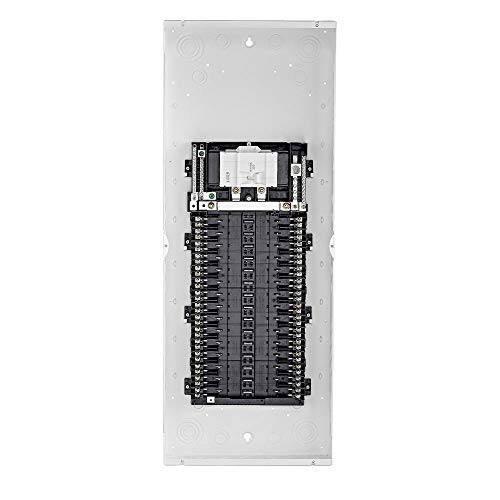
Leviton re-engineered the load center from the ground up, and it shows the moment you open the box. The standout feature is that you wire all your circuits to the panel interior at rough-in, without any breakers present. The breakers simply snap in afterward, making the finish work tidy and the breaker swaps tool-free.
Owners most praise its solid build quality and premium finish. It comes standard with tin-plated copper bussing for superior conductivity — a clear advantage over the aluminum bus in standard panels like the Square D above. The white, powder-coated finish gives it a modern, clean look that changes the “standard” gray-box aesthetic of electrical panels.
Owners call it a high-quality panel, with the build quality and appearance being the most-discussed strengths. It’s even praised as a panel that could be the “go to” for residential use, especially for those who value a clean installation. The interior has notches stamped for cable ties, so you can secure wiring properly and keep the panel neat.
Innovation leader: This is the panel that makes future breaker changes painless — you never touch the wiring again.
Budget caveat: The sleek door is not included, so factor that separate cost into your project total.
Reach for this if: You’re a pro or an enthusiast who wants the easiest wiring, a premium copper bus, and a beautiful finish.
Look elsewhere if: You want an all-inclusive kit with a cover and breakers ready to go from the start.
3. Square D HOM2040M200PC
Flexible mounting that lets you install the main breaker at the top or bottom, simplifying tricky wire runs.
This Square D convertible panel offers something most don’t: the freedom to feed the main breaker from the top or the bottom. That flexibility is a lifesaver when your conduit comes up from the floor or when a basement install makes a bottom feed much cleaner. Owners confirm it was “easy to mount” with this option clearly noted.
Like the value pack above, it delivers 20 spaces and 40 circuits with a fully distributed neutral bar, so Homeline Plug-on Neutral arc fault breakers click into any slot. There’s “lots of room to work” inside and “lots of knockouts,” which reviewers point out makes wiring less of a struggle. It ships with a combination flush/surface indoor cover.
It’s the same trusted aluminum construction as the PCVP, but you’re paying for the convertible main feature rather than the included breakers. Reviewers call it high-quality and reasonably priced, with electricians recommending it for small to medium homes. Just remember you’ll need to source breakers and a ground bar separately.
Best for: Installers with feed challenges, since the reversible main solves a real logistical headache.
Not ideal if: You expect a complete starter kit with breakers in the box.
4. ABB PowerMark Gold TM2020RCUBK1
A weather-resistant main panel that bundles a copper bus and four breakers, built to face the elements head-on.
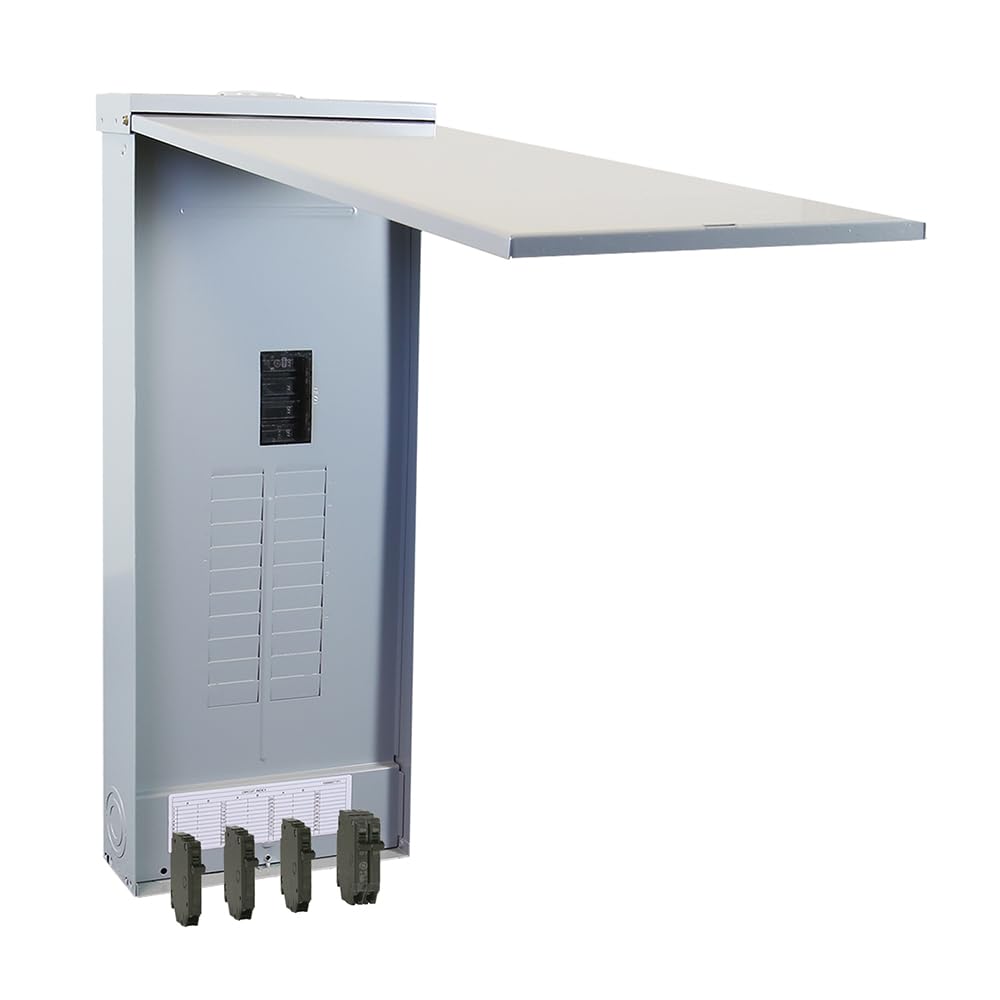
For many service entrances, the main panel lives outside next to the meter. This ABB PowerMark Gold is purpose-built for that, featuring a NEMA 3R weather-resistant enclosure, a galvanized steel casing that resists rust, and a copper bus bar for excellent electrical conductivity. It’s a 20-space, 40-circuit setup that comes ready to power a home.
from the start it includes a factory-installed 200A main breaker, three THQP 20A single-pole breakers, and one THQP 30A double-pole breaker. That gives you a head start on lighting and general-purpose circuits right away. The interruption rating is 22,000 AIC, standard for residential service, and it’s compatible with GE and ABB THQL/THQP breakers.
One owner reports installing this panel for a customer who had “tripping breakers or over heated breakers,” and after the swap, the customer was “extremely content.” The full-length neutral bars with split holes let you land wires faster, and the pre-loosened screws cut installation time. The galvanized construction (a zinc-coated steel) resists rust, so it holds up better outdoors than plain steel panels.
Built for outside: The weather-rated enclosure and rust-resistant steel make this the right call for exposed walls.
Note: At 32 pounds, it’s a hefty unit to mount, but the solid feel reflects its build quality.
Pick this for: A reliable outdoor main breaker installation where weather resistance and a copper bus matter.
Skip if: Your panel will live indoors — you can save money with a NEMA 1 enclosure.
5. Square D HOM3060M200PCVP
More slots for future circuits, this 30-space Square D gives a growing home room to add EV chargers and more.
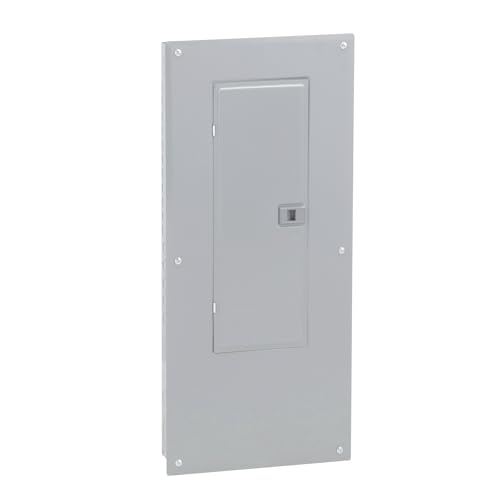
Planning for the future of your home’s electrical system starts with extra space. This Square D Homeline panel jumps to 30 physical spaces and 60 total circuits, so you won’t be shopping for a sub-panel when you add a hot tub, shop tools, or an EV charger down the road. It includes the same useful starter set of three HOM120 and two HOM230 breakers.
The fully distributed neutral bar carries over from the smaller model. You get plug-on neutral capability on every space for Homeline combination arc fault breakers, which is a modern code-friendly feature. It also includes a combination flush/surface cover to finish off the installation.
The 30-space version is essentially triple the control of the compact trailer panels you’ll see later. Owners note it fits well in a standard wall cavity and functions perfectly as a service or sub-panel. The main breaker works smoothly, though a few note the main lever can bow slightly when fitting it through the cover slot.
Room to grow
- 30 spaces means fewer future expansion headaches
- Includes breakers and a cover in the package
- Accepts tandem/quad breakers for even more circuits
Worth knowing
- The main breaker can require a little finesse to seat into the cover
- The aluminum bus is a budget-minded choice
Choose this if: You want the most circuit capacity for a large home remodel or new build.
Consider the 20-space if: You’re on a strict budget and don’t need the extra slots.
6. ABB TM3220CCU2K
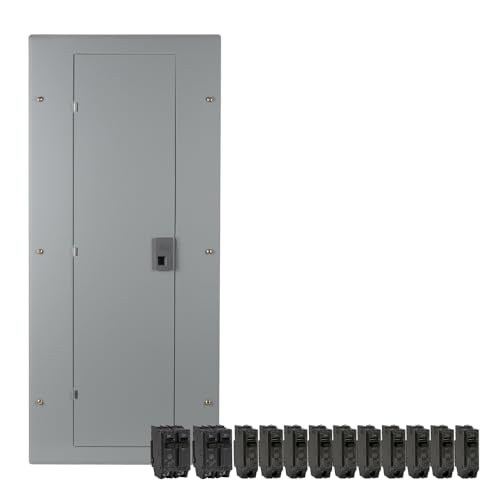
An all-inclusive indoor kit with 12 breakers already in the box, saving you significant time and money.
This ABB kit is the ultimate plug-and-play for a new house, adding a heater, or a large workshop. It’s a 32-space load center supporting up to 40 circuits, and it comes stocked with a complete set of breakers: ten 20A single-pole, one 30A double-pole, and one 50A double-pole THQL breaker. That means the heavy lifting for your initial circuit layout is done.
This panel lives in a NEMA 1 indoor enclosure (a box rated for dry, dust-free spots like basements and utility rooms), so it’s not for outdoor mounting. Its 22 kAIC interrupt rating (the maximum fault current it can safely stop) protects your whole distribution system from high short-circuit surges. The factory-installed 200A main breaker comes pre-wired, so you just connect your service wires and go.
The included breakers are the most-praised feature, with owners specifically noting it has a “30amp and 50amp” for larger appliances. One reviewer noted that it’s rare to find a kit that includes matching breakers, even if they aren’t AFCI protected. It’s described as a “great value for a trusted quality name brand,” approved by their electrician for a full-house setup.
Complete package: This is the closest thing to a whole-house solution in one box — the breakers alone make the price compelling.
Keep in mind: It’s an indoor-only panel, and the breakers are standard, not arc-fault protected.
Best for: DIYers and pros who want a turnkey 200A system without hunting down breakers.
Not for: Outdoor installations — you’ll need a NEMA 3R enclosure.
7. Siemens W0404MB1200CT
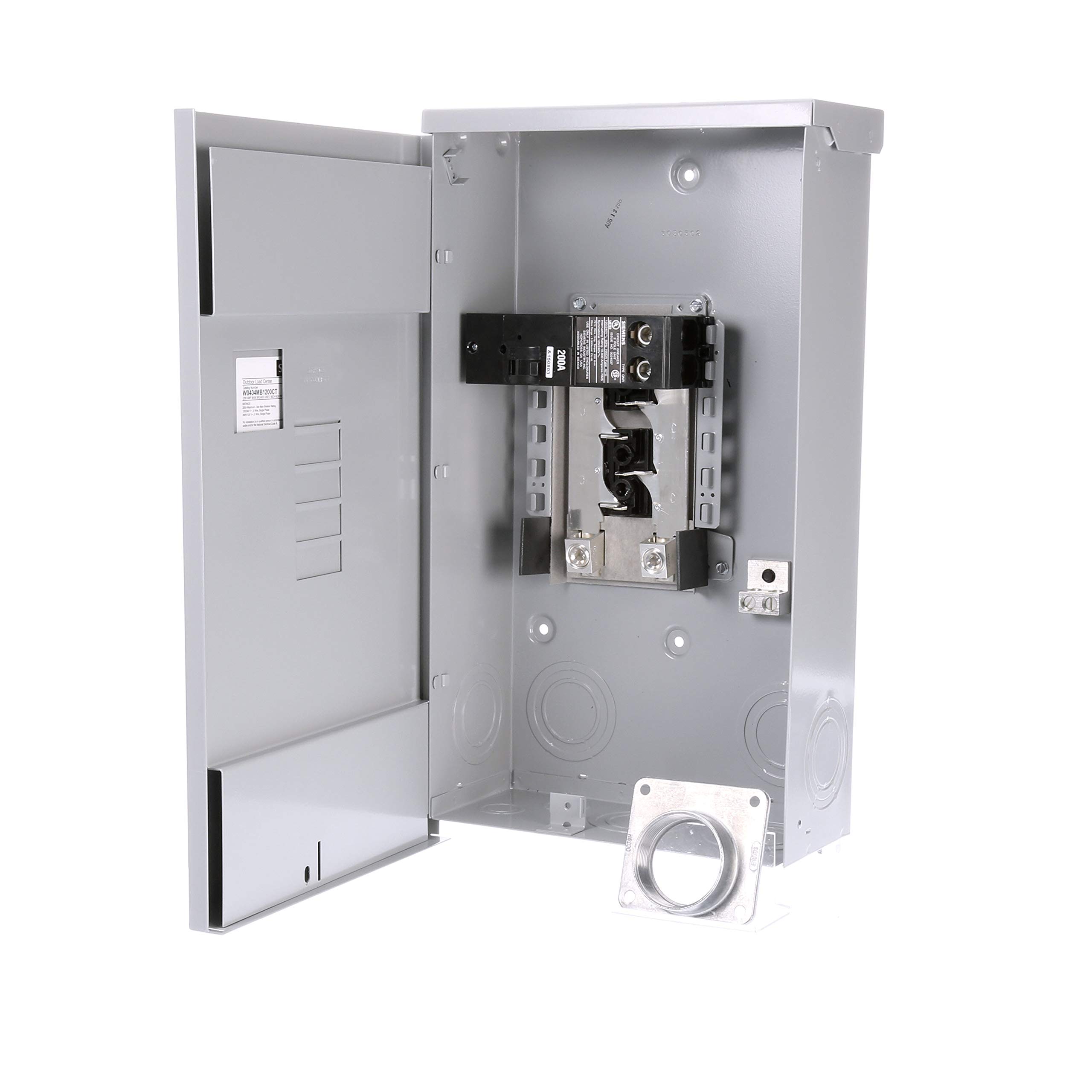
A compact 4-space outdoor panel that serves as a secondary disconnect or feed-thru for a detached structure.
Not every 200 amp panel is meant to be the main house distribution center. This Siemens unit is a compact, outdoor-rated solution with just 4 breaker spaces, ideal for a sub-panel feeding a detached garage, shop, or mobile home. It comes with a factory-installed 200A main and feed-thru lugs, allowing you to continue power to other equipment.
Weighing 21.5 pounds, it’s far lighter and smaller than larger mains like the ABB TM2020RCUBK1 above. That lightness makes it easy to mount on a post or exterior wall for simple applications. Owners mention it “works great” as a replacement for aging panels and is up to code for its intended purpose.
The honest feedback is that it’s a quality Siemens panel, but you should know the ground points are a bit limited, with one owner adding a ground lug from an old box. Also, the door sticker indicates it’s “Suitable Only For Use As Service Equipment,” which means the neutral bar is bonded and it can’t be isolated for use as a true sub-panel.
Perfect for: A simple 200A service disconnect at a trailer or a secondary outdoor building with minimal load.
Not for: Branch circuits — you’ll quickly run out of spaces with only 4 slots.
8. Siemens PN Series PNW0816B1200TC

An 8-space outdoor panel with plug-on neutral and a copper bus, striking a balance between size and capability.
This Siemens PN series panel doubles the capacity of a bare-bones 4-space unit, giving you 8 spaces and 16 circuits in a NEMA 3R enclosure (a weather-resistant box that sheds rain and snow). It fits a workshop, a large garage, or a backup power distribution point. The copper bus (the metal strip that carries current to breakers) conducts better and runs cooler than alloy versions, so it handles heavy loads more reliably.
The plug-on neutral design speeds up installation when you’re using GFCI or AFCI breakers, as they connect directly to the neutral bar without a pigtail. It includes 2 factory-installed ground bars and offers over 4 inches of wire bending space, making it comfortable to work in even with thicker gauge wires. It also has a 22,000 AIC interrupt rating.
Buyers consistently praise the build quality, and it handles standard 200 amp services without fuss. One owner moved 3 breakers into it and had an electrician add a generator plug, calling it “a good installation.” The trade-off: interior space is tight for an 8-space panel, so you may need to bend wires carefully to fit everything in.
Reach for this if: You need a rugged, outdoor-rated 200A feed with room for 8 branch circuits and prefer a copper bus.
Consider the 4-space if: You’re just feeding one disconnect and want the most compact footprint.
9. Siemens PN Series PN4060B1200C

A spacious 40-space indoor panel with a tin-plated copper bus, ideal for solar and large-format installations.
If you’re building big, this is the panel. The Siemens PN4060B1200C offers a massive 40 physical spaces and 60 total circuits, making it ready for solar arrays, multiple high-draw appliances, and a full home backup setup. It’s a NEMA 1 indoor enclosure designed to be the single hub for an ambitious electrical plan.
The copper bus is tin-plated, a detail that confuses some buyers into thinking it’s aluminum. The silver color is actually the tin plating on copper, which is more conductive than a standard aluminum bus. Owners in the know are quick to point this out, noting that Siemens and Square D QO both use this method for better performance.
Wiring is a joy in this unit. One owner wired it for an off-grid solar system using 3, 6, 10, and 12 gauge wire, reporting “plenty of room for bending even thick wires.” The plug-on neutral design makes wiring GFCI breakers easy. The potential downside is quality control during shipping — a few units have arrived dented or with a damaged main breaker, so inspect it upon delivery.
For the big build: The combination of 40 spaces, plug-on neutral, and copper bus makes this a top-tier choice for solar professionals.
Watch out for: Shipping damage, so make sure to check the main breaker immediately when it arrives.
Best for: Whole-home systems, solar installs, and anyone planning massive future expansion.
Skip if: You’re covering a small apartment — this is far more panel than you need.
10. Siemens MC2040B1200S

A single outdoor unit that combines the meter socket, main disconnect, and a 40-circuit panel in one UL-listed box.
This is the ultimate space-saver for a new service entrance. Instead of mounting a separate meter base and a separate main panel, this Siemens unit combines the meter socket, the main 200A breaker, and a 20-space, 40-circuit load center into one NEMA 3R outdoor enclosure. It streamlines the entire utility connection for an overhead feed.
It’s built for the utility side of the house, with a ring-type cover and pad-locking provisions on the device to secure the meter. It uses RX type hubs for the overhead feed, and the surface mount design sits cleanly against an exterior wall. Featuring a 22,000 AIC rating, it’s rated for standard residential fault currents and is UL Listed.
Owners appreciate it as a “perfect panel for service disconnect,” noting it has sufficient breaker space for additional circuits. The quality is praised most, and it’s a solid value for an all-in-one unit. Just remember to contact your local utility to confirm meter socket approval before purchase, as requirements vary by region.
The whole package
- Saves wall space by merging the meter and panel
- Outdoor NEMA 3R enclosure handles the elements
- Pad-lockable ring for meter security
Before you buy
- Designed for overhead feeds only, not underground
- Must be verified with your local utility for approval
Choose this if: You’re doing a full service upgrade and want the cleanest, most compact utility connection possible.
Consider a separate panel if: You have an underground feed or your utility requires a different meter setup.
Understanding the Specs
NEMA Rating (Indoor vs. Outdoor)
This dictates where your panel can be safely mounted. A NEMA 1 rating means it’s for indoor use only — a garage, basement, or closet, keeping dust out but not water. A NEMA 3R rating is your outdoor option, built to withstand rain, sleet, and snow. Choosing the right rating is critical because water intrusion will corrode the bus bars and breakers, creating a serious safety hazard.
Bus Bar Material: Aluminum vs. Copper
This is the metal strip that distributes power to every breaker. An aluminum bus is cheaper and common in value-oriented panels, but it runs hotter under heavy loads. A tin-plated copper bus, found in higher-end models, conducts electricity more effectively, stays cooler during peak usage, and resists corrosion over years of service. If you demand reliability for a full-home load, copper is the physically superior choice.
Spaces vs. Circuits
Understand the difference between “spaces” and “circuits” before you buy. Spaces are the physical slots where breakers snap in — a 20-space panel holds exactly 20 breakers. Circuits count the poles, so a tandem breaker (a slim unit that fits two breakers in one slot) can count as two circuits, which is why you’ll see specs like “20-Space 40-Circuit.” More spaces give you room to add circuits later, so buy more than you need today.
Plug-on Neutral Compatibility
A modern feature that simplifies installing combination arc-fault circuit interrupters (AFCIs), the breakers that detect dangerous electrical arcs in your wiring. With a plug-on neutral panel, these breakers connect directly to the neutral bar without a separate pigtail wire, making the installation faster, cleaner, and more secure. It’s a must-have feature for meeting modern electrical codes.
FAQ
What is the difference between a main breaker panel and a sub-panel?
How many circuits do I need in a 200 amp panel?
Can I install a 200 amp panel myself?
Is tin-plated copper bus better than an aluminum bus?
What does NEMA 3R mean for an outdoor panel?
Will a Square D breaker fit in an ABB or Siemens panel?
What is the AIC rating and why is it important?
What is a plug-on neutral panel?
Do I need a special panel for a generator or solar system?
Why is a 40-circuit panel more expensive than a 60-circuit panel from a different brand?
Final Thoughts: The Verdict
For most homes, the 200 amp panel worth buying is the Square D Homeline HOM2040M200PCVP — it pairs a trusted brand with five included breakers and a plug-on neutral design (breakers snap on without a separate neutral wire) at a price that’s tough to beat. If you want a premium copper bus and the simplest wiring, choose the Leviton LP320-BPD. For a true all-in-one service entrance that mounts flush and saves wall space, the Siemens MC2040B1200S is the one to grab.
How We Picked
We do not accept paid placement. Every pick is matched to a real buyer and a real use-case; we do not hands-on test units.
Sources & Methodology
Specifications: manufacturer listings and product documentation. Review insights: verified customer reviews, as of August 2026. Pricing: not shown on this page (it changes often); check the current price via the retailer link.
As an Amazon Associate, KitchPrep earns from qualifying purchases. This does not affect which products we feature.
Related Guides
