
Specs are compiled from manufacturer listings and verified buyer reviews and can change over time — please confirm the key details on the product page before buying.
When the grid goes dark, the first question isn’t about watts or phases — it’s whether your fridge stays cold and your sump pump keeps running. That’s the real job of a portable backup generator, and this guide cuts straight to which machines actually do it without drama. You’ll find picks that run a whole house, ones that quietly power an RV, and budget-friendly units that cover the basics.
I’m Mohammad Maruf — the founder and writer behind KitchPrep. This guide is built by comparing the manufacturers’ published specifications and the patterns across verified customer reviews, so you get each pick’s real strengths and trade-offs instead of marketing spin.
The best portable backup generator for you depends on your home’s size, your fuel preference, and how much noise you can tolerate during an outage.
Our Picks at a Glance


How To Choose The Best Portable Backup Generator
Your generator choice boils down to three decisions: how much power you need, what fuel you’ll feed it, and how much noise you can live with. Nail those three, and the rest is about outlets and convenience features.
Match Watts to Your Real Life
The most common mistake is buying on peak watts and ignoring running watts. A fridge needs about 600-800 running watts, but a microwave needs 1000. Add your essentials together and leave headroom — a 3400 running watt unit covers a fridge, freezer, and lights with room to spare.
Dual Fuel Gives You Options
Gasoline is easy to find but goes stale after months. Propane stores indefinitely, which makes it a smart backup fuel. A dual-fuel machine lets you switch based on what’s available, and most owners say that flexibility alone justifies the slightly higher cost.
Quick Comparison
| Model | Best For | Running Watts | Peak Watts | Weight | Amazon |
|---|---|---|---|---|---|
| Westinghouse 12500★ Best Overall | Whole-home backup | 9500 | 12500 | 212.1 lbs | Amazon |
| Westinghouse 6500Best Value | Mid-size home + RV | 5300 | 6500 | — | Amazon |
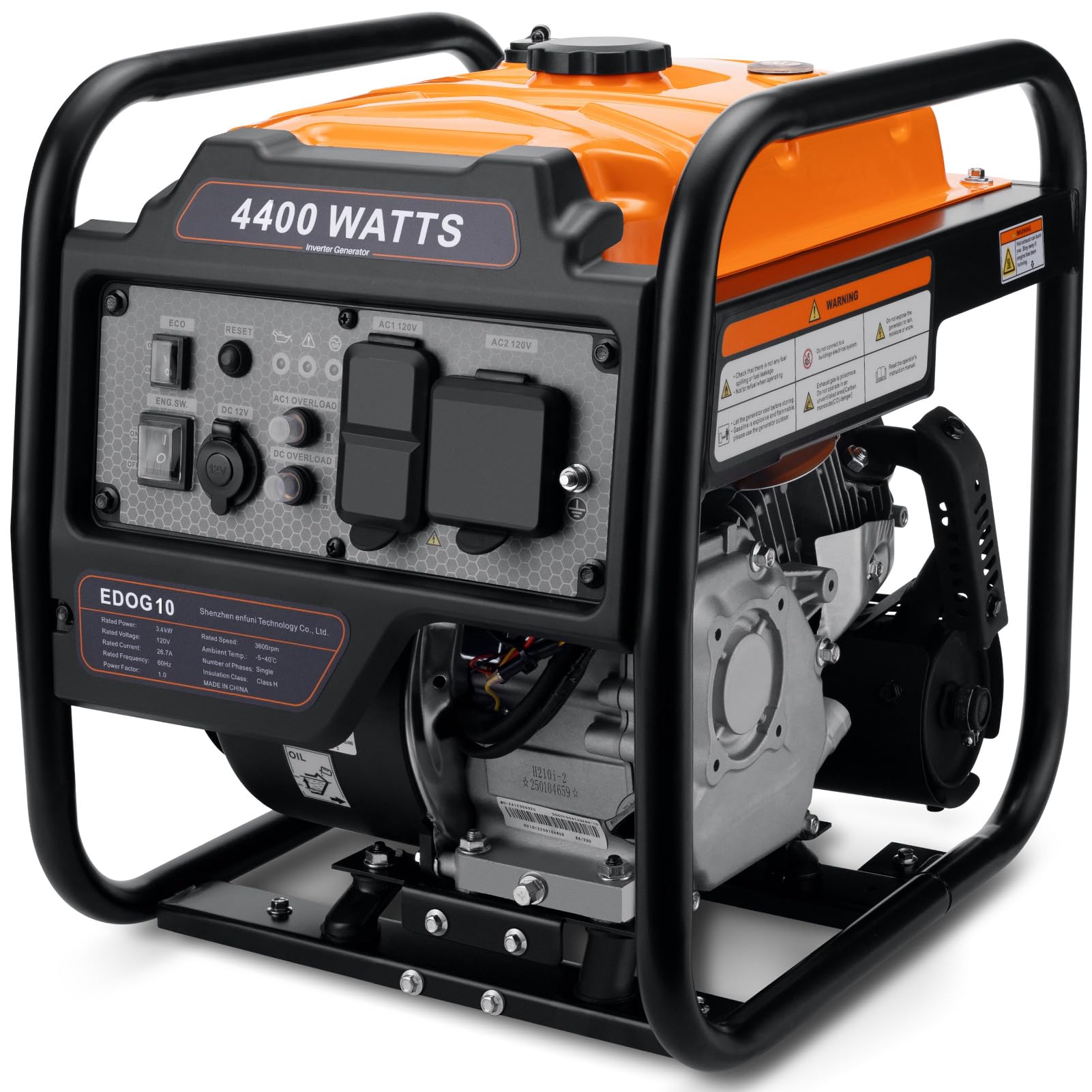
| Oxseryn 4400Transfer-Switch Pick | RV + heavy appliances | 3400 | 4400 | 56 lbs | Amazon |
| Champion 4000 | Lightweight RV inverter | 3000 | 4000 | 48.1 lbs | Amazon |
| WEN DF360iX | Dual-fuel RV + home | 2900 | 3600 | 49 lbs | Amazon |
| WEN 56360i | Quiet camper power | 2900 | 3600 | 46 lbs | Amazon |
| ERAYAK 2400 | Quiet sensitive electronics | 1800 | 2400 | 42 lbs | Amazon |
| GENMAX 2000i | Ultralight camping | 1600 | 2000 | 34 lbs | Amazon |
| Aceup 1200W | Entry-level essentials | 900 | 1200 | 35.5 lbs | Amazon |
In‑Depth Reviews
1. Westinghouse 12500 Peak Watt Dual Fuel Home Backup Portable Generator
Our pick — over 4.5★ from 800+ verified ratings; the strongest balance of quality and price.
The heavyweight that turns a blackout into a minor inconvenience for your entire home.
This is the machine you want when losing power means losing everything. With 12500 peak watts and 9500 running watts on gasoline, it powered a 100-amp home including central AC through a 50-amp outlet. Buyers report it ran their whole house without breaking a sweat — that’s the scale we’re talking about here.
The dual-fuel system means you can switch to propane, giving you 11200 peak and 8500 running watts when gas is scarce. Its 457cc engine with a cast iron sleeve is built to last, and the remote start key fob means you can fire it up from the porch instead of wrestling a pull cord. Owners mention the whole setup was easy, from wheel installation to first start.
At 212.1 pounds, this is not a casual carry — plan for two people to move it initially. The noise is real too, with mixed feedback on how loud it gets. But for the family that went through a multi-day outage with a freezer full of meat, the trade-off is obvious.
Whole-Home Muscle
- 12500 peak / 9500 running watts handles a full house
- Dual fuel with remote electric start via key fob
- Transfer-switch ready 50A outlet for permanent hookup
The Heavy Realities
- 212.1 lbs with wheels — needs 2-3 people to position
- Noise level gets mixed reviews; it’s an open-frame unit
- 5-hour break-in at half load required before heavy use
Built for the big job: If your priority is keeping a whole house, AC included, running through a storm, this is the one.
Heads up: Think twice if you need something you can lift alone — at 212.1 lbs, this stays where you put it.
2. Westinghouse 6500 Watt Dual Fuel Home Backup Portable Generator
The mid-size workhorse that runs a 30-amp RV or a home’s essentials without emptying your wallet.
For most households, this generator keeps your essentials running during a blackout. It delivers 6500 peak watts and 5300 running watts on gas, so it powered a sump pump, refrigerator, and electronics at the same time during a 4-day outage. The 274cc engine starts on the first pull for most owners, and buyers consistently call the build quality solid and heavy-duty.
The dual-fuel design is the star here — owners love switching between propane and gas depending on what’s available. On the RV side, it runs an entire 30-amp trailer including the AC, which is why RV dwellers are big fans. The 4.7-gallon tank with a fuel gauge gives up to 14.5 hours of run time, so overnight outages aren’t a worry.
It’s a large open-frame unit, so it’s not quiet, and quality feedback on noise is genuinely mixed — some find it quieter than expected, others louder. But when the alternative is no AC in summer, the volume is a fair price to pay.
Balanced Power
- 6500 peak / 5300 running watts covers home essentials + RV
- Dual fuel with 14.5-hour run time on a 4.7-gallon tank
- Transfer-switch ready L14-30R and RV-ready TT-30R outlets
Consider This
- Pull start can be hard when cold — 12 pulls reported at 19-23°F
- Noise level draws mixed opinions, typical for open-frame
Right-sized for most: Grab this if you want one machine that handles home backup and RV trips without going overboard on price.
The catch: If you live in freezing winters and dread pull-starting, consider the remote-electric models instead.
3. WEN 5600-Watt Portable Generator (GN5600)
The 56-pound inverter that runs a fridge, freezer, AC, and microwave all at once.
This one breaks the mold — inverter power at an open-frame weight. At 56 pounds, it’s a fraction of the weight of traditional units its size, yet off-grid users report running a refrigerator, freezer, AC, microwave, and even a welder simultaneously. The 4400 peak and 3400 running watts handle what most homes need.
The run time is the headline: up to 14 hours at 25% load in ECO mode on a 2-gallon tank with a fuel gauge. Owners say it’s cheaper to run than bigger brands and noticeably quieter, with noise rated under 72 dBA from 23 feet away. Starting is electronic, with cold start technology and a first-pull success rate that owners praise.
Honesty check: reliability is the dividing line here. Some owners have hit failures weeks in, while others pushed past 200 hours. The consensus is clear — this is a light-duty machine, not a daily driver. If you need consistent daily power, spend elsewhere.
Power-to-Weight
- 14-hour run time in ECO mode on 2 gallons
Watch This
- Reliability is mixed — some units failed within weeks
- Fuel tank is small; owners want an extra gallon
Best for light duty: Choose this if you want big inverter power you can actually lift and move around easily.
Not a daily driver: skip it if you need a generator running every single day — buy for occasional outages and trips only.
4. Champion 4000-Watt RV Ready Portable Inverter Generator

A 48-pound inverter that easily powered a 45-foot fifth wheel and a 15,000 BTU AC.
Champion proves lightweight doesn’t mean weak. At under 49 pounds, this is among the lightest 4000-watt inverters around, yet it runs a 15,000 BTU AC unit, powers a 30-gallon air compressor, and handled a full home renovation site with zero complaints from owners. The 4000 starting and 3000 running watts deliver clean power at less than 3% THD.
At 64 dBA from 23 feet, it’s quiet enough for campgrounds and tailgating. The 149cc engine starts easily, with owners reporting success on the first or second pull in all conditions. A 55-hour test run burned through 5 gallons of gas with no oil burn and no negatives reported — that’s efficiency you can plan around.
You can plug your RV directly into the panel, which has a 120V 25A TT-30R outlet (the standard RV hookup) and a 20A household duplex. A parallel port lets you double the output by connecting a second unit. The CO Shield auto-shutoff (a carbon monoxide detector that turns the engine off) adds safety for enclosed spaces, and the 3-year warranty with lifetime support backs it all up.
Light & Lively
- 4000 starting / 3000 running watts at just 48.1 lbs
- 64 dBA from 23 feet — campground friendly
- Parallel capable to double power with a second unit
The Fine Print
- Can run AC or microwave, but not both at once
- Gasoline only — no dual-fuel option here
Best all-rounder: Grab this if you want one lightweight, quiet unit for RV, camping, and home essentials.
Power limit: If you need AC plus microwave simultaneously, step up to a larger running-watt machine.
5. WEN Quiet and Lightweight 3600-Watt Dual Fuel RV-Ready Portable Inverter Generator (DF360iX)

A suitcase inverter that runs a fridge, freezer, TV, and AC — on propane or gas.
WEN packs dual-fuel flexibility into a 49-pound inverter frame. On gas you get 3600 surge and 2900 rated watts; on propane it’s 3500 surge and 2600 rated. Owners ran a 10,800 BTU AC, air fryer, microwave, fridge, and water heater — not all at once, but the capacity is genuinely there for RV and home backup.
At 52 dBA, it’s quiet enough for a campground conversation. Clean power protects laptops and smartphones, and the WEN Watchdog CO Shutdown Sensor automatically kills the engine if carbon monoxide builds up. The fuel shut-off lets the carburetor run dry, which extends the machine’s life between uses.
Owners logged over 50 hours with zero issues, and the digital display tracks fuel, load, and runtime. One note: the propane quick-connect is non-standard and shorter than typical, but the included hose works fine. Another owner found the 30A plug location blocks the RV plug from seating fully — a small shave fixes it.
Fuel Flexibility
- Dual fuel: 3600 surge watts gas / 3500 surge watts propane
- 49 lbs — a genuinely portable suitcase design
- CO Watchdog auto-shutdown for safety
Quirks to Note
- Propane quick-connect is non-standard — use the included hose
- 30A plug can block RV plug seating on some RVs
Best dual-fuel value: Pick this if you want inverter-clean power with the option to run on propane for indefinite storage.
Small fix needed: If you plug into both the 30A and RV outlets, expect a minor seating adjustment — not a dealbreaker.
6. WEN 3600-Watt Portable Inverter Generator (56360i)

The 46-pound inverter that fits under a camper bunk and runs a 13K BTU AC.
Campers love this one for a simple reason: it’s quiet, compact, and powerful. At 46 pounds and 149cc, the 3600 surge and 2900 rated watts ran a 13,000 BTU AC fine on a hot day and starts on the second pull, even at 14°F. Owners slide it under the bunk with no gas smell to worry about.
The fuel shutoff is the standout maintenance feature — it runs the carburetor dry before shutdown, which prevents the gunk buildup that kills small engines. Over 40 hours of use, owners burned about a gallon per 5 hours and reported zero problems. The panel includes two 120V receptacles, a TT-30R RV outlet, a 12V DC port, and two USB ports.
Cutting through the praise: the digital display shows fuel level, runtime, and power output, which owners genuinely appreciate. The 3-year warranty backs it up. If you need to power big power tools or multiple heavy appliances at once, this isn’t that machine — but for light home backup and RV life, it’s hard to fault.
Camper Perfect
- 3600 surge / 2900 rated watts in a 46-lb frame
- Fuel shutoff protects the carburetor long-term
- Fits under a bunk — compact 17.9″ x 11.6″ footprint
Scope Check
- Not enough power for large power tools or heavy appliances
- Oil changes every 25 hours with no filter
For the RV life: Choose this if you camp and need quiet, reliable power that’s easy to store and move.
Stay light: pass on it if you plan to run a welder or a full workshop — that’s open-frame territory.
7. ERAYAK 2400W Portable Inverter Generator

A 42-pound quiet inverter that powers your CPAP and laptop safely, all night.
If you’ve got sensitive electronics — CPAP machines, laptops, gaming consoles — this is the machine to eye. The 2400 peak and 1800 running watts come with less than 1.2% THD, meaning clean power that won’t fry your gear. Owners ran a coffee maker, AC, microwave, stereo, TV, and lights in a 17-foot trailer without any issues.
At 52.5 dB from 7 meters at 25% load, it’s genuinely quiet — campground-friendly. The 42-pound weight means one-hand lifting, and at 18.82″ x 11.73″ x 18.11″, it stores easily. ECO mode dynamically adjusts engine speed to stretch fuel, giving up to 16 hours at 25% load.
Fuel economy is a strength: 0.21 gallons per hour at 25% load means you’re not constantly refilling. But reliability does have a split personality — one owner had output fail within 90 days (company sent a replacement promptly), another got a defective unit with warranty runaround. The 3-year warranty is real, but quality control isn’t flawless.
Clean & Quiet
- Less than 1.2% THD — safe for CPAP, laptops, TVs
- 16-hour run time at 25% load in ECO mode
- 42 lbs — one-hand lift portable
The Reliability Question
- Some units failed within months; warranty response varies
- 2 AC outlets only — limited for heavy multi-appliance use
Best for electronics: Pick this if clean power for medical devices and gadgets is your top priority.
Know the risk: If you need guaranteed long-term reliability, a higher-reviewed brand may be worth the extra cost.
8. GENMAX Portable Generator 2000W (GM2000i)

At 34 pounds, one of the lightest 2000-watt inverters you can carry for miles.
This is the generator for the long walk from the truck to the campsite. At 34 pounds, the GM2000i is among the lightest in its class, with a sturdy handle built for distance. The 2000 starting and 1600 running watts come from a 79.7cc 4-stroke engine, producing clean power under 3% THD.
It ran a camper’s AC and lights along with power tools, and owners call it quieter than pricier brands. The 1-gallon tank delivers 8 hours at 50% load, with an Economy Mode for maximum fuel efficiency. One owner ran a 36-inch shop fan that dropped a dugout’s temperature by 20°F from 135°F.
The CO Detect shutdown sensor adds real safety, and the panel includes 120V/20A outlets plus dual USB ports and parallel capability. Starting is reliable — one pull if recent, seven after months idle. A few owners hit initial start issues, usually a missing wire or overfilled oil — fixable, but frustrating when it happens.
Carry It Anywhere
- 34 lbs — one of the lightest 2000W inverters
- 8-hour run time at 50% load on 1 gallon
- CO Detect shutdown for safety
Check On Arrival
- Some units arrive with missing wires or overfilled oil
- Avoid ECO mode above 50% load — it stumbles
For the distance hiker: Choose this if carrying the generator matters more than raw wattage.
Pre-flight check: Inspect it on arrival and do a break-in run — a few owners found small fixable issues early.
9. Aceup Energy 1,200W Gas Powered Generator
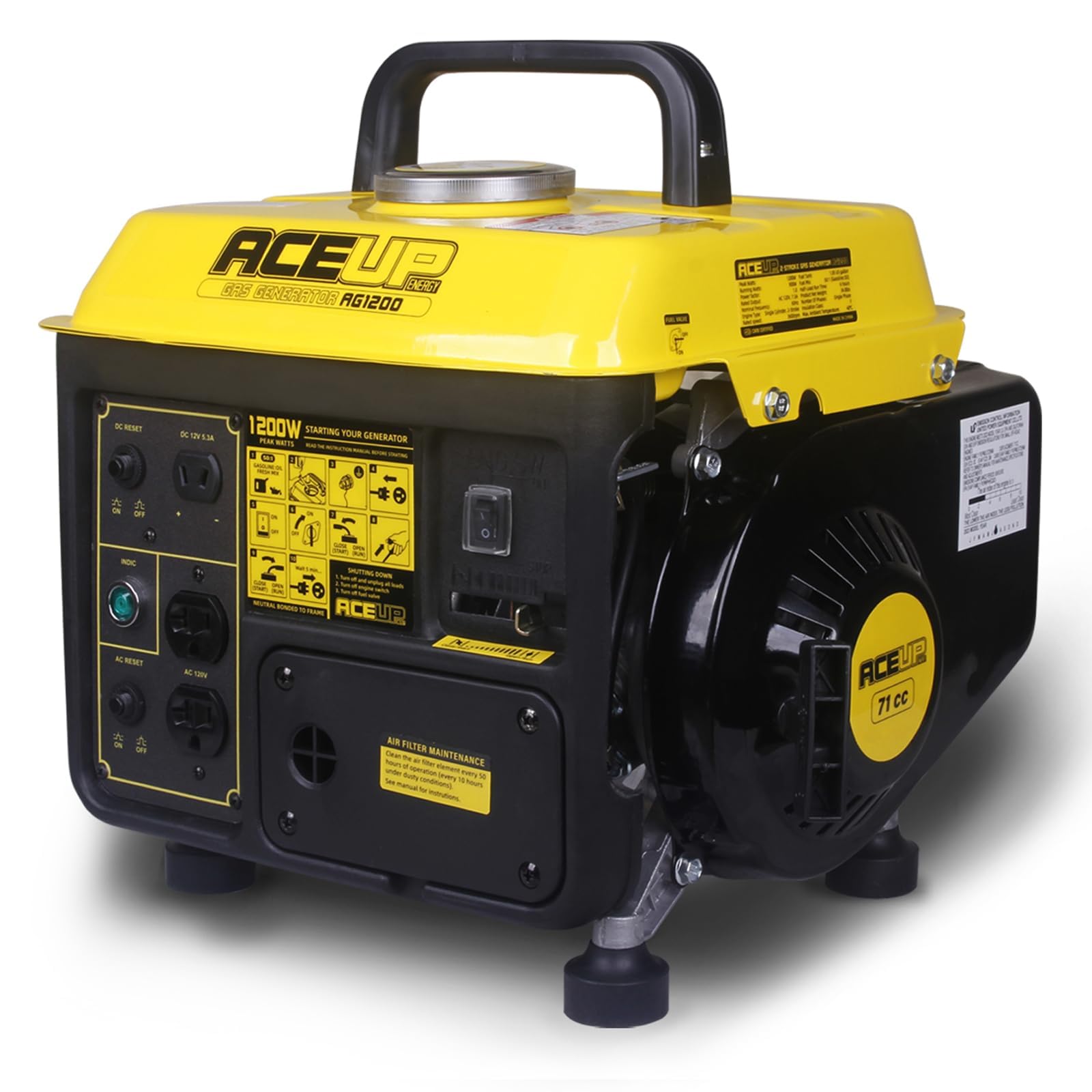
A 35.5-pound entry-level unit that charges your devices and runs small appliances.
This is the budget-friendly starting point for basic backup. The 1200 peak and 900 running watts from a 71cc 2-cycle engine keep it light at 35.5 pounds, and the compact footprint makes it easy to stash in a car for camping or emergencies. Owners found it perfect for charging phones, laptops, and running small appliances.
The 1.1-gallon tank delivers 6 hours of operation at half load, and the 50:1 gas-to-oil mix means no separate oil changes. It runs quietly at a distance, with a sound profile closer to a weed eater than a construction site. The panel includes a 120V duplex outlet, a 12V DC output, and overload protection on both.
The honest truth: reliability is the gamble here. An owner reported it “Failed to start over 5 days” before dying. Another, a 35-year mechanic, was impressed with the build quality for the price. This is a value play where your luck with quality control determines the experience.
Entry-Level Value
- 35.5 lbs — genuinely easy to carry
- 6-hour run time on a 1.1-gallon tank
- EPA & CARB compliant with 1-year warranty
The Gamble
- Reliability is inconsistent — some units fail early
- 900 running watts won’t run a fridge AND microwave
Best for the basics: Grab this if you need cheap power for phone charging, a fan, and a few lights during short outages.
Not for essentials: Avoid it if your fridge or sump pump absolutely must run — the 900 running watts have no margin.
Understanding the Specs
Running Watts vs. Peak Watts
Running watts is the continuous power the generator sustains, while peak (or starting) watts is the brief surge needed to kick on motors. A fridge needs its running watts to stay cold, but its compressor needs a surge of peak watts to start. Always size your needs against running watts, and keep peak watts as your safety margin.
Inverter vs. Conventional Generators
Inverter generators use electronics to produce cleaner, more stable power with less than 3% THD — safe for laptops, phones, and CPAP machines. Conventional generators are simpler, often cheaper, and put out more raw wattage, but the power can spike and damage sensitive electronics. If you’re plugging in anything with a circuit board, inverter is the safer bet.
Dual Fuel and Your Options
Dual-fuel generators run on both gasoline and propane. Gasoline is cheap and everywhere, but it degrades over months of storage. Propane stores indefinitely and burns cleaner, which makes it the smarter emergency fuel. Having both options means you can use whichever is available when the power goes out.
Noise and the Decibel Scale
Noise is measured in dBA, and every 10 dBA doubles the perceived loudness. A 52 dBA unit sounds like a normal conversation; a 72 dBA unit sounds like a vacuum cleaner. If you’re camping or in a tight neighborhood, check the dBA rating — it’s the difference between a peaceful night and a neighborly complaint.
FAQ
What size portable backup generator do I need for my house?
What’s the difference between running watts and peak watts for a generator?
Is a dual fuel generator worth the extra cost?
Can I run my refrigerator on a 2000-watt generator?
How long will a portable generator run on a full tank?
Is it safe to run a generator in the rain or snow?
Can I plug a generator into my house’s wall outlet?
Do I need to change the oil in my generator often?
What does THD mean and why does it matter for my electronics?
Should I get an RV-ready generator for my travel trailer?
Final Thoughts: The Verdict
For whole-home backup, the portable backup generator winner is the Westinghouse 12500 because its 12500 peak watts and remote start give you true whole-house coverage. If you want balanced power for home and RV, grab the Westinghouse 6500. And for quiet, portable inverter power that protects your electronics, the Westinghouse 4000 is the one to reach for.
How We Picked
We do not accept paid placement. Every pick is matched to a real buyer and a real use-case; we do not hands-on test units.
Sources & Methodology
Specifications: manufacturer listings and product documentation. Review insights: verified customer reviews, as of August 2026. Pricing: not shown on this page (it changes often); check the current price via the retailer link.
As an Amazon Associate, KitchPrep earns from qualifying purchases. This does not affect which products we feature.
Related Guides
