
Specs are compiled from manufacturer listings and verified buyer reviews and can change over time — please confirm the key details on the product page before buying.
A dead grid doesn’t care about your plans. When the lights go out, the right backup generator is the difference between a minor inconvenience and a costly disaster—spoiled food, a dark house, and no way to charge your phone. This guide helps you match a portable generator to your home’s actual needs, from keeping the fridge cold to powering the entire house.
I’m Mohammad Maruf — the founder and writer behind KitchPrep. This guide is built by comparing the manufacturers’ published specifications and the patterns across verified customer reviews, so you get each pick’s real strengths and trade-offs instead of marketing spin.
You need a back up generator that keeps your fridge, lights, and maybe your AC running when the grid fails. Your choice hinges on three factors: the wattage your essential appliances demand, the fuel you can store, and the runtime you need.
Our Picks at a Glance

How To Choose The Best Back Up Generator
Before you look at any model, you need to know what you’re trying to power. A generator for lights and a fridge differs greatly from one that can handle central AC and a well pump. Start by listing the essentials you can’t do without during an outage.
Match the wattage to your appliances
Every appliance has two power demands: running watts to keep it going, and peak (or starting) watts for the brief surge when it first kicks on. A refrigerator might run on 600 watts but need 1,200 watts to start its compressor. Add up the running watts of everything you plan to run at once, then make sure the generator’s peak watts can cover the biggest single surge on top of that running load.
Fuel type shapes your runtime and convenience
Gasoline is the most common and easiest to find in a pinch, but it goes bad if stored too long. Propane stores indefinitely and burns cleaner, which is why dual-fuel models that run on both are so popular. If you live in an area with long outages, consider how much fuel you’re willing to store and how often you’ll want to refill the tank.
Inverter vs. conventional: know the difference
A conventional generator produces power that can fluctuate, which risks damaging sensitive electronics. An inverter generator produces cleaner power—measured by total harmonic distortion (THD)—making it safe for laptops, phones, and TVs. Inverter models are also quieter and more fuel-efficient, though they typically cost more for the same wattage.
Quick Comparison
| Model | Best For | Running / Peak Watts | Fuel Type | Runtime | Amazon |
|---|---|---|---|---|---|
| Westinghouse 6500W★ Best Overall | Whole-home backup | 5300 / 6500 W | Gas & Propane | 14.5 hrs | Amazon |
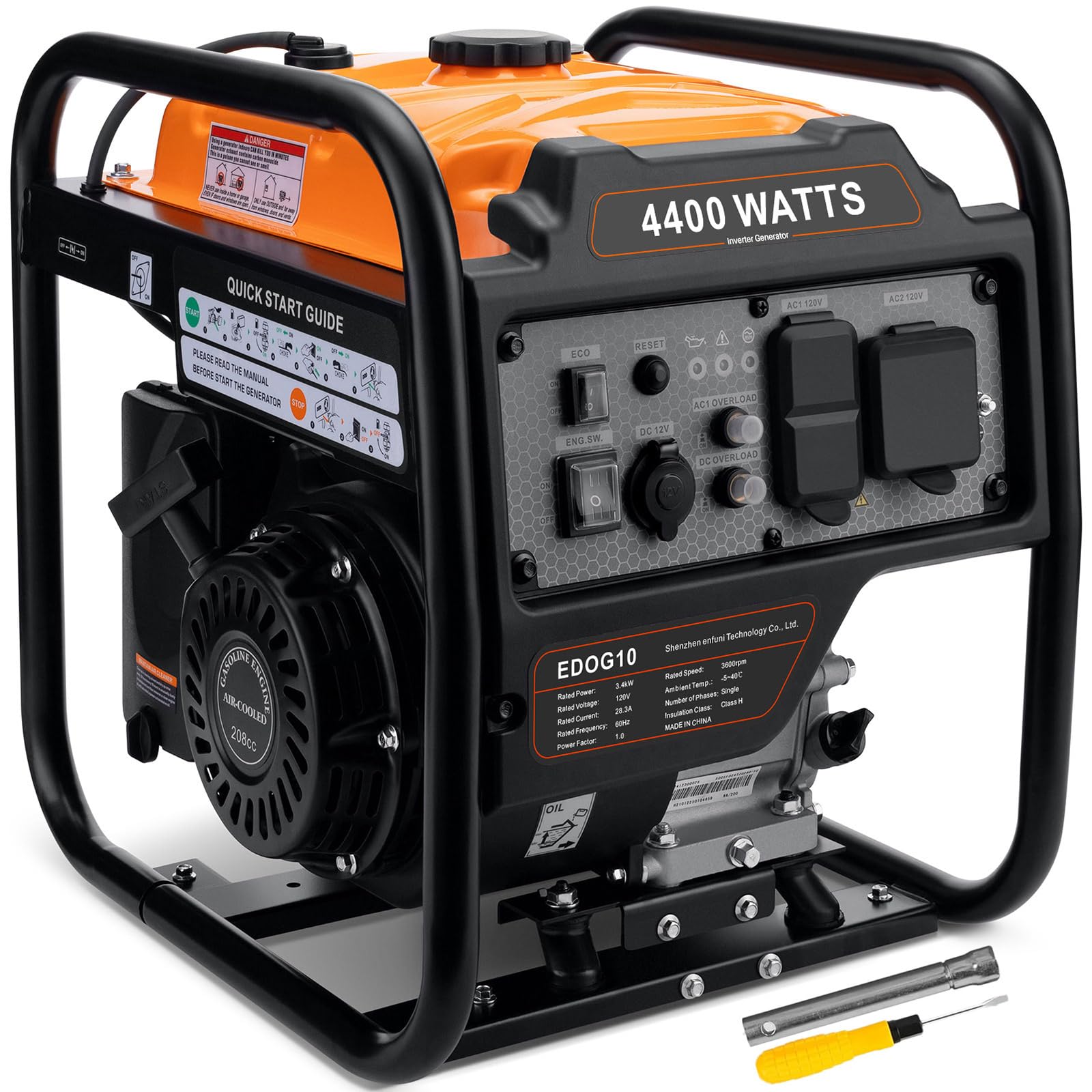
| Oxseryn 4400WBest Value | Heavy appliances | 3400 / 4400 W | Gasoline | 14 hrs | Amazon |
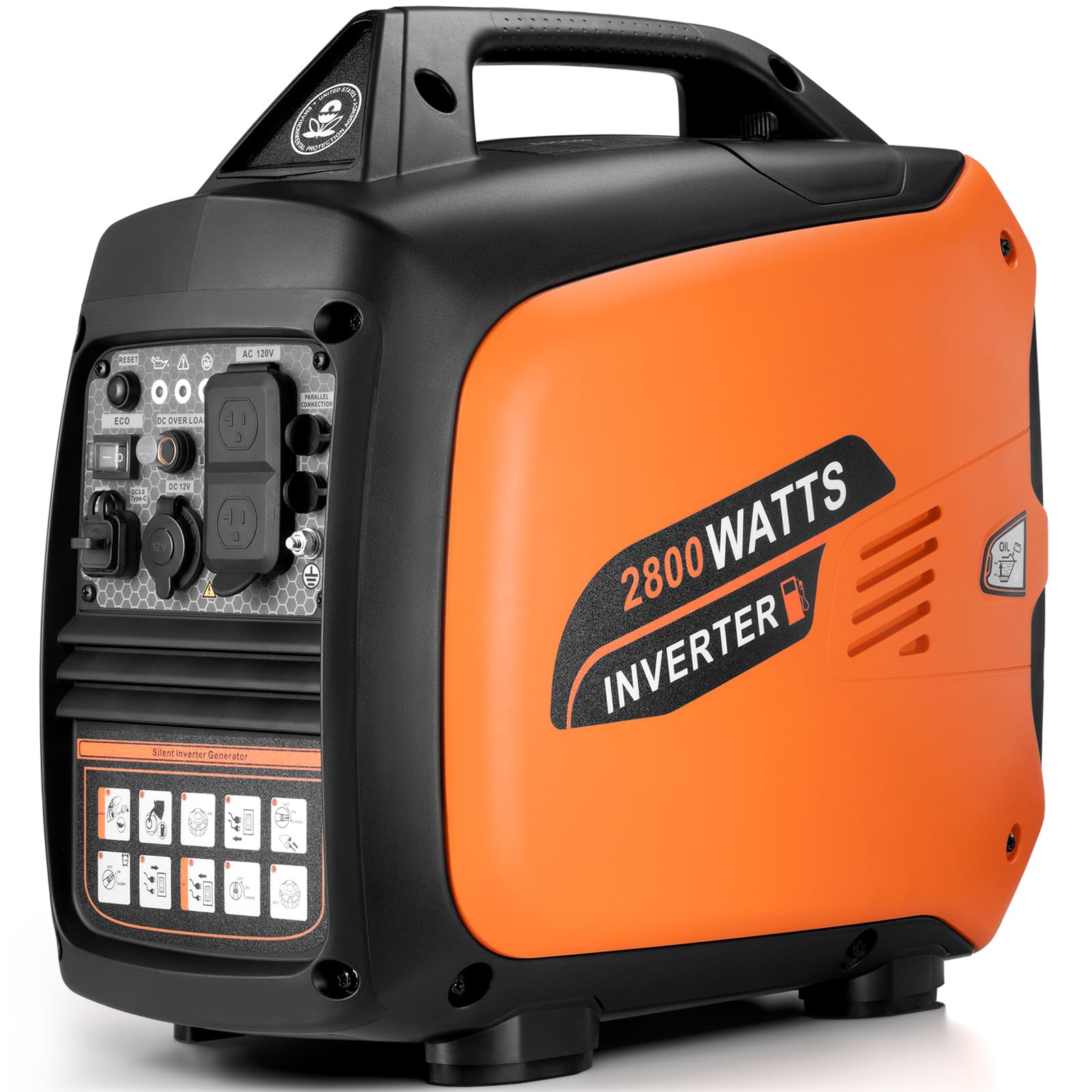
| Oxseryn 2800WQuiet Compact Pick | Camping & quiet power | 2000 / 2800 W | Gasoline | 9 hrs | Amazon |
| ERAYAK 2400W | Electronics & RVs | 1800 / 2400 W | Gasoline | 16 hrs | Amazon |
| ERAYAK 4500W | Parallel-ready setups | 3500 / 4500 W | Gasoline | — | Amazon |
| WEN DF360iX | Quiet dual-fuel | 2900 / 3600 W | Gas & Propane | — | Amazon |
| Champion 4000W | RV & campsite power | 3000 / 4000 W | Gas & Propane | 10 hrs (gas) | Amazon |
| Generac GP3300i | Lightweight portability | 2500 / 3300 W | Gasoline | 7 hrs | Amazon |
| WEN DF680iX | EV charging backup | 5100 / 6800 W | Gas & Propane | — | Amazon |
| Westinghouse 28000W | Whole-house power | 20000 / 28000 W | Gasoline | 15 hrs | Amazon |
In‑Depth Reviews
1. Westinghouse 6500 Watt Dual Fuel Portable Generator
Our pick — over 4.5★ from 950+ verified ratings; the strongest balance of quality and price.
The dual-fuel workhorse that keeps a whole house breathing during a multi-day outage.
When the power goes out for days, this is the generator you want in the garage. It delivers 5300 running watts on gasoline and 4800 on propane, with peaks of 6500 and 5800 watts respectively—enough to run a sump pump, refrigerator, and charge your electronics all at once. The 4.7-gallon fuel tank with a fuel gauge keeps it going for up to 14.5 hours, so you’re not waking up at 3 a.m. to refill.
Owners consistently praise how solidly this generator is built, and it starts right up on the first pull. You can switch between gasoline and propane depending on what you have on hand, which is handy during fuel shortages. One buyer put it plainly: “This generator was helpful for us when our electricity was out for 4 days.” The 274cc engine (the size of the engine’s cylinders) has a cast iron sleeve for longevity, plus automatic shutdowns for low oil and carbon monoxide (CO) to keep you safe.
The panel is genuinely versatile: one 5–20R 120V household duplex receptacle, one RV-ready TT-30R 30A receptacle, and one transfer-switch-ready L14-30R 30A receptacle, all with rubber covers. It even comes with oil, a funnel, a propane hose, a tool kit, and a wheel kit in the box. The trade-off is noise: some owners find it quieter than expected, others say it’s loud. For whole-home backup of essential appliances, that’s a fair price for this much power.
What owners love
- Dual fuel flexibility with propane or gasoline
- Strong build quality and reliability
- Easy first-pull starting
- Three versatile outlets including RV-ready and transfer-switch-ready
What to know
- Noise level is mixed—some find it loud
- Pull start can be hard in cold conditions
- Fuel tank is large, adding to overall weight
The clear pick: Best for homeowners who need reliable, high-output power for multi-day outages and want the flexibility of two fuel types.
Think twice if: You need a whisper-quiet unit for camping or sensitive neighbors—this is a workhorse, not a library.
2. Oxseryn 4400-Watt Inverter Generator
A budget-friendly inverter that out-powers its price tag and shrugs off a week of constant use.
This is the generator that proves you don’t need to spend a fortune for serious power. With 3400 running watts and 4400 peak watts, it handled a week-long outage running three sump pumps, two fridges, fans, a TV, and a modem nonstop for seven days. The 2-gallon fuel tank delivers up to 14 hours of runtime at 25% load, and the ECO mode stretches fuel even further—one owner reported 16 hours on a single fill.
At 57 pounds, it’s noticeably lighter than comparably powered units, though that lightness has a quirk: it can shift when you yank the starter cord. A simple brace with your foot or hand solves it, and buyers report it’s easy enough for anyone to start. Owners call it an excellent value for the wattage, with one noting it ran a 10,000 BTU window AC unit effectively.
You will need to add engine oil before first use, as it ships dry. The noise profile is manageable—loud up close at around 100 db, but dropping to 75 db at 30 feet. The choke label is reversed, which is a minor annoyance, but the manual is solid and the cold start technology means it fires up within a few pulls. For emergency home backup or RV use, this is a lot of machine for the money.
Reliability record: Owners consistently report this unit starts easily and runs for days without complaint, even under continuous 24/7 load during severe weather.
Watch for: It’s lightweight enough to slide when pulling the starter—brace it first, and you’re good to go.
3. Oxseryn 2800-Watt Portable Inverter Generator
The quiet, parallel-ready companion that powers a fridge, fans, and a CPAP on a single tank.
At just 40 pounds with a built-in handle, this inverter generator is built to travel—and it’s quiet enough to use at a campsite without annoying the neighbors. Running at under 58 dBA from 23 feet away, it produces 2000 running watts and 2800 peak watts from a 79.8cc engine. The 1.1-gallon fuel tank with a fuel indicator delivers up to 9 hours at 25% load, and owners mention “Runs 4+ hrs on 0.5 gal gas.”
Its clean power output is the standout feature. With less than 3% THD, it’s safe to plug in your phone, laptop, drone, or camera directly—no worry about damaging sensitive electronics. The outlet selection is generous for the size: two 120V AC ports, one 12V DC port, a USB port, and a Type-C port. It even supports charging a power station, which makes it a versatile piece of an off-grid setup.
Owners praise how efficiently it runs a whole spread of essentials—a fridge, five fans, lights, a CPAP, and a 65″ TV all at once at around 950 watts. The parallel function means you can link two units together for double the output, which is why some buyers grab a second one. A few owners note it stumbles near max load and won’t handle a microwave, so keep continuous use in the 900–1500W safe zone.
Why it’s a favorite
- True quiet operation for camping and neighborhoods
- Clean power safe for laptops, phones, and TVs
- Parallel-ready to double output later
- Featherweight at 40 lbs
Keep in mind
- Won’t run high-draw appliances like a microwave
- Overloads in ECO mode near max load
- Oil check requires removing a side cover
Reach for this if: You want a portable, quiet generator for camping, tailgating, or powering essentials and sensitive electronics during an outage.
Look elsewhere if: You need to run heavy appliances like microwaves or power tools with high starting surges.
4. ERAYAK 2400W Portable Inverter Generator

The whisper-quiet 2400-watt inverter built for CPAPs, laptops, and late-night campground peace.
If you need power for sensitive electronics, this ERAYAK is engineered for exactly that. It produces 2400 peak watts and 1800 running watts with an ultra-low THD of just 0.2%–1.2%, meaning the electricity is clean and stable enough for laptops, CPAP machines, gaming consoles, and TVs. The noise level is the standout—just 52.5 dB at 7 meters and 25% load—which makes it a welcome neighbor at any RV park or residential area.
Fuel efficiency is a real strength here. At 25% load in ECO mode, it sips just 0.21 gallons per hour, which works out to a 16-hour runtime. Even at full 100% load, it only consumes 0.2375 gallons per hour. Customers note it powers a coffee maker, microwave, and water pump in a 17-foot trailer, and one praised how reliable it is for tools on a worksite. The 42-pound weight with compact dimensions makes it a one-hand lift for most adults.
Reliability is the most-praised aspect, with owners noting it starts right away and delivers consistent power. The versatility is a close second—people use it for everything from home outages to garden work to charging batteries. There’s a genuine warranty story here: the company offers a 3-year limited warranty with free lifetime technical support. An occasional unit has had issues, but the responsive customer service that replaces defective units is exactly what you want in an emergency power source.
Quiet confidence: Owners consistently highlight how unobtrusive this unit is—quiet enough that you’ll forget it’s running, which is the highest praise for a generator.
Know before you buy: Some units have required warranty service within the first year, but the company’s replacement process has won back skeptical buyers.
5. ERAYAK 4500W Portable Inverter Generator

The mid-size inverter that ran a Chicago household for 14 hours straight during a storm.
This ERAYAK strikes a strong balance between power and portability. It produces 3500 running watts and 4500 peak watts from a 208cc engine, and at 54 pounds it’s genuinely manageable to move. The quiet operation at 60.5 dB(A) makes it suitable for campgrounds and neighborhoods, and the clean power (0.2%–1.2% THD) means your sensitive electronics are safe. One owner kept it running for roughly 14 hours continuously through a storm, powering a fridge, fan, lights, and medical devices while conserving gas.
The defining feature is the 50A parallel capability. Connect two 4500P units and they deliver a rated 7000W and peak 9000W with 50A output—effectively doubling your power when you need it. The outlet panel includes a 30A L5-30R RV outlet, two 120V AC outlets, a 12V 5A cigarette lighter port, and both USB-A and USB-C ports for device charging. Built-in 20A and 30A circuit breakers add overload protection.
Fuel efficiency is a genuine highlight: it consumes just 0.21 gallons per hour at 25% load. Owners praise it as a lifesaver during outages and note it runs multiple tools and machines effectively. The honest notes: it’s a bit louder than the marketing suggests, and you must add oil before first use (the low-oil protection will prevent starting otherwise). Some units burn through oil initially, which is normal during break-in.
Storm-season hero: Buyers repeatedly describe this as their go-to during extended outages, praising how far a single tank goes when you’re rationing fuel.
Fair warning: A few units have arrived with starting issues; the brand’s warranty support and Amazon’s return policy are your safety net.
6. WEN 3600-Watt Dual Fuel Inverter Generator

The suitcase-style dual-fuel inverter that’s quiet enough for a conversation next to it.
This WEN inverter is all about flexibility and refinement. It runs on both gasoline (3600 surge watts, 2900 rated watts) and propane (3500 surge watts, 2600 rated watts), so you can choose your fuel based on availability and storage. The 149cc engine is housed in a suitcase-style frame that weighs just 49 pounds, making it easy to carry. Owners call it a “suitcase generator that exceeds expectations,” running a fridge, freezer, computers, lights, and even a 5K BTU AC without complaint.
The quiet operation is one of its defining traits—comparable to the sound of a normal conversation, according to the US Department of Health and Human Services scale. It produces clean power to protect smartphones, tablets, and laptops, and the WEN Watchdog CO Shutdown Sensor automatically turns it off if dangerous carbon monoxide levels are detected. That’s a feature that could save your life if you’re running it near living spaces (though you still shouldn’t).
The outlet selection covers real needs: two three-prong 120V receptacles, a TT-30R RV receptacle, a 12V DC receptacle, and two 5V USB ports. The fuel shut-off helps limit maintenance by running the carburetor dry before shutdown. Reviewers point out the digital data center displaying fuel, load, voltage, and runtime is a handy touch. The honest caveats: the propane quick-connect hose is non-standard and shorter than expected, and the 30A plug placement can block the RV plug seating—minor issues that don’t undermine its value.
What impresses
- Genuinely quiet operation
- Dual fuel flexibility in a compact frame
- CO Watchdog safety sensor
- Digital display for fuel, load, and runtime
What to watch
- Propane hose connection is non-standard
- Initial run may smoke briefly during break-in
- Rated runtime on propane is less than claimed for some
The pick for: RV owners and homeowners who want a quiet, dual-fuel inverter that’s easy to carry and safe for sensitive electronics.
skip it if: You need more than 2900 running watts, or you want a standard propane quick-connect fitting from the start.
7. Champion 4000-Watt Dual Fuel Inverter Generator

The dual-fuel inverter that runs two fridges and a freezer for up to 12 hours on a 20-pound propane tank.
Champion brings its reputation for reliability to this 4000-watt dual-fuel inverter. It delivers 4000 starting watts and 3000 running watts on gasoline, with up to 10 hours of runtime, and 2700 running watts on propane with an impressive up to 25 hours. The 149cc engine is quiet at 64 dBA from 23 feet, and buyers consistently praise how much lighter and easier to transport it is than their full-size generators.
The propane story is genuinely compelling for off-grid use. One owner reports running two fridges and a freezer for 6–12 hours on a single 20-pound tank, with no carburetor maintenance worries—one of the key advantages of propane over gasoline. The CO Shield carbon monoxide auto shutoff system adds a critical safety layer. The included LPG hose and engine oil mean you can start using it right from the start.
The outlet panel suits RV and campsite life: a 120V 25A TT-30R outlet (the standard RV hookup), a 120V 20A household duplex outlet with clean electricity (less than 3% THD, meaning it’s safe for sensitive electronics), a 12V automotive-style outlet, and parallel outlets for linking a second Champion unit. Build quality and quiet operation are the most-praised aspects. Fuel options get mixed feedback—most say it runs great on propane, but a few couldn’t get it started on that fuel. Treat propane as a bonus, not a guarantee.
Camping favorite: Owners repeatedly highlight how this unit shrinks the gap between a heavy full-size generator and a tiny suitcase unit, delivering real power with easy transport.
Honest note: The dual-fuel system works best on gasoline for most owners; propane starting can be finicky on an occasional unit.
8. Generac 3,300 Watt Portable Inverter Generator

The Generac that delivers 50% more starting capacity than standard inverters in a 59.5-pound frame.
Generac’s PowerRush technology is the headline feature here, delivering 50% more starting capacity to handle the surge demand of refrigerators, RV air conditioners, and motor-driven tools that would overload a standard inverter. It produces 2500 running watts and 3300 starting watts, with TruePower Technology keeping THD under 3% so it’s safe for laptops, tablets, and CPAP machines. The 1.06-gallon fuel tank delivers up to 7 hours at 25% load.
The COsense technology is a meaningful safety feature—it monitors CO levels and shuts the unit down if dangerous concentrations are detected. Economy Mode automatically adjusts engine speed to cut fuel use and noise. At 59.5 pounds with a molded carry handle, one person can transport it easily. It even includes a USDA-qualified spark arrestor, making it legal for use in national forests, parks, and dry-condition outdoor areas—a detail most competitors don’t mention.
Owners love how easy it is to crank and how quiet it runs. One buyer ran a small window AC unit and noted “it didn’t make a sound change at all from the pull.” It’s been a daily-use workhorse for some, with one owner using it every day for nearly a year. The honest caveats: it’s slightly heavy for its wattage, and performance drops at high altitude—one owner notes you shouldn’t expect more than 2000 watts at 5000 feet. For a lightweight, reliable inverter from a trusted name, this is a strong contender.
Why it stands out
- PowerRush 50% more starting capacity
- Lightweight 59.5 lbs with carry handle
- Clean power safe for sensitive electronics
- USDA-qualified spark arrestor included
Consider this
- Rated runtime drops to 4.5 hours at 50% load
- Performance drops at high altitude
- Only gasoline fuel—no propane option
Grab this if: You want a trusted brand, easy one-person transport, and extra starting power for AC units or tools without the bulk of a full-size generator.
Look past it if: You need dual-fuel flexibility or plan to run it regularly at high elevations above 5000 feet.
9. WEN 6800-Watt Dual Fuel Electric Start Inverter Generator

The 240-volt dual-fuel generator that keeps both ACs running and can top off your EV battery.
This WEN is the most feature-packed inverter in the lineup, starting with its bonded-neutral 240V configuration that provides low-power Level 2 charging for battery and hybrid electric vehicles. It runs on gasoline (6800 surge watts, 5100 rated watts) and propane (6000 surge watts, 4500 rated watts) from a 224cc engine. The electric start with remote means you can fire it up from inside the house—a genuine convenience during a storm.
Real-world performance is impressive: one owner ran both 15,000 BTU air conditioners, a stove fan, and lights on a single 30A plug. Another relies on it daily for propane use in a cabin, running a water pump and everything else on a code-compliant panel. The 40-pound propane tank lasts 28–30 hours in Texas heat, and it’s quiet enough in ECO mode that it fades out at 100 yards. The onboard wheels and telescoping pull handle make the 99.2 pounds manageable.
The WEN Watchdog CO Shutdown Sensor adds a critical safety layer, and the fuel shutoff boost lifespan by using up the remaining carburetor fuel before shutdown. The outlet panel is comprehensive: one L14-30R 120V/240V receptacle, two three-prong 120V receptacles, one TT-30R RV receptacle, one 12V DC receptacle, and two 5V USB ports. The honest feedback: it’s heavy to load into a truck, and a few shoppers say reliability issues after extended use. For EV owners and heavy-power users, though, the 240V capability is a standout.
What you gain
- 240V output for EV Level 2 charging
- Remote electric start convenience
- Dual fuel with tool-free LPG connector
- Onboard wheels and telescoping handle
Weigh this
- Heavy at 99.2 lbs for loading
- Noise level is mixed—quieter than expected for some
- Some units cut off under heavy load until reset
Choose this for: EV owners, off-grid cabins, and anyone who needs 240V output plus the convenience of remote electric start in a dual-fuel package.
Reconsider if: You plan to move it frequently—at 99.2 pounds, this is better as a stationary setup than a daily transport.
10. Westinghouse 28000 Peak Watt Home Backup Generator

The 999cc V-Twin monster that powers a 3,200-square-foot house including the 6-ton AC.
This is the endgame of portable home backup. With 28,000 peak watts and 20,000 running watts from a 999cc V-Twin OHV engine (a large, powerful engine type), it can power an entire home—one owner runs a 3,200-square-foot house including a 6-ton AC, a well pump, and two fridges without breaking a sweat. The 17-gallon fuel tank with fuel gauge delivers up to 15 hours of runtime at 25% load, and the remote start key fob means you can fire it up from inside during a storm.
The outlet panel is the most complete in this lineup: four GFCI 120V 5–20R household outlets, two 50A 120/240V 14-50R outlets, two 30A 120/240V L14-30R outlets, one 30A 120V L5-30R outlet, and a transfer switch outlet. All outlets have rubber covers for safety. The low THD means it’s safe for sensitive electronics, and the digital readout displays lifetime run hours, volts, and frequency. It even has a battery charging port to keep the electric start ready.
The build quality is genuinely professional-grade. Durable copper windings produce cleaner power, run cooler, and last longer. The reinforced steel handles with quick-release pins help manage the 541.1-pound weight—which is the honest trade-off. This is not something you move casually; it needs a winch on hills, as one owner noted. But for whole-house power at a fraction of the cost of an installed unit, owners call it a professional-grade option at a residential price. One buyer compared it directly to a Generac standby unit and preferred this portable for its value.
The power player
- 28,000 peak watts powers an entire house
- Remote start key fob and push-button electric start
- Eleven outlets including dual 50A and 30A options
- Durable copper windings for cleaner power
Be realistic
- Extremely heavy at 541.1 lbs—needs planning to move
- Loud, though fencing can mitigate the noise
- Warranty covers parts only, not labor
The ultimate pick: For large homes, workshops, or anyone who refuses to lose HVAC during an outage and wants portable whole-house power.
Think hard if: You lack a permanent, accessible spot for it—this is a stationary powerhouse, not a grab-and-go portable.
Understanding the Specs
Running vs. Peak Watts
Running watts is the continuous power a generator produces to keep appliances going. Peak watts (also called starting or surge watts) is the brief burst of power needed to start motors—think fridge compressors or AC units. Always size your generator so the peak watts cover your largest appliance’s surge on top of your total running load.
THD: Total Harmonic Distortion
THD measures how clean the electrical waveform is. Lower THD (under 3%, ideally under 1.2%) means the power is stable and safe for sensitive electronics like laptops, TVs, phones, and CPAP machines. Conventional generators often have higher THD, which can damage these devices over time.
FAQ
How many watts do I need to run a refrigerator?
What is the difference between an inverter and a conventional generator?
Can I run a generator on propane instead of gasoline?
How long will a back up generator run on a full tank?
Is it safe to power sensitive electronics like laptops and TVs?
What size generator do I needto run my RV air conditioner?
What is a transfer switch and do I need one?
How loud is a back up generator?
How much does it weigh and can I move it myself?
Can I connect two generators together for more power?
Final Thoughts: The Verdict
If you want one dependable pick, the back up generator winner is the Westinghouse 6500W because it delivers the best blend of dual-fuel power, runtime, and outlet versatility for whole-home backup. If you want quiet, portable power for camping and sensitive electronics, grab the Oxseryn 2800W. And for the ultimate whole-house setup that can even top off your EV, the WEN DF680iX is the one to reach for. The crowd favorite—the Westinghouse—holds a 4.6-star rating across over 900 owners, making it the safest bet when the grid goes dark.
How We Picked
We do not accept paid placement. Every pick is matched to a real buyer and a real use-case; we do not hands-on test units.
Sources & Methodology
Specifications: manufacturer listings and product documentation. Review insights: verified customer reviews, as of August 2026. Pricing: not shown on this page (it changes often); check the current price via the retailer link.
As an Amazon Associate, KitchPrep earns from qualifying purchases. This does not affect which products we feature.
Related Guides
