
Specs are compiled from manufacturer listings and verified buyer reviews and can change over time — please confirm the key details on the product page before buying.
When the lights go out, you need to know if your generator can run your whole house—central air, fridge, well pump, and all. A 12,000-watt generator gives you the surge capacity to start big motors without shutting down, so you can keep daily life going during an outage. We sorted through the real specs and owner experiences to find which units actually deliver that muscle without drama.
I’m Mohammad Maruf — the founder and writer behind KitchPrep. This guide is built by comparing the manufacturers’ published specifications and the patterns across verified customer reviews, so you get each pick’s real strengths and trade-offs instead of marketing spin.
Here are the portable powerhouses that genuinely run a home, comparing fuel flexibility, starting watts, and real runtimes to help you pick the right 12000 watt generator for outages and job sites.
Our Picks at a Glance


How To Choose The Best 12000 Watt Generator
Choosing a generator this size is about matching raw power to your home’s real needs. You are not just picking a machine; you’re deciding what stays on during a storm—the freezer, the heating system, the lights, and maybe the air conditioner. This section walks you through the three decisions that matter most.
Understand Peak vs. Running Watts
Every motorized appliance, from a refrigerator to a well pump, needs a big burst of power to start, then less to keep running. That burst is your peak or starting watts, and the steady amount is your running watts. A 12,000-watt generator usually delivers around 9,500 running watts, which is the number you should use to budget your home’s load, not the flashier peak figure.
Fuel Type: Dual Fuel vs. Tri-Fuel
Being able to switch fuels is a lifesaver when gasoline runs dry during a long outage. Dual-fuel units burn gasoline or propane, giving you a clean, storable alternative. Tri-fuel adds natural gas, which connects to your home’s existing line for essentially unlimited runtime, but it requires a professional installation and a high-BTU supply line.
Safety and Starting Features
Look for a built-in carbon monoxide (CO) sensor that automatically shuts the engine down if dangerous fumes are detected. Electric start with a remote key fob means you can fire up the machine from inside, and a low-oil shutdown protects the engine from damage during long runs.
Quick Comparison
| Model | Best For | Peak Watts | Fuel Type | Engine Size | Amazon |
|---|---|---|---|---|---|
| Westinghouse 12500★ Best Overall | Whole-home backup | 12500 | Gas & Propane | 457cc | Amazon |
| DuroStar DS13000MXBest Value Dual-Fuel | Value dual-fuel | 13000 | Gas & Propane | 500cc | Amazon |
| Pulsar G12KBN-SGLong Runtime Pick | Long runtime | 12000 | Gas & LPG | 457cc | Amazon |
| All Power America 12000W | Budget gas power | 12000 | Gasoline | 459cc | Amazon |
| WEN TF-1450X | Tri-fuel flexibility | 14500 | Gas, Propane & NG | 500cc | Amazon |
| Westinghouse 12500 Gas | Gas-only simplicity | 12500 | Gasoline | 457cc | Amazon |
| DuroStar DS13000MXT | Natural gas ready | 13000 | Gas, Propane & NG | 500cc | Amazon |
| Generac 12500 Tri-Fuel | High surge capacity | 12500 | Gas, Propane & NG | 500cc | Amazon |
| Champion 12500 Tri-Fuel | Tech & monitoring | 12500 | Gas, Propane & NG | 500cc | Amazon |
| DuroMax XP12000E | Farm & job site | 12000 | Gasoline | 457cc | Amazon |
| DuroMax XP13000HXT | Remote start tri-fuel | 13000 | Gas, Propane & NG | 500cc | Amazon |
| Champion 15000 MKE | Maximum power | 15000 | Gasoline | 717cc | Amazon |
In‑Depth Reviews
1. Westinghouse 12500 Peak Watt Dual Fuel Generator
Our pick — over 4.5★ from 800+ verified ratings; the strongest balance of quality and price.
This dual-fuel unit powers an entire home, including central air, through a 50-amp outlet.
This Westinghouse is the crowd favorite for a reason: it runs your entire home, including the air conditioner, off a 50-amp outlet. The 457cc engine delivers 9,500 running watts and 12,500 peak watts on gasoline, and drops to 8,500 running watts and 11,200 peak on propane, giving you a fuel choice when gas is scarce. Buyers report it “ran my whole home and didn’t break a sweat,” and even powered a 100-amp house with AC through a 50-amp hookup.
You can be running within minutes of opening the box, because it comes with a remote start key fob, a 12V battery charger, oil, an oil funnel, a tool kit, and a manual. The cast iron sleeve engine is built for the long haul, and the automatic low oil and carbon monoxide shutdown keep you safe during unattended overnight runs.
The main trade-off is the noise. Owners consistently describe it as “noisy but reliable,” so if you live in tight quarters with neighbors, you will hear it clearly. It is also a heavy unit at 212.1 pounds, so plan for two people to move it into place before you use the wheels.
Dual fuel flexibility
- Performance is the most-praised trait — well over 280 owners single it out for powering entire homes
- Easy setup is the second biggest win, with over 200 owners noting it was quick to get running
- Dual-fuel design lets you switch to propane for cleaner, longer-running fuel
Peak watt noise
- Noise gets mixed feedback; many call it loud
- At 212.1 pounds, you need help to get it out of the truck
- Wheels and feet are not attached, so assembly is required
Powerhouse pick: you want a proven, reliable dual-fuel unit that powers a full home with AC.
Noise-sensitive skip: you are noise-sensitive or need to move it solo up stairs.
2. DuroStar DS13000MX 13,000-Watt Dual Fuel Generator
The 500cc engine delivers 13,000 peak watts, easily starting a 1.5-ton AC alongside other appliances.
The DuroStar brings 13,000 peak watts and a larger 500cc engine than the Westinghouse’s 457cc, giving it a bit more headroom for big surge loads. It is dual-fuel, so you can run gasoline for maximum power or propane for longer runtime and cleaner emissions. Owners mention it “powered entire home; slight strain when AC kicked in but barely audible,” handling 1.5-ton ACs, fridge, stove, microwave, TVs, and a water heater all at once.
Starting is a push-button affair with a front-facing fuel selector, and the all-metal construction with a steel frame is built to take weather and heavy use. The CO Alert system automatically shuts the engine down if it detects dangerous fumes, and the 50-amp outlet connects straight to a home transfer switch.
The catch is starting reliability has mixed feedback. The manufacturer’s summary notes most customers note flawless starts, but a few describe it running for only about 10 minutes before shutting down. One owner traced a similar issue to user error—a gas valve left off—so read the startup procedure carefully.
High output stamina: More engine for the money than most rivals, with the same whole-home capability.
3. Pulsar G12KBN-SG Heavy Duty Dual Fuel Generator
The 8-gallon tank provides up to 12 hours of runtime at half load on gasoline.
Pulsar focuses on endurance. The 8-gallon fuel tank gives you up to 12 hours of continuous operation at half load on gasoline, which is ideal for multi-day outages where refueling is a hassle. It delivers 12,000 peak watts and 9,500 rated watts on gas, with a 457cc single-cylinder, 4-stroke, air-cooled OHV engine protected by a powder-coated frame.
Owners praise its reliability, with one reporting no issues after three years of use, and another noting it runs an entire 2,400-square-foot home. The dual-fuel capability on LPG is a favorite for emergency situations where propane is easier to store long-term. Setup takes about 15 minutes, and the electric start gets you going without a struggle.
The honest downside is noise gets mixed reviews—some find it quieter than a 5,000-watt Husky, while others describe it as loud. It also needs a proper break-in period with three oil changes before heavy use.
Steel frame durability: buyers who want maximum runtime between refuels and a proven three-year track record.
4. All Power America 12,000 Watt Gasoline Generator

This gasoline-only unit starts instantly via electric start and includes a wheel kit and hour meter.
This All Power America unit is the no-frills entry point into 12,000-watt territory. Powered by a 459cc 4-stroke engine with electric start, it delivers 12,000 peak watts on gasoline alone. The included wheel kit and hour meter mean you can roll it out, hook it up, and track maintenance without buying anything extra.
Reviewers point out it started immediately from the start and ran smoothly to power most appliances. One long-term owner used it for 2.5 years, wiring it to a 30-amp circuit, and it fired up instantly to run the house through a 3-day outage, getting about 10 hours of runtime per tank of fuel.
The catch is longevity has been mixed. While many use it happily for years, a few shoppers say more serious issues over time, including vibration-related wear. It is also the heaviest of the budget group at 233 pounds, so plan your placement carefully.
Gasoline simplicity: buyers on a budget who need raw gas power for occasional outages, not daily commercial use.
5. WEN TF-1450X 14,500-Watt Tri-Fuel Generator
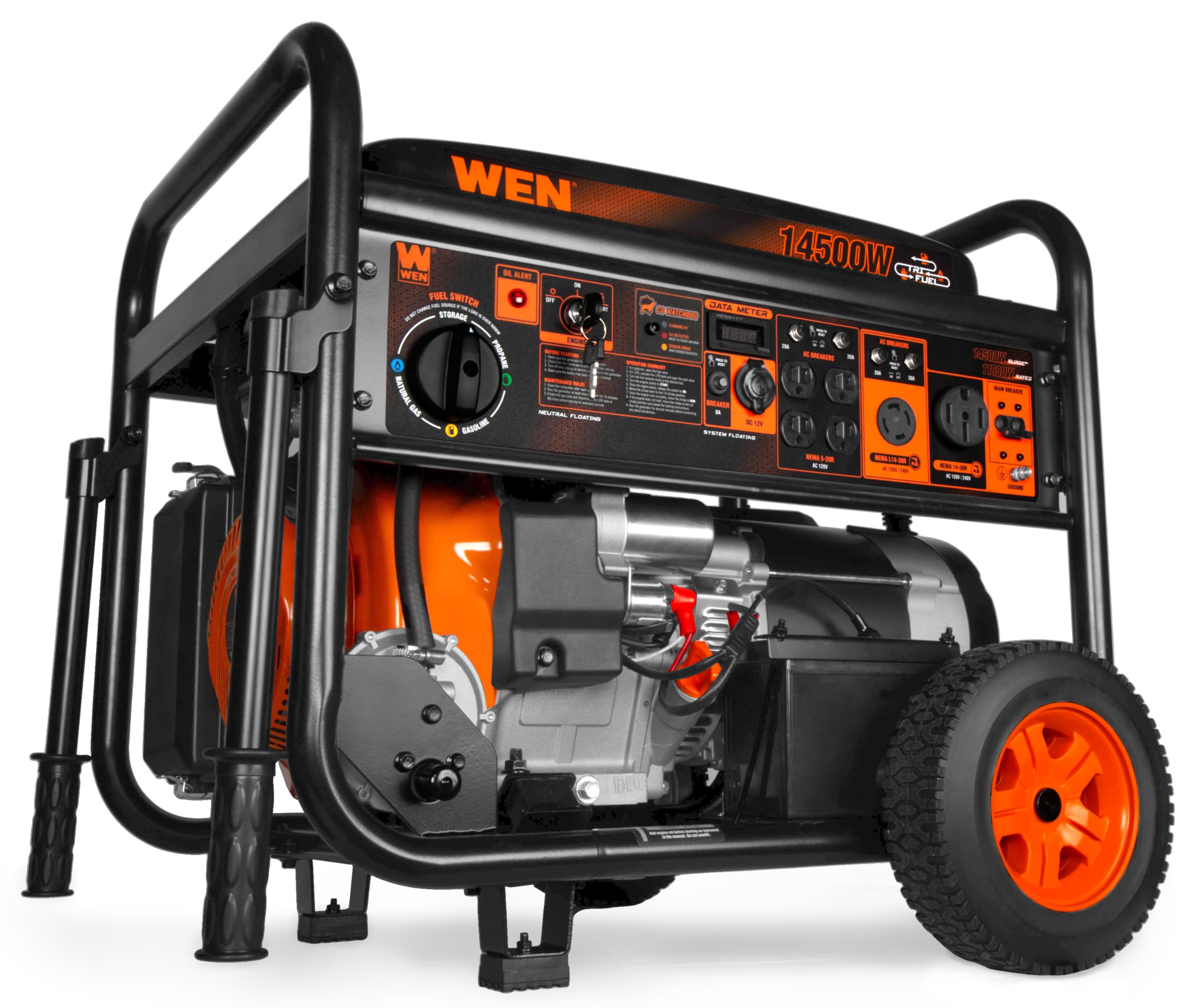
A simple dial switches between gasoline, propane, and natural gas for flexible fueling.
The WEN TF-1450X is the flexibility king, running on gasoline (14,500 surge watts, 11,500 running watts), propane (12,500 surge, 10,300 running), and natural gas (10,500 surge, 8,750 running) with a simple turn of the selection dial. That natural gas option means you can connect to your home’s gas line for essentially unlimited runtime during a prolonged outage.
You get up to 12 hours of half-load runtime from the 8.2-gallon tank, and the 500cc 4-stroke OHV engine (a standard overhead-valve design) starts with the turn of a key. from the start, you have four 120V outlets, a 120V/240V L14-30R transfer-switch outlet, a 120V/240V 14-50R outlet, a 12V DC automotive outlet, a bottle of oil, a 6-foot LPG hose, and an NG quick-connect adapter. The WEN Watchdog CO Shutdown Sensor auto-turns off the engine if carbon monoxide reaches dangerous levels, so you can run it overnight without worry.
Buyers report it “runs my whole house including central air and my garage all at once,” and note the 8-hour oil break-in is essential. The only limitation some mention is the 50-amp output cap, which is standard for this class.
Tri-fuel adaptability: If you have natural gas at home, this unit’s tri-fuel design makes it the most reliable long-outage companion.
6. Westinghouse 12500 Peak Watt Gas Generator

This gas-only model ran one home for 80 straight hours without a hiccup.
This Westinghouse strips out the dual-fuel option but keeps all the muscle, with 9,500 running watts and 12,500 peak watts from a 457cc 4-stroke OHV engine. The auto choke means it starts reliably in cold weather without fiddling, and the remote start key fob lets you fire it up from inside the house. It powered a 5-ton heat pump for 48+ hours below 32°F while running the oven and shower without struggle.
The outlet array is generous: two GFCI 120V 5–20R household receptacles, a transfer-switch-ready 120V L14-30R 30A outlet, an RV-ready 120/240V 14–50R 50A outlet, and two 5V USB ports. The cast iron sleeve engine with automatic low-oil and CO shutdown makes it a dependable overnight runner, with up to 12 hours of runtime on a 6.6-gallon tank.
Owners love the build, calling it “well-made, sturdy” and noting it started first try via electric start. The recurring gripe is the wheels — a few owners mention they fall off after about a year. The instruction manuals also get dinged for being confusing, so give them a careful read.
Proven reliability: Simpler fueling for slightly fewer options; the gas-only design is perfect if you always have fuel on hand.
7. DuroStar DS13000MXT 13,000-Watt Tri-Fuel Generator
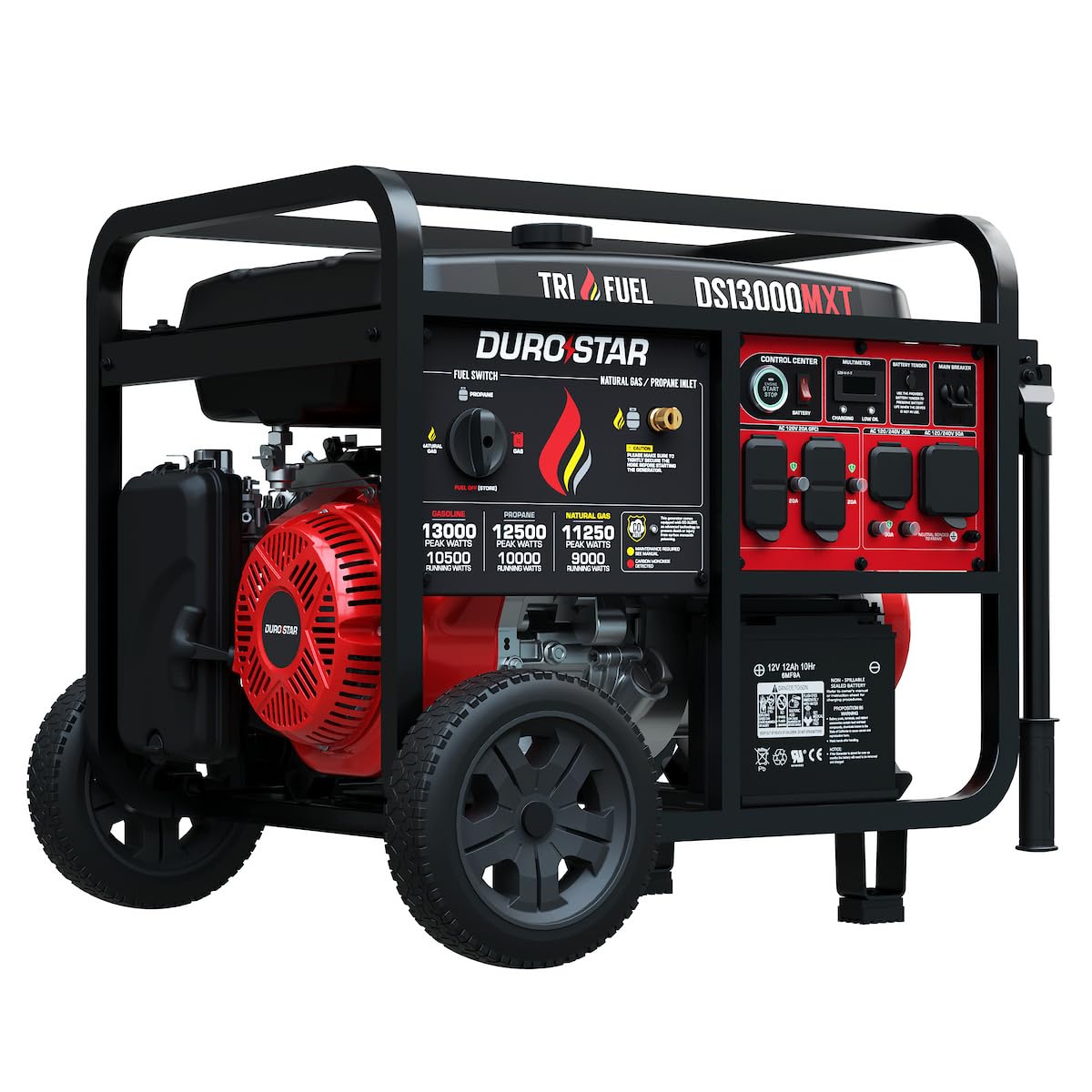
This tri-fuel unit ran a whole home for 72 hours on gas, then switches to natural gas for unlimited runtime.
The DuroStar DS13000MXT takes the 500cc tri-fuel platform and adds a 15-foot, 3/4-inch natural gas hose to the box, so you can connect to your home’s gas line right away. On gasoline, it delivers 13,000 watts of whole-home power, running AC, fridge, freezer, microwave, pumps, lights, and phones for 72 hours — refueling every 12 hours.
Push-button start with a remote control makes it easy to fire up, and the fully loaded power panel includes a transfer-switch-ready 50-amp outlet. The CO Alert system shuts the generator down if harmful fumes are detected, keeping your family safe during long runs. Owners call it “one of the best purchases in my 33 years,” praising its reliability through multi-day outages.
The catch to watch is the oil drain plug placement. A few owners note the drain tube sits near a tire, and the wheel can catch it and yank the plug loose, causing an oil leak. It is a design quirk to be aware of, not a reason to avoid the unit.
Tri-fuel convenience: homes with natural gas lines wanting near-unlimited backup runtime with one easy switch.
8. Generac 12,500 Starting Watt Tri-Fuel Generator
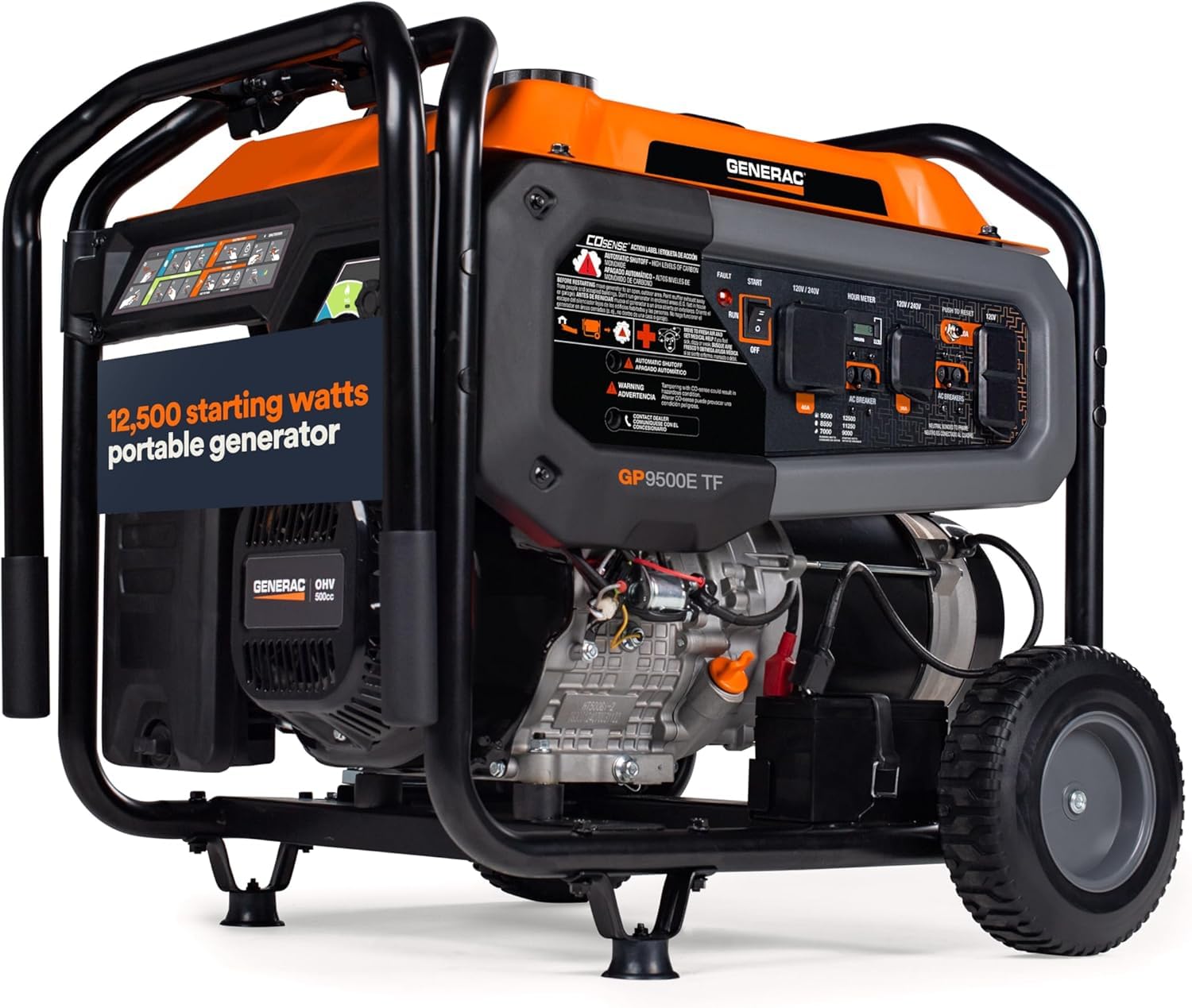
The 500cc Generac engine provides 32% more surge capacity than running output for big motor starts.
Generac brings its reputation for reliability to the portable market with this tri-fuel unit, delivering 9,500 running watts and 12,500 starting watts on gas. The 500cc OHV engine handles simultaneous starts of air conditioners, sump pumps, and power tools, which is where surge capacity really matters. The 7.5-gallon tank gives you up to 9.5 hours at 50% load on gasoline or 14 hours at 25% load.
The control panel is well-laid-out with two 120V 20A GFCI duplex outlets, a 120/240V 30A twist-lock L14-30R, and a 120/240V 50A 14-50R outlet, plus a digital hour meter. The 9.5-inch never-flat wheels and folding handle make the 219-pound unit manageable for one person on flat ground. COsense automatically shuts the generator down before carbon monoxide reaches dangerous thresholds.
Owners praise the power, with one noting it “runs the whole house including the AC” — just with the caveat not to overload it. One buyer famously warned that if something goes wrong, support can be hard to navigate, so keep your warranty paperwork handy.
Brand trust factor: Generac’s name and the 9.5-inch never-flat wheels make it a strong, mobile choice for frequent moves.
9. Champion 12,500-Watt Tri-Fuel Generator

The digital dashboard turns guesswork into precise load management.
Champion’s tri-fuel unit runs on natural gas, propane, or gasoline, with hoses included so it is ready on any fuel from the start. It delivers 12,500 starting watts and 10,000 running watts on gas, dropping to 11,250 starting and 9,000 running on propane, and 10,000 starting and 8,000 running on natural gas. The included engine oil and battery mean no trips to the store before your first start.
The standout feature is the Intelligauge, a digital display that tracks voltage, frequency, session run time, and total run time so you can monitor output and plan maintenance intervals precisely. The 500cc Champion engine starts with a handy rocker switch, and the CO Shield carbon monoxide auto shutoff system adds a layer of family safety.
Owners love the push-button start and the fuel flexibility, especially the option to use propane when gas runs low. One buyer did report the operator panel falling off during assembly, so expect to give the fasteners a once-over. The recommended 5-hour break-in period under varying loads is a real requirement here.
Solid performance: owners who want live readouts of their power draw and fuel status at a glance.
10. DuroMax XP12000E Gas Generator

A 457cc engine that has powered a 520-foot deep well for two years straight.
The DuroMax XP12000E is a proven workhorse for homesteads and farms, delivering 12,000 starting watts and 9,500 running watts from a 457cc OHV engine. Its MX2 Technology lets you choose between running at both 120V and 240V simultaneously, or at 120V only with full power on each receptacle — which is genuinely useful for splitting loads across your property.
The idle control is a smart feature for job sites, automatically lowering RPMs when not in use to save fuel and cut noise. Low-oil shut-off protects the engine during long unattended runs. Customers note easily outputting 10kW, running a 3-ton HVAC system, and powering a 520-foot deep well for years with ethanol-free fuel and regular maintenance.
The main things to know: it is rated 9,500 running watts, not the full 12,000, so budget your load accordingly. The battery is awkward to access, the 1-inch exhaust needs an adapter for some setups, and the 50A plug is not included. A few owners note the wheels can dent over time on rough terrain.
Compact power: A dependable, no-nonsense gas generator for serious property owners who maintain their equipment.
11. DuroMax XP13000HXT Tri-Fuel Generator
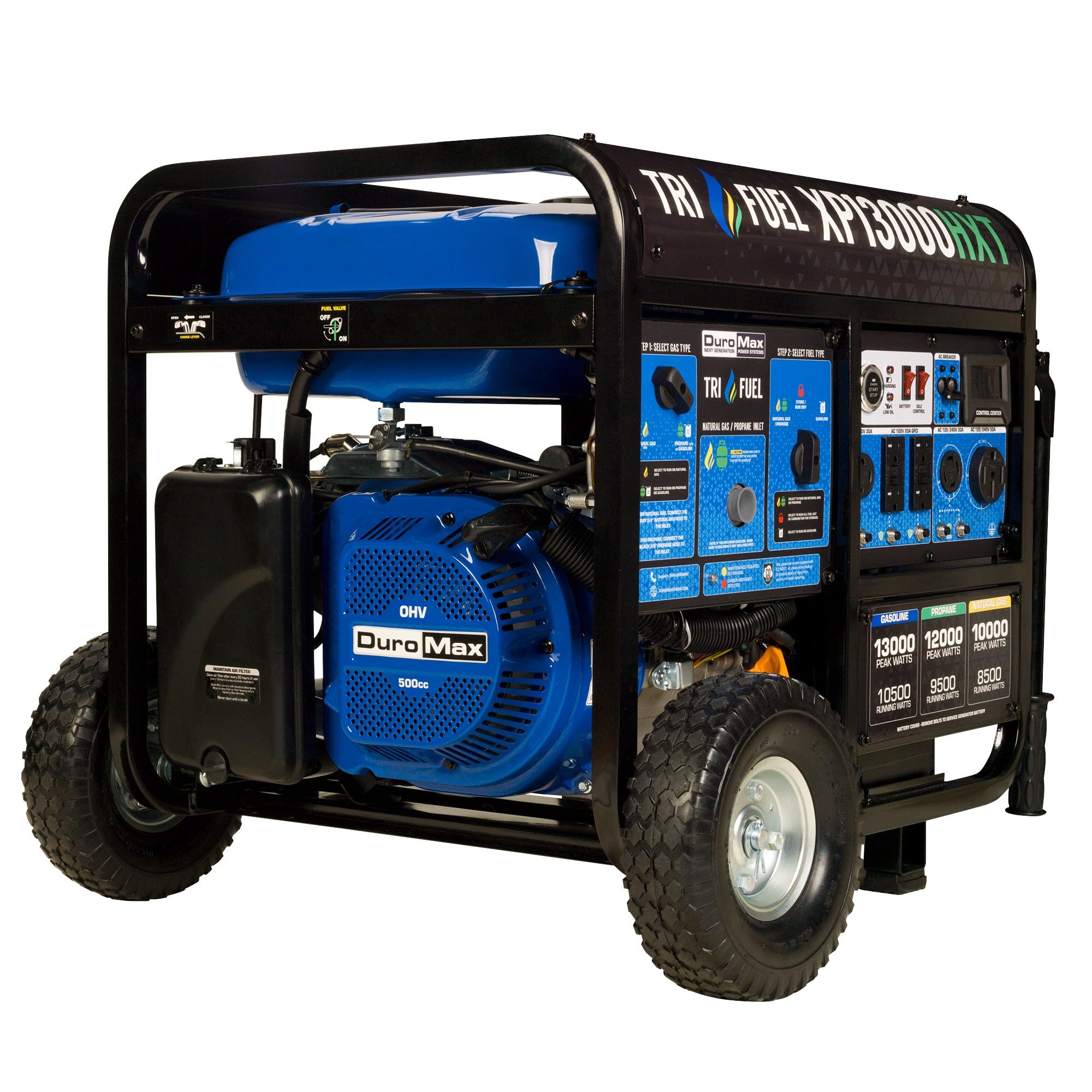
Start it with a remote from your porch while the storm rages outside.
The DuroMax XP13000HXT brings 13,000 watts of tri-fuel power with the convenience of both push-button and remote start. The 500cc OHV engine runs on gasoline, propane, or natural gas, and the front-facing interface lets you change fuel types in seconds. The included 15-foot, 3/4-inch natural gas hose means you can hardwire it to your home’s gas line for unlimited backup.
Reviewers point out it powers their entire house, running an AC, two fridges, and lights at about 60% load after a proper interlock install. One owner ran it for 48 hours on natural gas without issues, calling it “a beast of a unit.” The CO Alert system and transfer-switch-ready 50-amp outlet round out the package. Customer service gets strong praise, with one owner noting a dead battery was replaced free, quickly.
The honest considerations: natural gas connection needs a high-BTU supply line (225K BTU/hr recommended, typically 3/4-inch pipe), and it is heavy at 240 pounds. No oil is included in the box, and a battery maintainer is advised for long storage periods.
Tri-fuel readiness: homeowners with natural gas access who want remote start and near-endless fuel supply.
12. Champion 15,000-Watt MKE Series Generator
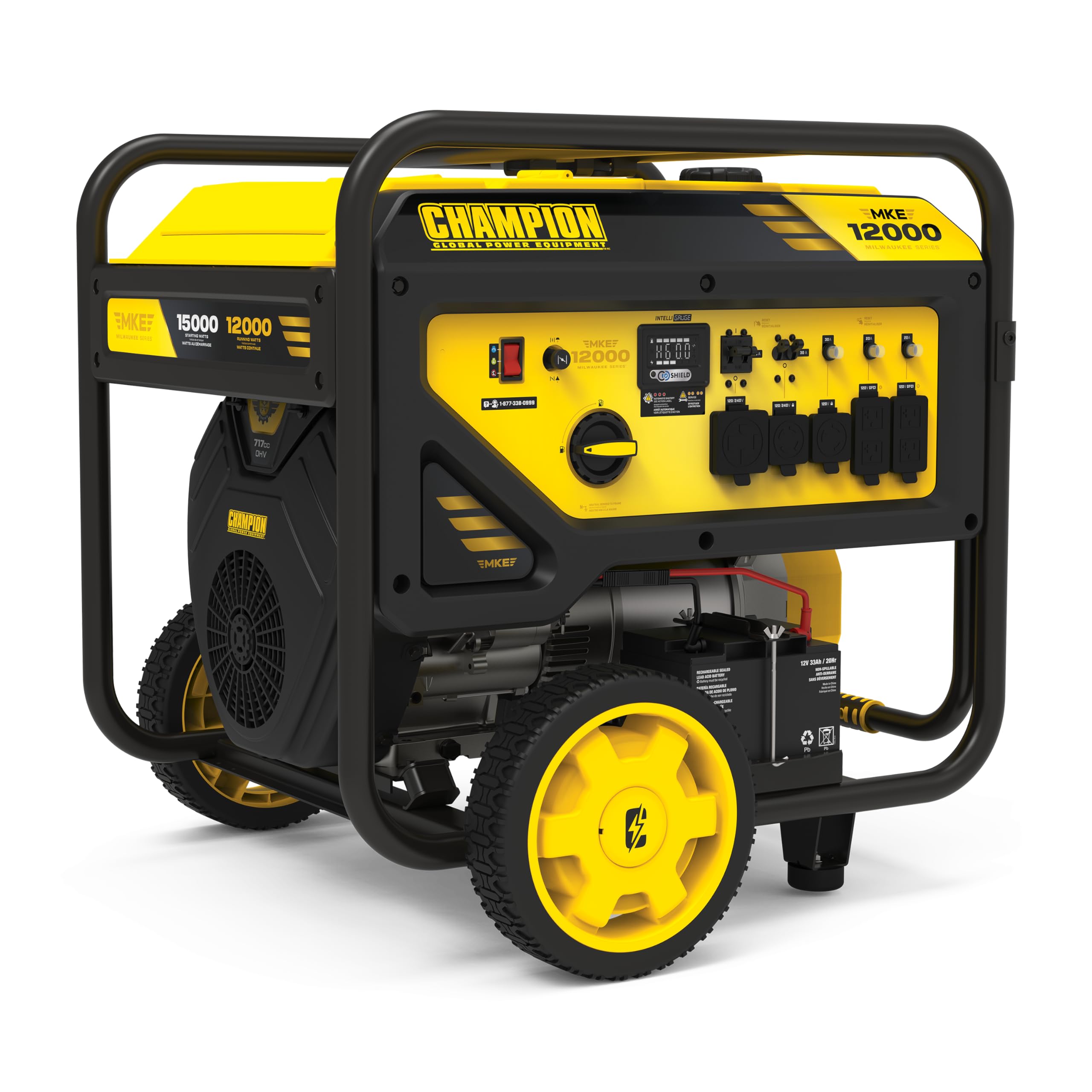
A 717cc V-Twin brute that runs welders and chop saws without blinking.
This Champion is a step up in raw power, with 15,000 starting watts and 12,000 running watts from a substantial 717cc Milwaukee Series V-Twin engine. It runs up to 9 hours on a full tank of gasoline at a noise level of 78 dBA from 23 feet. The battery-included electric start with a toggle switch, plus Cold Start Technology, makes firing it up in freezing weather much easier.
The outlet selection is built for serious work: one 120V 30A locking, a 120/240V 30A locking, a 120/240V 50A, and four 120V 20A GFCI outlets. The built-in Volt Guard surge protector prevents overloads, and the Intelligauge tracks voltage, hertz, and run-time hours. The lift hook is a thoughtful touch for loading and unloading with a crane or winch.
Shoppers say it “powered up dryer, washer machine, 220 mig welders, chop saws, and etc.” The main criticisms are weight at 332 pounds—this is not a daily mover—and a few owners reported issues with diaphragm fuel pumps, though one noted the warranty part replacement was low-maintenance. It is a gasoline-only unit at this tier, so if you want dual-fuel flexibility, look elsewhere.
Massive wattage: serious users running heavy tools and large appliances who need the extra 3,000 watts of headroom.
Understanding the Specs
Peak vs. Running Watts
Your generator has two power numbers. Peak (or starting) watts are the momentary surge needed to kick a motor on, which can be 2-3 times its running draw. Running watts are what the machine sustains continuously. For a 12,000-watt generator with 9,500 running watts, you should add up your appliances’ running watts to stay under 9,500, while the peak figure covers brief surges like an AC compressor starting.
CO Sensor and Safety Shutoff
A carbon monoxide sensor continuously samples the air and automatically shuts the engine down if CO reaches dangerous levels. This is a critical safety feature because generator exhaust is deadly in enclosed spaces. Look for “CO Alert,” “COSense,” or “CO Watchdog” on the spec sheet. Low-oil shutdown is the second safety essential, protecting the engine from damage if the oil level drops during a long run.
Fuel Type and Runtime
Dual-fuel generators burn gasoline or propane, giving you a storable clean-burning alternative when gas is scarce. Tri-fuel adds natural gas, which connects to your home’s line for near-unlimited runtime. Fuel tank size directly sets your runtime: an 8-gallon tank at half load can run 12 hours, while a 6.6-gallon tank at the same load runs about 12 hours on a more efficient engine.
Transfer Switch and Outlets
A transfer switch lets you safely connect the generator to your home’s electrical panel, so you can power hardwired circuits like your furnace or well pump. Look for a 120/240V L14-30R 30A outlet for smaller transfer switches or a 14-50R 50A outlet for whole-home setups. The 50A outlet is the standard for running an entire house, including central air.
FAQ
Will a 12,000-watt generator run my whole house with central air?
What is the difference between peak watts and running watts?
Is a dual fuel or tri fuel generator worth the extra cost?
How long will a 12,000-watt generator run on a full tank?
Do I need a transfer switch for a 12,000-watt generator?
How loud is a 12,000-watt generator?
Can I run a 12,000-watt generator on propane?
How heavy is a 12,000-watt generator and can I move it?
What size generator do I need to run a 5-ton AC unit?
How often doI need to perform maintenance on this generator?
Can I connect a 12,000-watt generator directly to my house panel?
What does the CO sensor on a generator do?
Final Thoughts: The Verdict
Across the board, the 12000 watt generator winner is the Westinghouse 12500 because it delivers proven whole-home performance with dual-fuel flexibility and an easy remote start, backed by a strong owner reputation. If you want natural gas capability for near-unlimited outage runtime, grab the DuroStar DS13000MXT or the DuroMax XP13000HXT with remote start. And for those who need maximum surge power for workshops and heavy tools, the Champion 15000 MKE is the one to reach for. Whatever you choose, pair it with a proper transfer switch and a CO sensor for safe, reliable backup power.
How We Picked
We do not accept paid placement. Every pick is matched to a real buyer and a real use-case; we do not hands-on test units.
Sources & Methodology
Specifications: manufacturer listings and product documentation. Review insights: verified customer reviews, as of August 2026. Pricing: not shown on this page (it changes often); check the current price via the retailer link.
As an Amazon Associate, KitchPrep earns from qualifying purchases. This does not affect which products we feature.
Related Guides
