
Specs are compiled from manufacturer listings and verified buyer reviews and can change over time — please confirm the key details on the product page before buying.
The biggest mistake with a 120-volt thermostat is buying the wrong voltage type. These controls run full line voltage, so a mislabeled unit can be a fire hazard. This guide focuses strictly on line-voltage models for baseboard heaters, wall heaters, and radiant floors. We break down specs, installation realities, and honest trade-offs for each pick.
I’m Mohammad Maruf — the founder and writer behind KitchPrep. This guide is built by comparing the manufacturers’ published specifications and the patterns across verified customer reviews, so you get each pick’s real strengths and trade-offs instead of marketing spin.
If you need a reliable unit to control your electric heaters, our breakdown of the best 120 volt thermostat options will help you find the perfect match for your home and budget.
Our Picks at a Glance

How To Choose The Best 120 Volt Thermostat
Selecting the right control for your electric heat starts with understanding what you are plugging into. You need a thermostat that matches your system’s voltage, the number of wires in your wall, and the heater’s power draw. Here is what matters when sorting through the options.
Single-Pole vs. Double-Pole: The Safety First Choice
Choosing between a single-pole and double-pole thermostat is the most important safety decision you will make. A single-pole thermostat breaks the connection on one wire, so your heater still has power flowing to it even when it is “off.” A double-pole thermostat disconnects both wires, completely cutting power to your heater and adding extra safety, especially in colder climates. Pick a double-pole model if you want a true positive-off state, meaning no electricity reaches the heater at all.
Matching Voltage and Wattage to Your Heater
For a true 120-volt system, you need a thermostat rated for that exact voltage. Using a 240-volt thermostat on a 120V heater circuit often leaves half the circuit live. Pay close attention to the maximum wattage rating. For example, a digital unit might handle 1920W at 120V, while a heavy-duty mechanical unit can switch up to 2,640 watts at the same voltage. Choose a unit that exceeds your heater’s draw for reliability.
Quick Comparison
| Model | Best For | Control Type | Max Wattage (120V) | Wiring | Amazon |
|---|---|---|---|---|---|
| Cadet BTF2W★ Best Overall | Cadet Baseboard Fit | Mechanical Dial | — | Single Pole | Amazon |
| meross Smart ThermostatSmart Pick | HomeKit & Voice Control | Smart App/Wi-Fi | 1,920 Watts | 4+ Wires | Amazon |
| Mysa Smart LITEPremium Pick | High-End Smart Scheduling | Smart App/Wi-Fi | — | Single/Double Pole | Amazon |
| Stelpro SWT2F | Complete Shutoff | Mechanical Dial | — | Double Pole | Amazon |
| Cadet T522-W | Heavy DIY Replacements | Mechanical Dial | 2,640 Watts | Double Pole | Amazon |
| YeloDeer EA19-120v | Simple 120V Control | Electronic Dial | 2,400 Watts | 4-Wire | Amazon |
| LUX ELV4 | Programmable Schedules | Digital Programmable | — | Line Voltage | Amazon |
| Honeywell TH115 | Radiant Floor Sensing | Digital Programmable | — | Line Voltage | Amazon |
| Schluter DHERT104 | Ditra-Heat Floor Systems | Smart Touch/Wi-Fi | 15 Amps Max | Line Voltage | Amazon |
In‑Depth Reviews
1. Cadet F Series Built-In Baseboard Thermostat (BTF2W)
Our pick — over 4.5★ from 950+ verified ratings; the strongest balance of quality and price.
The flawless match for Cadet baseboard owners who want a no-wire, dial-and-go upgrade.
This thermostat is the easy winner if you own a Cadet F series baseboard heater, because it mounts directly onto either end of the unit. That means zero extra wall wiring, just a simple swap on the heater itself. The white glossy housing is designed to blend right into the heater’s look, so it disappears into the room instead of sticking out.
You get a simple mechanical twist dial that covers a 45°F to 80°F range, and turning it fully counterclockwise drops it into low position. What wins people over is the sheer reliability — 84 owners specifically highlight how well it functions, and another 33 praise how easy the installation is. Buyers report it’s consistently “Easy to install! Works great!!” even in commercial settings where it runs daily.
The catch is that compatibility is restricted. Cadet explicitly builds this for its own F series heaters only, so it won’t help you if you have a different brand. It also uses a single-pole design, so power isn’t fully disconnected at the heater when off — just reduced.
Why It Wins
- No extra wall wiring needed for Cadet F heaters
- Easy to use large twist dial
- Compact flush design blends with the heater
The Limits
- Only compatible with Cadet F series heaters
- Single-pole means reduced, not fully off, heat
Grab it if: you have a Cadet F series heater and want the simplest, most reliable control swap you can do yourself.
Think twice if: your heater is a different brand or you need full power disconnect for safety.
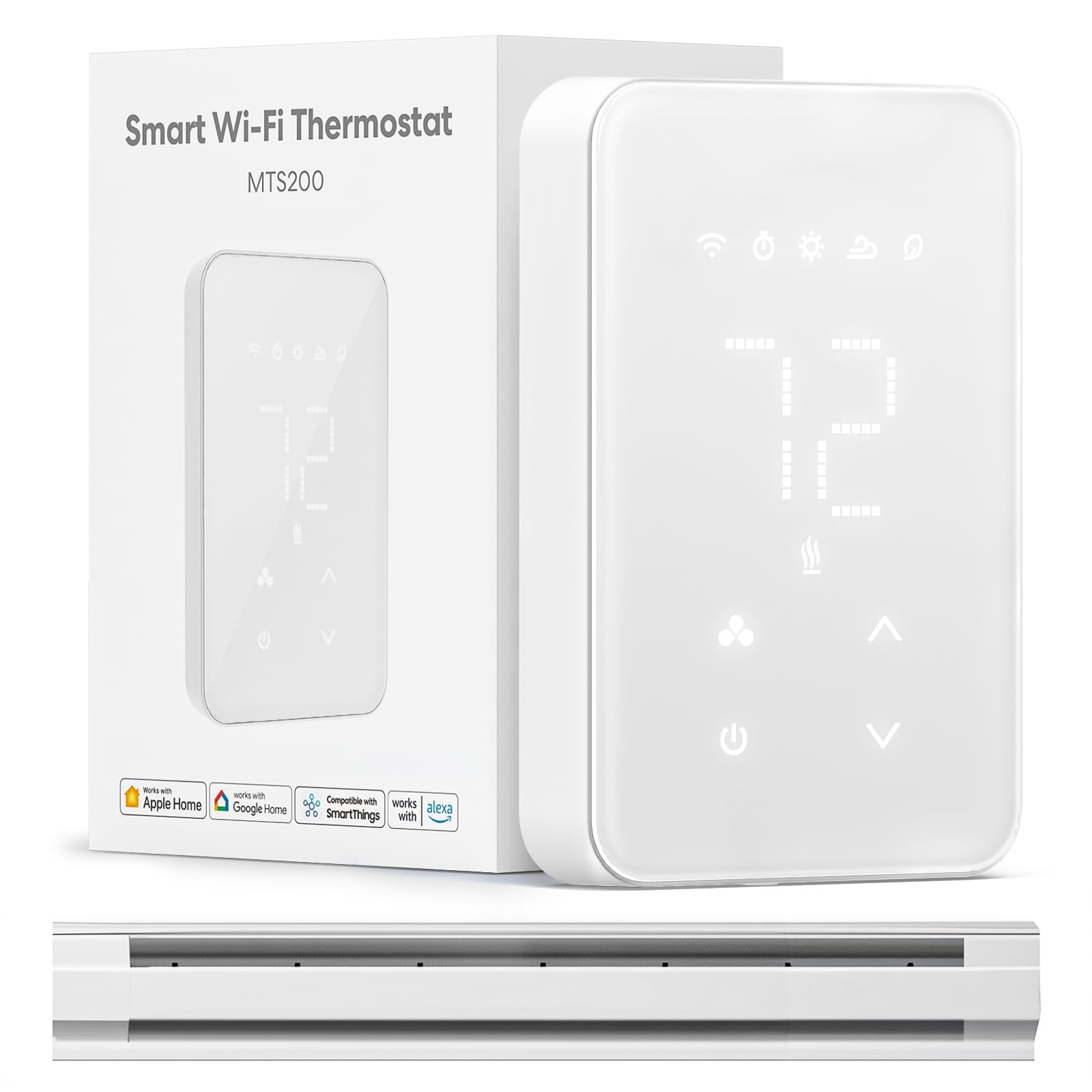
2. meross Smart Thermostat for Electric Baseboard Heaters
The smart upgrade that turns high-voltage baseboard heat into a voice-controlled, money-saving system.
If you want app control and energy insights without paying a premium, the meross is the balance. It works with 120V circuits and steps up to 240V, handling a max load of 16A — that’s 1920W at 120V and 3840W at 240V, so it can power most baseboard heaters you will find. The integration list is deep: Apple Home, Alexa, Google Home, and SmartThings, so you can just tell Siri or Alexa to warm the room without getting up.
Inside the Meross app you can build a 7×24 hour graphic schedule to lower heat when you are away. Owners love the 1°F accuracy and the adjustable 41°F to 95°F range, and the pure white LCD display looks clean on the wall. The open-window detection stops heating when it senses ventilation, and the energy monitoring shows real-time usage to help you track costs.
The main installation hurdle is that it needs 4 or more wires in your electrical box — you can’t run this on an older 2-wire setup. It also connects over 2.4GHz Wi-Fi only, which can be annoying if your router defaults to 5GHz.
Smart Perks
- Voice control via Siri, Alexa, Google
- 1°F high accuracy for steady comfort
- Built-in energy monitoring & reports
- Open-window detection saves energy
Install Reality
- Requires 4 wires in the box
- 2.4GHz Wi-Fi only
Choose this if: your home already has 4-wire runs and you want full smart home and voice integration at a mid-range price.
Look elsewhere if: your wiring is old 2-wire only or your router is strictly 5GHz.
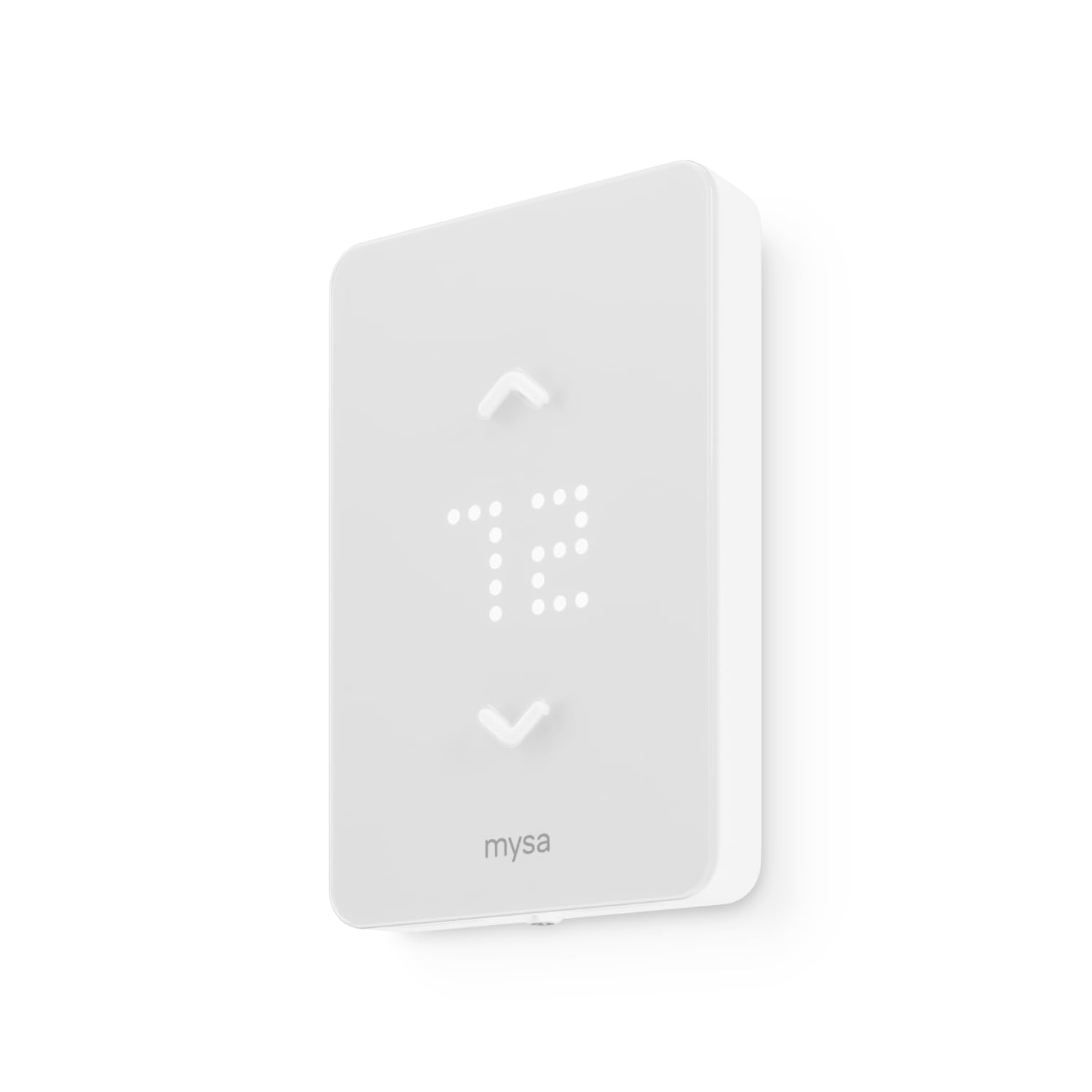
3. Mysa Smart Thermostat LITE for Electric Baseboard Heaters
A polished, app-driven control for whole-home electric heating that pairs a 26% savings promise with a 5-year warranty.
Mysa built the LITE for the smart-home buyer who wants no subscriptions and serious scheduling power. The free app (iOS and Android) lets you build custom 7-day schedules, drop the temperature when you are away, and warm things up before you arrive — the maker claims up to 26% savings on heating costs. It connects straight to your Wi-Fi without a hub.
Compatibility is wide: 120V, 208V, and 240V electric baseboard, fan-forced, wall, and convector heaters, with support for both single-pole and double-pole wiring. Owners praise the simplicity of the install, with 34 calling it easy, and the intuitive app interface gets consistent raves. The in-app wizard walked one owner through wiring that was over 40 years old without a hitch.
For such a well-rounded smart stat, the big differentiator is the 5-year warranty — a peace-of-mind edge most competitors skip. Just know it requires 4 wires (neutral or a second live wire), so check your box before ordering. It’s also the pricier option in the smart category.
Smart Scheduling: the 7-day custom schedules and vacation mode are what buyers rave about, especially for managing rooms remotely while traveling.
confidence: the 5-year warranty beats nearly everything else here, so if the unit fails, you are covered for half a decade — making the higher upfront cost easier to swallow.
Worth it for: homeowners with multiple electric heat rooms who want broad compatibility, no monthly fees, and long-term warranty protection.
Hold off if: your wiring has only 2 wires or you just need a simple single-room dial.
4. Honeywell TH115-AF-GA/U Radiant Heating Thermostat

A purpose-built digital stat for radiant floors that gives you three sensor modes in one compact unit.
If you are heating a bathroom floor, this Honeywell is the dedicated tool for the job. It is a 7-day programmable line-voltage thermostat for electric radiant floor systems, and it gives you three temperature sensing choices in a single unit: Ambient (air), Floor, or Ambient with Floor limits. That flexibility means you can prevent a tile floor from getting too hot while still controlling the room air.
Owners frequently install it as a direct replacement for a Nuheat SOLO system and report it works perfectly right from the start. The 120/240V compatibility and the floor sensor make it the go-to for in-floor setups. One owner even compensated for an old sensor wire (17 ohms vs the new 12 ohms) by simply raising the setpoint a few degrees, and the floor temp stayed spot on.
The honest downsides are the 24-hour clock forcing Celsius display and a few reports of units failing after extended use. It’s also a specialized device, so it offers zero smart-home integrations if that’s your priority.
Floor-Focused Control: the ability to switch between ambient, floor, and combined sensing is what makes this a standout for radiant heat safety and comfort.
Worth Knowing: the 24-hour clock forces Celsius display, which surprises some US buyers.
Reach for this if: you are replacing a radiant floor thermostat and want precise floor temperature control, not just air control.
skip it if: you need an app or voice control for your floor heat.
5. Schluter Ditra-Heat-E-WiFi Programmable Thermostat

The premium brain for Schluter Ditra-Heat cable systems, pairing a bright 3.5-inch color touchscreen with built-in shock protection.
When your floor heating is built on the Schluter Ditra-Heat system, this is the control panel designed to pair with it. The standout feature is the built-in Class A Ground Fault Circuit Interrupter (GFCI), which automatically cuts power to prevent electrical shock — a critical safety layer for wet areas like bathrooms. It handles both 120V and 240V cables with a max load of 15 amps.
The 3.5-inch color screen makes programming easier than the tiny displays on most rivals, and the Wi-Fi app lets you track energy use in daily and weekly kWh. Owners who swapped from older thermostats report the floor heats noticeably warmer — one saw it hit 80+°F versus the old 74°F — and gets toes warm within 5-10 minutes. The maker backs it with a 3-year limited warranty.
This is not a cheap investment, and Wi-Fi connectivity gets genuinely mixed feedback in the review pages — some say it works great, others report the connected features simply don’t. The physical install is also tight; you’ll want a deep or double-width wallbox to fit the wiring comfortably.
Safety First: the integrated Class A GFCI is a major draw for anyone wiring floor heat in a bathroom or kitchen.
Known Quirk: Wi-Fi reliability is a coin flip for some owners — have a backup plan if the app is your main reason to buy.
Best for: Schluter Ditra-Heat owners who want a top-tier color screen, energy tracking, and built-in GFCI safety in one unit.
Consider alternatives if: you are not using a Ditra-Heat cable system or you need rock-solid Wi-Fi every single day.
6. LUX ELV4 Programmable Line Voltage Thermostat
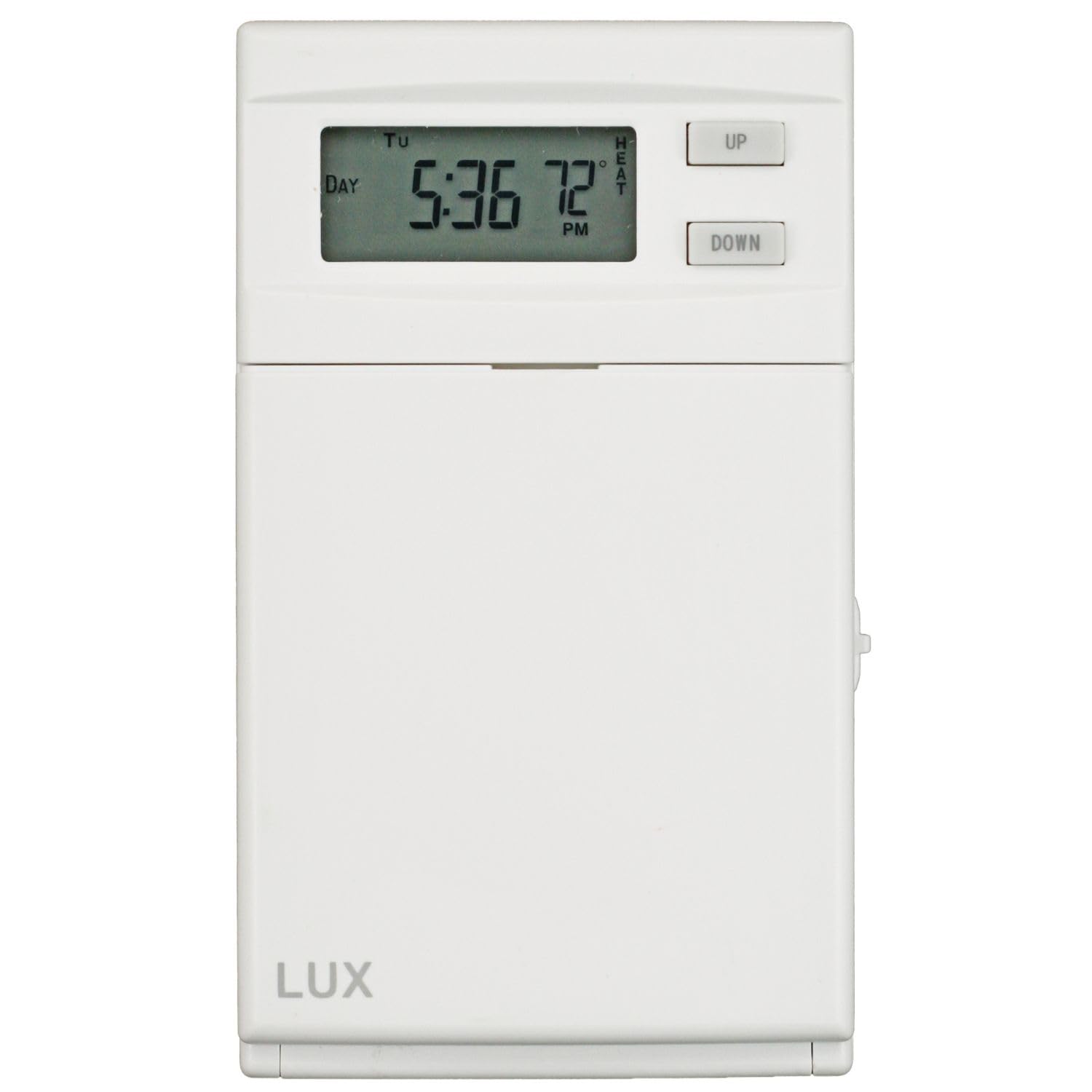
An affordable programmable digital stat that brings weekday-weekend scheduling to 120V systems without the smart-home fuss.
You can get real programmable savings without Wi-Fi or apps, and the LUX ELV4 proves it. It runs on standard AA batteries (not included) and offers 4 program periods per day, with separate weekday and weekend schedules. This is a huge upgrade over a plain mechanical dial because the heat can drop automatically when you leave for work and ramp back up before you arrive.
The setup is what owners love — a simple on-screen programming flow that replaces an old heat-only line-voltage stat without calling an electrician. One owner replaced a 1950s-era dial and found it handled the wiring easily. It also includes a temporary override, a low-battery indicator, and a positive off switch for complete shutdown.
It won’t work with heaters that combine a resistive heating element with a blower fan, so fan-forced units are out. A few buyers also describe the relay click as loud enough to notice in a quiet bedroom.
Budget Perks
- Weekday and weekend separate programming
- Positive off switch for full shutoff
- Low-battery indicator prevents surprises
Trade-offs
- Not for fan-forced heaters (inductive load)
- Relay click can be audible at night
- Requires 2 AA batteries
Grab it if: you want auto-scheduling energy savings at a budget price with the simplest possible install.
Pass if: you need it for a fan-forced heater or you’re a light sleeper sensitive to relay clicks.
7. Cadet Double Pole Line Voltage Thermostat (T522-W)
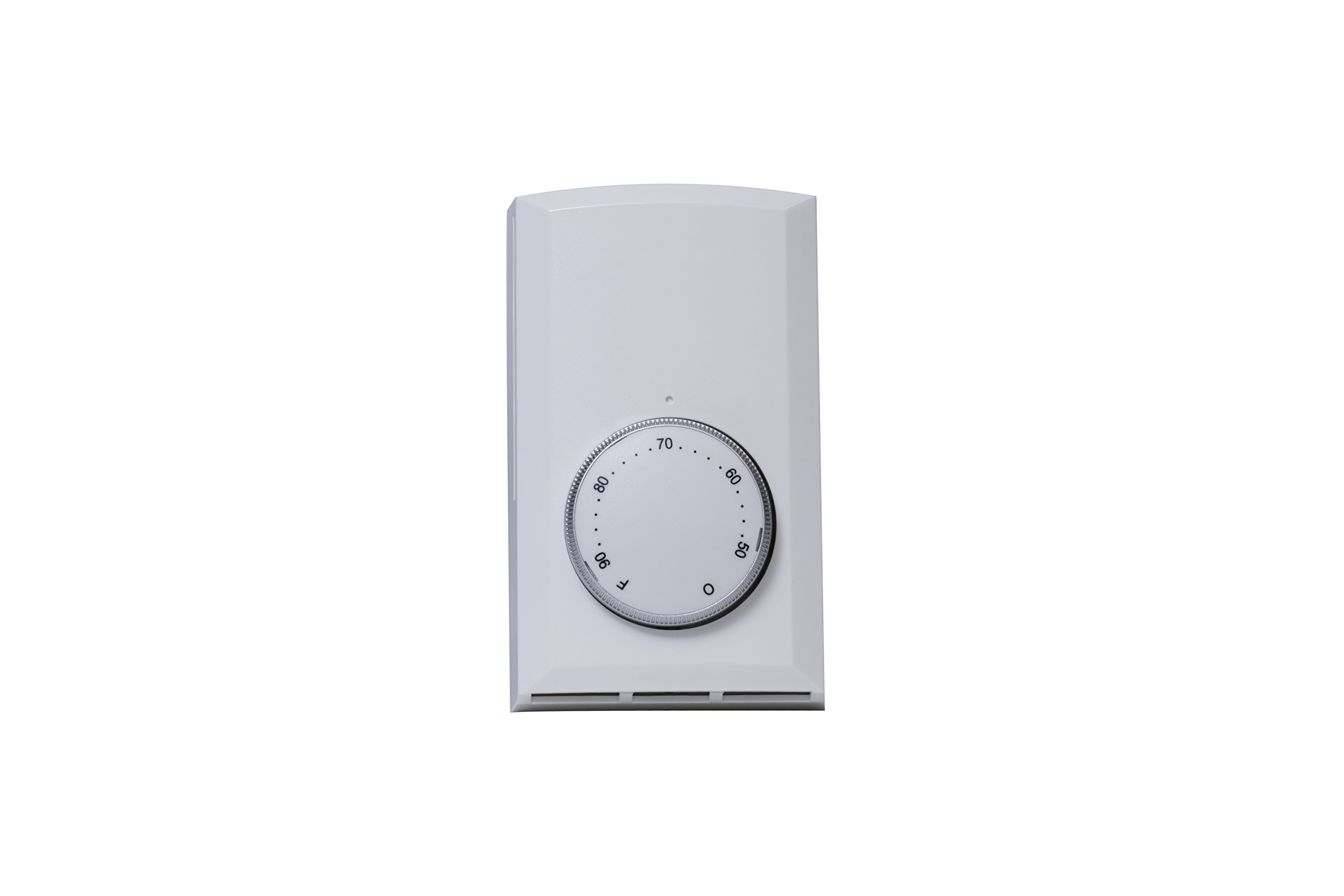
A heavy-duty mechanical wall stat that handles big loads and cuts power on both wires for real safety.
When you need to replace an old wall-mounted thermostat and want maximum wattage headroom, this Cadet is a workhorse. Its double-pole, 4-wire design switches both legs of the circuit, disconnecting power completely when the heater cycles off. It handles up to 5,280 watts at 240 volts or 2,640 watts at 120 volts and is rated for 22 amps, so it shrugs off loads that would strain a smaller stat.
Installation is genuinely DIY-friendly thanks to color-coded wires that make matching your old stat simple. Owners love replacing those little rheostat dials on the heaters themselves, which eventually fail, with these more sturdy wall units. One buyer specifically sought it out after a previous thermostat caught fire from an overloaded circuit — this unit’s higher wattage capacity was exactly what they needed, so it safely handles the load.
The twist dial covers a 40°F to 80°F range with a tight 3-to-6 degree cycle to hold the room steady, plus a positive off position. One owner did note the temperature control runs a bit off, needing the dial set to 79 to actually hold 73 degrees — read that as typical mechanical-dial drift rather than a defect.
Built Tough
- 1,760 watts more capacity at 120V than the YeloDeer
- Complete power disconnect with double-pole wiring
- Color-coded wires for easy swap
Expect This
- Mechanical drift means set it higher than desired temp
- Non-programmable, dial-only control
Reach for this if: you want a rugged, high-capacity mechanical replacement that can handle multiple heaters or a large wall heater safely.
Look elsewhere if: you need exact digital temperature accuracy or programmable schedules.
8. Stelpro Line Voltage Wall Thermostat (SWT2F)
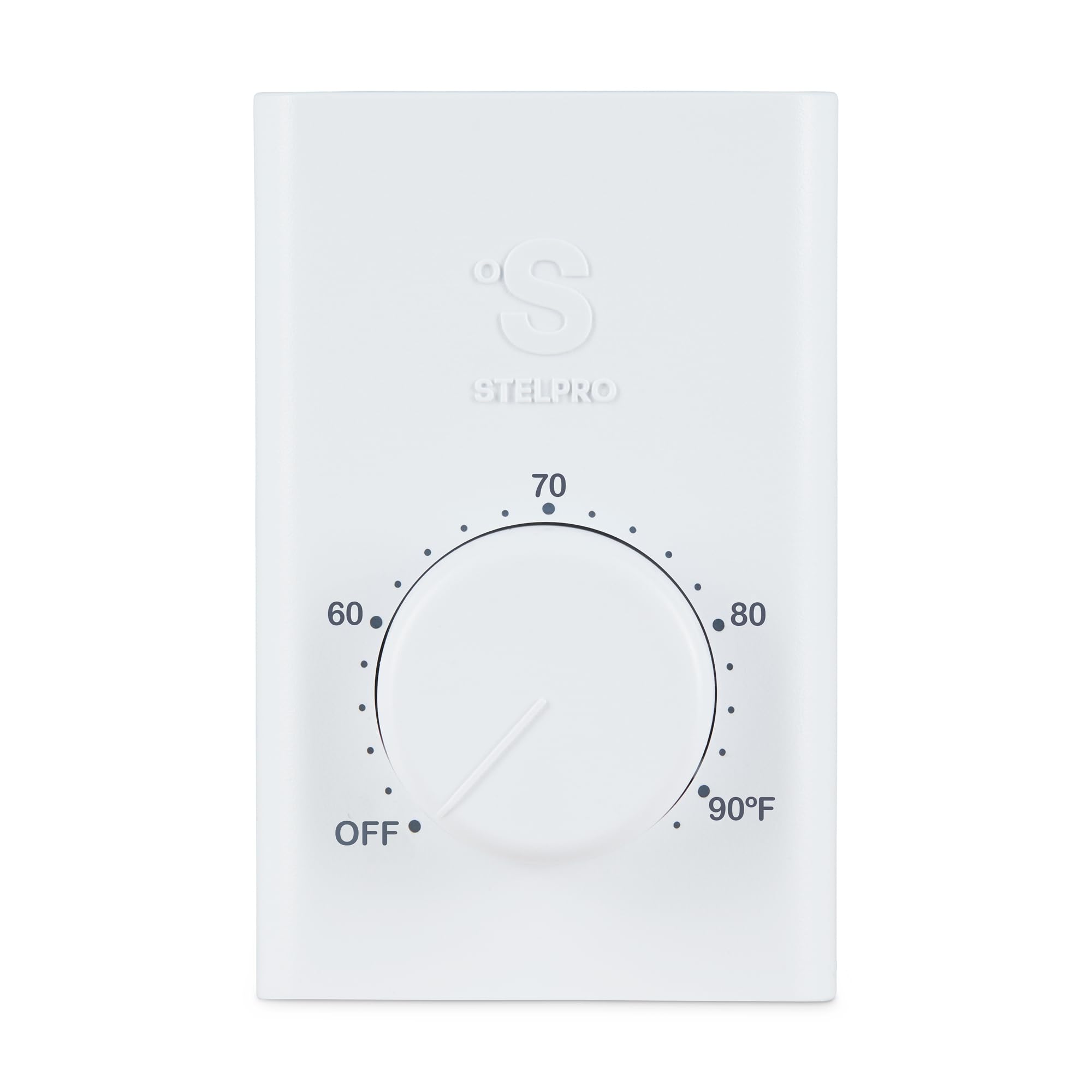
A compact, safety-focused mechanical stat for full power disconnect, best valued for its easy install rather than its calibration.
This Stelpro is a slim, low-profile wall thermostat that works with most electric heaters across 120–277V systems up to 22 amps, including baseboards, fan-forced units, and commercial heaters. As a double-pole model (SWT2F), it fully disconnects power on both wires when off — a safety advantage over single-pole units. It’s CSA/UL approved and backed by a one-year warranty from a North American manufacturer.
Buyers consistently praise the easy installation and the clean look of the rectangular white housing. It also offers a positive off and a smooth mechanical dial covering a 50°F to 90°F range. The review consensus is that it works well for basic on/off and simple heat control, and a few owners have bought multiple units for different rooms with zero complaints.
The significant weakness surfaces in calibration: owners mention setting it to 80°F only to have it shut off at 60°F — a 20-degree miss. This thermostat also uses a wide on/off differential (5-6°F) that you cannot adjust. It’s a fine budget pick if you can live with setting the dial well above your target, but it’s clearly not for precision control.
Easy Install: this is the trait buyers mention most — if you want a clean, quick swap and full power shutoff, this delivers.
The Honest Catch: the dial calibration runs notably off, so expect some trial and error to find your actual comfort setpoint.
Choose this if: you want a compact, certified double-pole stat for a simple heat-only system and don’t mind dialing it up a bit.
Avoid if: precise temperature maintenance matters more to you than the easy install.
9. YeloDeer 2 PCS 120V Only 4-Wire Electric Baseboard Thermostat
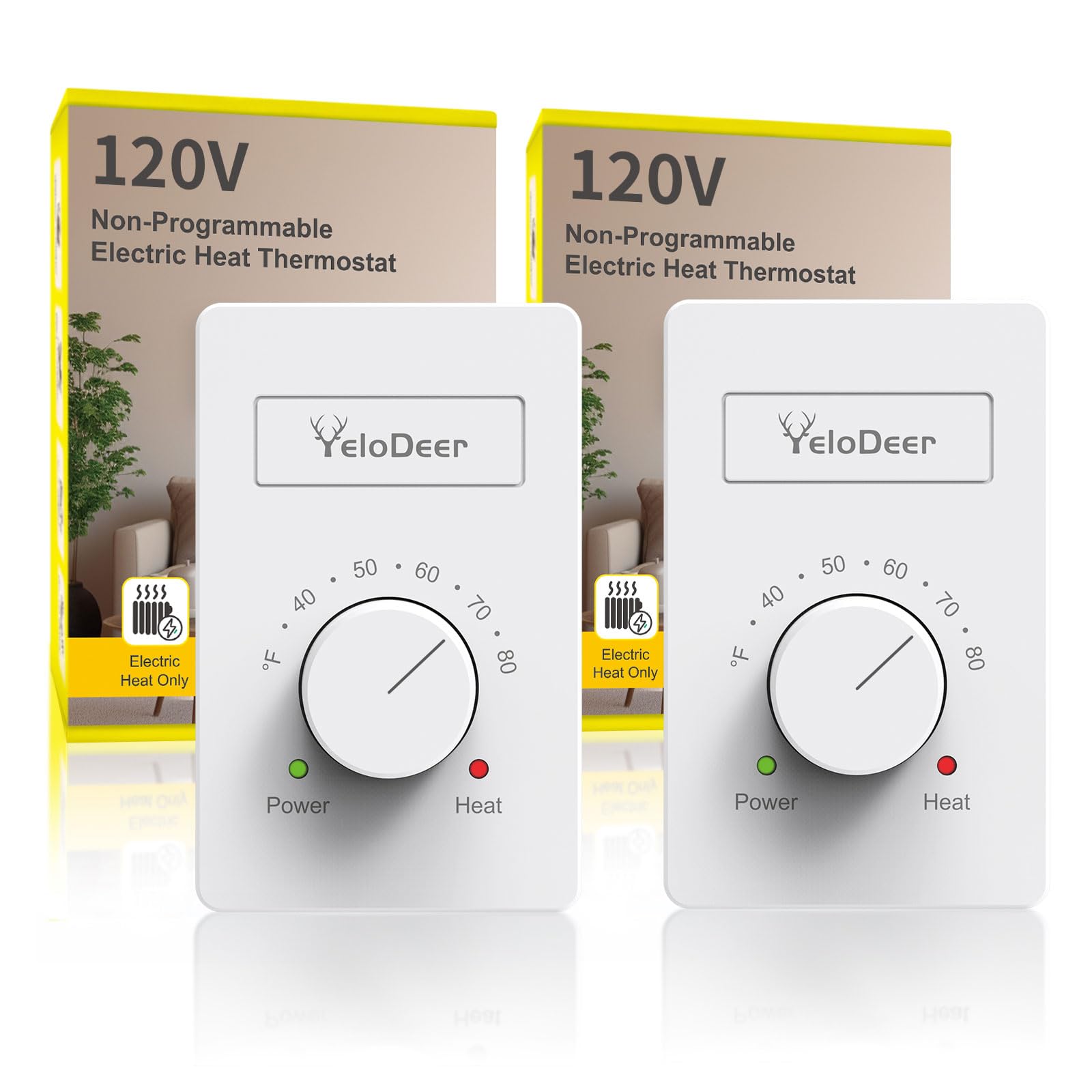
A clear 2-pack deal for 120V-only systems, delivering electronic accuracy and helpful indicator lights at a budget price.
This YeloDeer set gives you two thermostats for the price of one, which makes it an instant value play if you have multiple baseboard zones running on 120V. It’s designed specifically for 120-volt systems with a max of 2400 watts per thermostat. Unlike most mechanical dials, this uses an electronic controller rated for higher accuracy, keeping your room closer to the temperature you set.
The large knob rotates smoothly without locking into the common 5-degree increments, so the printed numbers are just reference marks and you can fine-tune anywhere in the 40°F to 80°F range. Owners highlight the indicator lights as genuinely helpful — they clearly show the connection point and when active heating is happening. Setup is straightforward and it works with baseboards, connectors, and fan-forced heaters.
There is a catch for some: the actual temperature swing can reach around 10 degrees before the unit kicks back in. One buyer used it successfully for a 12V Webasto diesel boat furnace but noted the wider temperature range as a drawback. It’s definitely not a smart thermostat — no app or Wi-Fi here.
Bang for Buck
- 2 thermostats in one purchase
- Electronic sensor is more accurate than mechanical
- Helpful indicator lights for heating status
Know Before Buying
- About a 10-degree temperature differential
- 120V only — not for 240V systems
- Still manual, non-programmable control
Best for: outfitting two 120V zones on a budget while getting better accuracy than a basic mechanical dial.
Think twice if: you need tight temperature swings under 10 degrees or 240V support.
Understanding the Specs
Line Voltage vs. Low Voltage
This is the most critical spec to understand. A line-voltage thermostat (like the ones on this list) carries the full 120V or 240V power directly through its switch to your heater. A low-voltage thermostat (24V) only controls a relay or contactor elsewhere. Buying a 24V stat for a baseboard heater means it will not work and could be unsafe. Always confirm your heater’s voltage before choosing.
Amps and Wattage Load
Your thermostat must be rated to handle the total power draw of your heater. For example, a unit rated for 16A at 120V is safe for up to 1920W, while a heavy-duty 22A rating can handle much larger loads. Adding up the wattage of all heaters connected to one thermostat is the only way to match it correctly. Never overload a thermostat — that’s how failures happen.
FAQ
Can I use a 120-volt thermostat on a 240-volt heater?
What is the difference between single-pole and double-pole thermostats?
How many wires do I need for a smart baseboard thermostat?
Why does my mechanical thermostat not reach the set temperature?
Can a smart thermostat actually save money on electric heat?
Do I need a floor sensor for radiant floor heating?
Is a thermostat with GFCI protection worth the extra cost?
Will a line-voltage thermostat work with a heat pump or central AC?
What does “4-wire” mean on a thermostat spec?
Can I install a line-voltage thermostat myself?
Final Thoughts: The Verdict
For most people, the 120 volt thermostat winner is the Cadet BTF2W because it’s the perfect drop-in match for Cadet baseboard heaters with zero extra wiring. If you want smart home and voice control, grab the meross Smart Thermostat. And for radiant floor systems, the Honeywell TH115 is the one to reach for.
How We Picked
We do not accept paid placement. Every pick is matched to a real buyer and a real use-case; we do not hands-on test units.
Sources & Methodology
Specifications: manufacturer listings and product documentation. Review insights: verified customer reviews, as of August 2026. Pricing: not shown on this page (it changes often); check the current price via the retailer link.
As an Amazon Associate, KitchPrep earns from qualifying purchases. This does not affect which products we feature.
Related Guides
