
Specs are compiled from manufacturer listings and verified buyer reviews and can change over time — please confirm the key details on the product page before buying.
Dead batteries stop work cold. The right 18V charger can cut charging time by up to three times compared to the starter unit. This guide ranks rapid dual-bay stations against basic single-slot bricks, using manufacturer specs and owner feedback to match your brand and workflow.
I’m Mohammad Maruf — the founder and writer behind KitchPrep. This guide is built by comparing the manufacturers’ published specifications and the patterns across verified customer reviews, so you get each pick’s real strengths and trade-offs instead of marketing spin.
If you own cordless tools, the 18 volt battery charger you choose decides whether you wait an hour or finish the job today, and this guide shows you which one fits your kit.
Our Picks at a Glance
How To Choose The Best 18 Volt Battery Charger
Your charger must match your tool brand first, speed second. An 18V battery charger is genuinely brand-locked — a Milwaukee pack physically won’t click into a Makita or Ryobi base, so compatibility is the non-negotiable starting point, not a feature to compare later.
Charging speed and amperage
Speed is set by amperage — the higher the amp rating, the faster current flows into your pack. A 3.5-amp charger pushes a small battery to full far quicker than a basic 2-amp unit. The trade-off is that high-speed charging generates heat, so look for a built-in cooling fan on the fastest models to protect battery life over years of use.
Dual bays vs. sequential charging
A true dual-bay charger powers both batteries at the same time, cutting your downtime in half. Some multi-slot chargers actually charge one pack at a time in sequence — they park the second battery and wait. Check the wording carefully: “simultaneous” means both at once; “sequential” means one after the other.
Safety protections and build quality
Every serious charger pairs a smart chip with the battery to stop overcharging, overheating, and short circuits. Third-party replacements can save real money, but quality varies — the safest bets carry CE, FCC, or RoHS certification marks, which confirm they passed standard electrical safety testing.
Quick Comparison
| Model | Best For | Charging Speed | Output Current | Bays | Amazon |
|---|---|---|---|---|---|
| Milwaukee M18 Dual Bay★ Best Overall | Pro users with several batteries | 0-100% in ~71 min | — | 2 (simultaneous) | Amazon |
| Bslite DC18RFBest Value | Makita owners wanting fast value | 15-45 min | 3.5 A | 1 | Amazon |
| BECDXPal M18 ReplacementCompact Pick | Milwaukee 12V + 18V households | ~1 hour | 3 A | 1 | Amazon |
| Bslite N18D Station | Budget Milwaukee backups | Up to 3x faster than sequential | — | 1 | Amazon |
| Philophca RD01 | Ridgid NiCad + Lithium users | 2.0Ah in 75 min | 2 A | 1 | Amazon |
| Powilling P117 | Ryobi owners charging two at once | ~45 min | 3 A | 2 | Amazon |
| Abeden P117 Dual | Large Ryobi ONE+ collections | 6.0Ah in 2-3 hrs | 2 A | 2 | Amazon |
| Bosch GAL18V6-80 | Bosch pros with many tools | 0-80% in 32 min | 8 A | 6 (sequential) | Amazon |
| Makita DC18SF | Jobsite crews with LXT packs | 2 batteries in 60 min | 2 A | 4 (pairs) | Amazon |
In‑Depth Reviews
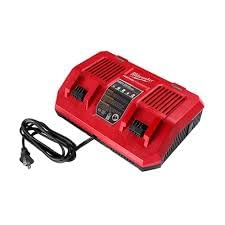
1. Milwaukee Electric M18 Dual Bay Simultaneous Rapid Charger
Our pick — over 4.5★ from 800+ verified ratings; the strongest balance of quality and price.
Charges two M18 batteries simultaneously, reaching 80% in about 61 minutes.
This is the charger for anyone who owns more than two Milwaukee M18 batteries and hates waiting. It handles two packs at the same time, and the numbers back up the speed: two XC8.0 batteries reach 80% in 60 minutes 56 seconds and hit 100% in 71 minutes 37 seconds. That is the crowd favorite here — a 4.8-star reputation built on 800+ owner experiences — because it turns a whole day of jobs into a single lunch-break charge cycle.
What wins people over is the simple reliability. An audible fan spins during charging and shuts off when done, so you know the job is finished without staring at the light. The green flash pattern signals when a pack passes 80%, and buyers report it comfortably handles six to eight batteries across high-demand tools. The wall-mount pattern matches the standard Milwaukee charger, so it swaps into your existing setup.
At 11″D x 4″W x 9″H and 3 pounds, this is a bench anchor, not a pocket tool, but that footprint buys serious current delivery. It runs on 110 volts and uses the M18 connector — this is strictly for the Milwaukee ecosystem. The honest trade-off is that if you only own one battery, the dual bays are wasted money; this earns its keep when you rotate several packs daily.
Why it leads the list
- Charges two M18 batteries at the same time, not in sequence
- 80% in about 61 minutes on 8.0Ah packs
- Fan shuts off when charging completes
Who should pass
- Single-battery owners get no benefit from two bays
- Only works with Milwaukee M18 packs
The pick for: Milwaukee owners juggling several batteries who want both bays working at once.
Look elsewhere if: you carry just one spare pack — a single-bay charger does the same job for less.
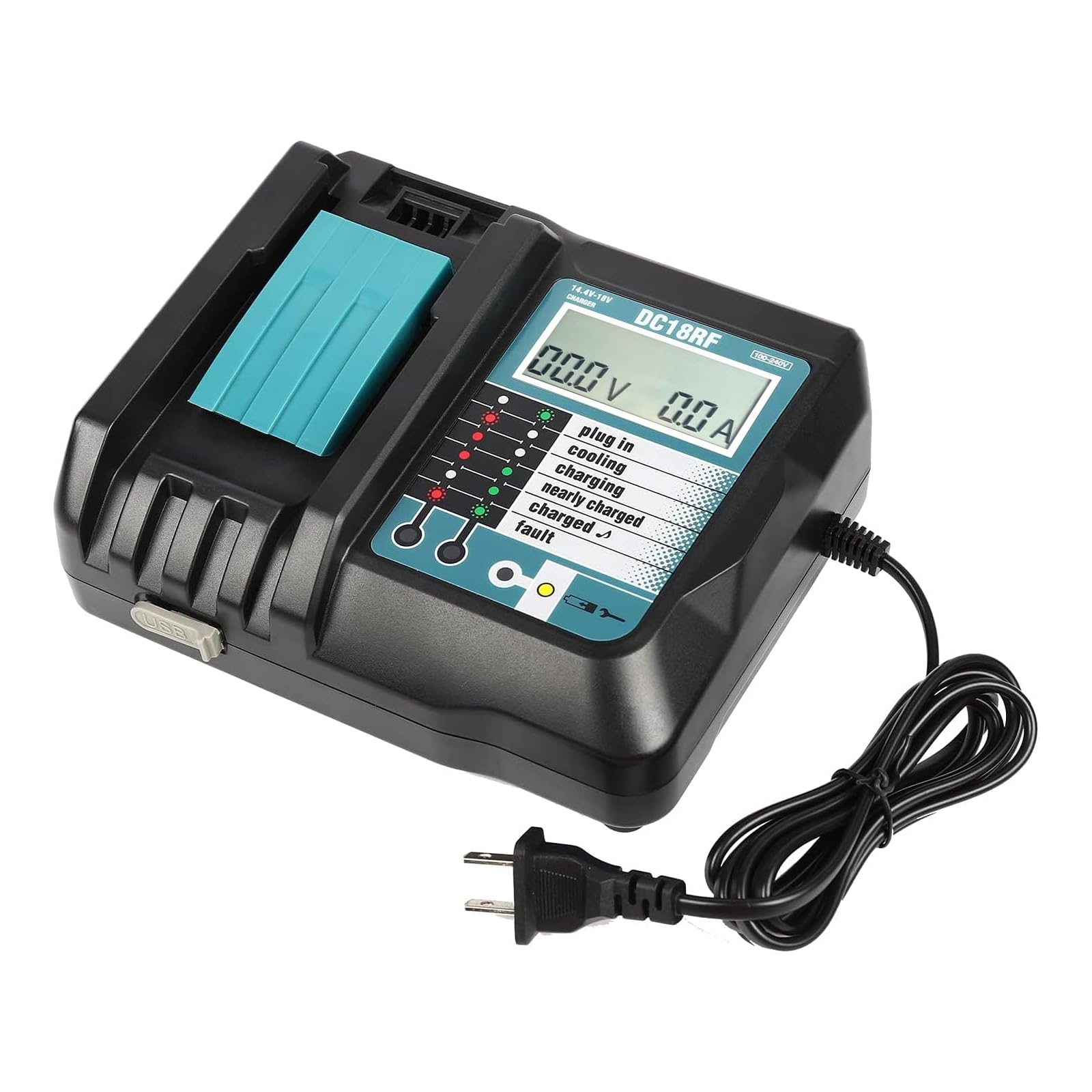
2. Bslite DC18RF Charger for Makita 14.4V/18V
Fills a dead Makita pack in as little as 15 minutes with 3.5A output.
Makita owners get a serious upgrade here. The front LCD screen shows live charging progress, voltage, and battery status, so you are never guessing whether a pack is ready.
Owners mention it “charges super fast” and call it exactly what they were looking for, with a digital face that shows charging status. It replaces the Makita DC18RC and DC18RD chargers and works across the BL1815, BL1820, BL1830, BL1840B, BL1850, BL1860, and BL1450 packs. The front USB port lets you top up a phone or fan on the same outlet — a genuinely handy bonus for a garage.
At 4.72″D x 2.76″W x 3.94″H, it is notably compact, about a 2.3x smaller footprint than the Milwaukee dual-bay above. It runs on 110 volts and carries CE, FCC, and RoHS certifications. The mild criticism is that battery life gets mixed feedback, so very old packs may not behave identically to new ones, but for standard Makita lithium packs this is a fast, cheap workhorse.
What you gain
- 3.5A current for genuinely fast top-ups
- LCD screen shows live charge level
- USB port charges your phone on the same unit
Keep in mind
- Single bay — one battery at a time
- Older packs may show mixed results
Grab this if: you want Makita charging speed and a charge-status screen without paying brand-new OEM prices.
Maybe not if: you regularly need two batteries ready at once — this fills one slot.
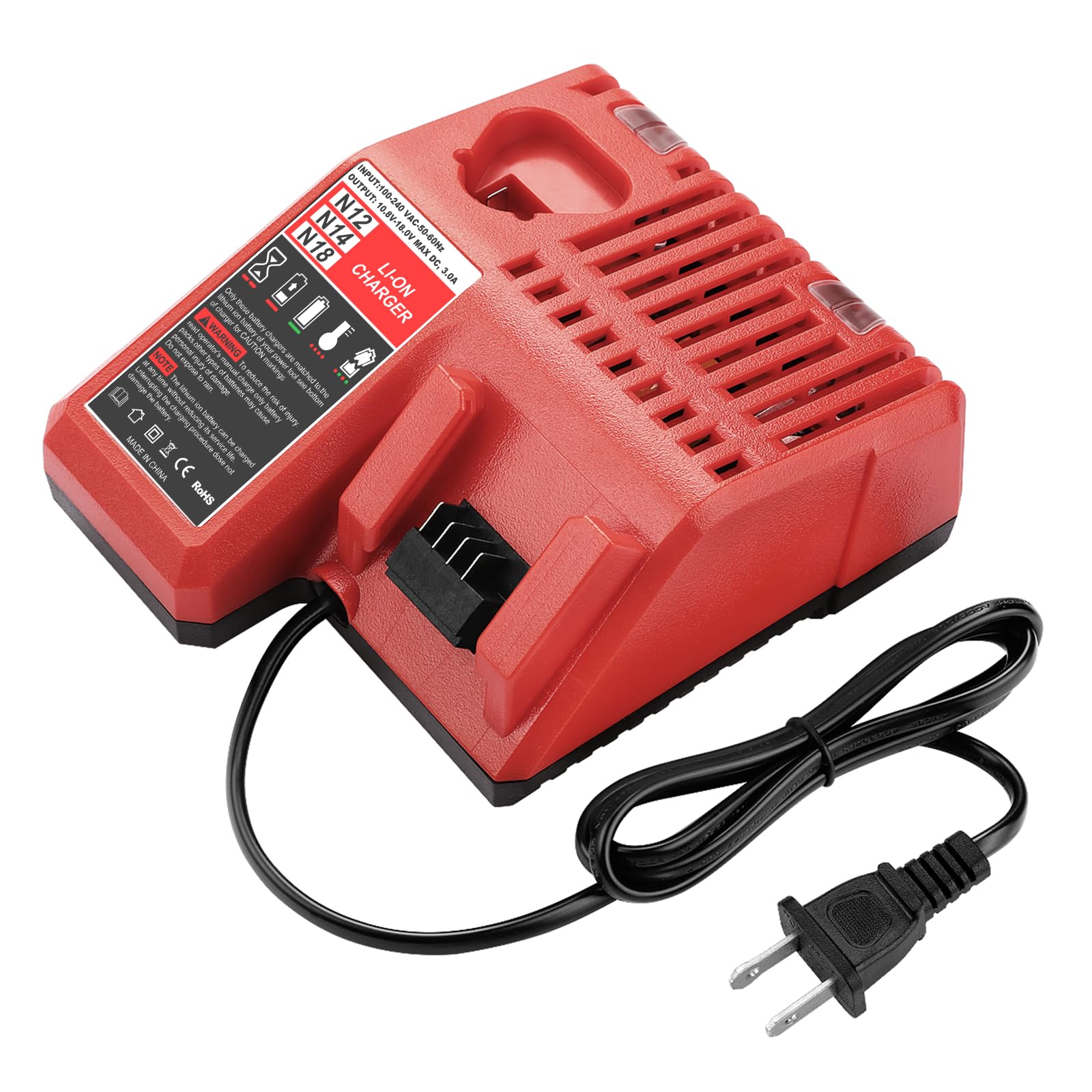
3. BECDXPal 18V Charger for Milwaukee 12V & 18V
Compact single bay charges both 12V and 18V Milwaukee packs.
This replacement charger is the answer for a mixed Milwaukee household that owns both M12 and M18 tools. It pulls 3 amps at 12V-18V DC output and the maker says it fills any compatible 18V or 12V battery within one hour — beating the original charger’s pace. Customers note it “charges the battery very fast” and stays compact, taking up almost no bench space.
Compatibility is the headline: it handles 18V packs like the 48-11-1815, 48-11-1820, and 48-11-1828, plus the full M12 lineup including 48-11-2401, 48-11-2430, and 48-11-2440. The input runs 100-240V AC, a 2.2x wider window than the 110V Milwaukee above, so it travels across regions without a converter. Five LED status signals tell you when charging, when full, and when something is wrong.
The multi-layer protection includes overheat, overvoltage, and short-circuit safeguards with FCC, RoHS, and CE certification. Quality feedback is a bit split — most owners are happy, some call the build cheap — so treat it as a dependable backup rather than a jobsite tank.
Why it fits a mixed kit
- One charger handles both M12 and M18 batteries
- 100-240V input works across regions
- Compact footprint for tight benches
Watch out for
- Single bay limits you to one battery at a time
- Build quality draws mixed owner feedback
Best suited to: anyone with both Milwaukee voltages who wants one small charger for both.
Choose the dual-bay instead if: you run a single voltage but need two packs charged simultaneously.
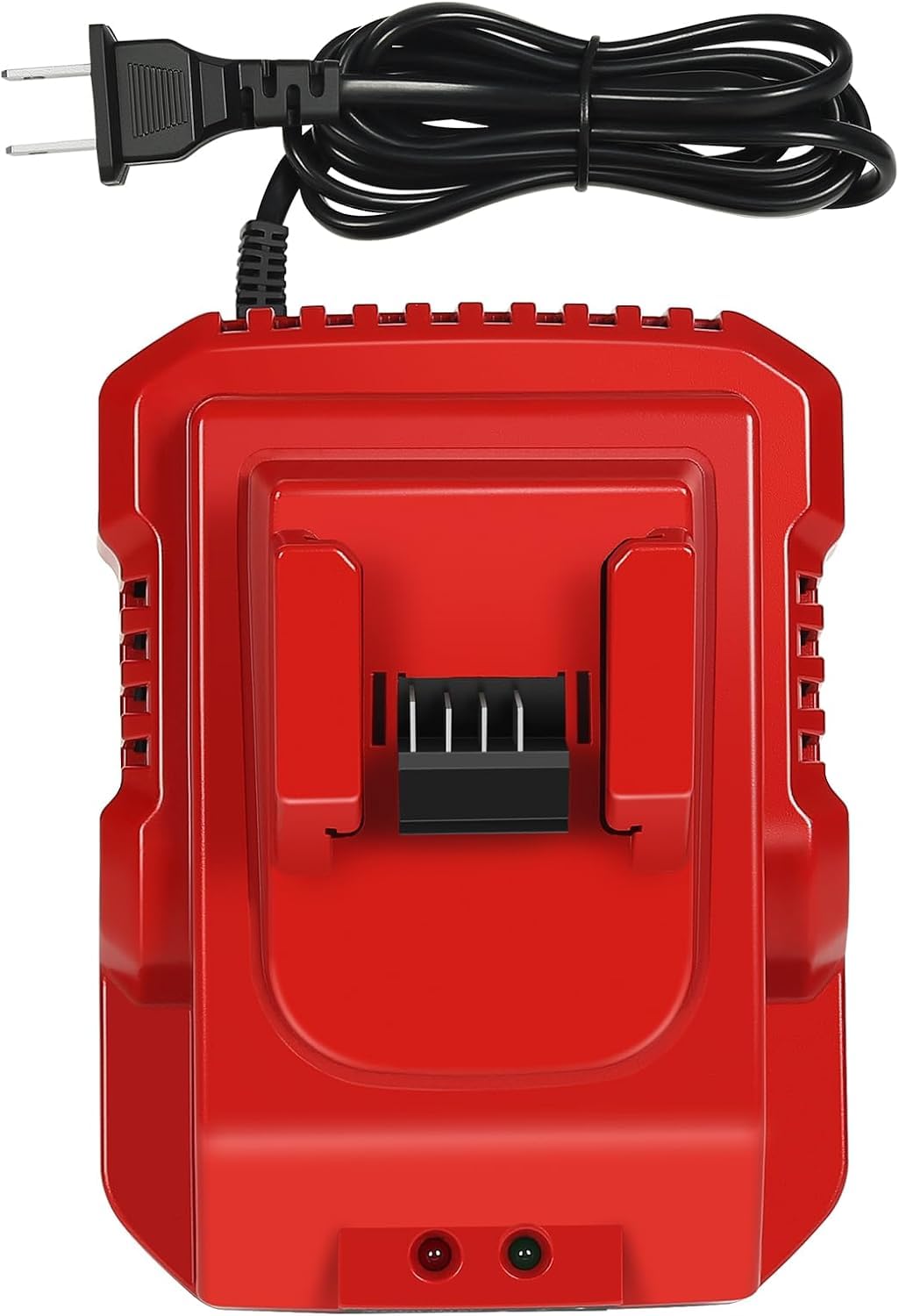
4. Bslite Rapid Charger Station for Milwaukee M18
Budget single-bay charger with four LED signals for charging, full, heat, and fault states.
This single-bay charger is a straight replacement for the standard Milwaukee M18 charger, and its defining feature is the sensitive indicator system. Red steady means charging, green steady means done, red flashing means the pack is too hot, and red-and-green alternating means a voltage deviation — so you always know the state at a glance. The maker claims it charges up to 3 times faster than sequential chargers.
It works with the broad Milwaukee 18V lithium lineup: 48-11-1820, 48-11-1828, 48-11-1830, 48-11-1835, 48-11-1837, 48-11-1815, 48-11-1840, 48-11-1850, 48-11-1860, 48-11-1880, and 48-11-1890 among others. Built-in protection covers over-charge, over-discharge, over-heating, over-current, over-voltage, and short circuit, and it carries UL and FCC certification. Owners split on speed — some call it very fast, others say it takes forever — so treat it as a budget-friendly backup rather than a promised speed upgrade.
Quality feedback is genuinely mixed here, with some praising it as high quality and others calling it cheap, plus an occasional unit that simply won’t charge. That makes it a gamble for a primary charger but a reasonable spare for a second location. At 110 volts and 5″D x 4.1″W x 6.5″H, it is small enough to mount near a workbench without dominating the space.
What stands out
- Four LED signals track charging, full, heat, and voltage faults
- Wide Milwaukee 18V compatibility list
- UL and FCC certified safety
Realistic downsides
- Charging speed earns mixed reports
- Build quality varies from unit to unit
Reach for this if: you want a cheap Milwaukee-compatible spare with clear charging status lights.
Think twice if: you depend on consistent fast charging every single day — this one is a lottery.
5. Philophca Charger for Ridgid 18V NiCad/Lithium
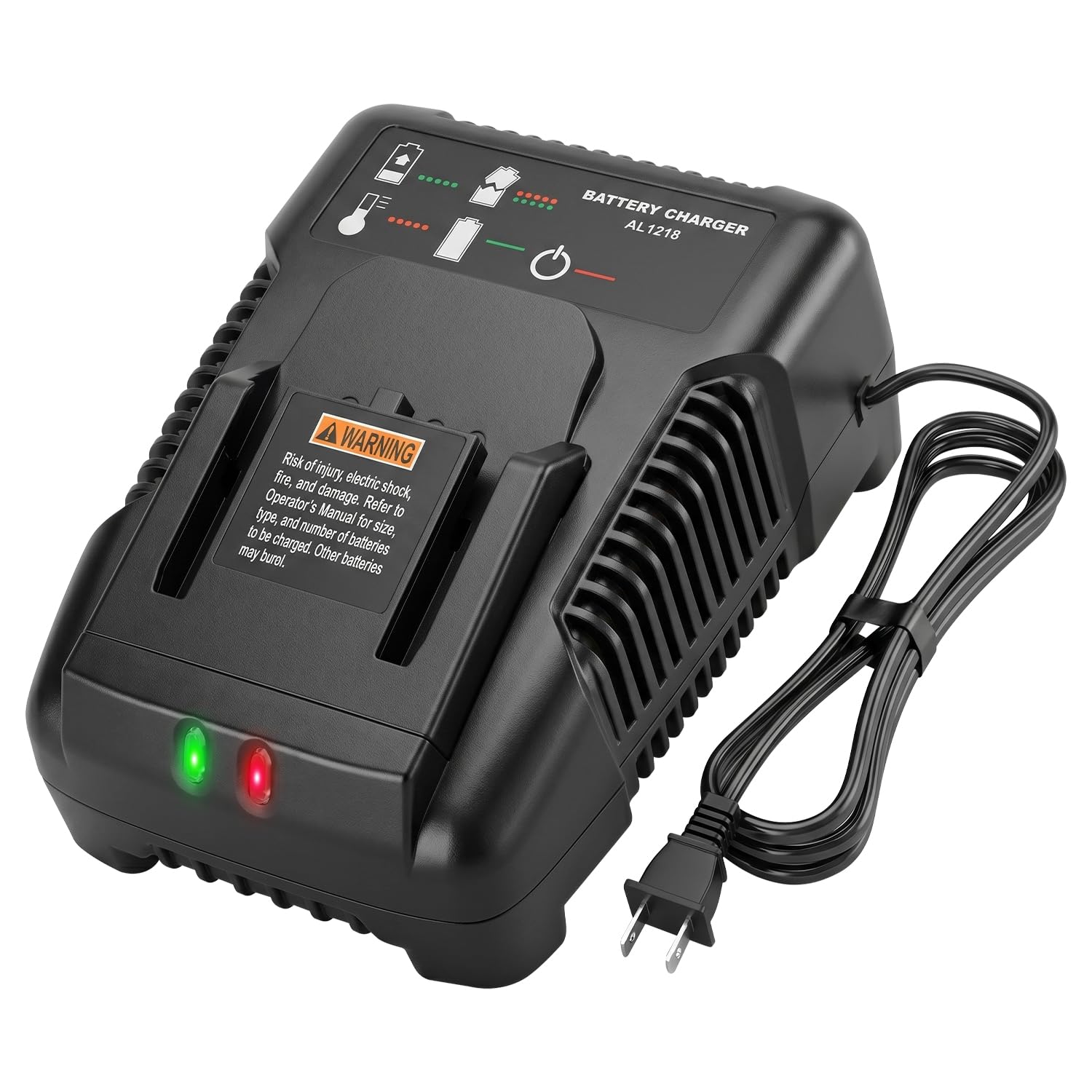
Dual-chemistry charger supports both NiCad and lithium Ridgid packs.
Ridgid owners face a unique problem: older NiCad batteries and newer lithium packs need different charging, and most chargers handle only one. This one does both. It is fully compatible with the dual-chemistry Ridgid 18V lineup including R840083, R840085, R840086, R840087, R840089, AC840085, AC840086, AC840087P, and AC840089, plus the R86092 and R86091 models.
Speed is solid for the class: it charges a 2.0Ah lithium battery in 75 minutes and a 4.0Ah pack in 2.3 hours or less, pushing 2 amps max DC output at 42W. Owners consistently call it accurate and fast, with one noting it “charges fast well worth the money.” The PC fireproof plastic and metal shell add durability, and the wall-mountable design keeps your workspace tidy.
It runs on 110-240V AC input and carries CE and FCC certification, with protection against over-charge, short-circuit, over-heat, over-load, and low-voltage. At only 14.08 ounces and 6.8″D x 5″W x 2.87″H, it is the lightest pick here. The one thing it is not is fast for big packs — 2.3 hours on a 4.0Ah is fine for a spare, but a pro rotation may want more amps.
Why Ridgid owners like it
- Charges both NiCad and Lithium Ridgid packs
- Featherweight at 14.08 ounces
- Wall-mountable for a tidy setup
The limit
- 2A current means 2.3 hours on a 4.0Ah pack
- Single bay only
Ideal for: Ridgid tool owners with a mix of old NiCad and new lithium packs who want one charger for both.
skip it if: you only run large lithium packs and need rapid turnaround.
6. Powilling P117 Charger for Ryobi 18V ONE+

Affordable dual-bay charger fills two Ryobi ONE+ batteries simultaneously.
Ryobi owners get a genuinely useful upgrade here: a dual charger that runs two 18V ONE+ batteries at once, cutting downtime in half. It replaces the original P117, P118, and P119 chargers and handles Ryobi 18V Lithium, NiCad, and NiMh packs across the P100 through P108 range. The 3-amp current and a listed 45-minute charge time keep most packs moving quickly.
The dual design is the point. Owners describe it as good value that does the job and does it quickly, with one noting it recharges larger batteries “very quickly” after buying them for a Ryobi fan. It runs on universal 100V-240V input, so it travels well, and the LED indicator communicates charge status. Multi-protection plus an excellent cooling system guard your packs.
Here is the honest catch: functionality gets mixed feedback, with most owners happy but some reporting batteries not charging properly. That pattern suggests occasional quality-control misses, so test your first charge cycle right away. At 9.7″D x 6.5″W x 3.7″H, it takes up real bench space, but two working bays make that footprint worth it for a Ryobi household.
The value play
- Two bays charge Ryobi packs simultaneously
- 100-240V input for travel
- 45-minute charge time on many packs
Check carefully
- Some reviewers point out charging failures
- Large footprint on the bench
Choose this if: you want a dual-bay Ryobi charger without paying OEM prices.
Be cautious if: you need guaranteed daily reliability — test this one immediately on arrival.
7. Abeden P117 Dual-Port Rapid Charger for Ryobi
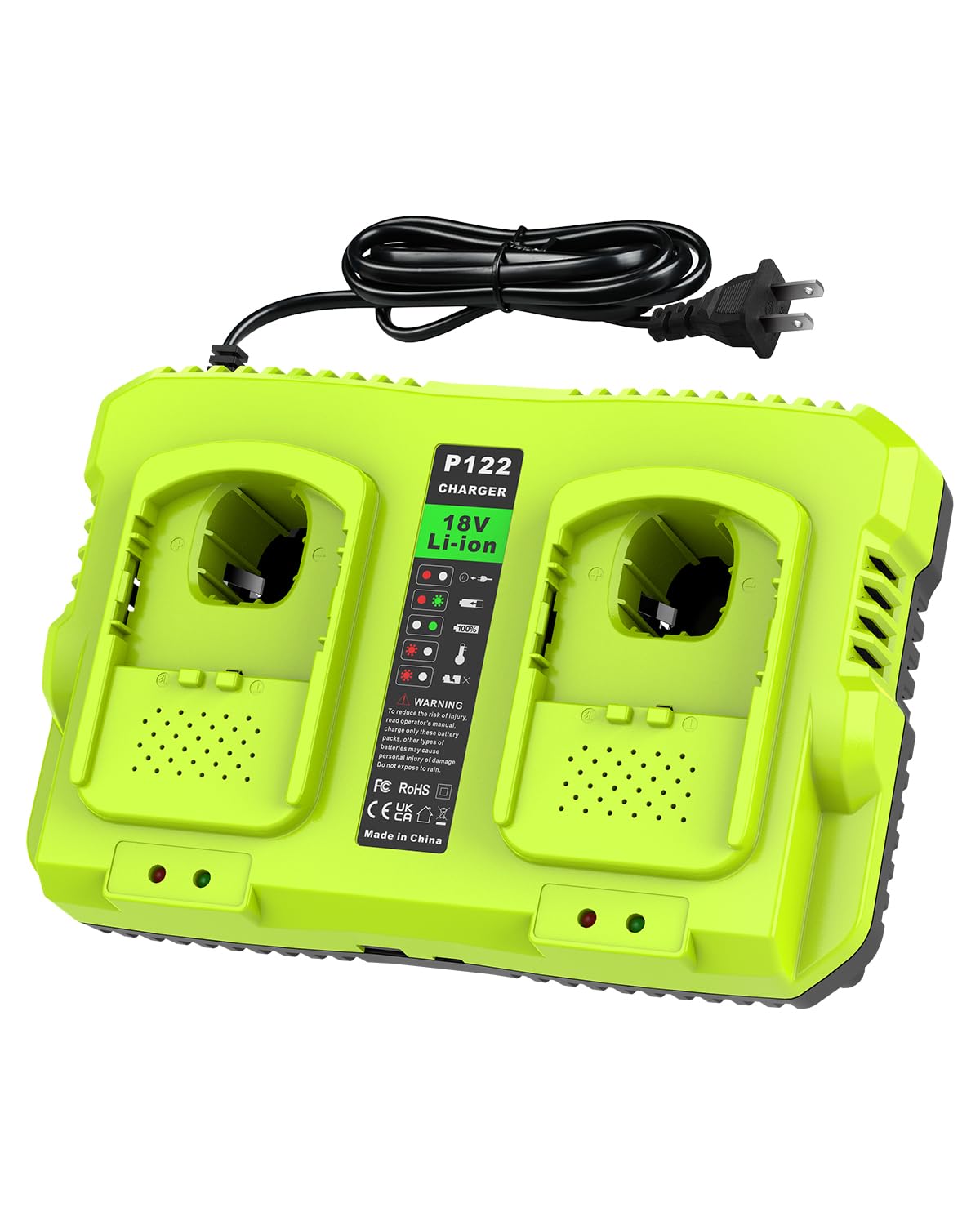
The dual-port Ryobi charger that also tops up your phone and handles HP Plus packs.
This is the most feature-dense Ryobi charger on the list. It replaces hot-selling original models — P117, P118, P118B, P119, P135, and P166 — and supports three battery chemistries: 18V ONE+ Li-ion, NiCad, and NiMh, including the HP PBP002 and PBP005 packs. It even handles 12V and 14.4V NiCad/NiMh, though not those voltages in lithium. The 100-242V global input covers travel anywhere.
The dual-port design charges two batteries at once, and the built-in 5V/5A USB port charges a phone or fan on the same unit. Output is tune at 2A for 18V Li-ion and 1.5A for NiCad/NiMh, with a 6.0Ah 18V pack reaching full in 2-3 hours. Owners praise its sturdy build — one survived a 4-foot toss by a delivery driver and “still held up” — and call it better than the OEM charger that was failing them.
Safety is comprehensive: overcharge, overcurrent, overload, short-circuit, and overheat protection, plus an integrated air duct for active cooling during long charges. LED indicators track power, charging, full, and fault states. The catch is that at 15.1″D x 2.5″W x 5.5″H it is a long unit, so measure your shelf first. It is a premium-feeling pick for a committed Ryobi user.
Why it stands out
- Dual ports plus a 5V/5A USB port for devices
- Handles Li-ion, NiCad, and NiMh chemistries
- Sturdy build that survived a 4-foot drop
Measure first
- Long 15.1-inch body needs shelf space
- 2A output is moderate, not rapid
Reach for this if: you run several Ryobi ONE+ tools and want one station that charges batteries and your phone.
Look elsewhere if: your space is tight — this one stretches out.
8. Bosch GAL18V6-80 18V 6-Bay Fast Charger

The 8-amp six-bay tower that charges a whole fleet of Bosch packs overnight or faster.
The Bosch GAL18V6-80 is for the serious user with a small army of tools. It delivers 8 amps of charging current — 4 times the output of the standard GAL18V-20 charger — and fills a spent 4.0Ah battery to 80% in 32 minutes and 100% in 50 minutes. Six bays charge batteries sequentially, cycling through each pack automatically, which owners love because it “auto switches to the next battery.”
The regulated dual-mode system is the smart part: the first 80% charges fast, while the final 20% switches to a long-life mode to protect the pack. An active cooling fan tune heat, and a five-LED indicator shows each battery’s status. The error indicator alerts you if charging stops due to temperature or battery failure. It even works with AMPShare batteries, a cross-brand system compatible with tools from multiple manufacturers.
Owners call the auto-shutoff the best feature — once every pack is done, it powers down, so you never wonder if you left the job site with something still plugged in. The recurring gripe is that charging performance gets mixed feedback when more than three batteries are plugged in, so heavy simultaneous loads can slow down. At 11.93″D x 8.27″W x 8.89″H with a carrying handle and cord wrap, it is built for transport.
The fleet charger
- 8A output charges a 4.0Ah pack to 80% in 32 minutes
- Six bays cycle automatically between packs
- Auto-shuts off when everything is done
The trade-off
- Performance dips with more than three batteries loaded
- Sequential charging, not truly simultaneous
The pick for: Bosch pros with many batteries who value automatic cycling and fast top-ups.
Pass if: you own one or two packs — six bays is overkill.
9. Makita DC18SF 18V LXT 4-Port Rapid Charger
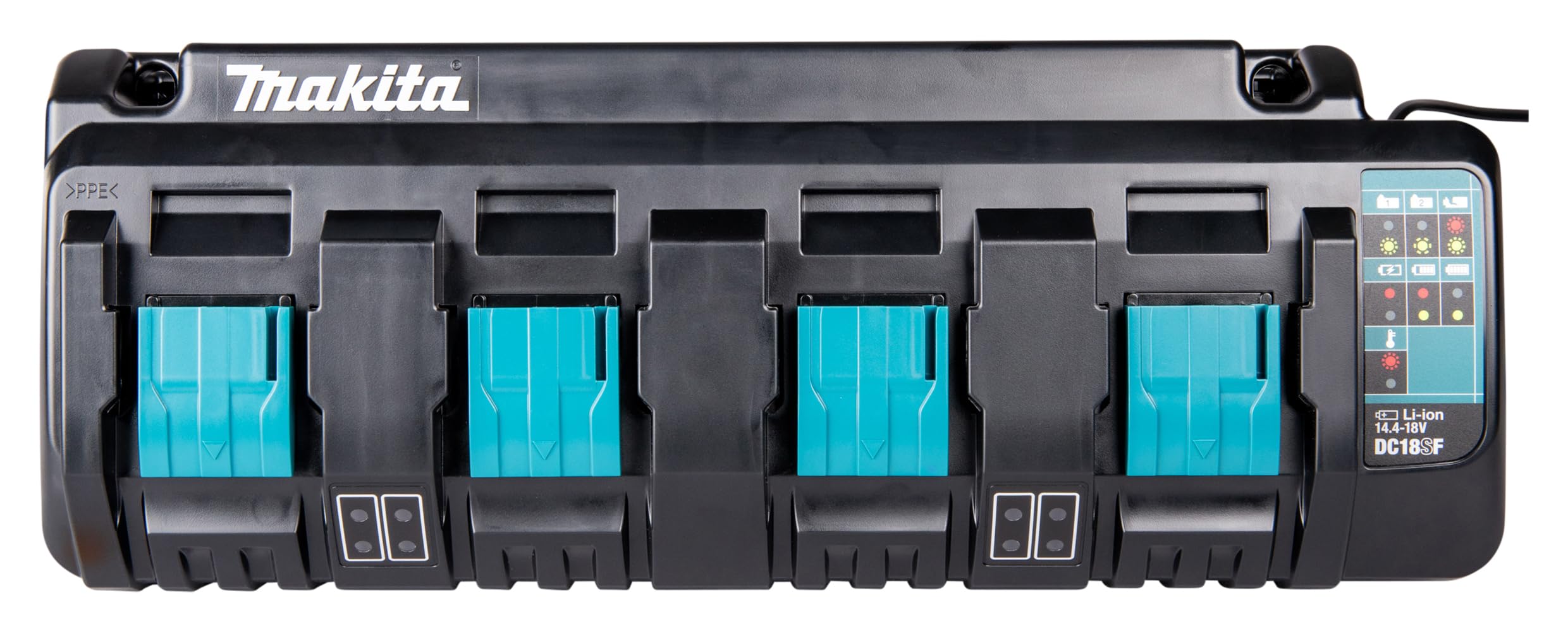
The 4-port Makita tower that keeps an entire jobsite crew’s batteries rotating all day.
Makita’s DC18SF is built for crews, not single-tool hobbyists. It charges two 18V LXT batteries in 60 minutes and four in 120 minutes, or two Compact packs in just 30 minutes and all four in 60. The Rapid Optimum Charger monitors each battery and actively controls current, voltage, and temperature for faster charging and longer pack life. At 17.3″ long and only 4.5 lbs, it is designed to travel in a gang box.
Owners who run it daily report charging ten 5.0Ah batteries a day and watching it auto-shut-off when done. The wall-mount design is a favorite — it mounts flat and keeps a busy workspace organized. One honest quirk: it charges in pairs, so ports 1 and 3 work together, then 2 and 4 follow. Port 2 waits for port 1, which owners describe as a deliberate design that can confuse at first. The LEDs also flash constantly while powered, which one owner called “annoying for OCD users” — a small thing, but worth knowing.
This genuine Makita charger carries the brand’s usual sturdy build, and shoppers say it beats juggling single chargers. It is the most expensive pick here, and it charges in pairs, so it is not truly four-at-once. For a jobsite or shop running multiple Makita tools, it keeps power flowing. It only charges 18V LXT packs, so leave your 12V CXT batteries for another charger.
Built for crews
- Four ports charge two packs in 60 minutes
- Lightweight 4.5 lb design travels well
- Wall-mountable with auto-shutoff
Know before you buy
- Charges in pairs, not all four at once
- LEDs flash constantly while powered
Get this if: you run a Makita shop or jobsite where several batteries rotate through tools all day.
Choose a single charger if: you only need one pack topped up now and then.
Understanding the Specs
Charging current (amps)
The single biggest speed factor is amperage — the amount of electrical current flowing into your battery. A 3.5-amp charger fills a small pack in minutes, while a 2-amp unit takes noticeably longer. Higher output generates more heat, which is why the fastest chargers add a cooling fan. If speed matters, look for 3 amps or more and active cooling.
Dual-bay vs. sequential charging
A simultaneous dual-bay charger powers both batteries at once, halving downtime. A sequential charger parks the second battery and waits for the first to finish. The Bosch 6-bay and Makita 4-port units charge in sequence or pairs by design — great for a whole fleet, but not truly all-at-once. Match the charging pattern to how many batteries you need ready at the same moment.
FAQ
Will an 18V charger work with any brand of battery?
Can I charge a NiCad battery on a lithium charger?
Does a higher amp charger damage my battery?
What do the different LED light patterns mean?
Is it safe to leave a battery on the charger overnight?
Why does my dual charger only charge one battery at a time?
How long does a typical 18V battery take to charge?
Can a third-party charger replace my original brand charger?
What is the AMPShare system in the Bosch charger?
Final Thoughts: The Verdict
Across the board, the 18 volt battery charger winner is the Milwaukee M18 Dual Bay because it genuinely charges two batteries at once and hits 80% in about an hour — the crowd favorite with a 4.8-star reputation. If you want fast Makita charging with a live status screen, grab the Bslite DC18RF. And for a whole fleet of Bosch packs, the Bosch GAL18V6-80 auto-cycles through six batteries and shuts itself off when done.
How We Picked
We do not accept paid placement. Every pick is matched to a real buyer and a real use-case; we do not hands-on test units.
Sources & Methodology
Specifications: manufacturer listings and product documentation. Review insights: verified customer reviews, as of August 2026. Pricing: not shown on this page (it changes often); check the current price via the retailer link.
As an Amazon Associate, KitchPrep earns from qualifying purchases. This does not affect which products we feature.
Related Guides
