
Specs are compiled from manufacturer listings and verified buyer reviews and can change over time — please confirm the key details on the product page before buying.
A miter saw’s first cut sets the tone for every joint you’ll make. If the angle is off even a hair, your baseboards meet with a gap you’ll be staring at for years. This guide helps you find a basic miter saw that delivers square, accurate cuts without the premium price of sliding models.
I’m Mohammad Maruf — the founder and writer behind KitchPrep. This guide is built by comparing the manufacturers’ published specifications and the patterns across verified customer reviews, so you get each pick’s real strengths and trade-offs instead of marketing spin.
Trimming out a room or building a fence starts with a basic miter saw that cuts clean angles every time. Your choice depends on blade size, motor power, and angle-lock precision.
Our Picks at a Glance
How To Choose The Best Basic Miter Saw
Before you buy, you need to match the saw’s blade size to the thickest boards you’ll actually cut. A basic 10-inch saw is the most common choice for trim and hobby work, but a 12-inch blade handles taller baseboards and bigger dimensional lumber in a single pass.
Match the blade to your lumber
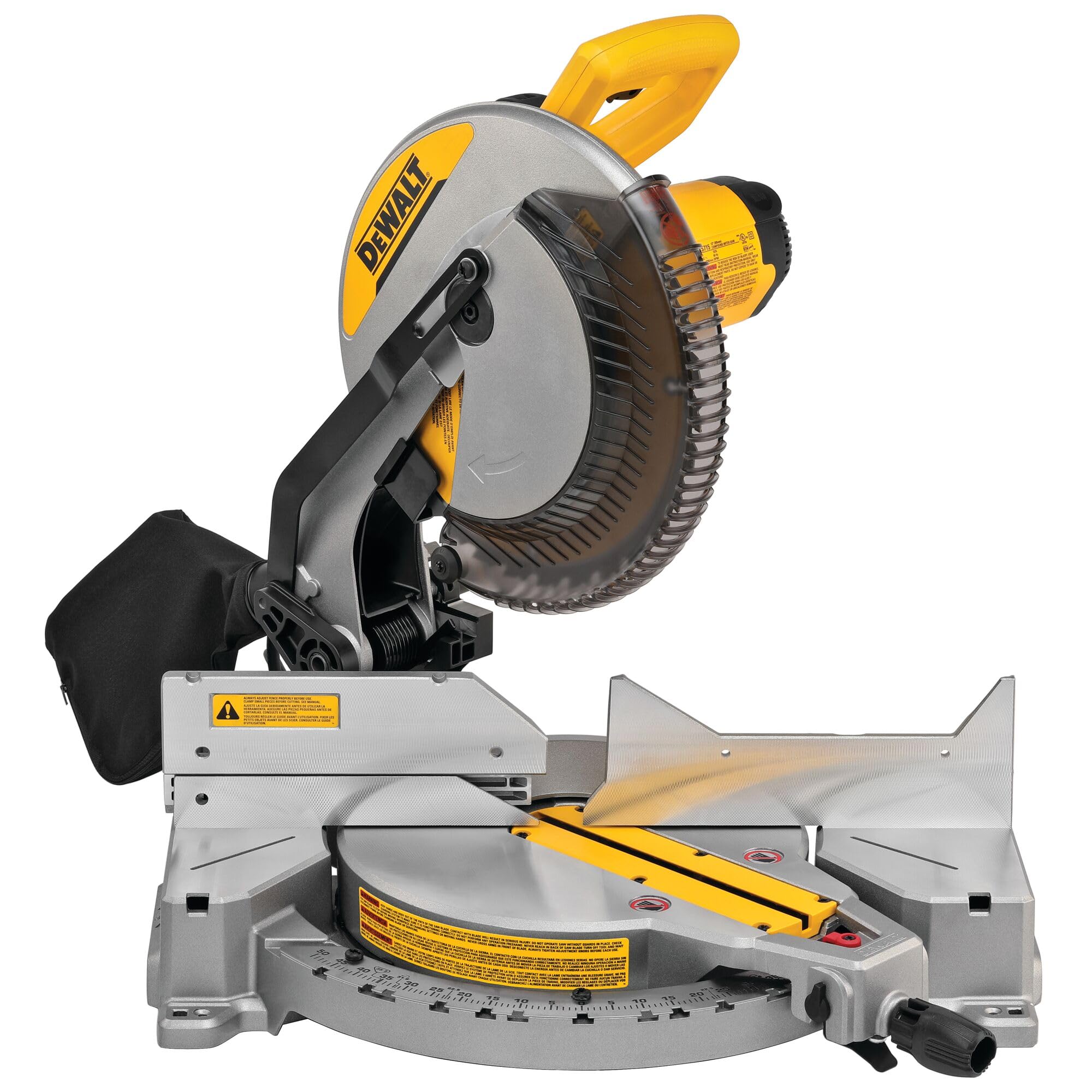
The blade diameter sets your cutting capacity. A 10-inch saw handles most home trim and 2x4s comfortably. If you work with 4×4 posts or thick crown molding, a 12-inch saw like the DEWALT DWS715 gives you the extra reach, cutting a 2-inch x 8-inch board at 90 degrees without flipping it.
Read the motor honestly
Most basic saws in this class run on a 15-amp motor, which gives you steady, repeated cuts through pine, poplar, and even hardwoods. The no-load speed, measured in RPM (revolutions per minute), tells you how fast the blade spins before it touches wood — anywhere from 4,600 to 6,000 RPM is normal, meaning the motor spins fast enough for clean cuts.
Single bevel is usually enough
A single bevel saw tilts its head in only one direction, typically to the left. That covers crown molding and picture frames, which is what most DIYers need. A dual bevel tilts both ways, saving you from flipping the board, but it costs more. If you mostly cut square or simple angles, single bevel is a smart, budget-friendly place to start.
Quick Comparison
| Model | Best For | Blade Size | Motor | No-Load Speed | Amazon |
|---|---|---|---|---|---|
| DEWALT DWS715★ Best Overall | Wide cuts & pro-accuracy | 12 inches | 15 Amp | — | Amazon |
| Yumark 255CCompact Pick | Portability & soft metals | 10 inches | — | 6,000 RPM | Amazon |
| MarvTool JS-1017C3Best Value | Beginner value & 4x4s | 10 inches | 15 Amp | 5,000 RPM | Amazon |
| Metabo HPT C10FCG2 | Reliable trim work | 10 inches | 15 Amp | 5,000 RPM | Amazon |
| VEVOR J1G-ZP32-255 | Budget-conscious hobbyists | 10 inches | 15 Amp | 5,000 RPM | Amazon |
| Delta S26-262L | Stand compatibility | 10 inches | 15 Amp | 5,500 RPM | Amazon |
| Genesis GMS1015LC | Laser-guided accuracy | 10 inches | 15 Amp | — | Amazon |
| Evolution R210CMS | Cutting metal & wood | 8-1/4 inches | — | — | Amazon |
| Ryobi TS1346 | DIY beginners | 10 inches | 14 Amp | 5,500 RPM | Amazon |
| RIDGID R4113 | Renovation work | 10 inches | 15 Amp | — | Amazon |
| Makita LS1040 | Precision trim & framing | 10 inches | 15 Amp | 4,600 RPM | Amazon |
In‑Depth Reviews
1. DEWALT 12-Inch Miter Saw (DWS715)
Our pick — over 4.5★ from 6,500+ verified ratings; the strongest balance of quality and price.
A 12-inch workhorse that makes clean, square cuts on wide boards.
This saw handles big jobs without hesitation. The 12-inch blade is 20% larger than the 10-inch models on this list, which is exactly why it slices a full 2-inch x 8-inch board at 90 degrees in one pass — no flipping the work around. It also has 14 positive stops on a stainless-steel miter detent plate, so locking into a common angle like 22.5 or 45 degrees is a click, not a guess.
The 15-amp motor cuts smoothly, as owners describe. and the tall sliding fence supports a 5-1/2-inch base vertically, which is perfect if you’re standing up tall baseboards for a cut. It bevels 0 to 48 degrees to the left and 0 to 3 degrees to the right, giving you real flexibility for crown work. The honest trade-off is bulk: at 42.8 pounds, it’s over twice the weight of the lightweight Yumark below, so it’s a bench fixture rather than a carry-around tool. As buyers report, “The clamp that’s included isn’t all that good, but the saw itself is sweet!”
The tool height is 15 inches, and a short power cord is a common owner note — plan for an extension cord.
What Wins Owners Over
- 12-inch blade takes on 2×8 lumber without flipping
- 14 positive stops for fast, repeatable angle locks
- Tall sliding fence supports 5-1/2-inch tall baseboards
- Owner favorite for accuracy and easy setup
The Trade-Offs
- Heavy at 42.8 pounds, so it is not a travel saw
- Included clamp is a weak point
- Short power cord needs an extension for most shops
Reach for it if: you want maximum cutting capacity in a basic, non-sliding design.
Look elsewhere if: you need to carry your saw between job sites — this one earns its spot on a dedicated stand.
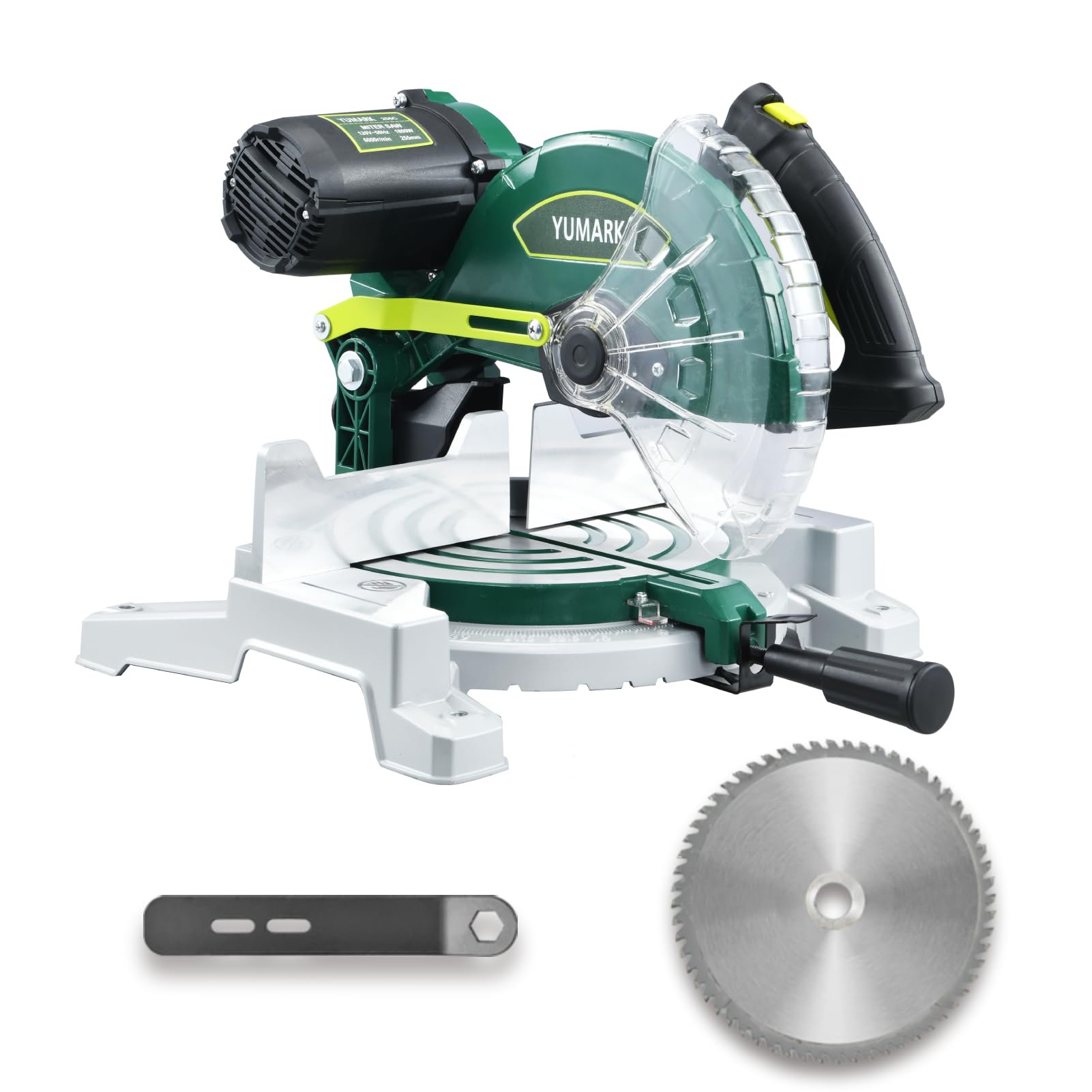
2. Yumark 10-Inch Miter Saw (255C)
A featherweight that still spins fast enough for soft metals, made for the mobile DIYer.
This is the saw you grab when portability matters more than sheer mass. At 20 pounds, it’s less than half the weight of the DEWALT — a 2.1x gap that you’ll feel on the first trip up a ladder or out to a fence line. Owners mention it’s “Not as heavy as my old one, nice for moving it,” and the compact, foldable design is genuinely suited to small shops and job sites where floor space is precious.
Its all-copper motor spins to a no-load speed of 6,000 RPM — 20% faster than the 5,000 RPM MarvTool below — which is the highest top speed on this list. That extra spin helps it power through wood, plastic, aluminum, and soft metals with a smooth, precise finish. The dual 45-degree adjustable table has a thickened fixing stopper for a stable base, and the extended machine base keeps the platform steady during cuts.
The main complaint in owner feedback is the missing operating manual — the seller points buyers to a listing video instead, which is frustrating if you need a reference for blade changes or adjustments. You also get a safety cover and a shock-absorbing handle that owners say keeps fatigue low during longer sessions. It’s a value-focused option for basic wood and soft-metal projects, not a jobsite workhorse.
Best for travel: at 20 pounds with a foldable base, this is the most job-site-friendly basic saw here.
The catch: no printed manual arrives in the box, so be ready to look up setup online.
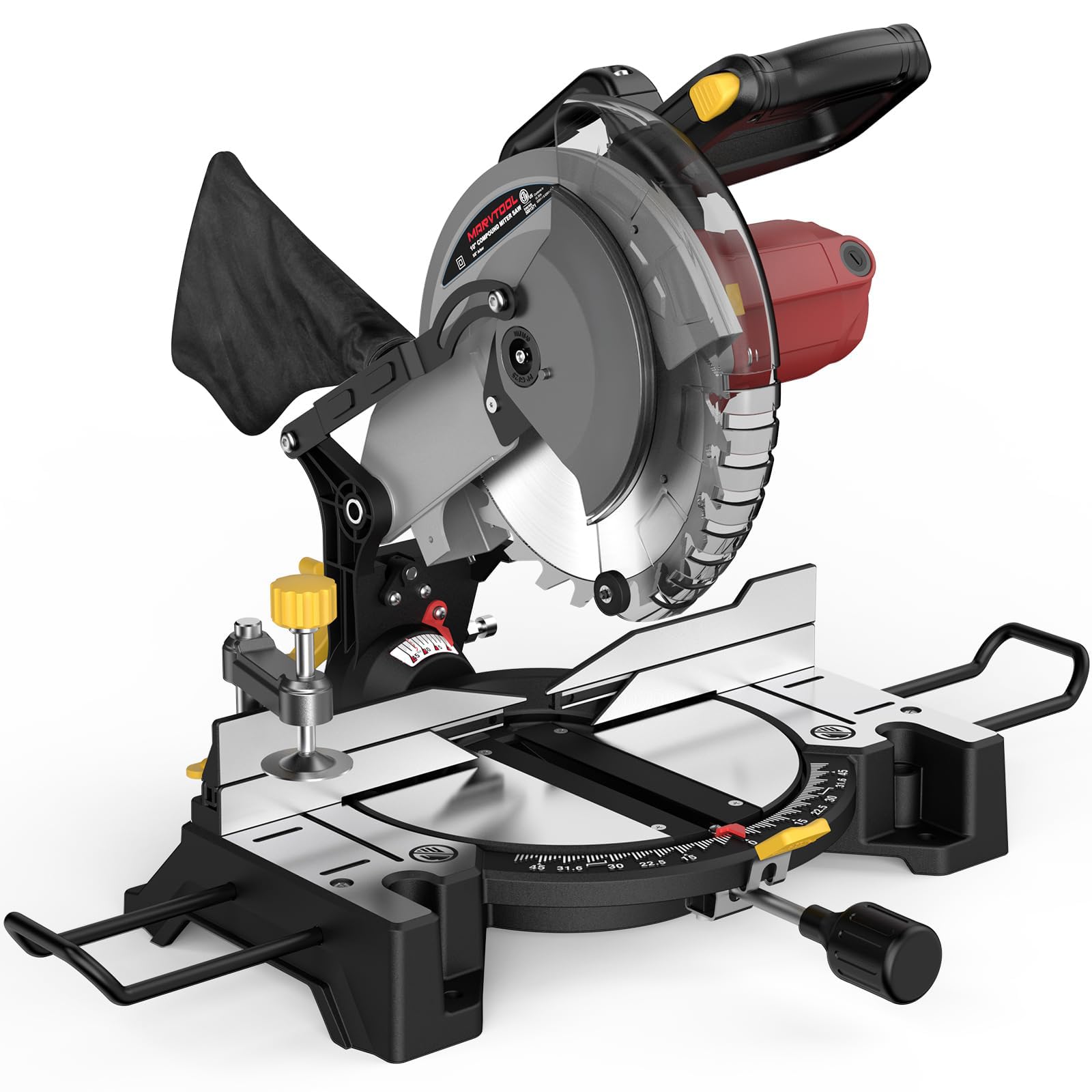
3. MarvTool 10-Inch Compound Miter Saw
The beginner-friendly powerhouse that chews through 4×4 hardwood without complaint.
If this is your first miter saw, owner feedback is emphatic: it’s a great place to start. One buyer sums it up: “Works great came already put together, love it worth the price.” Customers note it cuts through 4×4 hardwood with no problems and handles hundreds of 2x4s without slowing down, making it a legitimate choice for building a wood fence or tackling framing projects.
Power comes from a sturdy 15-amp motor spinning a 10-inch blade at 5,000 RPM — the same speed as the pricier Metabo HPT. It cuts soft metal, wood, plastic, and laminates, and the dual flexibility of left miter angles from 0 to 45 degrees plus bevel cuts from 0 to 45 degrees on both sides lets you produce compound angles for crown molding and shadow boxes. At 20.5 pounds, it’s just half a pound heavier than the budget Yumark, and its head locks into the base for compact storage.
The trade-offs are minor but real for a budget tool: the depth stop feels slightly flimsy, though it works, and the instructions are a little vague when it comes time to change the blade. The 36-tooth carbide-tipped blade cuts clean from the start, and two extension tables plus a 2-year warranty sweeten the deal. This pick wins on the strength of its owner satisfaction relative to its cost.
Why It’s a Winner
- 15-amp motor powers through 4×4 hardwood with ease
- Dual bevel from 0-45 degrees for compound cuts
- Comes with extension tables and 36T blade
- 2-year warranty for confidence
The Reality Check
- Startup kick is noticeable on first power-up
- Depth stop is functional but feels flimsy
- Acute angle rotation needs the knob loosened almost fully
Who it beats: for raw cutting power per dollar, it outmuscles the cheaper Yumark and matches the faster Metabo HPT speed.
Who it doesn’t: if you need a laser guide or LED line, this bare-bones model skips those extras.
4. Metabo HPT 10-Inch Miter Saw (C10FCG2)
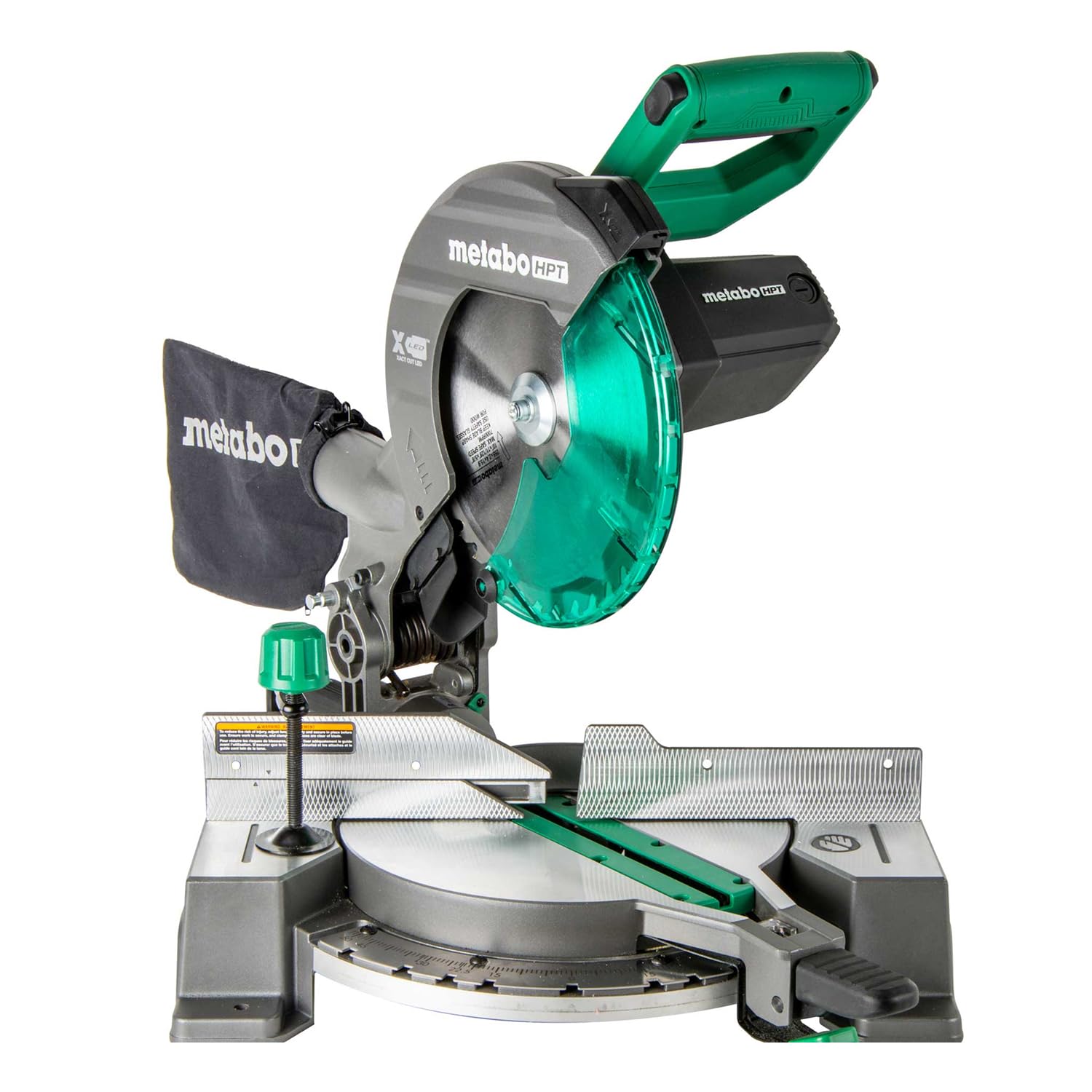
A 24-pound trim specialist with a shadow line that shows exactly where the blade will land.
The defining feature here is the Xact Cut Shadow Line, which projects a crisp blade-shaped shadow onto your workpiece so you can see the cut path clearly — something owners say beats a laser in daylight conditions. This 15-amp saw spins at 5,000 RPM and handles trim, baseboards, and 2×6 framing smoothly, with owners praising its clean, accurate cuts and simple controls.
It’s a single bevel with a 0-45 degree left bevel and a wide 0-52 degree miter range left and right, which is more miter angle than most basic saws offer. The improved miter scale and large 10-inch table give you better material support, and the vice clamp secures your workpiece for safety and precision. Many owners call it the best saw they’ve owned, and the consensus on build quality is strong.
There are a couple of honest flaws to plan around. Some reviewers point out the arbor nut (the part that holds the blade) can get stuck, and dust collection is mediocre at best. It also has no custom angle lock — just click detents — so if you need a weird in-between angle, you’ll be eyeballing it. For straightforward miter work on trim and small boards 6 inches or less, this is a reliable, trusted choice backed by a 5-year warranty.
The standout: its shadow line guidance makes lining up cuts easier than any laser on this list.
Plan for it: the arbor nut can bind, and you’ll want a shop vac hooked up for dust.
5. VEVOR 10-Inch Compound Miter Saw
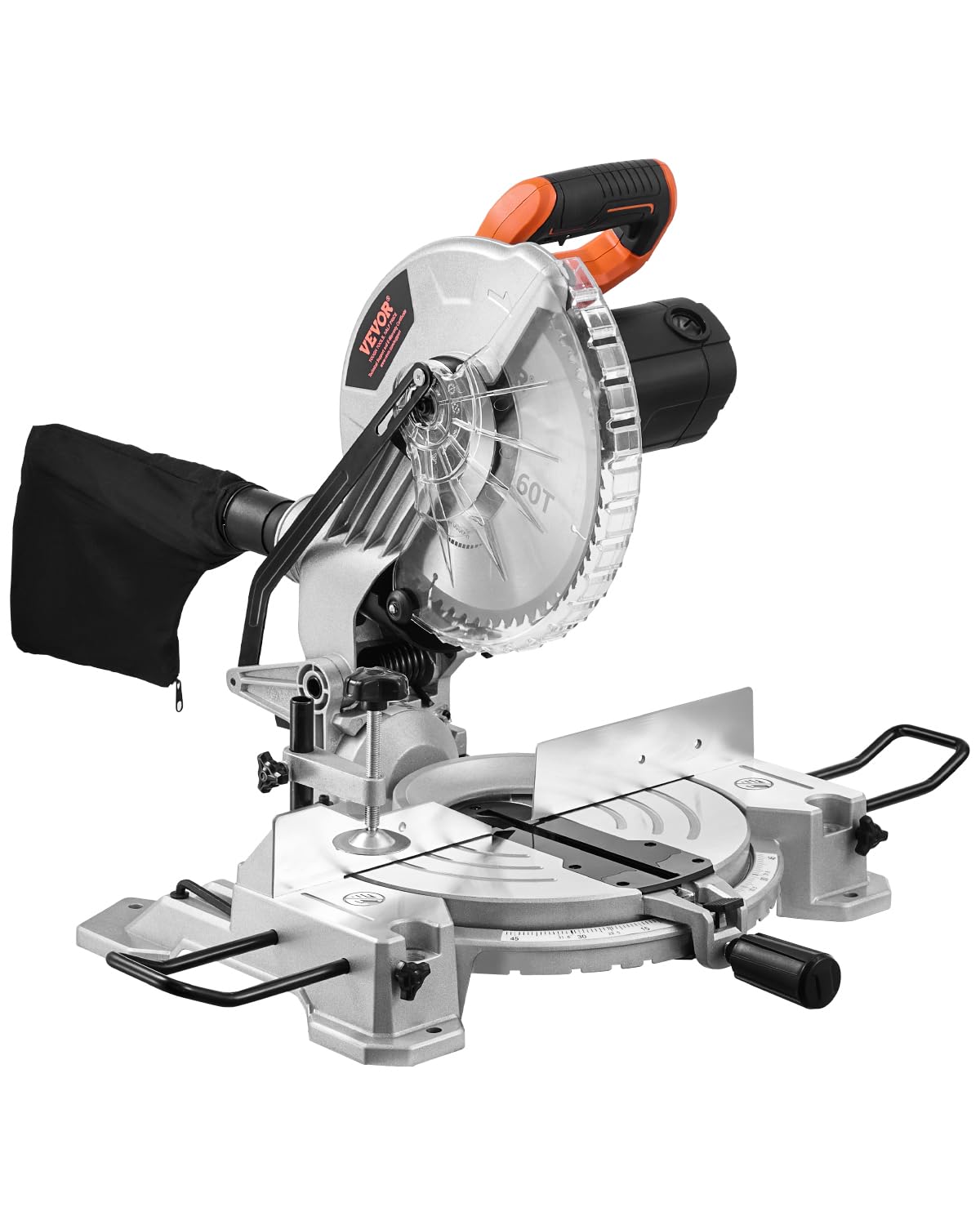
A 60-tooth blade and LED guide make this a precision-focused pick for detail work.
VEVOR’s approach here is all about accuracy at a friendly price. The LED guide system projects a clear cutting line so you can see exactly where the blade will pass, and the precision scale locks your desired angle firmly in place. Owners praise the tight turntable arm for accuracy, and the 60-tooth blade delivers smooth performance that reduces chipping on finishes — a real advantage for picture frames and detailed wood crafts.
The cast aluminum base is the signature feature — lighter than traditional cast iron, it makes the saw easier to transport while still providing strength and heat dissipation for continuous runs. It delivers 2,800W of straight-cutting power and 3,000W of bevel-cutting power at 5,000 RPM, with the head tilting 0 to 45 degrees left for bevel cuts. The dual-button activation system prevents accidental startups, a safety feature that’s always welcome.
The honest caveat is that this is a home-use tool, not a pro-grade unit. Some owners note the plastic knobs may wear over time, the included dust bag is small, and installing the blade can be tricky. Owners call it safe, reliable, and great value for home projects. This is a smart budget option if you want LED precision without paying a premium.
The Highlights
- 60-tooth blade gives smooth, chip-resistant cuts
- LED guide line improves accuracy
- Cast aluminum base is lighter than cast iron
- Dual-button safety start
Keep in Mind
- Plastic knobs may wear with heavy use
- Dust bag is small and fills quickly
- Blade installation is a bit difficult
Reach for this if: you want LED-guided accuracy for crafts and trim without overspending.
Look elsewhere if: you’re framing daily on a jobsite and need a tool built for that abuse.
6. Delta 10″ Shop Master Miter Saw (S26-262L)

A dependable 5,500 RPM cutter with a laser that fits any standard miter saw stand.
Delta built this one to live on a stand. The standout compatibility note is that it works with virtually all miter saw stands, so you can attach it to a setup you already own. Power comes from a 15-amp motor spinning a 10-inch blade at a brisk 5,500 RPM — noticeably faster than the 5,000 RPM of the MarvTool and Metabo HPT picks above.
It cuts nominal 4×4 and 2×6 boards at 90 degrees and handles a 2×6 in a single pass. The integrated laser guide is meant to show you the cut line ahead of time, and some owners find it accurate while others note the laser can sit 1-2cm off center and is hard to adjust. The spindle lock holds the blade securely while you loosen the arbor nut for blade changes, which owners say is simple.
At 29-1/2 pounds with a 5/8-inch arbor, it’s a mid-weight basic saw. The recurring complaint is the angle pivot can loosen during cutting, which risks a beveled cut if you don’t check it, and the dust bag doesn’t do a great job containing shavings. Buyers still call it easy to use, lightweight, and excellent basic tool value for the money. This is a solid, no-frills performer if you already have a stand and want a laser-equipped backup or first saw.
Why it fits: the universal stand compatibility makes it a natural upgrade or replacement for existing setups.
The caveat: the laser may need realignment, and the angle pivot deserves a firm hand when tightening.
7. Genesis 15-Amp 10-Inch Miter Saw (GMS1015LC)

A laser-guided, 9-stop compound saw that keeps the price friendly for home projects.
Genesis packs a lot of guidance into a budget frame. The integrated laser guide projects the cut line so you know exactly where the blade will fall — and owners find it effective and easy to use. The 15-amp motor handles 2x4s and 4x4s with no issues, and the 9 positive miter stops lock firmly at commonly used angles for fast, repeatable setup.
The compound head makes bevel cuts up to 45 degrees left and performs compound miter cuts for crown molding, shadow boxes, and picture frames. The electric brake stops the blade in seconds — a real safety feature you don’t always see at this level — and the arbor lock makes quick blade changes painless. It comes remarkably complete: a 60T carbide blade, hold-down clamp, dust bag, two extension wings, a blade wrench, and even two AAA batteries for the laser.
Owners love it for trim work, with one buying it specifically for cutting baseboards over a weekend and praising how easy and clean it cuts. The honest caveats are that it’s loud — ear protection is essential — and it is not for cutting metal, as the heat can melt plastic parts. The dust bag is also somewhat useless, so plan for a shop vac at the exhaust port. For woodworking around the house, this is a high-value, feature-rich option.
Packed In the Box
- Laser guide plus 9 positive miter stops
- Electric brake stops the blade in seconds
- 65T carbide blade and extension wings included
- Arbor lock for quick blade changes
Honest Limits
- Very loud during operation
- Not designed for cutting metal
- Dust bag is ineffective — use a shop vac
Reach for this if: you’re a first-timer who wants a laser, multiple stops, and everything needed in one box.
Think twice if: you plan to cut anything metal — this is strictly a wood saw.
8. Evolution R210CMS 8-1/4″ Miter Saw

The compact machine that sails through steel, aluminum, and wood with one special blade.
Most basic miter saws are wood-only, but Evolution’s whole pitch is multi-material cutting. The included 24-tooth Japanese tungsten-carbide-tipped (TCT) blade handles wood, plastic, and even steel and aluminum with embedded nails — owners say it slices through a 2×2 3/16-inch thick square tube “like a hot knife through butter” and leaves a clean finish that’s cool to the touch.
The 1200W hi-torque motor powers the most compact frame here at 15″L x 10.2″W x 15.5″H, weighing 12.8 pounds. It offers 0-45 degree bevel tilt and 45-45 degree miter angles, so you get compound cutting capability in a genuinely small package that stores in a tight space. A 3-year limited manufacturer’s warranty backs it up.
The catch is that it’s a specialist tool with a learning curve. Some owners warn that cutting metal generates hot shavings that can melt into the plastic components after repeated use, and heavy metal cutting can burn out the blade by the tenth cut on thick angle iron. Others note the plastic knobs feel cheap and the clamp is weak. This is not the saw to buy if you mostly cut wood — it’s the saw for a DIYer who frequently works with metal and wants one compact tool that does it all.
The specialist: for metal and wood in one budget machine, there’s nothing else this compact.
The trade-off: hot metal shavings can stress plastic parts — keep metal cutting sessions modest.
9. Ryobi 10 in. Compound Miter Saw (TS1346)

A beginner-friendly 14-amp saw with an LED cutline that makes first cuts feel guided.
Ryobi aims this squarely at the first-time buyer, and the owner feedback confirms it’s a “bang for your buck” recommendation for DIY beginners. The heavy-duty 14-amp motor delivers up to 5,500 RPM — the same top speed as the Delta above — which is plenty of power for difficult cuts in framing and trim. The 24-tooth carbide-tipped blade provides fast, clean cuts from the start.
The LED Cutline Indicator projects a clear line onto your workpiece, giving you higher accuracy for positioning cuts without a laser. A 1-1/4 inch dust port helps keep your work area clean when you attach a shop vac. The saw comes complete with the 24-tooth blade, a blade wrench, a dust bag, a work clamp, and an operator’s manual — and it’s backed by a 3-year manufacturer’s warranty.
Owners specifically note the factory-set 45-degree angle is perfect from the start, which removes the biggest source of frustration for a new woodworker. The LED light gets called “a bonus” and the overall quality is praised. This is a solid, approachable choice if you want a simple, guided first saw for picture frames and home trim.
Why beginners love it: the factory 45-degree angle is spot-on, so your first miter joint fits.
Who it’s not for: pros needing a daily workhorse — this is a home-garage companion.
10. RIDGID 15 AMP 10 in. Dual Bevel Saw (R4113)

A dual-bevel design with an LED cutline for cutting both directions without flipping lumber.
This RIDGID is here for one specific advantage: the dual bevel. Unlike the single bevel saws above that only tilt left, this one cuts bevels on both sides of the blade, which saves you from flipping the material when you need angled cuts on both ends of a board. That matters for crown molding and other compound projects where symmetry is critical.
It runs on a 15-amp motor spinning a 10-inch high-speed steel blade, with an LED Cut Line Indicator to guide your placement. The 50-degree cutting angle gives you a bit more range than the standard 45-degree saws. Owners use it for renovation work, with one noting a son “loves it” and has used it for home renovations, and another finding it “worth every penny” for bringing new life to a home project.
There’s an important catch to understand before you buy: despite the “dual bevel” name, the owner feedback is clear that this saw only bevels from one side, and the material must be reversed for the next bevel. That’s a significant difference from a true dual-bevel mechanism, and it’s caught several buyers off guard. It also has a very small pool of reviews, so consider this a solid RIDGID-branded option if you want the 15-amp power and LED guidance, but be clear-eyed about its bevel limitation.
The appeal: RIDGID’s 15-amp motor and LED line in a clean, recognizable package.
The surprise: it bevels from one side only — treat the “dual” claim with caution.
11. Makita LS1040 10″ Compound Miter Saw

The precision-focused 15-amp classic with 9 positive stops for furniture-grade joints.
Makita’s LS1040 is the kind of tool that owners keep for a decade and pass along. The strong 15-amp direct-drive motor spins at 4,600 RPM — the lowest top speed on this list — but that trade-off buys you legendary smoothness and precision. It’s a non-sliding saw with a single pivot that owners say delivers “corners like a dream” when framing artwork, and it’s widely recommended for trim work.
The dual post compound pivoting arm keeps the head stable, while the machined aluminum base and dual slide rails give it a rock-solid feel. Miter cuts range 0-45 degrees left and 0-52 degrees right, with 9 positive stops at 15, 22.5, 30, and 45 degrees on either side plus 0 — the same detent system you’d want for repeatable crown or baseboard angles. Bevel cuts go up to 45 degrees left. The included 40-tooth micro-polished blade cuts clean and smooth, and a vertical vise, wrench, and triangular rule round out the kit.
Owner consensus is that it’s accurate, lightweight, and well-made, though it’s also loud on startup — described as “starts with a bang.” The blade bolt can be very hard to remove, and the compact non-sliding design means large crown molding laid flat needs more careful positioning. This is the pick for the woodworker who values precision and longevity over raw speed, and it’s a saw that handles 90-95% of home jobs with ease.
Why It Endures
- 9 positive stops at all the common angles
- Machined aluminum base for stability
- Included 40T blade cuts clean
- Light 27-pound frame for a Makita
The Reality
- Loud startup may surprise you
- Blade bolt is difficult to remove
- Compact design limits large crown molding
Reach for this if: you want a precision trim saw with a trusted name and parts availability for years.
Look elsewhere if: you need the highest blade speed or a sliding head for wide stock.
Understanding the Specs
Blade Diameter and Cutting Capacity
The blade size in inches determines the thickest board you can cut in one pass. A 10-inch blade is the most common standard and easily handles 2x4s and most trim, typically cutting nominal 2×6 at 90 degrees. A 12-inch blade goes bigger, cutting a full 2×8 in a single pass, which is what makes the DEWALT DWS715 stand out. Think about your largest common board before you choose.
Amps and No-Load Speed
Motor strength is measured in amps, and almost every basic saw here is a 15-amp model — that’s the standard for this class and it’s plenty for steady cutting. No-load speed in RPM tells you how fast the blade spins with no material touching it. Anywhere from 4,600 to 6,000 RPM is normal, and it mostly affects how fast the saw can push through hardwood rather than a meaningful quality difference in everyday use.
FAQ
Will a 10-inch miter saw cut a 4×4 in one pass?
What is the difference between a miter cut and a bevel cut?
Is a single bevel saw enough for crown molding?
Can I cut metal with a wood-cutting miter saw?
What does a positive stop or detent do on a miter saw?
How much does weight matter when choosing a basic miter saw?
Is a laser guide better than an LED for lining up cuts?
What safety features should I look for in a basic miter saw?
Why is one miter saw 5,000 RPM and another 6,000 RPM?
What is the advantage of a taller fence on a miter saw?
Final Thoughts: The Verdict
The basic miter saw winner for most people is theDEWALT DWS715 because it delivers the widest 12-inch cutting capacity and a 15-amp motor with 14 positive stops — the strongest combination of power and repeatable accuracy in this list. If you want a laser-guided companion for home trim work, grab the Genesis GMS1015LC with its 9 miter stops and included 60-tooth blade. And for precision furniture-grade joints on a budget, the Makita LS1040 remains the name owners trust for square cuts that last years. Every pick here earns its spot, but remember to match the blade size to the thickest board you’ll actually cut — that single decision will shape your entire experience.
How We Picked
We do not accept paid placement. Every pick is matched to a real buyer and a real use-case; we do not hands-on test units.
Sources & Methodology
Specifications: manufacturer listings and product documentation. Review insights: verified customer reviews, as of August 2026. Pricing: not shown on this page (it changes often); check the current price via the retailer link.
As an Amazon Associate, KitchPrep earns from qualifying purchases. This does not affect which products we feature.
Related Guides
