
Specs are compiled from manufacturer listings and verified buyer reviews and can change over time — please confirm the key details on the product page before buying.
If you are shopping for a 2000 Watt UPS, the real question isn’t “which one is popular” — it’s “which one can actually handle my gear’s power draw without tripping.” Most units in this class deliver between 1200W and 1980W of true output, and that gap decides whether your server, gaming PC, or 3D printer stays on during an outage. The other decision is the plug: several high-capacity models need a 20-amp outlet, not the standard 15-amp wall socket most homes have. This guide breaks down the real specs, real trade-offs, and which pick fits which setup.
I’m Mohammad Maruf — the founder and writer behind KitchPrep. This guide is built by comparing the manufacturers’ published specifications and the patterns across verified customer reviews, so you get each pick’s real strengths and trade-offs instead of marketing spin.
Finding the right 2000 watt ups means matching wattage, outlet type, and battery runtime to the equipment you actually own.
Our Picks at a Glance


How To Choose The Best 2000 Watt UPS
Before you compare brands, you need to know two numbers about your own setup: the total wattage your equipment draws, and what kind of wall outlet you have. A UPS that needs a 20-amp plug won’t work in a standard garage or bedroom socket without an adapter, and overloading a smaller unit can cause it to shut off or buzz loudly.
Match the VA rating to your actual power draw
The “2000VA” in the name is an apparent-power rating; the real-world number is the watts output. In this list, that ranges from 1200W on the budget option up to 1980W on the premium picks. If you run a single high-end gaming PC with a 1500W power supply, you need a unit with higher wattage headroom, not just a high VA number. For a rack server, network switches, and storage, calculate the sum of every device’s power supply rating, then add a buffer.
Know your outlet: 15-amp vs 20-amp vs 30-amp
Several units here use a NEMA 5-20P plug, which has a sideways neutral prong and requires a 20-amp circuit. Others, like the premium CyberPower pick, need a twist-lock L5-30P for a 30-amp circuit. If your home doesn’t have those outlets, you either adapt (with limits on what you can draw) or choose a model with a standard 5-15P plug. This is the single most common surprise in customer feedback — the UPS arrives and won’t fit the wall.
Sine wave vs simulated sine wave
Modern computers and nearly all Active PFC power supplies work best with a “pure sine wave” output. A “simulated sine wave” (sometimes called stepped approximation) can cause some PSUs to shut down or behave erratically when they switch to battery. If you are protecting a gaming rig, a server with redundant power supplies, or any modern hardware, prioritize pure sine wave output — it’s the difference between a clean transfer and a crash during an outage.
Quick Comparison
| Model | Best For | True Wattage | Outlet Type | Waveform | Amazon |
|---|---|---|---|---|---|
| CyberPower OR2200PFCRT2U★ Best Overall | PFC servers & multi-monitor rigs | 1320W | NEMA 5-20P (20A) | Pure Sine Wave | Amazon |
| MARUSON 2000VABudget Champion | Budget workstations | 1200W | NEMA 5-20P (9A) | Simulated | Amazon |
| CyberPower OR2200LCDRT2UServer Pick | Workgroup servers | 1320W | NEMA 5-20P (20A) | Simulated | Amazon |
| GOLDENMATE 2000VA/1600W | High-draw gaming PCs | 1600W | NEMA 5-15P | Pure Sine Wave | Amazon |
| Eaton Tripp Lite SMART3000RM2U | Rack environments needing 3000W | 3000W | L5-30P | Pure Sine Wave | Amazon |
| APC SMT2200C (Tower) | Long-run home servers | 1980W | NEMA 5-20P (20A) | Pure Sine Wave | Amazon |
| APC SMT2200 | Network-grade conditioning | 1980W | NEMA 5-20P | Pure Sine Wave | Amazon |
In-Depth Reviews
1. CyberPower OR2200PFCRT2U PFC Sinewave UPS
Our pick — over 4★ from 100+ verified ratings; the strongest balance of quality and price.
The rack-and-tower sine wave unit that handles heavy PFC loads without a peep.
If your equipment uses an Active PFC power supply — which means most modern servers, gaming PCs, and pro audio gear — this is the pick that keeps it alive. It outputs pure sine wave power, the cleanest form of backup, which is what PFC supplies need to stay running instead of dropping out when the grid flickers. The 4ms transfer time keeps connected hardware running without interruption. In practice, buyers report it powers a PC plus five monitors at just 24% load, giving roughly 45 minutes of runtime, and about 90 minutes without the monitors attached.
You get eight protected outlets: six standard NEMA 5-15R and two NEMA 5-20R for higher-draw devices. The input is a NEMA 5-20P right-angle plug with a 10-foot cord, which means you need a 20-amp wall outlet — a common stumbling block, and some buyers miss it and end up with an unusable plug. Keep that in mind before you order. The rotatable LCD panel shows estimated runtime, battery capacity, and load capacity at a glance, so you always know your margin during an outage.
Reliability is the dominant theme across owner experiences, with performance earning the most praise by a wide margin. A 3-year warranty (batteries included) plus a Connected Equipment Guarantee covers your gear if the UPS fails. It’s a heavier unit, but that’s the cost of a metal enclosure and serious internal components — and the trade-off is years of dependable service.
Why it wins
- Pure sine wave output keeps Active PFC power supplies stable
- 8 total outlets with two 20-amp receptacles for big draws
- Rotatable LCD shows runtime, capacity, and load in real time
- AVR corrects fluctuations without draining the battery
Watch out for
- Requires a 20-amp outlet — a sideways neutral prong wall socket
- Rack/tower form factor is heavy to move around
Reach for this if: you run a server, a multi-monitor workstation, or any Active PFC hardware and want clean sine wave backup with a real LCD readout.
Check your wall first: it needs a NEMA 5-20P 20-amp receptacle, not a standard 15-amp socket.
2. MARUSON 2000VA Line-Interactive UPS
The affordable 1200W tower that protects basic workstations and network gear on a budget.
This is the entry point into the 2000VA class, delivering 1200W of true output through eight protected NEMA 5-15R outlets — four of them battery-backed and four surge-only. It uses simulated sine wave output, which is fine for standard desktop computers, monitors, and network hardware, though it’s not the best match for newer Active PFC power supplies. At 25 pounds and about 11.7 x 5.8 x 7 inches, it’s dramatically more compact than the rack-mount units above — roughly half the footprint of the CyberPower rack/tower models, making it a genuinely space-saving choice for a home office.
Two-step boost and one-step buck AVR smooths voltage dips and spikes without draining battery runtime. A 12-point shield protects RJ-11/RJ-45 data lines, with overload, overcharge, and short-circuit protection. Setup is genuinely plug-and-play, with the LCD status panel and downloadable software handling automatic shutdowns.
The honest caveat is reliability — the most-discussed aspect is mixed, not glowing, and it’s the reason this sits at budget tier. Some owners mention it works “right from the start” for a rack server, but a few have described a unit that made loud buzzing noises under a 1000W load and shut off seconds later. The takeaway: it’s a solid value for light-duty desktop protection, but if you plan to push it near its 1200W limit, spend more for a unit with a stronger track record.
Best-value read: this is a great fit for a basic workstation or home network stack where you need battery backup without the premium price tag.
The honest catch: reliability feedback is genuinely mixed, so treat this as a light-duty pick rather than a max-load workhorse.
3. CyberPower OR2200LCDRT2U Smart App LCD UPS
A rack-mount server backup with decades of documented owner loyalty.
This 2000VA/1320W unit is built for workgroup servers, network devices, and telecom gear that doesn’t use Active PFC power supplies. The big selling point is longevity: owners routinely report running it for six years or more with zero issues. As buyers put it, the batteries lasted 6.5 years before needing replacement, and a fresh set restored full function. That kind of track record is rare in this category, and it’s the reason this unit earns its “server pick” label.
All eight outlets are NEMA 5-20R, so each receptacle can handle a 20-amp draw — useful for feeding multiple devices from a single unit. The multifunction LCD shows runtime in minutes, battery status, and power conditions, alerting you to problems before they cause downtime. AVR corrects minor fluctuations without battery drain, and the unit is UL certified. Owners note it handles high-draw 3D printers, like an SV08 and Bambu P1P running simultaneously, that overloaded a smaller 1500VA unit — with about 20 minutes of runtime to finish a print layer.
The trade-off is weight and size. It’s a heavy 2U rack/tower unit that you won’t want to move often. It also requires a 20-amp input plug, so verify your outlet situation first. But if you want a unit that quietly does its job for half a decade-plus, this is the one owners come back to — the review pages are full of “owned since 2018, zero issues” stories.
Built to last
- Owners document 6+ years of service on original batteries
- Eight 20-amp outlets for heavy simultaneous draws
- LCD shows runtime in minutes and battery status
- UL safety certified
Know before you buy
- Needs a 20-amp wall outlet
- Heavy 2U chassis is a chore to relocate
- Simulated sine wave — not for Active PFC gear
Pick it for: a server stack or 3D printer farm where proven long-term reliability matters more than cutting-edge waveform.
skip it if: your equipment uses Active PFC power supplies, which need pure sine wave output.
4. GOLDENMATE 2000VA/1600W Lithium UPS

The lithium-powered sine wave unit that plugs into a normal 15-amp wall socket.
This is the most technologically interesting pick in the list, and it solves two problems at once. First, it delivers 1600W of true power — the highest wattage in the mid-range tier — through a standard NEMA 5-15P plug, so no 20-amp outlet hunting required. Second, it uses a Lithium Iron Phosphate (LiFePO4) battery pack rated at 51.2V and 9Ah, with a lifespan the maker puts at over 10 years and more than 3,000 charge cycles. That’s a fundamentally different battery chemistry than the sealed lead-acid cells in every other unit here, and it means you won’t be swapping batteries every few years.
For gaming rigs, this is the one owners reach for. The review pages show it running a 1500W power supply with an RTX 5090 without breaking a sweat, and another owner powers an i9-1400K with 128GB of RAM. It also tackles two 3D FDM printers with AMS units attached, holding the load until a whole-house generator kicks in. The eight NEMA 5-15P outlets are spaced wider than usual to fit bulky power adapters side by side, and the front panel includes USB charging ports — one Type-C and one Type-A, at 10W total — plus a communication port for automatic Windows shutdown.
The balanced view: performance and power output are the two most-praised aspects, and owners consistently call it quiet. Battery life is more mixed — some find runtime excellent, while others measure it at about 80% of the calculated maximum. The unit is also physically larger and heavier than lead-acid equivalents because the 51.2V system needs a bigger transformer. There’s a 1-year warranty here, which is shorter than the 3-year terms on the CyberPower units, so factor that in if long-term coverage is a priority.
Why it stands out: it’s the only unit in this list with a standard wall plug and a decade-scale lithium battery, making it the most future-proof mid-range pick.
The trade-off: a shorter 1-year warranty and bulkier chassis than the competition.
5. Eaton Tripp Lite SMART3000RM2U SmartPro 3000VA
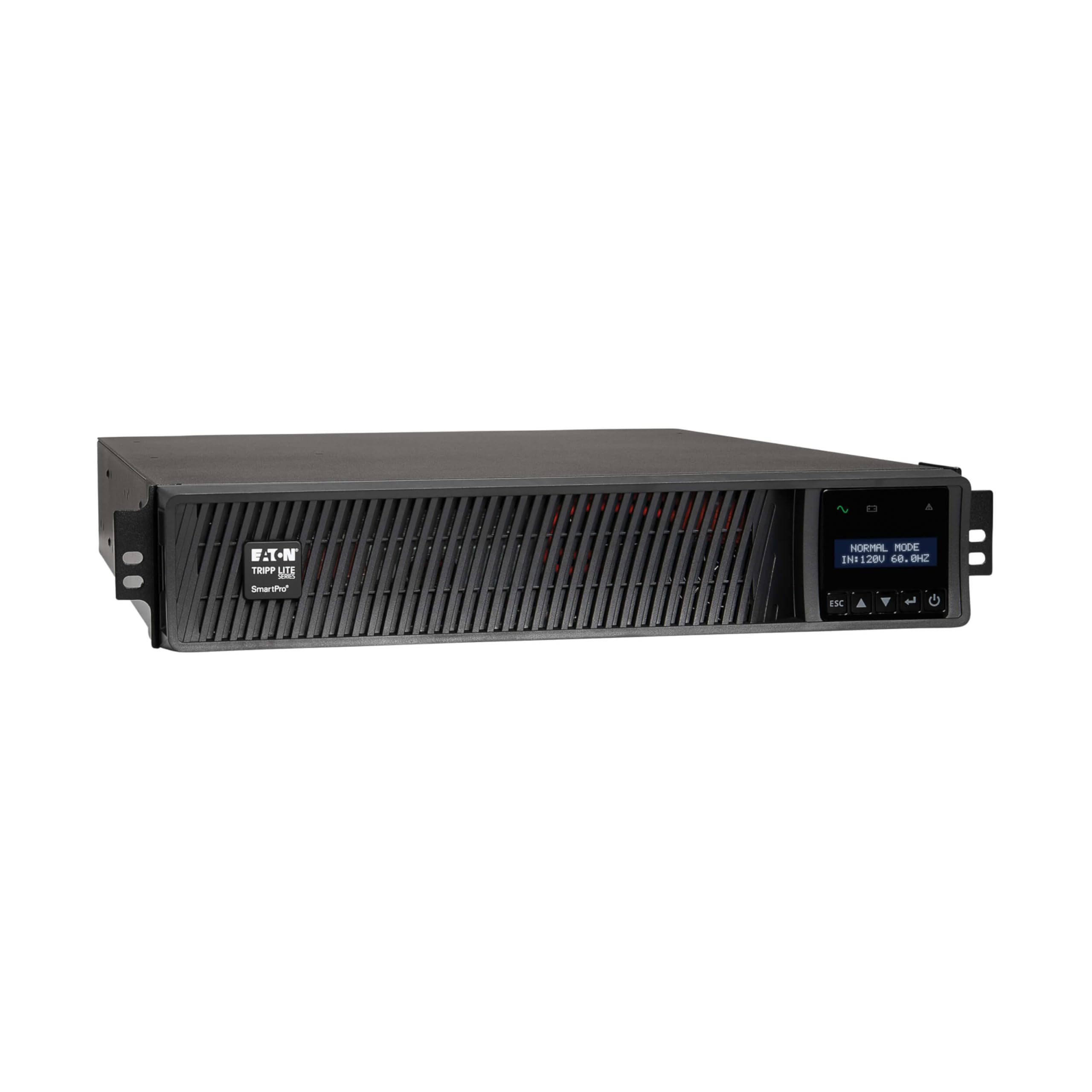
The big-boy 2U rack unit that outclasses the 2000W class entirely.
Strictly speaking, this one is a 3000VA/3000W unit — a step above the 2000W class this guide centers on — but it earns its place for anyone who wants serious headroom in a 2U rack chassis. With 3000W of pure sine wave output, it can power a full server rack section that would max out the 1980W units below. You get seven outlets: one L5-30R for a big draw and six 5-20R for rack devices. It filters EMI/RFI noise, includes Automatic Voltage Regulation, and rotates between rack and tower mounting using the included tower support stand.
A standout feature is the web card slot for the optional WEBCARDLXE, which gives you remote management via SNMP, web, SSH, or Telnet — you can reboot a locked-up device from anywhere and get power alerts by email. Batteries are user-replaceable with Eaton’s EBP-1617 pack, which keeps the unit serviceable for the long haul. The 2U form factor with a 23.7-inch depth slots neatly into standard racks.
The honest cautions: the unit’s a bit noisy, with a fan that some owners find loud, and one reviewer noted receiving a unit with dated batteries. The amperage is 18.75 A, so plan your circuit accordingly — it needs a substantial feed. If you need the headroom and rack-mount convenience, this is a legitimate upgrade over the 2000W class, but only buy it if you genuinely need more than 1980W of clean output.
Choose this for: a rack environment that needs more raw wattage than the 2000W class provides, with remote management.
Consider first: whether your circuit and ears can handle the 18.75 A draw and the fan noise.
6. APC 2200VA Smart UPS SMT2200C (Tower)

The tower UPS with legendary runtime for homes that lose power for hours.
If your priority is how long your gear stays up when the grid goes dark, this APC tower is the one to beat. It delivers 1980W of pure sine wave output from a 2200VA battery, and customers note genuinely long runtimes — one buyer runs two computers plus dual monitors for two and a half hours on a full charge, and another saw up to 1 hour and 40 minutes during a real outage. That’s the class-leading runtime story, and it comes from the big sealed lead-acid battery bank inside this 134-pound tower.
You get eight battery-backed outlets total: six NEMA 5-15R and two NEMA 5-20R. The input is a NEMA 5-20P, so you’ll need a 20-amp circuit. For monitoring, the SmartConnect portal gives automatic notifications, firmware updates, and remote status via a secure web portal — a real step up from the USB-only units. The LCD display shows load, battery charge, and runtime, and the whole unit is network-manageable via serial, USB, or optional ethernet.
Reliability is the most-praised aspect here, with quality right behind it. Buyer feedback consistently describes it as “heavy but worth it,” and one owner uses it to run commercial SLS 3D printers for hours through outages. The battery charge time is 4 hours, the battery average life is rated at 5 years, and APC backs it with a 3-year repair-or-replace warranty (2 years on the battery) plus a Connected Equipment Protection Policy. The main practical note: at 134 pounds, this is a “set it once and never move it” device.
What it delivers
- Pure sine wave 1980W output for any modern gear
- Documented runtimes of 2+ hours on real setups
- SmartConnect cloud monitoring with auto alerts
- 4-hour recharge time
What it costs you
- 134 pounds — absolutely not portable
- Needs a 20-amp wall outlet
- Premium price for the capacity
Best for: homes and small offices that face long outages and need hours of clean runtime for multiple computers.
Think twice if: you can’t dedicate a 20-amp circuit and a permanent floor spot to a 134-pound tower.
7. APC 2200VA Smart UPS SMT2200RM2UC (Rack)

The 112-pound network-grade tower that keeps terminal servers up for hours.
This is the classic APC Smart-UPS 2200VA, delivering 1980W of pure sine wave output through eight battery-backed outlets, with network-grade power conditioning built in. The solid-state AVR boosts low voltage and trims high voltage without ever touching the battery, which extends the life of your connected gear and the UPS itself. It’s the pick for anyone running a home server, terminal server, or AV system that needs clean, conditioned power at all times — not just during outages.
Reliability is the top-praised aspect here by a wide margin, with setup close behind. Reviewers point out keeping their computer systems and monitors running for over 3 hours through power outages, and terminal servers sail through 30-minute outages without a reboot. The unit is network-manageable via serial, USB, or optional ethernet, and offers pure sine wave output that’s compatible with Active PFC power supplies. The nominal output is 120V with a 2200VA/1980W capacity rating.
The practical realities: this is a 112-pound tower with a NEMA 5-20P input, so it needs a 20-amp outlet and a permanent home. The typical recharge time is 3 hours. One buyer mentioned the cooling fan as a minor irritant, and a single long-term owner had a battery-expansion failure, though that’s an outlier against a strong reliability consensus.
The strengths
- Pure sine wave 1980W for Active PFC gear
- Documented 3-hour runtimes at light loads
- Network-grade conditioning that eliminates monitor squeal
- 3-hour recharge time
The realities
- 112 pounds — a permanent installation, not a portable
- Needs a NEMA 5-20P 20-amp outlet
- Fan noise noted as a minor nuisance
Best for: home labs and terminal servers that need dependable, network-managed pure sine wave power with a proven reliability record.
Be realistic about: runtime at heavy loads drops sharply — at 900W you’re looking at minutes, not hours.
Understanding the Specs
VA vs Watts
VA (volt-amperes) is the apparent power rating; watts is the real usable power. The gap comes from the “power factor” of your equipment. A 2000VA unit with a 0.6 power factor delivers about 1200W; one with a 0.99 power factor delivers closer to 1980W. Always match the watt rating to your equipment’s total draw, not the VA number.
Pure vs Simulated Sine Wave
Pure sine wave output mimics the clean grid power your devices expect. Simulated sine wave (stepped approximation) is cheaper to produce but can cause Active PFC power supplies to glitch or shut down on battery. For modern gaming PCs, servers, and pro audio, choose pure sine wave.
AVR (Automatic Voltage Regulation)
AVR smooths out voltage dips and spikes while you’re still on wall power, without tapping the battery. This extends both the UPS battery life and the life of your connected gear. It’s the feature that keeps your equipment running through brownouts, not just blackouts.
Line-Interactive Topology
Line-interactive UPS units correct voltage fluctuations using a tap-switching transformer, offering more protection than a standby unit while staying quieter and cheaper than an online double-conversion unit. This is the most common design in the 2000W class and works well for most home and office gear.
FAQ
What size UPS do I need to run a 1500W gaming PC?
Can I plug a UPS with a 20-amp plug into a standard 15-amp outlet?
How long will a 2000VA UPS run my equipment?
What is the difference between pure sine wave and simulated sine wave UPS?
How often do I need to replace a UPS battery?
What is AVR and why does it matter?
Can a UPS power a 3D printer through an outage?
Is a rack-mount UPS better than a tower UPS?
Final Thoughts: The Verdict
If you want one dependable pick, the 2000 watt ups winner is the CyberPower OR2200PFCRT2U because pure sine wave output, eight protected outlets, and the rotatable LCD cover the needs of the broadest range of gear — including Active PFC hardware — at a fair price. If you want the longest emergency runtime above everything else, the APC SMT2200C is the one to reach for, with owners reporting two-plus hours on real multi-computer setups. And if you want the most forward-looking battery tech with a standard wall plug, the GOLDENMATE lithium model delivers 1600W with a decade-scale battery life. Check your wall outlet type before you order — that single detail shapes which of these will actually work in your home.
How We Picked
We do not accept paid placement. Every pick is matched to a real buyer and a real use-case; we do not hands-on test units.
Sources & Methodology
Specifications: manufacturer listings and product documentation. Review insights: verified customer reviews, as of August 2026. Pricing: not shown on this page (it changes often); check the current price via the retailer link.
As an Amazon Associate, KitchPrep earns from qualifying purchases. This does not affect which products we feature.
Related Guides
