
Specs are compiled from manufacturer listings and verified buyer reviews and can change over time — please confirm the key details on the product page before buying.
Hunting for a 12 CFM air compressor usually means you have real work to do — spraying a car, running a nail gun, or feeding a sandblaster without constant stops. This guide cuts through the marketing noise to show which units actually deliver the airflow you need, which ones quietly fall short, and what the owners who run them daily have to say. The picks here range from portable off-road inflators you toss in a truck bed to 600-pound stationary monsters for a full shop.
I’m Mohammad Maruf — the founder and writer behind KitchPrep. This guide is built by comparing the manufacturers’ published specifications and the patterns across verified customer reviews, so you get each pick’s real strengths and trade-offs instead of marketing spin.
The honest truth is that “12 CFM” means different things on a 12-volt off-road pump versus a 230-volt workshop tank. Use this 12 cfm air compressor roundup to match the right machine to the jobs you actually tackle.
Our Picks at a Glance


How To Choose The Best 12 CFM Air Compressor
Before you pick a compressor, you need to understand that CFM (cubic feet per minute) is the airflow your tools actually use. A nail gun might need 2-3 CFM, but a paint sprayer or a sandblaster can demand 10-15 CFM continuously. If your compressor’s output is lower than what the tool needs, the tank drains fast and you sit waiting for it to catch up.
Match the CFM to your air tools
Check the CFM requirement on your most demanding tool, then add a buffer. A 12 CFM unit handles a spray gun or a couple of high-volume impact wrenches comfortably. For continuous work like sandblasting, look for a unit with a higher rating — some of the compressors in this list push 24 CFM or more.
Decide between portable and stationary
If you need air in many places, a portable unit with wheels or handles lets you roll it around a job site or take it off-road. If you work in one fixed spot, a stationary vertical tank saves floor space but stays put, so you run hoses to where you work. Decide first: one location or many?
Understand the power requirements
Smaller compressors run on standard 120V household outlets. Bigger shop units — the ones with 5 HP, 6.5 HP, or 7.5 HP motors — need 230V or 240V single-phase power, and some gas-powered models need no electricity at all. Check your shop’s wiring before you buy a big electric unit.
Quick Comparison
| Model | Best For | Max Airflow | Max Pressure | Tank Size | Amazon |
|---|---|---|---|---|---|
| ALL-TOP 12V Dual Cylinder★ Best Overall | Off-road tire inflation | 12.35 cfm | 150 psi | Hose only | Amazon |
| VEVOR 80 Gallon Oil FreeBest Value | Industrial workshops | 15.5 cfm | 145 psi | 80 gallons | Amazon |
| VEVOR 15HP Gas Powered | Remote job sites | 33 cfm | 115 psi | 30 gallons | Amazon |
| DEWALT 60 Gallon Vertical | Quiet shop air | 15.3 cfm | 175 psi | 60 gallons | Amazon |
| Ingersoll Rand 2340L5-V | Continuous duty power | 14 cfm | — | 60 gallons | Amazon |
| NorthStar Gas 30 Gallon | Remote spray work | 24.4 cfm | 90 psi | 30 gallons | Amazon |
| Ingersoll Rand 2475N7.5 | Heavy industrial use | 24 cfm | 175 psig | 80 gallons | Amazon |
In‑Depth Reviews
1. ALL-TOP 12V Air Compressor
Our pick — 4.5★ from 250+ verified ratings; the strongest balance of quality and price.
The portable off-road champion that turns tire inflation into a set-it-and-walk-away task.
The hook here is the smart digital brain. You set your target pressure on the LCD control panel and the dual-cylinder pump stops itself automatically, so you never over-inflate a tire. The specs back the convenience: 12.35 CFM of airflow at a max 150 PSI, which is why overlanders trust it for big rigs. Buyers report it’s genuinely fast, with a 37-inch tire climbing from 18 to 37 psi in under 10 minutes.
The build leans tough on purpose. Heavy-duty alligator clamps grab your 12V battery directly, a cleanable sponge filter handles dusty trails, and an anti-vibration metal base lets you mount it permanently in a vehicle. A 2-year warranty covers the motor. The trade-off is the calibration: a few owners set a higher number to get the real pressure they want, and the unit gets hot after heavy use, so it needs a cool-down before storage.
What wins people over here is reliability — the compressor keeps working after a year of constant off-road abuse, and owners call the compact size with its carry bag a space-saver in a Jeep or truck. The hose reaches all four tires, which removes a lot of crawling around. This is the pick for anyone who wants real air power that rides along in the vehicle.
What owners love
- Auto-stop at your preset PSI means hands-free filling
- 12.35 CFM fills 37-inch tires from 18 to 37 psi in under 10 minutes
- Compact with a carry bag and a hose that reaches all four tires
Fair trade-offs
- Gauge calibration drifts a bit over time for some users
- Runs hot after extended use, so let it cool before storing
Grab it for: off-roaders, crawler owners, and anyone inflating big tires in the field.
Think twice if: you need to run continuous shop tools, not just fill tires — this is a portable, not a stationary tank.
2. VEVOR 80 Gallon Oil Free Compressor
A shop-sized 80-gallon tank with oil-free simplicity and a quiet 86dB hum.
The whole pitch here is massive air storage without the mess of oil changes. An 80-gallon tank paired with a 6.5 HP oil-free motor delivers 15.5 SCFM at 90 PSI, and The maker claims it can fill the tank in about 6 minutes.. Buyers who painted a full car report the tank never dropped below 120 psi during the job, and the oil-free pump meant no water in the lines.
Owners note it’s quiet — Its 86 dB rating keeps a workshop tolerable. — and they praise the fast recovery. The catch is setup: it needs a 220V/60Hz single-phase connection, and buyers mention a short 4-foot power wire, no included regulator, and two 1/4-inch outlets instead of a more flexible manifold. At 264.6 pounds it’s a solid fixture, and the top-heavy build means you should anchor it.
One buyer did hit a tank weld leak on arrival and found VEVOR’s support slow, with Amazon stepping in to resolve it. That’s a quality-control risk, not the norm — most owners call it powerful and reliable for the money, comparing it favorably to pricier oil-lubed pumps. For a workshop that wants big capacity on a budget, this is hard to pass up.
The strong points
- 80-gallon tank keeps a spray gun running without pressure dips
- Oil-free design means no oil changes and no water in the lines
- Fast recovery even while painting a full car
Setup realities
- Needs a 220V/60Hz outlet and a separate power cord
- Plan to add a regulator and water separator yourself
Choose this for: woodshops and small manufacturing that want the biggest tank for the least money.
Note before buying: you’ll spend extra on a regulator and power cord, and you need 230V wiring ready.
3. VEVOR 15HP Gas Powered Compressor

A gas-driven 33 CFM workhorse that brings construction-site air anywhere there’s no outlet.
This is the answer when the job site has no electricity but still needs serious air. A 30-gallon tank with dual air outlets lets you run two tools at once, and cast iron cylinders keep the pump stable under strain.
Mobility is the design goal. Four smooth-rolling wheels make it easy to move around a workshop or roll out to an outdoor project, and an automatic shut-off protects the pump when oil levels run low. Owners mention it fires up a spray gun with no issue and fills truck tires fast while building pressure quickly. One owner even said it’s a “little guy” that does big work.
The honest read: a few units arrived with minor damage or a pressure relief valve that didn’t work, and the quick-connect fitting isn’t a standard US style — you’ll likely need an adapter. Most owners are impressed, though, and the gas engine means no extension cords and no 230V outlet needed. This is the pick for remote work and construction sites.
Why it stands out
- 33 CFM airflow tops every other unit in this list
- Gas powered, so it runs anywhere with zero electrical hookup
- Dual outlets let two tools share the air supply
Watch out for
- Quick-connect fitting may not match standard US hoses
- An occasional unit arrives with a minor defect
Ideal for: construction crews and remote operators who can’t count on a wall outlet.
Not for: indoor shops where gas fumes and noise matter, and where 230V electric is easier.
4. DEWALT 60-Gallon Vertical Compressor
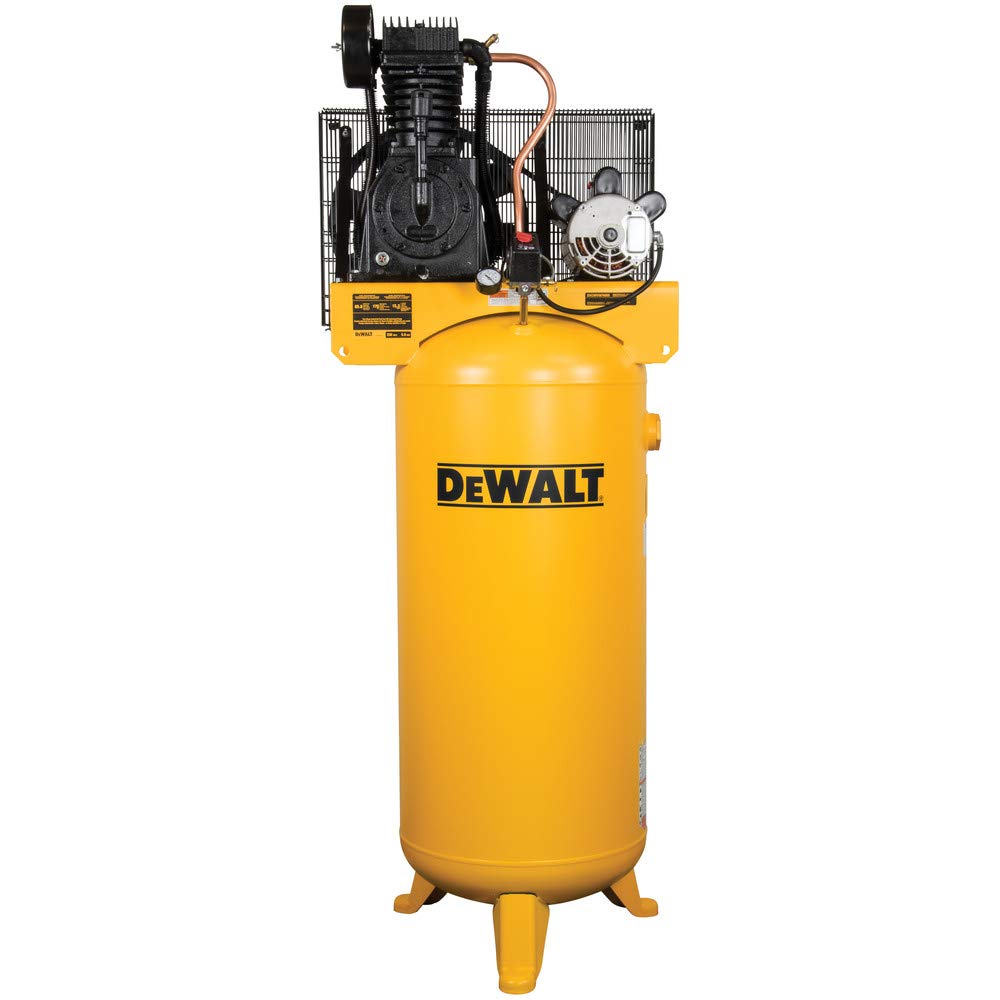
The stationary shop unit that runs at a library-quiet 65 dB while pushing 15.3 CFM.
Noise is the deciding factor here. A 65 dB rating is genuinely quiet for a compressor this size., so you can run it in a home workshop without yelling over the motor. The 5 HP, 230-volt two-stage pump delivers 15.3 SCFM at 100 PSI and 13.5 SCFM at 175 PSI, giving you strong headroom for most shop tools while the 60-gallon vertical tank saves floor space. Customers note it reaches 170 psig very quickly.
Build quality is the headline in owner feedback — the unit arrives solid, looks great, and functions flawlessly for many. One reviewer noted it held pressure for 7 days after being shut off, which speaks to good valves and fittings. The two-stage, belt-drive, oil-lubed design is the kind of hardware that lasts, and it’s a first large stationary compressor for many buyers who are impressed with it.
The caveats are practical, not performance-related. Some buyers found no wiring instructions included, and it needs a 230V hookup that you’ll likely handle yourself. A rare unit shipped with a weld defect from quality control. But for a quiet, powerful, space-efficient vertical tank from a trusted brand, this is a strong mid-to-premium choice.
Standout strengths
- Quiet 65 dB operation suits a home workshop
- Two-stage pump hits 175 psi and recovers fast
- Vertical 60-gallon tank keeps a small footprint
Practical notes
- No wiring instructions included for the 230V hookup
- Big and heavy, so plan the delivery route to its spot
Best for: home shops and small garages that value quiet operation and a compact vertical footprint.
skip it if: you run only 120V outlets and aren’t ready to wire a 230V circuit.
5. Ingersoll Rand 2340L5-V

Cast-iron durability engineered for 100% continuous duty, not hobbyist bursts.
This is the compressor you buy when you want the pump to outlast the building. The individually cast cylinders, overhung crankshaft, and one-piece connecting rod are built for easy maintenance, and the cast iron design is rated for 100% continuous duty — meaning it’s designed to run all day without breaks. It delivers 14 CFM from a 60-gallon vertical tank on 230 volts, single phase, and owners call the SCFM rating impressive.
The Type 30 two-stage design is a classic for good reason. Buyers replacing older 30-gallon non-oil units say the difference is night and day, especially on noise — the 5 HP pump is far quieter than the oil-free units they ran before. Owners were surprised by how well it’s packaged on a pallet, with freight delivery bringing it right into the garage. The motor is rated for continuous duty, which is the reassurance a working shop needs.
The gripes are about assembly quality control, not the core design. A few buyers found pump bolts not started, a stripped drain plug, or a cross-threaded fitting that needed a tap to fix. Check the bolts and fittings on delivery before you rely on it. For a shop that runs air all day, this cast-iron workhorse is the long-term investment.
Built to last
- Cast iron pump rated for 100% continuous duty
- Two-stage design runs noticeably quieter than oil-free units
- Easy-to-service cylinders and connecting rod
Delivery checks
- Inspect bolts and drain plug on arrival — some ship loose
- Heavy 430-pound unit needs a plan for moving it
Reach for it when: you run air tools for hours daily and want a pump that won’t quit.
Weigh this: if you’re not ready to torque-check fittings and arrange freight delivery, a lighter unit might suit you better.
6. NorthStar Gas Air Compressor

A Honda-powered 24.4 CFM unit that starts every time for remote spraying jobs.
The star of this unit is the Honda GX390 OHV engine, a name buyers trust to fire right up even after sitting. With electric start and a recoil backup, plus a low-oil shutdown to protect the engine, this NorthStar is built for jobsite reliability. It pumps 24.4 CFM at 90 PSI into a 30-gallon horizontal tank, and the full cast iron pump with a V-style cylinder design helps keep it cool under load. Owners doing remote sealcoat spraying say it holds 90 PSI set pressure without complaint.
The engine reliability is what keeps buyers coming back — several owners are on their fourth unit and would buy the same one again. They note it’s not much heavier than comparable electric-motor versions, at 490 pounds, and the jobsite-ready frame keeps it manageable. Performance is consistently praised, with the Honda motor getting the credit for dependable starts and plenty of air pressure.
The assembly quality is the honest weak spot. A few owners found an improperly installed fitting that needed disassembly to fix, and some shipped with the throttle linkage clip installed upside down, causing idle issues until flipped. Buyers also warn about the vinyl tubing, recommending an upgrade to copper. A little setup effort gets you a powerhouse that’s excellent for remote, high-volume air work.
What makes it shine
- Honda GX390 engine starts reliably every time
- 24.4 CFM at 90 PSI powers demanding pneumatic tools
- Full cast iron pump with V-style cylinders for cooling
Setup friction
- Some units ship with a fitting or linkage installed wrong
- Vinyl tubing is flimsy — plan to upgrade to copper
Pick this for: remote spraying, sealcoating, and jobsite work where dependable starts matter more than anything.
Be ready for: a hands-on setup session to fix assembly quirks before it runs clean.
7. Ingersoll Rand 2475N7.5

The 7.5 HP industrial beast that makes “running out of air” a phrase from your past.
When nothing else is big enough, this is the ceiling. The Ingersoll Rand 2475N7.5 pairs a 7.5 HP motor with an 80-gallon ASME receiver tank, delivering up to 24.3 CFM at 90 PSI and a 175 psig maximum operating pressure. It’s rated for 100% continuous duty, and The cast iron pump is built for over 15,000 hours of trouble-free use.. Owners say it’s “probably more substantial of a unit than I actually need” — and they mean that as praise.
The service intervals are a big selling point. All Season Select synthetic lubricant runs 2,000 hours between changeouts—four times longer than petroleum-based oils.. The individually cast cylinders and one-piece connecting rod make maintenance straightforward when it finally comes due. A medium-sized shop, reviewers point out, will never run out of air with this unit — it’s rated for continuous use and lives up to that claim.
The trade-offs are minor for the category. The synthetic oil is pricey, and a 611-pound unit demands a serious delivery plan. Some owners upgraded from a 5 HP model and found the difference immediately obvious — better pressure, more flow, faster recovery. If your workshop runs high-demand tools all day, this is the last compressor you’ll need to buy.
The heavy-duty edge
- 24 CFM and 175 psig from an 80-gallon tank
- Rated for 100% continuous duty with a 15,000-hour pump design
- Synthetic oil needs changing only every 2,000 hours
The cost of power
- Premium price and premium oil add up over time
- 611 pounds needs freight delivery and a permanent spot
Buy this if: you run a busy shop with multiple high-CFM tools going at once, all day long.
Only pass on it if: your air needs are modest enough that a smaller, cheaper tank would cover them.
Understanding the Specs
CFM and SCFM at 90 PSI
CFM (cubic feet per minute) measures how much air the pump delivers. The honest rating is usually given as SCFM at 90 PSI — that’s the airflow at a working pressure most tools use. If a spec only lists a max CFM with no pressure, treat it with suspicion. Match the SCFM at 90 PSI to your most demanding tool and add a buffer so you’re not always waiting on the tank.
Single-Stage vs. Two-Stage Pumps
A single-stage pump compresses air once and is fine for intermittent home use. A two-stage pump compresses air twice for higher pressure and efficiency, and it’s built for continuous duty in a shop. If you run air tools for hours daily, two-stage is the durable choice — it runs cooler and lasts longer under load.
Tank Size and Recovery Time
The tank stores compressed air so the pump doesn’t run constantly. A bigger tank, like 60 or 80 gallons, gives you a longer burst of air before the pump kicks back on. Recovery time is how long the pump takes to refill the tank — shorter is better for continuous tools like spray guns.
Power Requirements
Portable 12V units plug into a vehicle battery and travel with you. Small shop units run on standard 120V outlets. Bigger electric compressors — 5 HP and up — need 230V or 240V single-phase power, which may require new wiring. Gas-powered models need no electricity at all but add fuel, fumes, and noise to the equation.
FAQ
What does 12 CFM mean on an air compressor?
Is CFM at 90 PSI different from regular CFM?
Can a 12 CFM compressor run a spray gun?
What voltage do I need for a 12 CFM shop compressor?
How long does an air compressor last?
What is the difference between oil-free and oil-lubed compressors?
Should I buy a gas or electric air compressor?
How does tank size affect my work with a 12 CFM compressor?
What maintenance does a 12 CFM air compressor need?
Can I run two air tools at once on one compressor?
Final Thoughts: The Verdict
For most buyers, the 12 cfm air compressor pick depends on where you work. The portable ALL-TOP wins for off-roaders and tire work, while the VEVOR 80-gallon is the budget-friendly shop anchor. If you need continuous duty for a serious workshop, the Ingersoll Rand 2475N7.5 is the one to reach for, and the gas-powered NorthStar is your go-to for remote jobsites. The crowd favorite across the whole list — the portable ALL-TOP with its smart auto-stop and 12.35 CFM — holds the highest owner satisfaction at 4.5 stars from 200+ ratings., proving the best compressor isn’t always the biggest one.
How We Picked
We do not accept paid placement. Every pick is matched to a real buyer and a real use-case; we do not hands-on test units.
Sources & Methodology
Specifications: manufacturer listings and product documentation. Review insights: verified customer reviews, as of August 2026. Pricing: not shown on this page (it changes often); check the current price via the retailer link.
As an Amazon Associate, KitchPrep earns from qualifying purchases. This does not affect which products we feature.
Related Guides
