
Specs are compiled from manufacturer listings and verified buyer reviews and can change over time — please confirm the key details on the product page before buying.
A grill thermometer that lies to you is worse than no thermometer at all. You lift the lid at what you think is 350°F, and your chicken is charred or your brisket stalled. The gauges on this list are the ones owners actually trust, picked by comparing the published specs and the patterns in thousands of verified reviews. You get the honest strengths and trade-offs of each, so you can match one to your exact grill and cooking style.
I’m Mohammad Maruf — the founder and writer behind KitchPrep. This guide is built by comparing the manufacturers’ published specifications and the patterns across verified customer reviews, so you get each pick’s real strengths and trade-offs instead of marketing spin.
If you cook low and slow or like a hard sear, the right bbq grill temperature gauge keeps your chamber temp honest from first smoke to final rest.
Our Picks at a Glance

How To Choose The Best BBQ Grill Temperature Gauge
Most grill lids come with a pre-drilled hole, and that hole size determines your entire shopping list. Measure the mounting hole and the bolt pattern on your lid before you click buy, and you will save yourself a drilling session and a box of wrong threads.
Thread Size and Mounting Hole
The thread on the stem is what locks the gauge into your lid. A 1/2″ NPT thread (a standard pipe thread) is the most common, and it typically needs a 23/32″ drill bit hole. Some gauges use a different fitting, so check the spec against your grill’s existing hole to avoid drilling into a brand-new lid.
Temperature Range and Dial Readability
Look for a dial that labels the zones you actually cook in. Smoking sits around 225°F to 250°F, grilling lives between 375°F and 525°F, and searing needs to read past 525°F. A gauge that starts at 100°F or 150°F and tops out at 800°F or 900°F covers the full cook, and larger faces are easier to read from a distance.
Quick Comparison
| Model | Best For | Dial Size | Temp Range | Stem Length | Amazon |
|---|---|---|---|---|---|
| Tel-Tru BQ300★ Best Overall | Calibration and durability | 3 inch | 100–500 °F | 4 inch | Amazon |
| Hiorucet Nexgrill ReplacementBest Value | Direct parts swap | 2 15/16 inch | 100–800 °F | 2 inch | Amazon |
| Frienda 3-Pack | Multiple grills at once | 2-3/8 inch | 50–800 °F | 2-7/8 inch | Amazon |
| WEMEIKIT Smoker Gauge | Low-light cooks | 3-1/8 inch | 150–750 °F | — | Amazon |
| LavaLock 3″ Adjustable | Smokers with 1/2″ NPT | 3 inch | 50–550 °F | 2.5 inch | Amazon |
| KAMaster Kamado Gauge | Kamado-style grills | 3 1/4 inch | 150–900 °F | 2 1/2 inch | Amazon |
| LavaLock Black Face | High-temp searing | 3 inch | 50–900 °F | 3 inch | Amazon |
In-Depth Reviews
1. Tel-Tru BQ300 Barbecue Thermometer
Our pick — over 4.5★ from 600+ verified ratings; the strongest balance of quality and price.
The calibratable dial that turns an occasional smoke into a repeatable science.
The calibratable dial is what makes this gauge trustworthy, letting you reset the needle when it drifts. Buyers report the 3-inch black dial tracks their Meater+ internal probe perfectly, which is the highest compliment a chamber thermometer can get. It is built from heavy duty stainless steel and made in the USA, so it is the rare part that can outlive the grill it sits in.
The stem reaches 4 inches into the cook chamber, and that extra reach matters. Compared to the Frienda’s shorter 2-7/8-inch stem, this one reads the air deeper in the smoke, closer to where your meat actually sits. It comes with calibration directions, so when it drifts off after a season of abuse, you can fix it instead of replacing it.
Installation needs a 7/8-inch step bit and may require extra parts for a proper fit. It uses a 1/2″ NPT thread that fits a 7/8″ drill hole, and owners mention the fitting actually runs to 3/4″ and fits DynaGlo grill bungs without reducers. You will likely need a step bit at least 7/8 of an inch wide, and the recommended installation kit sells separately, which a few owners found unnecessary.
Why owners stick with it
- Recalibratable so a drifted needle is fixable, not trash
- Heavy duty stainless steel that resists years of smoke
- Large 3-inch dial is easy to read at arm’s length
Who should think twice
- Installation needs a 7/8-inch step bit and occasional extra parts
- Premium cost that a basic gauge can undercut
Reach for it if: you want a gauge you can calibrate and trust for years of low-and-slow cooks.
Look elsewhere if: you only need a quick cheap reader and do not want to buy a step bit to fit it.
2. Hiorucet Grill Lid Thermometer for Nexgrill
The drop-in fix that revives an old gas grill lid without any drilling.
If you own a Nexgrill, Brinkmann, or Charmglow, this is the rare gauge built to match your existing screw holes. It measures 2 15/16″ x 1 7/8″ with 1.5″ from screw to screw, so it lines up with the stock part and swaps in cleanly. Owners describe it as “like a football kicker, it has one job” — and it does that job right every single time.
The dial reads from 100°F up to 800°F, which spans the full gas grill cooking range from a low smoke to a screaming sear. The stainless steel construction resists the weather, and the easy-to-read face makes it simple to check the temp without opening the lid and losing heat.
The only real drawback is that removing the old gauge can be tricky in tight spaces. A few owners found the old gauge difficult to remove because of tight quarters around the mounting nuts, which is a grill-cover design issue rather than a fault of this part. Accuracy also gets mixed reviews, so treat it as a reliable guide rather than a laboratory instrument.
What wins people over: it is a true replacement part, not a universal guess, so the fit is right the first time for a long list of gas grill models.
Who it suits best: anyone replacing a dead or rusted stock gauge on a compatible grill who wants a 10-minute install.
3. Frienda 3-Pack Charcoal Grill Thermometer

Three stainless gauges that arm every grill and smoker you own for the price of one premium unit.
This pack solves the classic multi-grill problem: you have a Weber kettle, a wood smoker, and a gas burner, but only one working gauge. Each box holds three thermometers with a 2-3/8″ dial and a 2-7/8″ stem, plus the screw thread and wing nut to mount each one. Owners have installed one in the lid of a Weber charcoal grill and reported it works perfectly.
The face reads from 50°F to 800°F, and the dial even labels the zones — 250-375°F for baking, 375-525°F for grilling, and 525-800°F for searing. That makes it beginner-friendly because you can see at a glance whether you are in the right band. The waterproof surface resists fogging, so you can read it through the smoke.
This stem-mounted gauge reads only the air near the stem, not the meat or grate. This is a stem-mounted gauge, so it reads the air right at the stem, not your meat or the hot spots across the grate. Owners call it “inexpensive, effective” and note it gets you in the ballpark — enough to manage vents and heat, not enough for competition-level accuracy.
The practical wins
- Three gauges cover multiple grills or give you a spare
- Color-coded zones teach the right heat bands
- Fits a standard hole size without extra drilling
Know the limits
- Reads only at the stem, not the meat or grate
- Imprecise enough that some owners call it a rough guide
Best for: casual grillers who want a functional gauge on every cooker without spending big on each one.
Skip if: you need pinpoint accuracy for long smokes — go calibratable instead.
4. WEMEIKIT Luminous Smoker Thermometer

The glow-in-the-dark face that keeps your evening smoke on track without a flashlight.
This gauge is made for the twilight cook. It absorbs daylight and starts glowing toward evening, which means a 9 p.m. brisket check does not require you to hold a phone light on the dial. The 3-1/8″ face is larger than most, and the four color-coded heating sections make the zones obvious at a glance. Owners with a Lynx 42″ BBQ call it a great replacement that works well in both smokers and fireboxes.
It is built for a 13/16″ mounting hole with a 1/2 NPT thread, which covers Oklahoma Joe’s and many Char-Griller, Pit Boss, Masterbuilt, and Dyna-Glo models. The range runs from 150°F to 750°F, so it starts a bit high for true cold smoking but handles every normal barbecue cook. The bimetallic probe is designed to measure accurately even in heavy use.
The glow is dim, just enough to locate the needle, not bright enough to read clearly. The illumination is fairly dim, so it will help you find the needle, but it is not a night-light. Some owners wanted a brighter face, while others were thrilled that a glow-in-the-dark part meant “no need for flashlight.” The face reads accurately for most, though one owner found it within a few degrees only after a boiling-water test.
The defining strength: the luminous dial is a genuine late-evening convenience that most gauges simply do not offer.
The honest trade-off: the glow is subtle rather than bright, so temper expectations before you buy it for night cooks.
5. LavaLock 3″ Adjustable BBQ Thermometer
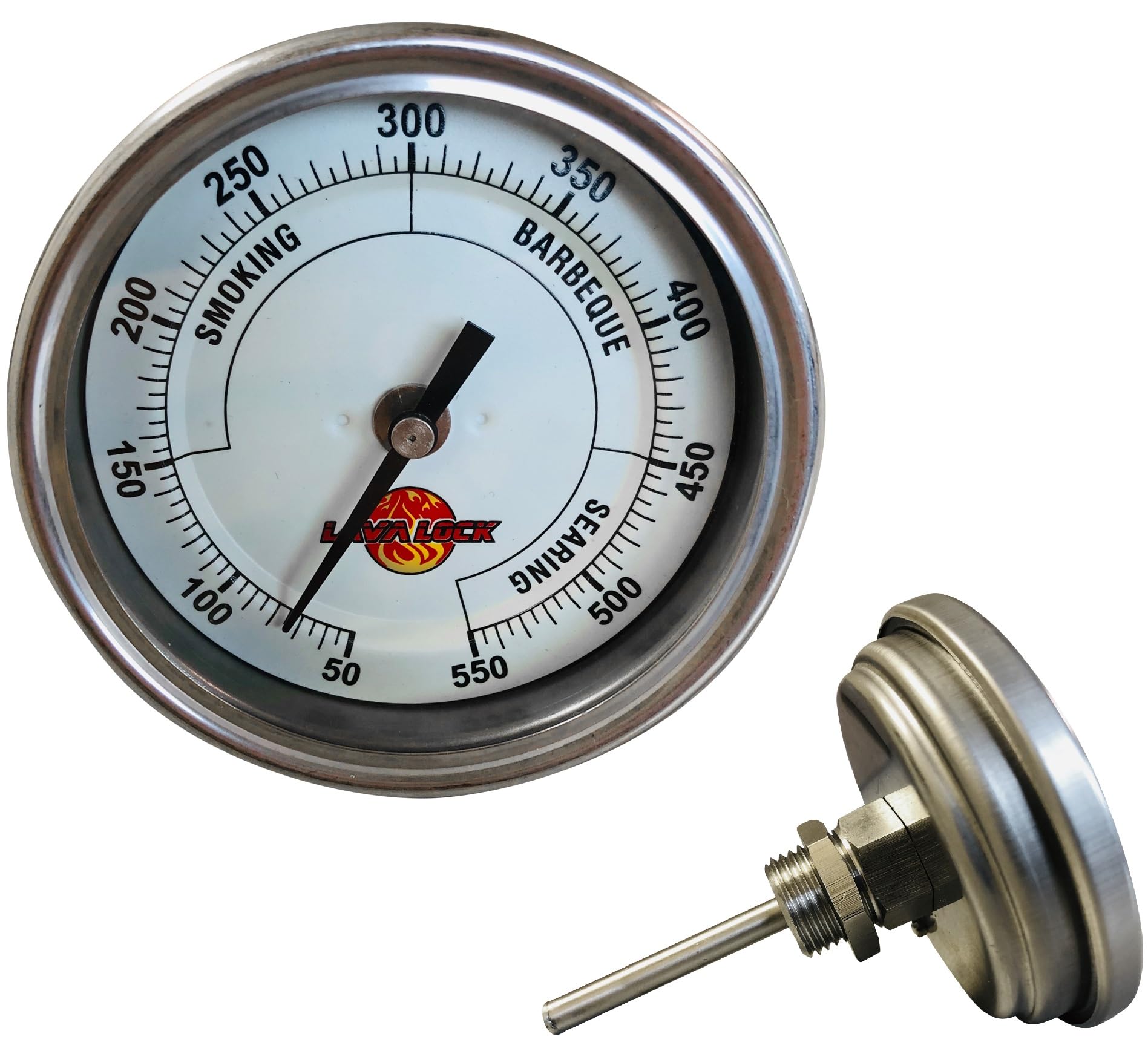
The fully adjustable face that recalibrates in seconds and shrugs off years of coastal weather.
This gauge is a favorite replacement for the notoriously inaccurate stock thermometers on Oklahoma Joe smokers. It is fully adjustable, so when the needle drifts, you reset it with the face screw rather than buying a new unit. Owners who calibrated it against boiling water found it accurate, and one reported no rust after 8 years of coastal exposure.
The 3″ face has a heavy duty sight glass, and the 2.5″ stem with a 1/2″ NPT thread fits Oklahoma Joes Highland and Longhorn models directly. The range spans 50°F to 550°F, which covers smoking and grilling but tops out below searing territory. The dial reads clearly from a window, which is handy for a propane smoker where you do not want to open the door.
The needle responds slowly, lagging behind the actual chamber temp by up to 15 minutes. The needle responds slowly, with owners noting it reads 180-200°F when the chamber is actually 225-250°F and needs an extra 15 minutes to settle. That makes it a poor primary gauge for precise low-and-slow work, but a great companion to a wireless probe.
What owners prize
- Adjustable face screw makes calibration a 30-second job
- 8 years of coastal use without rust in one owner’s report
- 2.5″ stem screws into existing 1/2″ NPT fittings
The slow needle
- Response lags behind the real chamber temp by 15 minutes
- 50–550 °F range will not register a hard sear
Pick this if: you smoke on an Oklahoma Joe and want a tough, adjustable gauge as your everyday reader.
Think twice if: you need instant temp feedback or plan to sear past 550°F.
6. KAMaster Waterproof Kamado Gauge

The big no-fog face built specifically for Kamado Joe and Akorn ceramic cookers.
Kamado grills run hot and hold heat, and this gauge is designed for exactly that. The 3 1/4″ face is the largest on this list, and the waterproof no-fog glass lens means steam and smoke do not cloud your read. The 2 1/2″ stem with a 1 3/4″ thread is sized for KJ classic and big joe models, and owners with a Komodo Joe bought on clearance confirm it works great.
The range runs from 150°F to 900°F, which comfortably covers kamado searing at high heat. The extra long stainless probe rod responds in a quick 3 to 4 seconds, so you are not waiting on a laggy needle when you are checking a hot sear. Owners who bought two for both of their grills like that you can zero it out with the adjustable screw on the bottom edge.
Mounting requires drilling a center hole on some grills, which may not sit flush. On an Akorn grill, the replacement requires drilling a center mount and realigning the screw hole, and it does not sit perfectly flush. Accuracy also earns mixed feedback — some call it very accurate, while others report it off by about 50 degrees, so treat it as a reliable guide for your kamado.
Who it serves: kamado and kettle owners who want a big, readable face that survives steam and reads up to a 900°F sear.
The honest caveat: mounting may need drilling and the needle is a guide, not a lab-grade instrument.
7. LavaLock Black Face High Temp Thermometer
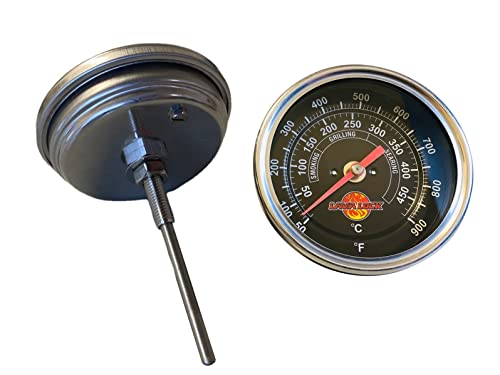
The 900°F black face that keeps searing honest without ever fogging over.
If your cooks swing from 225°F smoke to a 700°F pizza oven sear, this gauge covers the entire arc. The range spans 50°F to 900°F, the widest on this list, and the heavyweight glass plus leak-free seal is built for a lifetime of harsh heat. The M8 installation nut is included, so the 3″ face and 3″ stem mount cleanly on a smoker or grill.
Accuracy holds up against digital displays, with owners reporting it “accurate to within a few degrees” and calling it a wonderful upgrade over stock gauges. One owner with a CharGrill smoker noted these are the only thermometers that work on their unit, screwing straight through the manufacturer’s pre-cut holes. The mechanical face is fully adjustable, so the +/- 1% accuracy stays true as the needle drifts.
The only noted shortfall is a slow needle response, which takes time to settle after a temp change. A buyer found the gauge accurate to their digital display but slow to reach the target temp, so expect a settle-in period rather than instant feedback. If you want a rugged, wide-range dial with US-based support behind it, this is a strong premium pick.
The standout strengths
- Widest range on the list, 50°F to 900°F, for smoke and sear
- Leak-free seal and heavyweight glass for hard use
- Fully adjustable face screw keeps it calibrated
What to watch
- Needle settles slowly after a temp change
- Premium price for a dial gauge
Best for: grillers who want one rugged gauge that handles both low smoke and extreme sear without fogging.
Not ideal if: you need instant response from a dial — pair it with a probe for timing.
Understanding the Specs
NPT Thread and Mounting Hole
The thread size on the stem decides whether a gauge screws into your grill or needs a drill. A 1/2″ NPT thread (a standard pipe thread) is the most common, and it usually needs a 23/32″ drill bit hole. Always check your lid’s existing hole size before buying so you are not stuck drilling a brand-new grill.
Temperature Range and Zones
The dial’s range tells you what the gauge can actually read. Smoking sits low around 225°F, grilling runs 375°F to 525°F, and searing needs to read past 525°F. A gauge that starts at 50°F covers cold smoking, while one starting at 150°F is fine for standard barbecue but not true cold smokes.
FAQ
What is the standard hole size for a grill thermometer?
Will a gauge with a 1/2″ NPT thread fit my Oklahoma Joe smoker?
Why does my grill thermometer read a different temp than my digital probe?
How long does a BBQ thermometer last?
Can I calibrate my grill thermometer at home?
What temperature range do I need for smoking versus searing?
Is a 3-inch dial better than a 2-inch dial?
Do I need a waterproof or no-fog grill thermometer?
Final Thoughts: The Verdict
For most buyers, the bbq grill temperature gauge winner is the Tel-Tru BQ300 because it is the one gauge you can calibrate and trust for years. If you want a drop-in replacement for a gas grill, grab the Hiorucet Nexgrill gauge. And for a 3-pack that arms every cooker you own, the Frienda set is the one to reach for.
How We Picked
We do not accept paid placement. Every pick is matched to a real buyer and a real use-case; we do not hands-on test units.
Sources & Methodology
Specifications: manufacturer listings and product documentation. Review insights: verified customer reviews, as of August 2026. Pricing: not shown on this page (it changes often); check the current price via the retailer link.
As an Amazon Associate, KitchPrep earns from qualifying purchases. This does not affect which products we feature.
Related Guides
