
A small French press looks simple—until you actually live with one.
The “one mug” size is where the details get ruthless: the heat drops faster, tiny filter gaps become obvious, and any hint of grit feels ten times bigger because you’re not diluting it across a whole pot. That’s why a 12 oz french press coffee maker can be either the most satisfying coffee ritual in your kitchen… or the fastest way to start your day annoyed.
Here’s the trap most guides fall into: they talk about “stainless vs glass” like it’s a style choice. In real life, it changes your entire brew curve. Glass cools down quickly (cleaner, brighter, but easier to under-extract). Insulated steel stays hot longer (richer body, but easier to drift into bitterness if you sip slowly). And travel presses add a whole new layer: lids, seals, and the annoying truth that “leakproof” is rarely absolute.
I built this guide around what actually moves the needle: filter geometry, how the plunger behaves under pressure, how easy it is to decant without slosh, what happens after six months of daily use, and the recurring “love it / hate it” patterns that show up again and again in owner feedback. The goal is simple: you finish this article with one confident choice—and a cup you’re genuinely proud of.
How to Choose the Right 12 Oz French Press Coffee Maker
Before you pick a model, decide what you want your mornings to feel like. Quick and portable? Calm and countertop-pretty? “Clean cup” obsessed? Here’s the framework for choosing a 12 oz french press coffee maker that doesn’t just look right—it brews right.
1. The “3-Cup” Label Problem (And Why It Matters)
A lot of small French presses are marketed as “3 cup.” That’s not a lie—it’s just a different definition of “cup.”
- Coffee industry “cups” are often 4 oz: Think small espresso-style servings, not diner mugs.
- Grounds + filter space steal volume: Some travel presses leave a noticeable pocket of liquid below the filter after you plunge. That can be intentional (to slow extraction), but it can also feel like you “lost” coffee.
- Practical takeaway: If you want one big mug with a little room for cream, this size is perfect. If you want two full-size mugs, it will always feel small—no matter how the listing labels it.
2. Pick Your Body Type: Glass Carafe vs Insulated Steel
This isn’t just about durability. It’s about how the coffee extracts while you brew and while you drink.
- Glass presses: Usually brew a slightly brighter cup because they lose heat faster. They’re also visually satisfying (you can watch the crust form) and often easier to clean. The downside is break risk and faster cooling if you’re a slow sipper.
- Insulated stainless presses: Hold heat dramatically better, which is amazing on a cold morning. The trade-off: longer heat retention can keep extraction going if the coffee stays in contact with the grounds for too long (hello, bitterness) unless the design truly “locks” the brew.
- Best rule of thumb: If you sip slowly or carry your coffee around, go insulated—but pick a design that minimizes continuing extraction after plunging.
3. Filtration Is the Whole Game in Small Presses
On big presses, a little sediment is tolerable. On a single mug, it’s personal. Filtration quality comes down to how the mesh sits, how the plates sandwich the mesh, and how tight everything stays over time.
- Classic 3-piece filters: Common on Bodum-style presses. When assembled snugly and used with a coarse grind, they make a rich, classic cup with a little texture.
- Multi-level / micro filtration: Some stainless models use layered mesh or finer screens to reduce grit. This can produce a cleaner cup—but it adds parts and can increase cleaning time.
- Watch for “fines migration”: If reviewers mention “a teaspoon of grounds in every cup,” that’s not a taste preference issue—it’s a mechanical fit issue (mesh gap, warped plate, or a stem that doesn’t keep pressure evenly distributed).
4. The Heat Retention Trap (How to Avoid Bitter Coffee)
French press coffee extracts like tea: it’s a steep. If your coffee sits hot on the grounds, it keeps changing.
- For glass presses: Preheat with hot water for 30–45 seconds, then dump. This stabilizes your brew temperature and improves consistency.
- For insulated presses: Preheat too—but be mindful of contact time. Plunge at your target time and either drink promptly or decant into a separate mug if the design doesn’t truly stop extraction.
- For travel presses: A good one should let you plunge and sip without turning your last sips harsh. That usually means a tighter seal and better filtration—not just thicker walls.
5. Ergonomics: Pouring, Plunging, and the “One-Hand Test”
Small presses are often used half-awake. That’s why the little physical details matter more than people admit.
- Handle comfort: A too-small handle feels fine in photos and awful in real life—especially with hot liquid inside.
- Pour alignment: Some lids include arrows or pour markers. That sounds minor until you pour at 6:10 AM and drip coffee down your counter.
- Plunge feel: The best plungers press smoothly. A jerky plunge can disturb the bed of grounds and send fines straight into your cup.
6. Cleaning and Long-Term Ownership (The Unsexy Truth)
A French press is only “low effort” if you can clean it fast. Otherwise, it becomes a weekend-only gadget.
- Dishwasher-safe is nice—but not always ideal: Some finishes (paint, coatings, wood accents) last longer with hand washing and towel drying.
- Look for replaceable filter parts: Mesh screens wear out. Being able to replace them is how a press becomes a “years-long” tool instead of a “few months” fling.
- Travel lids = more crevices: If you hate cleaning bottle caps, keep that in mind before choosing a press-mug hybrid.
Quick Comparison: 12 Oz French Press Coffee Maker Picks
I ordered these by “real-world usefulness”: the most broadly satisfying daily drivers first, then the more specialized picks (travel kits, ultra-stylish showpieces, and rugged camping options).
On smaller screens, swipe or scroll sideways to see the full table.
| Model | Type | Best For | Key Feature | Amazon |
|---|---|---|---|---|
| ESPRO P1 Travel Press | Travel Press | Clean cup on the go | Double micro-mesh filtration | Amazon |
| Bodum Jesper | Glass + Steel | Premium countertop feel | Safety lid + slim frame | Amazon |
| Bodum Travel Press Set | Press Mug | Commuters | Extra lid included | Amazon |
| Easyworkz Nando | Insulated Steel | Hot coffee, less grit | Multi-level filtration | Amazon |
| Bodum Chambord (Copper) | Classic Glass | Style + ritual | Iconic metal frame | Amazon |
| Bodum Crema 3‑Cup | Framed Glass | Quick morning workflow | Protective frame + easy rinse | Amazon |
| BonJour Monet | Glass + Steel | Everyday glass press | Filtering lid to reduce sediment | Amazon |
| Bodum Caffettiera | Bodum Classic | Simple daily cup | Replacement parts available | Amazon |
| POLIVIAR Portable Press | Travel Kit | Giftable “pretty + practical” | Canister + carry bag | Amazon |
| Small Travel Set (JennLee) | Travel Kit | Pack-and-go brewing | Case + dual filters + canisters | Amazon |
| Bodum Kenya | Starter Pick | First-time press users | Lightweight, easy cleanup | Amazon |
| Miscedence Insulated Press | Rugged Steel | Camping & durability | Steel build + marked fill lines | Amazon |
In‑Depth Reviews: 12 Small French Presses That Actually Make Sense
Instead of repeating spec sheets, these reviews focus on the stuff that decides whether you’ll love your press on day one—and still like it on day one hundred: filtration behavior, heat retention, plunge feel, cleanup friction, and the “tiny annoyances” owners keep mentioning.
1. ESPRO P1 – The “No Sludge” Travel Press That Feels Like a Real Upgrade

If you love French press flavor but hate that muddy “last inch of the cup,” the ESPRO P1 is built for you. Its whole identity is filtration and control: it uses a finer double filter approach than a typical press so you get more body than drip coffee, but far less grit than the classic mesh-and-pray setup.
Where it really shines is the “travel reality” part. This isn’t a fragile countertop carafe—it’s a brew-and-sip press designed to keep coffee hot for hours. Owners who obsess over texture often mention the same win: the cup stays consistent from the first sip to the last, instead of turning into sludge soup as fines settle.
The trade-off is complexity. More filtration usually means more parts, and that means you’ll spend a bit more time rinsing and brushing compared to a basic Bodum-style press. There’s also the practical habit shift: if you want truly mess-free bag travel, you have to be the kind of person who always keeps track of lids and seals.
Why it’s the top pick
- Cleaner cup: Designed to reduce grit without stripping the classic French press richness.
- Heat retention: Double-wall stainless keeps coffee hot far longer than glass.
- Travel-ready shape: Built to be handled, carried, and used outside the kitchen.
- Better “last sip” experience: Less settling sludge means you actually finish your cup.
Good to know
- More pieces to clean: Worth it for clean-cup lovers, annoying for minimalists.
- Requires routine: Travel systems work best when you’re consistent about lids and rinse habits.
- Not a party brewer: It’s a one-cup quality tool, not a multi-mug pot.
Ideal for: People who want French press richness with dramatically less grit—especially commuters, campers, and office brewers who hate lukewarm coffee.
2. Bodum Jesper – The Sleek Countertop Press That Feels “Designed”

Some presses are purely functional. The Jesper is functional and intentional-looking. It’s got that slim, architectural Bodum design language where the frame doesn’t just “hold glass,” it makes the whole thing look like a finished piece on the counter.
In real use, it behaves like the best kind of traditional press: straightforward, predictable, and capable of a rich cup when you stick to a coarse grind and a sane steep time. People who replace older Bodum presses often mention the build feeling sturdy and the brewing process being consistently reliable—especially for the “one large mug” morning.
The honest downside is that it’s still a glass press. The metal holder can get warm, and the carafe needs respect (no banging around in a sink, no dramatic thermal shock from cold rinse right after brewing). If you want the ritual and the look—and you’re okay with basic care—this is a genuinely satisfying upgrade.
Why it’s a standout
- Countertop appeal: Looks premium without being fussy to use.
- Comfortable workflow: Simple add → pour → steep → plunge routine.
- Safety lid: Helps prevent splashing while pressing.
- Great “single-mug” sizing: Feels purpose-built for one person.
Good to know
- Not insulated: If you sip slowly, your coffee cools faster than steel presses.
- Glass care required: Treat it like a glass tool, not a steel camp mug.
- Frame warmth: Metal can get warm—use the handle as intended.
Ideal for: Anyone who wants a premium-feeling small press for daily home brewing, especially if “looks good on the counter” matters.
3. BODUM Travel Press Set – The Classic Brew-and-Go Mug (With a Real Caveat)

This is the “commuter classic” idea: one vessel that brews like a French press and functions like a travel mug. You add grounds, add hot water, wait, plunge, and sip—no decanting, no extra cup, no glass carafe to baby.
Owners who love it tend to love it for one reason: it makes the morning routine incredibly direct. The grip band makes it comfortable to hold, and the extra lid is a practical bonus if you want to drink without the plunger assembly.
Now the caveat: it’s not meant to be treated like a fully leakproof bottle. That’s not marketing drama—it’s a real-life habit requirement. If you keep it upright, it’s a great daily tool. If you toss it sideways into a bag, you’re gambling. Also, any press-mug design needs a quick rinse habit; coffee oils build up in lids faster than people expect.
Why commuters love it
- One-tool routine: Brew and drink from the same mug.
- Heat retention: Vacuum insulation keeps coffee hot far longer than glass.
- Two-lid flexibility: Press lid for brewing, extra lid for sipping.
- Comfort grip: Silicone band makes it easy to hold.
Good to know
- Upright only mindset: Best for cupholder/desk, risky for tossed-in-bag travel.
- More lid cleaning: Coffee oils hide in cap crevices—rinse early, rinse often.
- Contact-time awareness: If grounds stay immersed too long, flavor can drift.
Ideal for: Office and commute brewers who want a direct “steep, press, sip” workflow and can keep the mug upright.
4. Easyworkz Nando – Hotter Coffee, Less Sediment, No Glass Anxiety

If your main complaint with small presses is “my coffee is cold after the first cup,” the Nando’s double-wall stainless build is the point. It’s designed to hold heat longer than glass, so you can brew, pour, and still have a genuinely warm second serving (or a second round in the same mug if you’re brewing for one).
Filtration is the other headline. Multi-level mesh setups are meant to reduce fines slipping through, and when the filter assembly stays tight, you get a smoother cup without losing the French press body that people buy presses for in the first place.
The big ownership detail is maintenance: some users report the plunger hardware loosening over time. That’s not a dealbreaker if you treat it like a tool (check tightness, assemble correctly, don’t over-torque). In fact, many long-term owners of metal presses get into a simple rhythm: quick rinse after every brew, deeper clean weekly, and a brief filter check when you notice any grit increase.
Why it earns the slot
- Excellent heat hold: Great for slow sippers and cold mornings.
- No glass stress: Travel and sink-cleaning feel far less risky.
- Smoother cup potential: Multi-level filtration can reduce fines.
- Solid daily-driver vibe: Feels sturdy and “use it every day” friendly.
Good to know
- Check the plunger hardware: If it loosens, sediment can increase.
- More parts than basic glass: Still easy, just not “one rinse and done.”
- Small-batch only: Best for one person, not a group brew.
Ideal for: People who want a hot, rich cup without babying glass—and who appreciate filtration that aims for less grit.
5. BODUM Chambord (Copper) – The Countertop Showpiece That Still Brews Right

The Chambord is the French press silhouette most people picture in their head—and the copper version is the one that makes guests say, “Okay… that’s gorgeous.” If aesthetics motivate your routine (no shame—ritual matters), this one earns its countertop space.
Brewing-wise, it’s a classic: borosilicate glass, metal frame, and a traditional mesh filter assembly. That means you get that true French press texture and aroma—oils intact, body intact. It also means you should expect a little “French press character” in the cup: if you grind too fine or plunge aggressively, you’ll invite sediment.
The ownership reality is simple: respect the glass and respect the finish. Avoid thermal shock (don’t rinse cold immediately after brewing), and don’t scrub the copper like it owes you money. Treat it gently and it’s the kind of press you keep for years, not weeks.
Why people adore it
- Design factor: Looks like a premium piece, not a gadget.
- Classic flavor: Full-bodied cup with aromatic oils intact.
- Simple to operate: No tricks—just a clean steep and plunge.
- Gift-worthy: One of the most “presentable” small presses.
Good to know
- Glass is glass: Durable for glass, but still breakable.
- Not a sludge-free filter: Use a coarse grind for the cleanest cup.
- Finish care: Gentle cleaning keeps it looking sharp longer.
Ideal for: Home brewers who want the classic French press ritual plus serious visual appeal.
6. Bodum Crema 3‑Cup – A Small Press That’s Built for Daily Workflow

A lot of small glass presses feel delicate. The Crema’s framed design changes the daily experience: it’s easier to grip, kinder to countertops, and less “nervous” to use when you’re moving fast. People who deliberately seek out Bodum often describe the workmanship as the difference—smooth plunging, solid feel, and a cup that tastes unmistakably like French press (rich, round, aromatic).
The day-to-day convenience is real: it’s the kind of press you can rinse quickly and put back in rotation without it turning into a weekend-only object. The frame also helps if your brewing station is tight—think small kitchens, crowded counters, or brewing under an appliance spout.
That said, quality control is worth respecting. When a press is positioned as “premium,” owners rightfully expect perfect alignment and finish. If you’re the type who notices a crooked fit or a manufacturing flaw immediately, inspect it on arrival so you don’t spend months annoyed by a small defect.
Why it works in real life
- Comfortable handling: Frame makes the small press easier to hold and pour.
- Classic press flavor: Rich body with oils intact.
- Daily-driver friendly: Rinses quickly, doesn’t feel fragile in routine use.
- Countertop protection: Frame helps prevent metal-on-counter scraping.
Good to know
- Inspect on arrival: Some buyers report occasional manufacturing inconsistencies.
- Still glass inside: Frame reduces anxiety, but it can’t make glass unbreakable.
- “3 cup” label confusion: It’s basically one generous mug, not three mugs.
Ideal for: People who want a premium-feeling small glass press that’s comfortable, practical, and genuinely easy to live with daily.
7. BonJour Monet – The Quietly Brilliant Glass Press With a Reputation for Longevity

The BonJour Monet has a very specific vibe: it doesn’t scream for attention, but it tends to earn long-term loyalty. Owners who’ve used it for years often describe the same pattern—great coffee, minimal fuss, and a glass carafe that holds up better than they expected when treated like a kitchen tool (not a sports ball).
Two real-world strengths matter here. First, it’s a comfortable pourer. A small press that dribbles is a daily annoyance; this one’s spout and handle layout are built for clean serving. Second, the lid is designed to help reduce sediment in the cup—useful if you’re chasing a smoother finish without moving to a fully “micro-filtered” system.
The caution is classic glass-press reality: don’t do the “shake it upside down” move to eject grounds, and don’t let the carafe fly out of the frame during cleaning. Treat it with normal respect and it can be a surprisingly dependable everyday piece.
Why it’s underrated
- Long-term reputation: Many owners report years of dependable use.
- Comfortable pour: Spout and handle make serving easy and controlled.
- Sediment reduction: Lid design aims to cut down on grit in the cup.
- Low effort maintenance: Easy rinse daily; deeper wash weekly works well.
Good to know
- Glass rules apply: Don’t bang it in the sink or shock it with cold water.
- Not a travel piece: Built for countertop brewing, not backpacks.
- “3 cups” = small cups: It’s essentially one large mug for most people.
Ideal for: Home brewers who want a classic glass press that pours well, cleans easily, and has a track record of lasting.
8. Bodum Caffettiera – The “Just Works” Press for One Perfect Cup

If you want a small press that behaves exactly like a French press should—no learning curve, no “special system”—the Caffettiera is that move. It’s the classic Bodum approach: a straightforward glass carafe, a steel frame, and a filter assembly that’s simple enough to take apart and clean without turning your sink into a puzzle table.
One thing owners often notice is how satisfying it is as a personal-size brewer. It makes a rich, smooth cup for one, and because it’s not oversized, it doesn’t invite the “brew too much and reheat later” habit that ruins good coffee.
There’s a subtle quirk that shows up in feedback: some users mention the carafe and plunger feel a bit loose in the frame. In practice, a bit of tolerance can actually protect glass (less stress as temperatures change). If it ever becomes truly sloppy, it’s usually a sign to check filter assembly tightness and replace worn screens over time.
Why it stays popular
- Simple and reliable: No complex parts, no gimmicks.
- Classic French press flavor: Full-bodied and aromatic.
- Easy to maintain: Quick rinse daily, deeper clean weekly is enough.
- Long-term friendly: Replacement parts help keep it running for years.
Good to know
- Not insulated: Coffee cools faster than double-wall steel presses.
- Glass care required: Treat it like glass, not like camping gear.
- Occasional “looseness” comments: Usually manageable with correct assembly.
Ideal for: Anyone who wants a dependable, classic, personal-size French press with straightforward cleaning and long-term part support.
9. POLIVIAR Portable Press – Stylish, Insulated, and Surprisingly Thoughtful

POLIVIAR nailed something many travel presses forget: the experience. The grip feels deliberate, the pour alignment marker helps you pour like a civilized human, and the overall look makes it feel like a “gift-quality” brewer rather than a generic metal cylinder.
In the cup, the double-wall insulation helps keep temperature stable, and the dual-filter setup aims to reduce sediment. When everything is fitted correctly, the result is a smooth, rich brew that still tastes unmistakably like French press coffee (not paper-filtered drip).
The big watch-out is finish and care. Some owners report textured coatings shedding faster than expected, while others find the smoother finishes hold up far better with the exact same usage. If you want this press to stay beautiful, treat it like a coated tool: gentle wash, towel dry, and avoid long soaks—especially if your model includes any wood or decorative accents.
Why it’s a great pick
- Looks premium: One of the most aesthetically “giftable” travel-style presses.
- Comfort grip: Silicone sleeve helps with heat and handling.
- Travel-minded extras: Includes storage/carry components for brewing away from home.
- Stays cooler to hold: Insulation helps prevent hot-hand moments.
Good to know
- Finish durability varies: Smoother coatings often hold up better than textured ones.
- Care matters: Towel dry and avoid harsh scrubbing for longer life.
- Still a small brewer: Designed for one cup at a time.
Ideal for: Anyone who wants an insulated personal press that looks great, travels well, and feels more premium than a basic camp press.
10. Small French Press Travel Set (JennLee) – Compact, Smart, and Built for Packing
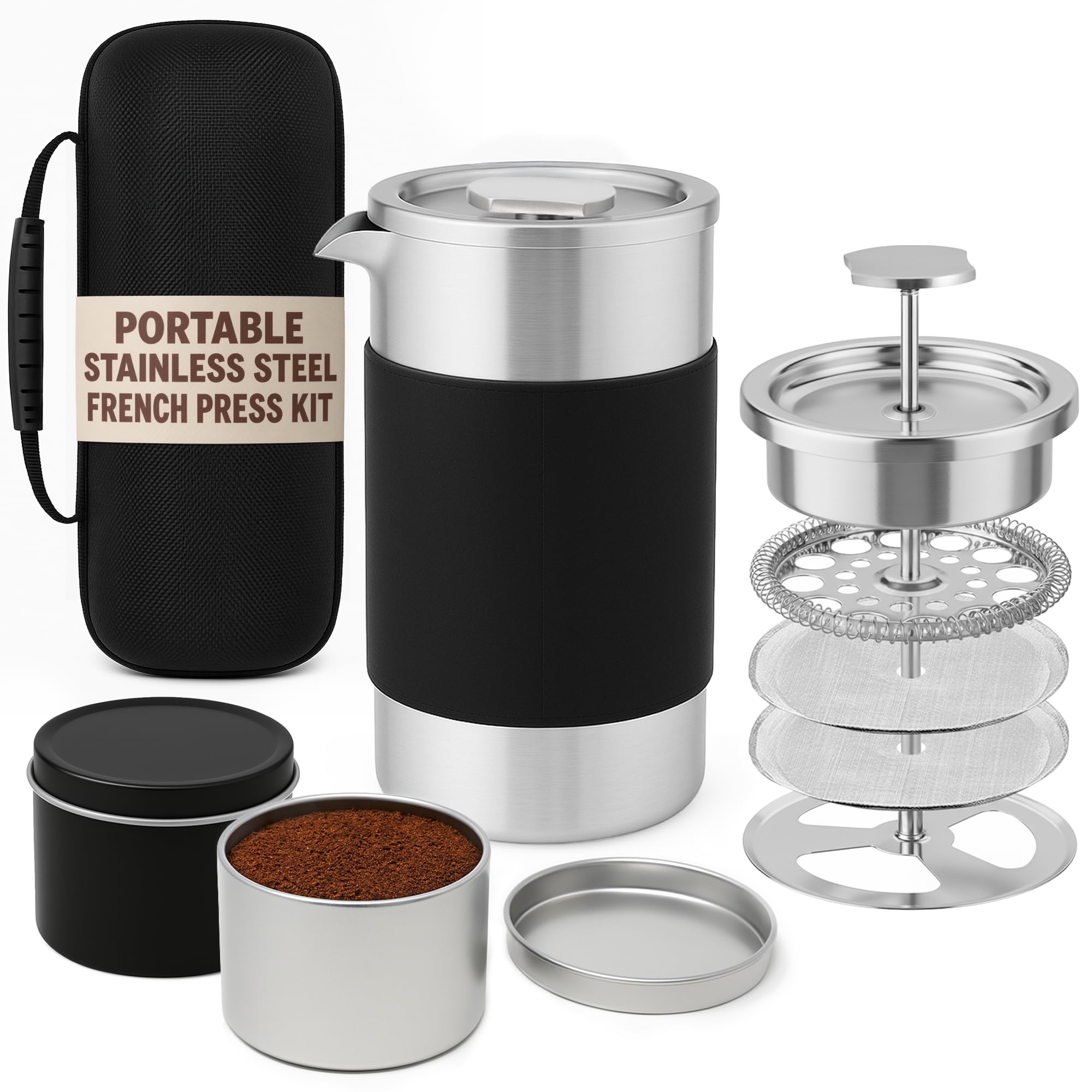
This kit is built for people who pack intentionally. You get the press, you get storage canisters for coffee/tea add-ins, and you get a hard shell case that says, “I am not letting this bounce around my bag like a loose battery pack.”
The standout is the filtration approach. Owners who brew very fine grounds (even espresso-ish or Turkish-fine) often mention the mesh doing a shockingly good job compared to typical travel presses. It won’t make ultra-fine coffee magically sediment-free, but it can reduce grit enough that the cup feels enjoyable instead of sandy.
There’s a real-world quirk you should know: some users point out that the “marked volume” and the “usable drink volume” don’t always feel the same, because of space below the filter after plunging. That can be a feature (helps keep grounds from sloshing into your sip zone), but if you’re expecting every ounce to pour out, it may surprise you. Think of this as a personal brewer that prioritizes drinkability over maximizing every last drop.
Why travelers like it
- Packable system: Case + canisters create a true travel kit.
- Insulated body: Helps keep coffee hot while staying comfortable to hold.
- Fine-mesh advantage: Can reduce grit more than many basic travel presses.
- Easy grip: Compact size works well for smaller hands.
Good to know
- Usable volume can feel smaller: Some liquid may remain under the filter.
- Canisters are small: Great for short trips, limited for long coffee-heavy travel.
- More items to track: Case and tins help—but it’s still a kit.
Ideal for: Travelers and campers who want a compact, all-in-one coffee kit with better-than-average filtration for a personal cup.
11. Bodum Kenya – The No-Fuss Classic That Teaches You the Ritual

The Kenya is the kind of press people buy, use for years, and only think about again when they accidentally break the glass. It’s simple, functional, and sized perfectly for a personal cup or two smaller servings.
Owners love the “it just works” aspect: the plunger setup is straightforward, the frame makes handling easier than a naked beaker, and cleanup is as painless as French press cleanup gets. It also pulls double duty for tea surprisingly well, because a properly fitted mesh filter can keep loose leaves reasonably contained when you don’t over-agitate.
The durability complaints that show up most often are exactly what you’d expect from a small glass press: breakage (usually from drops or sink mishaps) and filter components loosening over time if they aren’t tightened correctly. If you want this to be a long-term daily tool, build one habit: every few weeks, check the filter assembly is snug before brewing. It’s a 10-second action that prevents months of grit frustration.
Why it’s a great first press
- Simple learning curve: Ideal for first-time French press users.
- Comfortable handling: Frame reduces “hot glass beaker” awkwardness.
- Easy to clean: Rinse, disassemble occasionally, done.
- Versatile: Coffee and loose-leaf tea both work well.
Good to know
- Glass is the weak point: Drops and sink knocks are the usual endgame.
- Filter plates can loosen: Quick checks prevent gritty cups.
- Not insulated: Brew hot, drink reasonably soon for best flavor.
Ideal for: Anyone who wants an easy, classic starter press to learn the ritual and dial in their grind and timing without overthinking gear.
12. Miscedence Insulated Press – Tough, Hot-Holding, But Filtration Can Be Hit-or-Miss
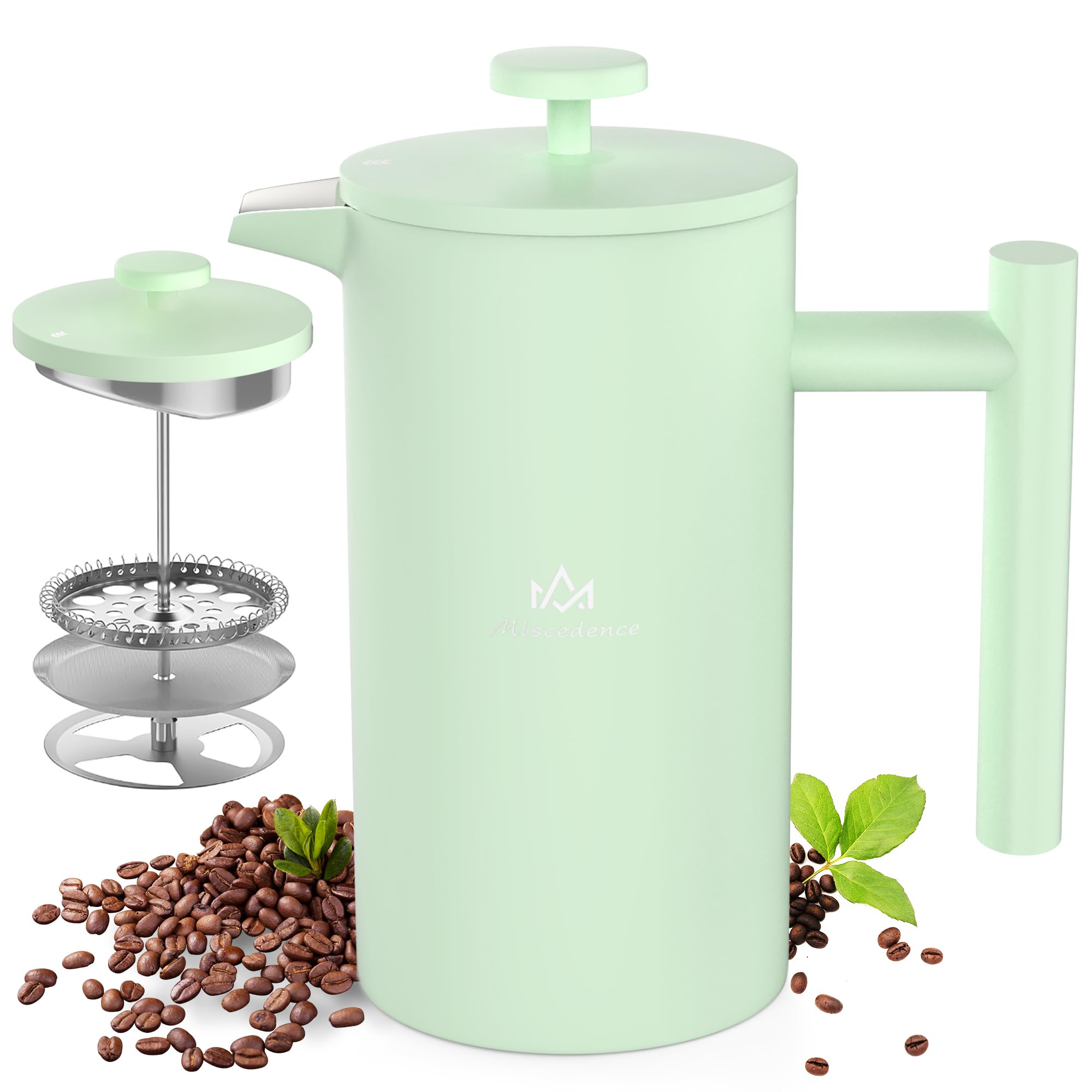
If your lifestyle is “camping, office, home, repeat,” a stainless press that can take a hit is a beautiful thing. Owners who love this one talk about durability in a very practical way: it can handle bumps, it holds heat well, and it doesn’t baby you the way glass does.
It also includes quality-of-life touches that matter more than they sound: a pour-direction marker, a spout designed to drip less, and interior volume marks so you can brew consistently without guessing every morning.
The potential downside is filtration consistency. Some users report the screen letting grounds through, which usually points to one of three things: a grind that’s too fine, a mesh fit that isn’t perfectly seated, or a stem/plate design that doesn’t apply even pressure. If you’re willing to tweak (coarser grind, careful assembly, gentler plunge), it can become a reliable workhorse. If you demand perfect filtration with zero effort, you may prefer a press designed specifically around micro-filtration.
Why it’s worth considering
- Durability first: Built for people who don’t want to worry about glass.
- Heat retention: Holds temperature better than most countertop glass presses.
- Practical markings: Fill lines help repeatable brewing.
- Travel/camping friendly: Steel body is a natural fit for outdoor use.
Good to know
- Filtration can vary: Some users report grounds sneaking through.
- Assembly matters: Correct seating and a gentle plunge improve results.
- Small batch size: A personal brewer, not a group pot.
Ideal for: People who prioritize durability and heat retention, and don’t mind being slightly intentional about grind size and filter assembly.
Brew Guide: Make Any Small French Press Taste Better
A great press helps—but your technique decides whether you get “rich and chocolatey” or “bitter and gritty.” These are the levers that matter most for small-batch French press brewing.
Grind Size + Agitation Control
Most “sludge problems” start with grind size and stirring. Use a coarse grind (think kosher salt, not sand). Stir gently once after adding water, then stop. Aggressive stirring breaks the crust and suspends fines—those fines are what slip through mesh and settle into your last sips.
Press slowly and steadily. A hard plunge can force micro-particles through the filter, especially on classic 3-piece designs.
Heat, Preheating, and the “Bitter Drift” Problem
Preheat glass and steel presses with hot water for 30–45 seconds, then dump. This stabilizes brew temperature and improves extraction.
For insulated presses, watch contact time. If your press doesn’t truly stop extraction after plunging, decant into a mug once brewed—or drink promptly—so your final sips don’t turn harsh.
FAQ: Small French Press Coffee Makers
Why does my “3-cup” press only make one mug?
How do I reduce grit without changing coffee beans?
Should I leave coffee in the press after plunging?
Is stainless steel “better” than glass for taste?
What’s the fastest way to clean a French press daily?
Final Thoughts: The Smart Buy for Your Routine
If you want the cleanest, most consistent “French press style” cup in a personal size—especially for travel—the ESPRO P1 is the most confidence-inspiring pick in this lineup. If you want a premium countertop press that feels like an intentional part of your kitchen, the Bodum Jesper is a beautiful upgrade. And if your mornings happen in the car, at a desk, or on a trail, the Bodum Travel Press Set gives you the easiest “brew-and-go” workflow—just keep it upright and rinse the lid early.
