
A sharp knife isn’t a luxury—it’s the difference between effortless prep and that annoying “why won’t this tomato slice?” struggle. And here’s the part most people miss: you don’t need a drawer full of gadgets or a chef’s training to keep your knives in great shape. You just need the right sharpener style for your knives, your hands, and your patience level.
This guide is built for real kitchens, not showroom fantasies. I dug through thousands of owner notes, common failure points, and long-term “still using it” feedback patterns to understand what actually happens after the honeymoon phase. That means we’ll talk about the unsexy stuff that makes or breaks your results: angle consistency, burr removal, whether the machine chews up steel, how messy cleanup gets, and which designs quietly struggle with small paring knives, flexible fillet blades, or thick hunting knives.
By the end, you’ll be able to pick a best at home knife sharpener for your exact situation— whether you want a fast electric you can use in sixty seconds, a rolling system that makes angle control nearly foolproof, or a precision guided setup that can repair chips and dial in your edge like a hobbyist… without turning your kitchen into a workshop.
Below are 15 standout sharpeners on Amazon that cover every major sharpening “personality”: premium electric machines, classic workhorse electrics, rolling sharpeners, belt systems for knives and tools, a multi-angle manual sharpener, and a complete whetstone kit for anyone who actually enjoys the craft.
How to Choose the Best At Home Knife Sharpener for Your Kitchen
Knife sharpening is simple in theory: you’re bringing two sides of the blade back to a crisp meeting point (the apex). In real life, people get inconsistent results for three reasons: they sharpen at the wrong angle, they don’t remove the burr, or they choose a sharpener that doesn’t match their knives (or their patience).
1. Decide what you want: “kitchen sharp” or “hobby sharp”
Some sharpeners are built for speed. Others are built for control. Both can be excellent—if you expect the right outcome. Here’s the most practical way to think about it:
- Kitchen-sharp: Cuts tomatoes cleanly, slices onions without crushing, and glides through proteins. This is what most people actually need.
- Hobby-sharp: Cleaner bevels, more precision, and the ability to repair chips, reprofile edges, or chase a more polished finish.
If you want “kitchen-sharp” with the least effort, electric systems and rolling sharpeners are usually the happiest path. If you want the most control over angle and finish (or you own a mix of kitchen knives and pocket knives), guided systems and stones win.
2. Angle is the real feature (not the preset list)
Most buying guides obsess over “stages,” but angle affects how your knife behaves every single time you cut. A few helpful guidelines:
- 15° per side (about 30° inclusive): Often preferred for harder steels and finer slicing. Great when you want a more effortless bite through food.
- 20° per side (about 40° inclusive): A tougher edge that tolerates more abuse, especially on common household stainless knives.
- 22–25° per side and up: Common for outdoor/work knives where edge durability matters more than laser-like slicing.
The “best” angle depends on your knife steel and how you treat your knives. If your knives live on glass boards, go in the dishwasher, or meet bones a little too often, a slightly sturdier angle tends to feel better day-to-day. If you baby your knives and love paper-thin slicing, a finer angle feels amazing.
3. Choose the sharpener style that fits your reality
There are five main styles in this guide. Each one has a personality—pick the one that matches you, not just the specs:
- Electric wheel/disc sharpeners: Fast, consistent, and very approachable. Great if you want sharp knives now. The tradeoff is that they can remove more steel than slower methods, and many lock you into one angle.
- Rolling sharpeners (magnetic angle blocks): Quiet, satisfying, and surprisingly foolproof for straight-edge kitchen knives. They shine for maintenance and mild dullness, but many struggle with very small blades (less magnet contact) or aggressive repair.
- Guided clamp systems (rod + stones): The sweet spot for “serious at-home” sharpening. You clamp the knife, set an angle, and work through grits. It’s slower than electric, but the repeatability is fantastic—especially if you like precision.
- Belt sharpeners: Powerful and versatile. They can sharpen knives and tools, handle unusual shapes, and work quickly. The tradeoff is a bigger learning curve—belts can round tips or remove material fast if you rush.
- Whetstones + strop kits: Maximum control and edge potential. Also the most technique-dependent. If you enjoy a hands-on craft, stones can be deeply rewarding. If you don’t, stones can feel like homework.
4. Match the sharpener to your knife types
Before you hit buy, look at your knife lineup. A sharpener can be amazing for one category and frustrating for another.
- Short paring knives: Often tricky on rolling sharpeners (less blade surface for magnets) and some electric guides (handle clearance at the heel).
- Flexible fillet knives: Many fixed-angle electrics struggle to fully sharpen near the heel or keep the thin blade stable.
- Serrated knives: Some electrics have a polishing stage designed to refresh serrations; many manual/rolling sharpeners are not intended for serrations.
- Ceramic knives: Only certain diamond-abrasive systems are suitable; most classic electrics are intended for steel.
- Thick outdoor knives and tools: Belt systems and adjustable guided kits usually handle these best.
5. Think about maintenance, not just “sharpening day”
Most people ruin edges between sharpening sessions, then blame the sharpener. If your goal is consistently sharp knives, your workflow matters:
- Daily/weekly maintenance: light honing or polishing stages, quick touch-ups, or a rolling sharpener for a few passes.
- Occasional full sharpening: when knives are truly dull, you need a coarse stage (electric stage 1, coarse stones, or belts) to rebuild the apex.
- Deburring: the “secret step” that makes edges feel dramatically sharper and last longer. (We’ll cover this in detail below.)
If you cook a lot, you’ll love systems that make touch-ups effortless. If you only cook occasionally, a simple sharpener that “just works” when you pull it out matters more than an ultra-fancy setup.
Quick Comparison: 15 Best At Home Knife Sharpener Picks
Here’s a clean bird’s-eye view of the 15 knife sharpeners we’ll review. Use this table to spot the style you prefer (precision guided, electric, rolling, belt, or stone), then jump to the detailed breakdown for the real-world “what it’s like” context.
On smaller screens, swipe or scroll sideways to see the full table.
| Model | Sharpener type | Angle focus | Best match | Amazon |
|---|---|---|---|---|
| Work Sharp Precision Adjust Elite | Guided clamp | 15°–30° | Most repeatable edges across kitchen + EDC | Amazon |
| Chef’sChoice 15XV EdgeSelect | Electric 3‑stage | 15° system | Fast premium sharpening & 15° conversions | Amazon |
| The Original Tumbler Rolling Knife Sharpener™ | Rolling system | 15° / 20° | Quiet, consistent maintenance for most kitchens | Amazon |
| ORIGINAL Adjustable Rolling Knife Sharpener Kit | Rolling multi‑grit | 10°–40° | Rolling precision with real grit progression | Amazon |
| Work Sharp MK2 Knife & Tool Sharpener | Belt system | Adjustable guides | Knives plus tools, fast edge repair | Amazon |
| VIDOME Electric Knife Sharpener (3‑stage) | Electric 3‑stage | 15° system | 15° sharpening with diamond abrasives + polish | Amazon |
| Presto 08810 Professional EverSharp | Electric 3‑stage | Thickness selector | Mixed knife sizes (including lighter blades) | Amazon |
| dskiley Electric Knife Sharpener (3‑stage) | Electric 3‑stage | 20° guide | Everyday Western kitchen knives, quick touch-ups | Amazon |
| Work Sharp Electric Kitchen Knife Sharpener (E2) | Compact electric | Single guided angle | Drawer-friendly, consistent everyday sharpening | Amazon |
| Newise Electric Knife Sharpener (3‑stage) | Compact electric | 15° system | Small-space 15° sharpening with dust collection | Amazon |
| Presto 08800 EverSharp (2‑stage) | Electric 2‑stage | 20° guides | Classic, simple sharpening for most household knives | Amazon |
| AIERLIAN Rolling Knife Sharpener Kit | Rolling value | 15° / 20° | Affordable rolling sharpener for fast results | Amazon |
| Sharp Pebble 5‑Angle Precision Adjust | Manual pull‑through | 12°–24° | Beginner-friendly quick sharpening with angle options | Amazon |
| Narcissus 2‑Stage Electric Knife Sharpener | Electric 2‑stage | Guided slots | Low-effort sharpening with metal dust collection | Amazon |
| Intelitopia Complete Sharpening Stone Set | Whetstone kit | Technique-based | Best edge potential for those who want to learn stones | Amazon |
In‑Depth Reviews: 15 Standout Knife Sharpeners for Home
Now we’ll zoom in. These reviews focus on what actually matters when you’re sharpening at home: how consistent the angle feels, how quickly the edge comes back, where people get tripped up, and the little habits that turn “decent sharp” into “why didn’t I do this years ago?” sharp.
1. Work Sharp Precision Adjust Elite – Repeatable Edges Without the Guesswork

If you want one system that can handle kitchen knives and pocket/utility knives with consistent angles, the Precision Adjust Elite is a very strong “buy once, use for years” choice. It’s the kind of setup that rewards you with repeatable results because the most important part—angle control—doesn’t rely on your wrist being perfect. You clamp the knife, pick an angle, then work through the stones.
The Elite kit’s real advantage isn’t just that it includes multiple abrasives—it’s that the progression makes sense for real life: a coarser option for repairs and reprofiling, mid-grits for sharpening, then ceramic and a strop to refine and clean up the edge. That last step (refining and deburring) is where many at-home sharpenings fall apart, and this kit makes it far easier to finish properly.
The most common “first-time frustration” is speed: if your knives are very dull or chipped, reprofiling takes patience. But once an edge is set, touch-ups go much faster—and that’s how this system shines long-term.
Why you’ll like it
- Angle control you can repeat – Great for people who struggled with stones because holding a steady angle is the hardest part.
- Real repair capability – A practical choice if you have rolled edges, small chips, or knives that have been “abused” on hard boards.
- Versatile across knife types – Works well for kitchen knives and EDC knives where you might want different angles.
- Better finishing potential – Ceramic + strop helps remove the burr and smooth the edge so it feels sharper and lasts longer.
Good to know
- Large chef knives often require “section sharpening” (heel, belly, tip) to keep the angle consistent along the curve.
- It’s slower than electric systems when you’re doing heavy reprofiling—this is precision-first, not speed-first.
- Clamp setup matters: taking 20 extra seconds to seat the blade securely pays off in a cleaner bevel and less frustration.
Ideal for: anyone who wants the most repeatable, controlled sharpening at home—especially if you own a mix of kitchen and pocket knives.
2. Chef’sChoice 15XV EdgeSelect – Fast “Pro-Level” 15° Edges at Home
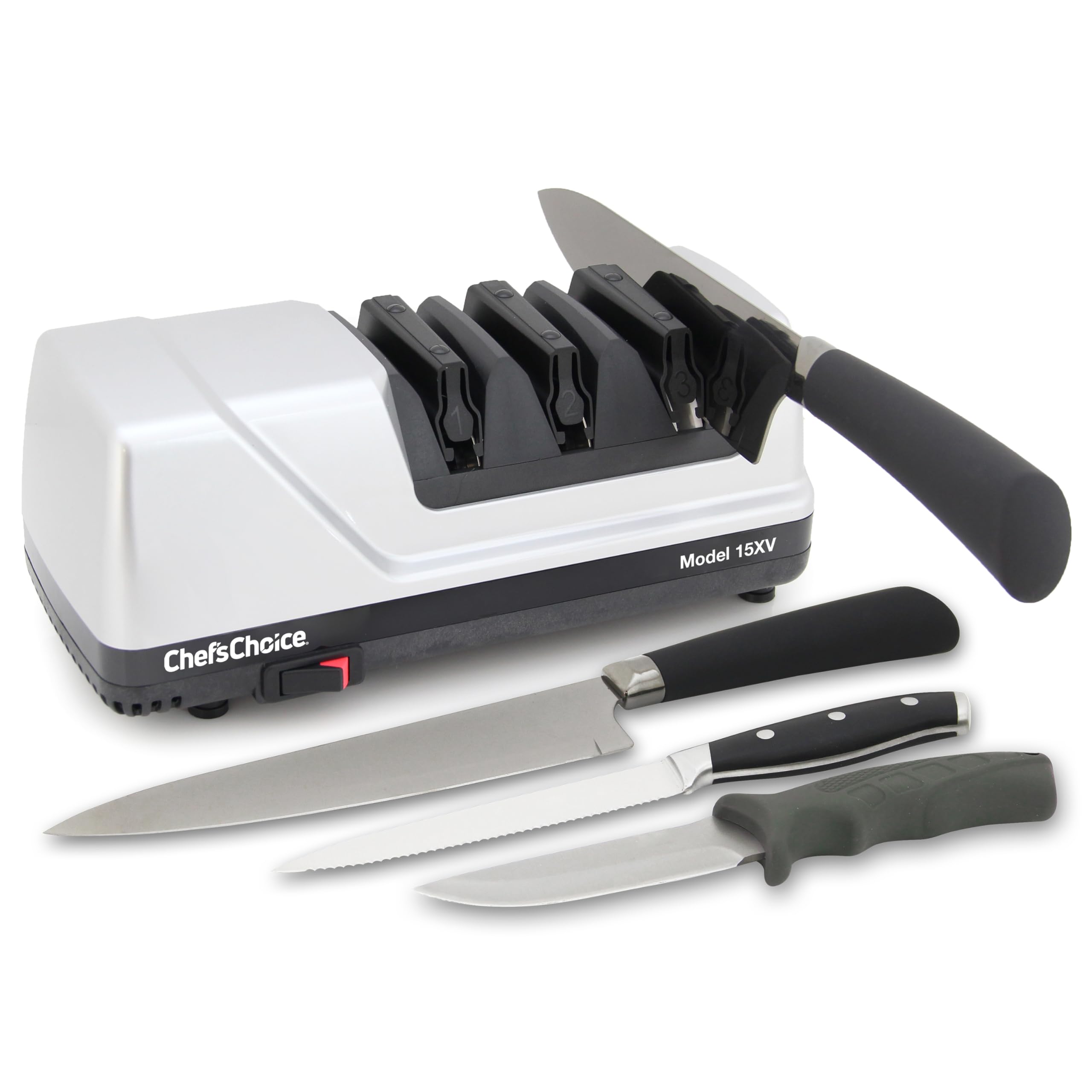
The Chef’sChoice 15XV is the “I want sharp knives today” machine—especially if you like the idea of a finer, high-performance 15° edge. Owners who have tried everything from steels to stones often describe the same moment: a knife that used to struggle suddenly slides through tomatoes and paper with a clean, confident bite.
What makes this sharpener different is that it’s designed to create a multi-faceted 15° edge. If your knives started life with a broader factory edge, the first stages can reshape them into a thinner cutting geometry. Once that edge is established, many people find they can maintain sharpness mostly with the finishing stage—meaning less metal removal during routine touch-ups.
This is not a “set it and forget it forever” tool—technique still matters. The big win is that technique is mostly about light pressure and consistent pull speed, not learning to freehand angles. Read the manual, start with a less-loved knife, and you’ll usually get excellent results quickly.
Why it stands out
- Speed with consistency – Ideal when you want sharp knives without practicing a skill for weeks.
- 15° edge performance – Great for cooks who love smooth slicing and “less resistance” through food.
- Strong finishing stage – That final polishing/finishing step can make edges feel dramatically cleaner and more refined.
- Great for households with many knives – When you’re sharpening a drawer full of knives, electric convenience is hard to beat.
Good to know
- It’s powerful—use light pressure. Overdoing Stage 1 can remove more material than you intended.
- Some knives may show cosmetic scuffs near the edge from guides; this doesn’t usually affect performance, but it matters to some owners.
- If you prefer a sturdier 20° style edge for tougher chores, a 20°-focused sharpener may fit your habits better.
Ideal for: serious home cooks who want fast, repeatable sharpness and like the idea of a high-performance 15° edge.
3. The Original Tumbler Rolling Knife Sharpener™ – Simple, Quiet, and Satisfying

Rolling sharpeners became popular for a reason: they remove the most annoying part of sharpening (holding the angle) without turning the process into a loud, messy production. The Tumbler is the iconic “roll it back and forth” design: choose 15° or 20°, stick the blade to the magnetic guide, then roll the diamond side until the edge comes back. Flip it, and the second side helps refine and clean up the edge.
Where this style really shines is maintenance. If your knives are regularly used (and regularly dulled), a rolling sharpener makes it easy to do small, frequent touch-ups—meaning your knives stay sharp more often, and you don’t have to grind aggressively later. It’s also one of the more “kitchen friendly” systems: minimal noise, no power cords, and a process that feels safe and controlled.
The most consistent limitation in owner feedback is small blades. Paring knives, narrow pocket knives, and very shallow blades can be trickier because the magnetic contact area is smaller. It can still work, but it’s not the “perfect for everything” solution that guided systems can be.
Why people love it
- Angle control without skill – It takes the guesswork out of 15° and 20° edges for common kitchen knives.
- Quiet and clean – No motor noise, minimal dust, and easy to set up on a counter.
- Great for routine upkeep – Touch-ups are quick, so knives stay sharper week to week.
- Beginner-friendly feel – The rolling motion is intuitive, and it’s harder to “wreck” an edge than with belts.
Good to know
- Heavily damaged edges take longer—rolling systems are not the fastest repair method.
- Small or very narrow blades can be awkward due to limited magnet contact and handle clearance.
- It’s primarily for straight-edge knives; serrations and scissors require other tools.
Ideal for: home cooks who want quiet, consistent sharpening for most straight-edge kitchen knives with minimal learning curve.
4. ORIGINAL Adjustable Rolling Knife Sharpener Kit – The “Rolling System for Control Freaks”
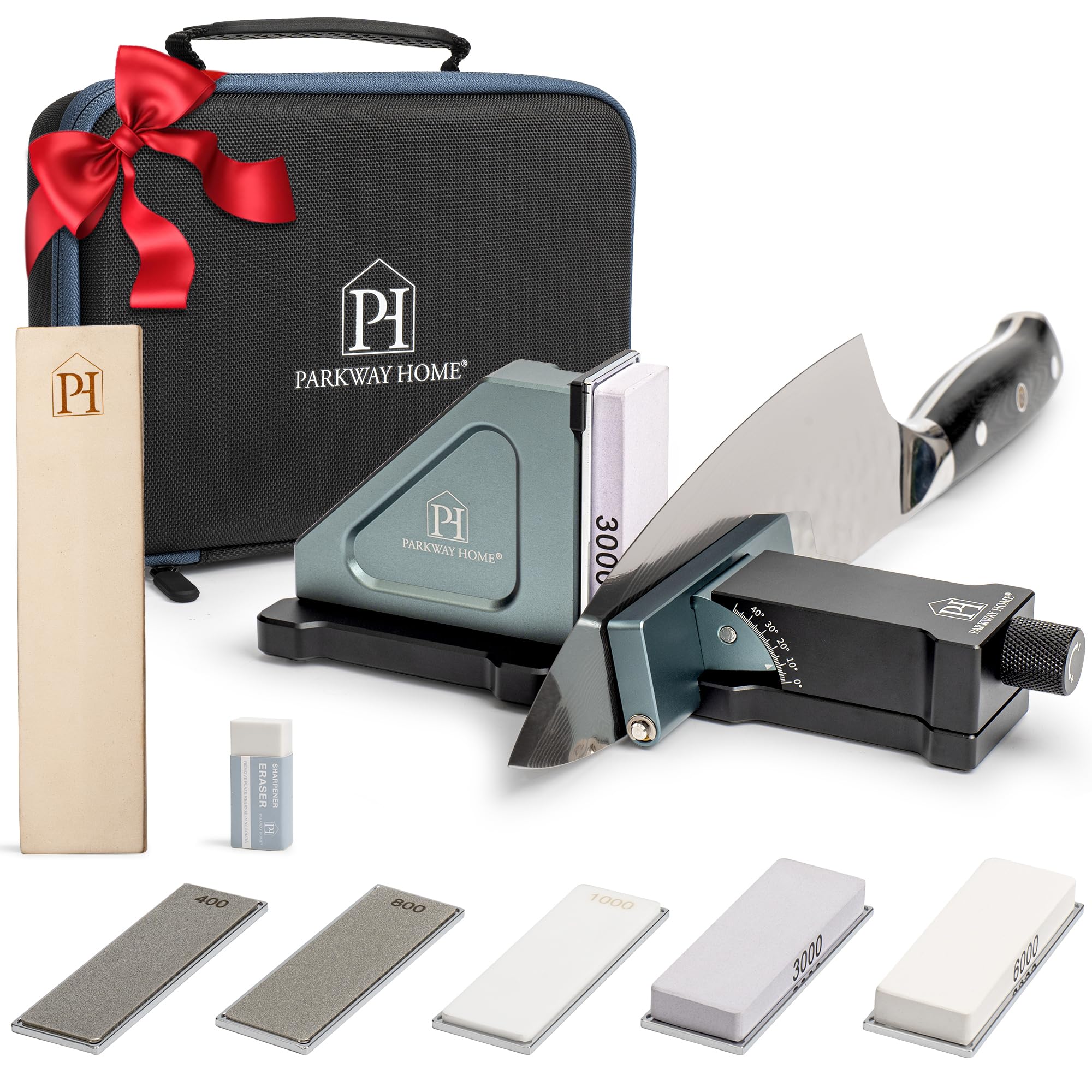
If you like the rolling sharpener concept but want more control than “one abrasive and a hone,” this kit is built to feel closer to a real sharpening progression—without forcing you to hold angles by hand. The big headline feature is the adjustable angle range, letting you dial in anything from ultra-fine slicing angles to tougher, more durable edges. It also includes a height adjuster, which matters more than people realize: better alignment means better contact along the whole blade, especially on tall chef knives and cleavers.
The removable plate system is what makes it feel “serious.” You can repair and shape with coarser diamond plates, refine with ceramic, then polish with finer plates. That’s the same logic used in traditional sharpening—just packaged in a rolling format that feels quieter and more forgiving. It’s also packaged like a proper kit, which sounds small… until you’ve owned a sharpener where pieces get lost in a drawer.
Real-world notes are also realistic: you’ll get metal swarf (shavings), especially on coarse plates, and magnets will collect it. And like other rolling systems, very small blades may need extra care because there’s less blade area for the magnet to grip.
Why it’s special
- Angle flexibility – You can match the edge to the knife and the job instead of being locked to one preset.
- Full grit progression – Coarse shaping through fine polishing gives you a cleaner “finished” edge feel.
- Height adjustment – Helps keep contact consistent across different blade heights without hacks.
- Quiet, controlled sharpening – Great for people who dislike loud electrics and don’t want to freehand stones.
Good to know
- More parts = more cleanup and organization, especially if you switch plates often.
- Metal shavings collect on magnets; wiping down (or using a cleaning eraser/putty) becomes part of the routine.
- Very small knives can be less stable on magnetic guides; take lighter passes and focus on consistency.
Ideal for: anyone who wants rolling simplicity but also wants a true “repair → refine → polish” sharpening workflow at home.
5. Work Sharp MK2 Knife & Tool Sharpener – Fast, Versatile, and Seriously Capable

This is the sharpener you buy when you want more than “make my chef knife better.” The MK2 is built around flexible abrasive belts, which can sharpen kitchen knives, outdoor knives, serrated edges, and even tools like axes and mower blades. That versatility is the payoff. The tradeoff is that it demands respect: belts remove material quickly, and speed/pressure mistakes show up fast.
The good news is that owners consistently point to the same path to success: go slow, use the guides properly, and let the belt do the work. Two-speed control helps you stay gentler on knives while still having power when you’re repairing rough edges. The edge guide supporting the knife toward the tip can also reduce the common “rounded tip” problem—if you keep your motion smooth and controlled.
Where this fits best in a home is as a “maintenance and repair station” for a household that uses knives hard, plus tools. If you only sharpen a couple of chef knives twice a year, it may feel like overkill. But if you’ve got a drawer of knives, a garage of tools, and you want one machine to handle it, this is a serious contender.
Why it’s a beast
- Multi-tool versatility – Knives, serrations, scissors, yard tools… belts handle a wider world than most sharpeners.
- Fast edge repair – Great when knives are truly dull or damaged and you need material removal with control.
- Two speeds – More control for knives, more power for heavy-duty sharpening tasks.
- Strong long-term value – Replaceable belts mean you can keep it running for years with consistent performance.
Good to know
- There’s room for rookie mistakes—watching technique videos and practicing on cheaper blades is smart.
- Belt systems can round tips if you rush transitions; smooth, consistent motion matters.
- If you want a highly polished “show bevel,” guided stones or rolling multi-grit kits are usually easier to finish beautifully.
Ideal for: households that want one sharpening tool for knives and tools, and don’t mind a short learning curve for powerful results.
6. VIDOME Electric Knife Sharpener – Diamond 3‑Stage Sharpening with a 15° Focus

If you want the convenience of an electric sharpener but prefer a finer, more “slicey” edge style, VIDOME’s 15° approach is appealing. Stages 1 and 2 focus on sharpening and honing with diamond abrasives, then Stage 3 polishes with stropping disks to refine the feel. That three-step setup matters because many “it got sharp but not that sharp” complaints come down to poor finishing and burr removal.
A practical advantage here is cleanliness: built-in collection for metal filings reduces the “glitter dust” problem some electric sharpeners create. And because it’s guided, the learning curve is mostly about timing and pressure—pull evenly, don’t shove forward, and don’t press hard. Owners who struggle with stones often appreciate how predictable that feels.
The nuance: a 15° edge can be fantastic, but it’s not automatically better for every knife. If your household knives are softer steel and get used roughly, a sturdier edge angle may hold up better between touch-ups. This sharpener is best when you’re willing to use the polishing stage regularly and keep edges maintained.
Why it’s a strong pick
- Convenient 3-stage workflow – Repair/sharpen/hone, then polish to make the edge feel cleaner.
- 15° edge focus – Great for smoother slicing when your knives can support a finer edge.
- Cleaner sharpening – Built-in capture for filings makes cleanup easier than many electrics.
- Good “no-stress” learning curve – Technique is simpler than stones: light pressure, steady pull, repeat.
Good to know
- Very thin fillet blades and very small paring knives can be hit-or-miss on many guided electrics—take your time and test carefully.
- Expect to do more passes on very dull knives; don’t rush Stage 1 with heavy pressure.
- If you want a tougher edge for rough treatment, a 20°-focused sharpener may feel more durable day-to-day.
Ideal for: home cooks who want a guided electric sharpener with a finer edge style and a proper finishing stage.
7. Presto 08810 Professional EverSharp – The “Family Drawer” Sharpener

Some homes don’t have “a knife set.” They have a chaotic mix: a chunky chef knife, a thin paring knife, a flexible fillet knife, a couple of older carbon blades, and a mystery drawer of steak knives. The Presto 08810 is built for that reality. Its thickness selector adjusts the guides so you can better match the sharpening slot to what you’re actually holding.
This matters because a huge number of “electric sharpeners don’t work on my small knives” complaints come down to guide geometry and heel clearance. When you can tell the sharpener “this is a thin blade,” you often get a more consistent result along the edge without the handle bumping into the housing. Add the extra-fine ceramic honing stage, and you’re not just grinding—you’re refining.
The biggest success pattern here is gentle technique. Owners who get great results tend to do light pressure, consistent pulls, and don’t live in the coarse stage. Think of Stage 1 as a repair shop, not a daily routine.
Why it’s practical
- Thickness selector – Helps accommodate a wider variety of blade types than many fixed-guide electrics.
- Three useful stages – Repair, sharpen, then fine hone for a cleaner feel.
- Great for many knives at once – If you want to sharpen a pile of knives quickly, this workflow fits.
- Beginner-friendly results – The guides do a lot of the work as long as you keep pressure light.
Good to know
- Like most electrics, it won’t perfectly sharpen every millimeter near the handle on every knife—this is common, not a defect.
- Pushing down hard can make the motor feel weak; light pressure usually works better.
- For ultra-precise edges and custom angles, guided stone systems still offer more control.
Ideal for: households with a mixed knife drawer who want a fast electric solution that adapts better to different blade thicknesses.
8. dskiley Electric Knife Sharpener – A Straightforward 20° “Sharpen, Fine, Polish” System
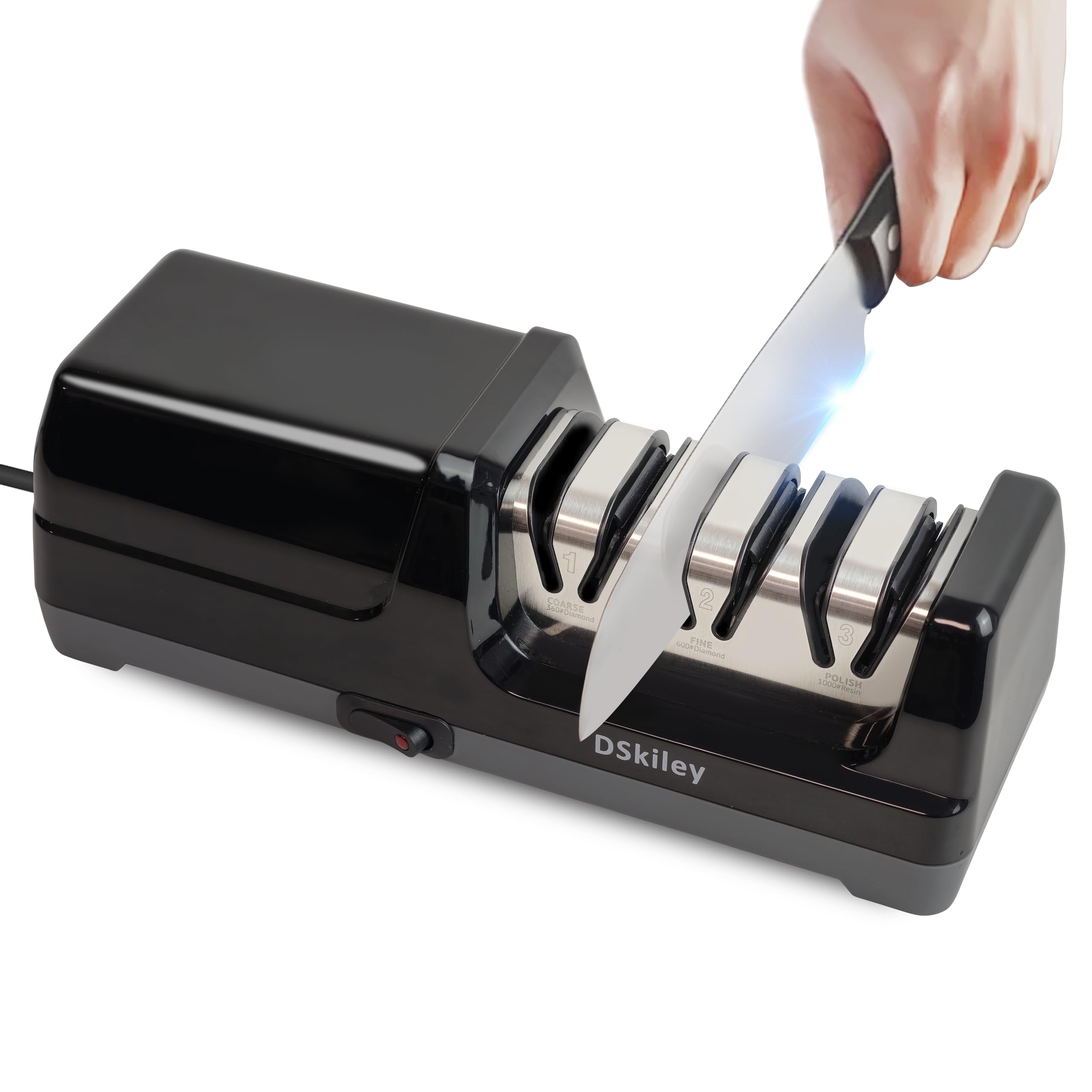
If your kitchen is mostly “standard household knives,” a guided 20° electric sharpener can be the most satisfying choice. The reason is durability: a slightly sturdier edge tends to hold up better when knives meet cutting boards, plate edges, and the occasional “oops, I hit a bone.” This dskiley unit keeps the workflow very simple: use the coarse stage when knives are genuinely dull, refine on the fine stage, then polish to clean up the bite.
Owners highlight the convenience factor: a few passes, and the knife feels alive again. And the magnetic shavings collector is more than a gimmick. Metal dust is part of sharpening; containing it keeps your counter cleaner and makes the whole process feel less “workshop” and more “kitchen.”
The most important expert tip here is restraint. Most electrics perform best when you treat coarse stages like emergency tools, not weekly routines. If you sharpen lightly and then maintain with the later stages, you’ll get good results while removing far less steel over time.
What it does well
- Durable 20° edge style – A great match for typical Western kitchen knives used daily.
- Clear 3-stage logic – Easy to understand, easy to repeat, and easy for families to share.
- Cleaner countertop routine – Magnetic collection helps keep filings contained.
- Fast improvement – Great for people who want “noticeably better” in minutes.
Good to know
- Narrow blades can have heel-clearance issues (the handle may bump before the very back edge is fully sharpened).
- Fixed 20° is not ideal for knives designed for finer edges; if you prefer 15°, pick a 15° system instead.
- As with most electrics, it’s not built for specialty single-bevel knives.
Ideal for: busy kitchens that want a durable edge quickly and appreciate easy cleanup from a built-in shavings collector.
9. Work Sharp Electric Kitchen Knife Sharpener (E2) – Small, Guided, and Easy to Store

The E2 is built for the person who wants sharpening to feel like a normal kitchen habit, not a project. It’s compact, stores easily, and uses a guided approach so you’re not balancing angles by feel. It also includes a ceramic honing wheel, which is a big deal if you want to keep knives performing between sharpening sessions.
What this kind of system does best is consistent, repeatable “good sharp” results. It’s not trying to be a polishing station or a show-bevel tool. Think of it like an edge maintenance appliance: bring knives back quickly, then keep them there. If you’re the type who sharpens briefly every few weeks instead of waiting until knives are completely dead, the E2’s workflow feels easy.
One thing to understand up front: it’s a single guided approach. That means it won’t perfectly match every knife’s original bevel geometry. For most household kitchens, that’s fine—and sometimes even helpful because predictability beats perfection. If you want angle-by-angle customization, a guided clamp system is more flexible.
Why it’s lovable
- Drawer-friendly design – Compact storage makes it more likely you’ll actually use it.
- Guided sharpening – Less guesswork for non-experts, more consistent results over time.
- Ceramic honing wheel – Great for keeping edges lively without aggressive grinding.
- Good “family appliance” energy – Easy for multiple people to use with predictable outcomes.
Good to know
- It won’t produce the ultra-refined edge you’d get from a full stone progression and stropping.
- If your knives are severely chipped or need heavy reshaping, a belt system or a coarser guided kit is faster.
- Like many guided electrics, accessory sharpening modes (like scissors) may not be the primary reason to buy it.
Ideal for: people who want consistent sharpening in a compact size, plus a built-in way to keep knives sharp between sharpening sessions.
10. Newise Electric Knife Sharpener – A Compact 15° Setup with 3 Stages
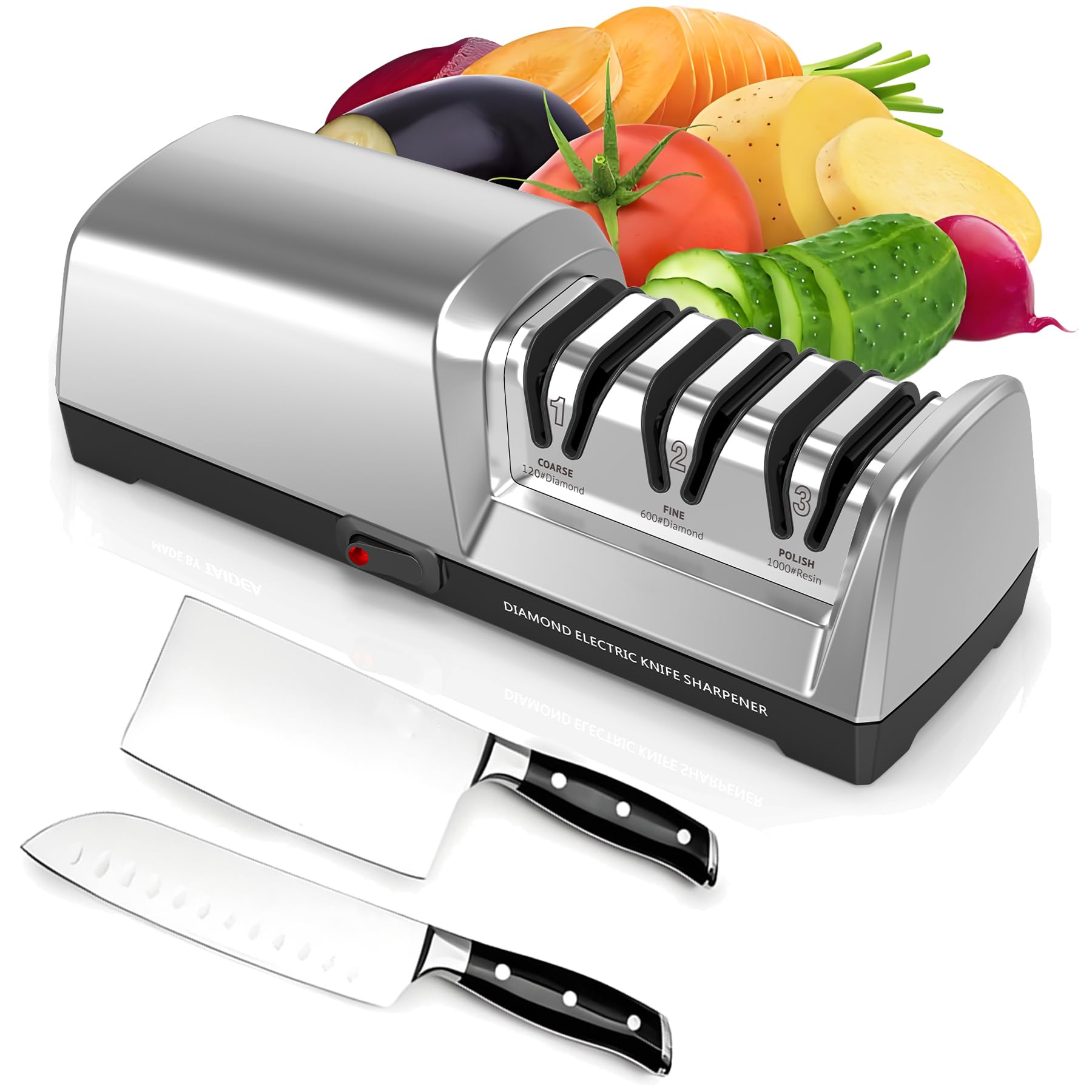
If counter space is limited, the Newise is appealing because it’s designed to be small and simple while still offering a real 3-stage system. Stages 1 and 2 focus on creating and refining the edge, while Stage 3 polishes, which can help your knives feel noticeably cleaner and more controlled. And the 15° approach targets that “effortless slicing” vibe many people want.
The best way to use a compact electric like this is to treat it as a maintenance tool, not an aggressive repair shop. If your knife is totally blunt, you can still bring it back—but you’ll get better results (and preserve your blade longer) by doing consistent light touch-ups rather than long “grind sessions.”
The built-in dust collection is a practical bonus. Metal filings are normal, but containing them makes sharpening feel cleaner, especially if you’re doing it on a kitchen counter right before cooking.
Why it’s interesting
- Small footprint – Easier to store or leave out without taking over your kitchen.
- 3-stage workflow – The polish stage helps with the “why doesn’t it feel sharp?” problem that comes from burrs.
- 15° edge feel – Great when you want smoother slicing and cleaner cuts.
- Cleaner sharpening routine – Dust collection makes the process less messy.
Good to know
- Smaller housings can feel tighter around long knives; slow, controlled pulls help.
- If you want total angle flexibility or chip repair speed, guided clamp systems are stronger tools.
- As with most electrics, very thin flexible blades can be more finicky than stiffer chef knives.
Ideal for: small kitchens that want a compact 15° electric sharpener with a polishing stage and cleaner dust handling.
11. Presto 08800 EverSharp – Fast, Simple, and Surprisingly Effective

The Presto 08800 is a classic for a reason: it’s straightforward, fast, and it takes a huge amount of guesswork out of sharpening. Two stages keep the interface simple: a coarser stage for shaping/repair and a finer stage for sharpening and polishing. For many households, that’s all you need to stop living with dull knives.
The main “secret” to getting great results is not doing more—it’s doing smarter. Most knives don’t need heavy grinding. Owners who love this sharpener often use the fine stage for routine sharpening and reserve the coarse stage for occasional edge repair. Then, if there’s a noticeable burr, a few light passes on a honing rod (or a quick strop) can make the edge feel dramatically cleaner.
If you have very hard Japanese knives designed for finer angles, you may prefer a 15° system. But for everyday household knives, this style can be an absolute productivity upgrade—especially when you have many knives to refresh and you want it done quickly.
Why it’s still popular
- Extremely easy to use – Great for people who struggled with manual sharpeners.
- Fast sharpening – Efficient when you’re refreshing a whole set of kitchen knives.
- Guides do the thinking – Consistent results without needing to learn angle control.
- Simple 2-stage design – Less complexity, less confusion, easier routine.
Good to know
- It’s designed for most non-serrated blades; specialty knives may need different tools.
- Like many electric systems, it can leave a burr—finishing with a hone/strop helps.
- Not built for ceramic knives.
Ideal for: families who want a simple electric sharpener that delivers big improvement quickly on most household kitchen knives.
12. AIERLIAN Rolling Knife Sharpener – Big-Brand Style Results for Less

This is the rolling sharpener for people who like the rolling concept but don’t want to spend premium money to try it. The design gives you two common kitchen angles (15° and 20°) with a magnetic support block, plus a dual-sided roller: diamond for sharpening and ceramic for refining/polishing.
What owners consistently enjoy is how “foolproof” it feels compared to stones. If you’re tired of awkward pull-through gadgets that chew on blades unpredictably, rolling systems can feel calmer and more controlled. You’re essentially “rolling a controlled abrasive” along a fixed-angle edge. That simplicity is why so many people end up actually maintaining their knives more often.
Where expectations matter: this isn’t designed to replace a full stone progression for perfectionists, and very small blades can be trickier. But for most straight-edge kitchen knives, it’s a very practical way to get back to clean slicing without turning sharpening into a hobby.
Why it’s worth considering
- Great value entry into rolling – Easy way to get the “angle control” benefit of rolling systems.
- Two sensible angles – Covers most household needs without overwhelming options.
- Diamond + ceramic combo – Sharpen, then refine for a smoother edge feel.
- Compact and non-electric – Easy to store, easy to use anywhere.
Good to know
- Quality control and packaging can vary; check contents when it arrives.
- Small knives and shallow blades may need extra stabilization due to limited magnet grip area.
- It’s primarily for straight-edge knives (not a serration/scissor solution).
Ideal for: beginners who want the rolling sharpener experience—simple angles, good results, and minimal learning curve.
13. Sharp Pebble 5‑Angle Precision Adjust – Quick Manual Sharpening with Real Angle Options

A lot of manual sharpeners are either too aggressive, too vague, or both. The Sharp Pebble 5-angle model is appealing because it makes angle a real setting, not a guess. You can choose from multiple angles depending on whether you want a fine slicing edge or a tougher all-purpose edge, then use the stages to repair, restore, and polish.
The best way to think about this tool is as a fast, approachable maintenance sharpener. It’s designed to be easy to hold and easy to use. For many people, that’s the point: a sharpener that fits in a drawer, comes out quickly, and makes knives obviously better without any setup.
Here’s the expert nuance: pull-through systems can remove material faster than you think if you yank the blade through with pressure. The “winning” technique is gentle, controlled pulls and minimal use of the coarsest stage. If you treat it like a finishing and touch-up tool, you’ll often be happier with edge life and overall results.
Why it’s useful
- Real angle selection – Helpful if you own different knife styles and want more control than one preset.
- Fast learning curve – Easy for beginners who don’t want to learn stones or belts.
- Simple 3-stage workflow – Repair, sharpen, then polish for a cleaner feel.
- Portable and low mess – No cords, minimal cleanup, easy storage.
Good to know
- It likely won’t give the same refined edge as a guided stone progression and stropping.
- Pull-through sharpeners are not ideal for specialty blades and can be too aggressive if used with heavy pressure.
- If your knives are heavily chipped, a guided system or belt sharpener repairs faster and more cleanly.
Ideal for: beginners who want a quick manual sharpener with angle options and a simple routine for everyday kitchen use.
14. Narcissus Electric Knife Sharpener – Quiet, Fast Sharpening with Dust Collection
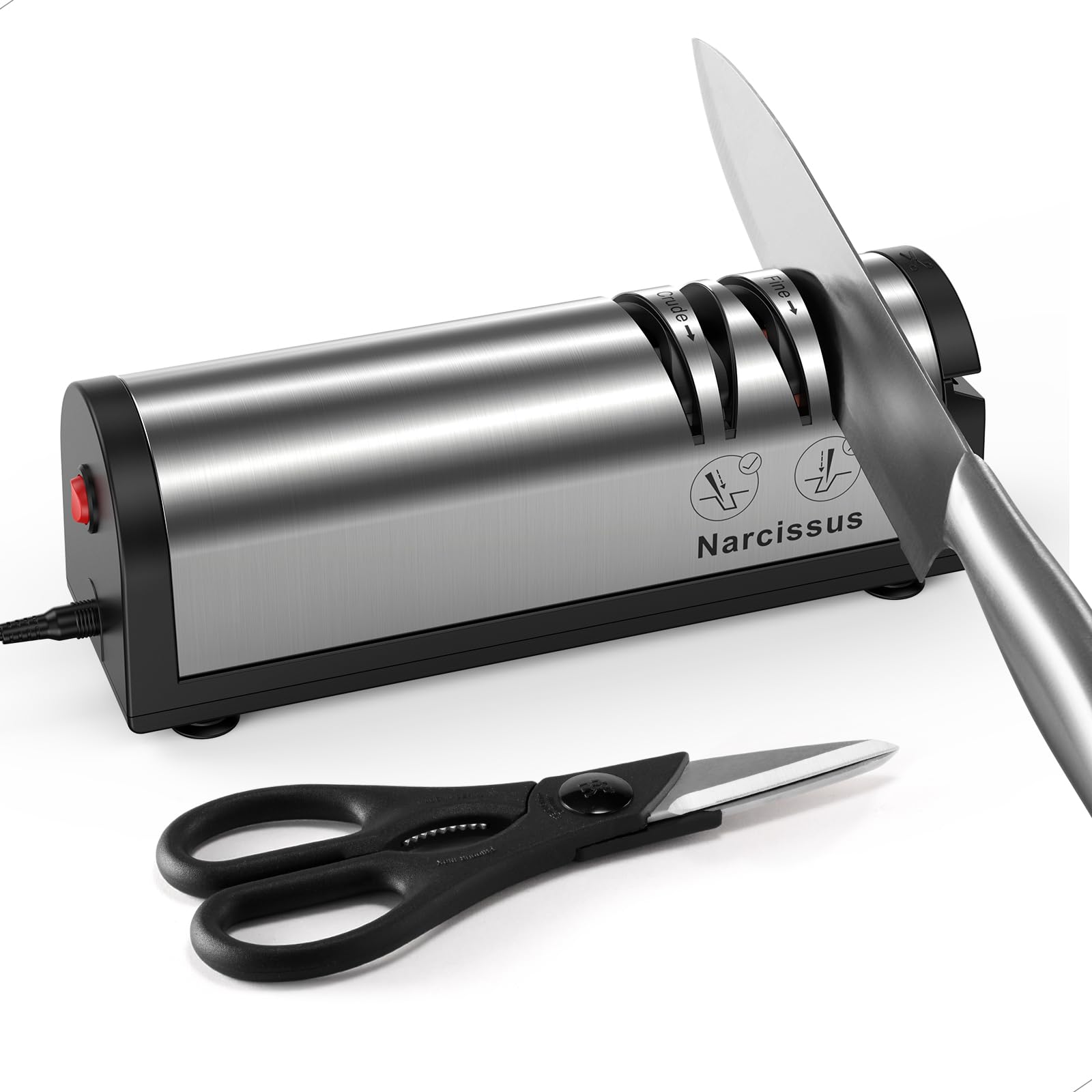
The Narcissus is a great example of what many people actually want from sharpening: less effort, less time, less strain. It’s compact, uses a 2-stage approach (sharpen then polish), and includes a dust collection box to capture metal shavings. For anyone with hand fatigue or stiffness, an electric that works quickly without a heavy learning curve can be a real quality-of-life upgrade.
Owners who get the best results tend to follow a simple habit: keep the blade guided against the wall of the slot, use steady pulls, and don’t overdo it. A few passes often restore a very practical cutting edge. Because it’s designed to be easy, it also becomes “sharpening you actually do,” which is the whole point.
If you’re chasing ultra-refined edges or you want to control angles, this won’t replace guided sharpening. But as a low-friction way to stop fighting dull knives, it’s a compelling everyday tool.
Why people buy it
- Quick sharpening with low effort – Great if you want sharp knives without hand strain.
- Compact footprint – Easy to keep on the counter or store in a cabinet.
- Cleaner cleanup – Dust collection reduces mess on the counter.
- Useful extra slot – The scissors slot adds everyday utility for many kitchens.
Good to know
- Some blades may feel “caught” in the fine stage if the angle or placement is off—slower pulls and light pressure help.
- It’s not designed for full angle customization or high-level polishing work.
- As with many electrics, very thin specialty knives can be less consistent than standard chef knives.
Ideal for: anyone who wants a compact, quiet-ish electric sharpener that reduces effort and keeps cleanup simple.
15. Intelitopia Sharpening Stone Set – Best “Learn the Skill” Kit with Full Progression

If you want the highest ceiling for edge quality at home, stones are still the classic answer—because you control everything: angle, pressure, grit progression, and finish. The Intelitopia kit is popular because it includes the pieces beginners usually forget: a flattening stone (so your stones stay usable), non-slip bases (so your hands feel safer), an angle guide (so you’re not guessing), and a strop for finishing and burr removal.
Here’s the honest reality of stones: the first session takes time. But once you learn to find the burr and keep your angle steady, you can restore blades that most pull-throughs and some electrics struggle with. The grit range here is practical: coarse enough to fix dull knives, fine enough to polish and refine. For many home cooks, that becomes a once-in-a-while “reset,” with faster touch-ups in between.
If you do choose stones, the big success strategy is patience and light pressure. Let the abrasive do the work. The strop step is also not optional if you want your edge to feel truly crisp—because a burr left behind can make a knife feel sharp for five minutes, then suddenly feel dull again.
Why it’s worth it
- Highest edge potential – Stones can create very clean, sharp, refined edges when used properly.
- Full progression included – From restoring dull edges to polishing and finishing.
- Better long-term control – You decide angles and pressure, which is great for mixed knife collections.
- Maintenance tools included – Flattening stone and non-slip bases improve safety and consistency.
Good to know
- There’s a learning curve; your first session is slower than any electric sharpener.
- Stones require maintenance (flattening and cleaning) to perform well long term.
- If you want “fast and automatic,” stones may feel like too much effort.
Ideal for: anyone who wants the most control and is willing to learn a repeatable technique for truly excellent edges at home.
How Knife Sharpeners Actually Work (and How to Get Better Results)
Sharpness isn’t magic. It’s geometry plus finishing. Most systems—electric, rolling, guided, belt, or stone—are all doing some version of the same thing: removing metal to rebuild the apex, then refining it so it bites cleanly. The difference is how much control you get, how quickly material is removed, and how easy it is to finish the edge correctly.
The part most people miss: burrs and “false sharpness”
- Sharpening creates a burr – a thin foil of metal that flips from side to side as you abrade the edge.
- A burr can feel sharp… briefly – because it catches on food and paper, then breaks off and leaves a duller edge behind.
- Finishing removes or refines that burr – using ceramic, stropping disks, honing wheels, or a leather strop.
This is why people sometimes say “it was sharp for a day.” In many cases, the apex wasn’t fully cleaned up. Electric sharpeners with a polishing stage, guided kits with ceramic + strop, and stone users who strop properly tend to get edges that feel sharper longer because the burr is actually dealt with.
If you want a quick self-check: after sharpening, gently slice paper. If it cuts but feels “scratchy” or tears, your edge may still have a burr. A few light finishing passes often transform that feeling immediately.
Practical habits that improve every sharpener
- Use light pressure – heavy pressure reduces control and can shorten edge life, especially on electrics and belts.
- Do fewer coarse passes – reserve coarse grinding for real dullness or damage, not routine maintenance.
- Work evenly – count strokes or time so you don’t overwork one side and create uneven bevels.
- Clean abrasives – metal swarf clogs surfaces; cleaning keeps sharpening efficient and consistent.
- Finish on purpose – use the polish stage, ceramic hone, or strop. That’s where the edge becomes “clean.”
- Protect the edge between sharpenings – soft boards, hand washing, and avoiding bone contact extends sharpness more than any gadget.
The best sharpening routine is the one you’ll repeat: light touch-ups often, heavier sharpening rarely. That keeps your knives performing while removing less steel over time—meaning your knives last longer and stay more predictable.
FAQ: Knife Sharpeners at Home, Answered
How often should I sharpen my kitchen knives?
What’s the difference between honing and sharpening?
Will an electric sharpener ruin my good knives?
Can I sharpen serrated knives at home?
Should I choose 15° or 20°?
Final Thoughts: Picking the Best At Home Knife Sharpener for You
Sharp knives change your cooking more than most people expect. You prep faster, you waste less food, and you stop “muscling” your knife through ingredients. The best part? Once you choose a sharpener that fits how you live, keeping knives sharp stops being a chore and becomes a quick habit.
Here’s a clean way to turn this guide into a decision you’ll feel good about:
- Want the most repeatable, controlled edge for a mixed knife collection? Start with the Work Sharp Precision Adjust Elite. It’s the closest thing here to “precision sharpening without needing expert hands.”
- Want fast, premium electric sharpness with a high-performance edge feel? Go with the Chef’sChoice 15XV. It’s built for quick, consistent results with strong finishing.
- Prefer a quiet, controlled rolling sharpener? Choose the Tumbler Rolling Knife Sharpener for simple 15°/20° maintenance, or the Adjustable Rolling Knife Sharpener Kit if you want more angles and a true grit progression.
- Need one sharpener for knives plus tools? The Work Sharp MK2 is a powerhouse—just take a little time to learn technique.
- Want a simple electric that handles a family drawer of mixed knives? The Presto 08810 and classic Presto 08800 are practical, fast, and easy to repeat.
- Want to learn stones and chase the highest ceiling for edge quality? Pick the Intelitopia Stone Set and treat it like a skill you’ll own for life.
No matter which route you choose, the winning move is consistency: maintain edges lightly and often, finish the edge properly, and you’ll end up with a kitchen full of knives that feel reliable every time you cook. Once you match the right system to your habits, you’ll have a best at home knife sharpener that earns its spot in your kitchen for years.
